
I Ran Both Tools on the Same Three Sites — Here’s the Setup
Most SE Ranking vs Ahrefs comparisons test the tools. I tested what happened when I actually used them to do SEO.
That’s not wordplay. The standard comparison format — database size, feature checklist, UI score out of ten — tells you what a tool has. It doesn’t tell you whether having it changes anything. I’ve read comparisons that gave Ahrefs a 9.2 and SE Ranking a 7.8 and still couldn’t tell me whether switching would fix the specific problem I was staring at. That’s not a review. That’s a spec sheet with an opinion stapled to the end.
So I ran both tools on three real sites, at the same time, for six weeks.
Before getting into the results — a quick word on who this article is written for. If you’re brand new to SEO and still evaluating your first tool, SE Ranking is the cleaner starting point and this article will tell you why in detail. The learning curve is gentler, the pricing is more forgiving, and the core workflows — rank tracking, on-page auditing, basic keyword research — are accessible without a tutorial. Ahrefs at the beginner stage is like learning to drive in a Formula 1 car. The capability is real but the complexity gets in the way before you have the context to use it well. If you’re past the basics — you’ve been doing SEO long enough to have a tool preference and a workflow you’re protective of — read everything below. That’s who this was written for.
A local service business at around 800 monthly visits — the kind of site where rank tracking and on-page fixes are the whole job. A mid-size affiliate site in a competitive niche, sitting at roughly 40,000 monthly visits, where content gaps and backlink prospecting actually matter. And a B2B SaaS site that had been parked at the same traffic number for the better part of a year with no obvious reason why.
The plan tiers matter here, so I’ll say them once: SE Ranking Core plan against Ahrefs Standard. Roughly comparable on price for a solo SEO or small agency. I wasn’t stress-testing what either tool can do at its ceiling — I was testing the version you’re most likely running right now. Comparisons that benchmark Ahrefs Enterprise while you’re deciding whether Standard is worth it are answering a different question than the one you’re asking.
One tool missing from this comparison deserves a direct acknowledgement: Semrush. If you’re evaluating SE Ranking vs Ahrefs, there’s a reasonable chance Semrush is also on your list — it sits in the same price bracket as Ahrefs Standard, covers similar research territory, and comes up in the same conversations. The reason this article focuses on SE Ranking and Ahrefs specifically is that they represent the sharpest version of the decision most SEOs in this position are actually making: a tool built around operational workflow versus a tool built around research depth. Semrush occupies a middle ground that makes it a reasonable all-rounder but a less useful comparison point for someone who has already chosen SE Ranking and is evaluating whether the jump to a research-depth tool is worth it. If a full three-way comparison is what you need, that’s a separate article. This one is about the specific decision — stay or switch — and Ahrefs is the right tool to test that decision against.
One more thing before we get into results. The “SE Ranking is the budget option, Ahrefs is the serious one” framing is doing real damage to how people make this decision. It pre-loads the conclusion before the evidence. Some of what I found fits that narrative. A lot of it doesn’t — and the parts that don’t are the parts that will actually help you decide.
Table of Contents
SE Ranking vs Ahrefs (2026): At-a-Glance Comparison
| Feature | SE Ranking | Ahrefs |
|---|---|---|
| Starting Price (monthly) | $103/month (Core) | $29/month (Starter — heavily restricted) |
| Most Comparable Plans | Growth — $223/month | Standard — $249/month |
| Annual Discount | ~20% off | ~2 months free |
| Users Included | 3 users (Growth) | 1 user (Standard) |
| Projects | 30 (Growth) | 20 (Standard) |
| Rank Tracking Frequency | Daily — all plans | Weekly (Standard); daily limited |
| Keyword Database | Good for most use cases | Larger, deeper long-tail coverage |
| Backlink Index | Improved — not Ahrefs-level | Industry leading |
| Backlink Context | Link only | Anchor text, traffic, link type, topic |
| On-Page Audit | Prioritised, beginner-friendly | Comprehensive, noisier |
| Content Editor / AI | Built into core workflow | Minimal — deliberate product choice |
| Client Reporting | White-label, drag-and-drop, free client seats | Functional — not a primary feature |
| Looker Studio Integration | Native | Manual export / third-party connector |
| API Access | For both Core and Growth Plans | Available for Lite to Enterprise |
| Agency Features | Lead gen widget, role-based access, Agency Pack | Limited |
| Free Trial | 14 days — full access, no credit card | None — Starter plan only ($29/month) |
| Refund Policy | 14-day window on annual plans | No refunds on monthly plans |
| Payment Options | Credit card + PayPal | Credit card only |
| Best For | Agencies, content-first SEOs, multi-client ops | Link builders, large-scale keyword research |
SE Ranking Wins This — and It’s Not Close
Here’s something I didn’t expect going into this: the tool that costs less won the workflows I use most.
Rank Tracking Frequency and Accuracy
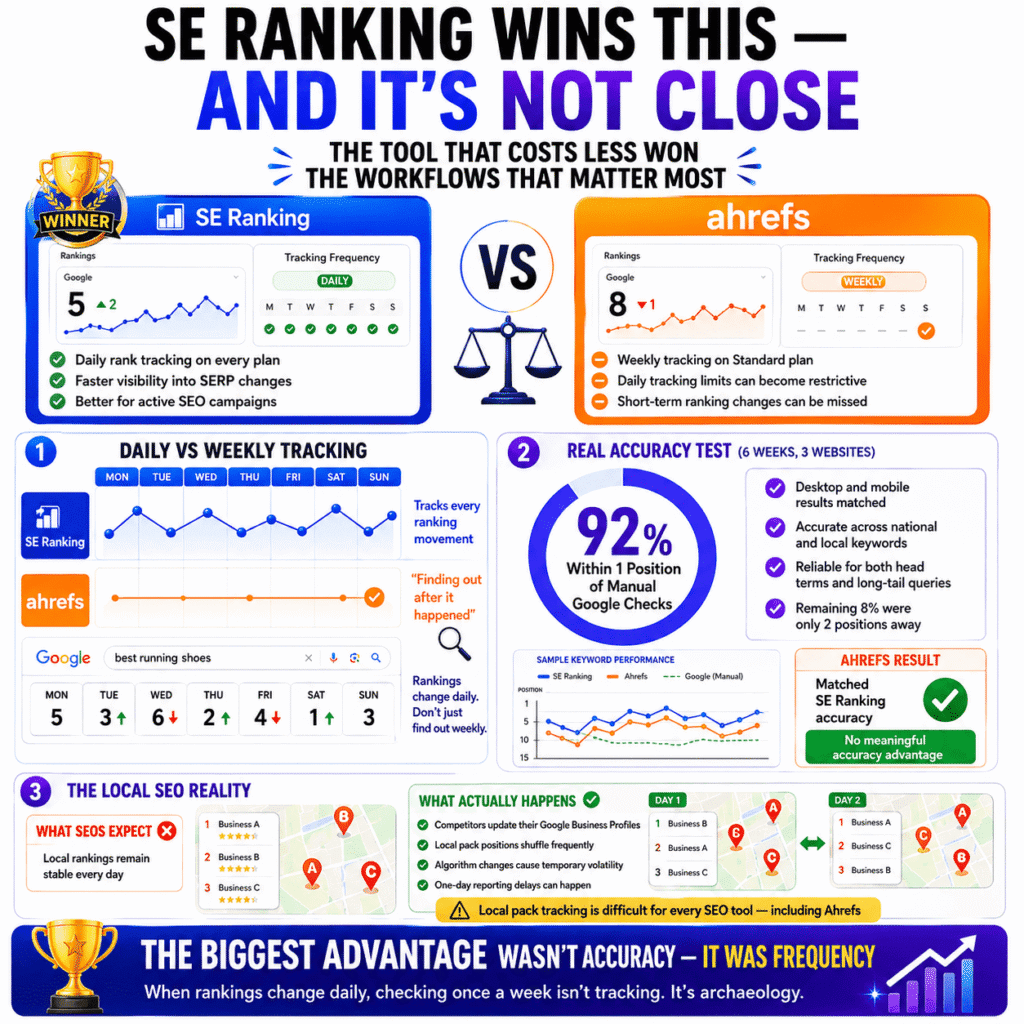
Ahrefs Standard tracks weekly. SE Ranking tracks daily — on every plan, not just the expensive ones.
I know that sounds like a minor logistics difference. It isn’t, depending on what you’re working on. The local service site in this test moved around constantly — local pack positions shifting mid-week after a competitor updated their Google Business Profile, rankings bouncing after a minor algorithm tremor that didn’t even make the SEO news cycle. Checking positions once a week on a site like that isn’t tracking — it’s archaeology. You’re not catching movements, you’re finding out about them after the fact.
Ahrefs does let you increase tracking frequency, but the daily limit on Standard is tighter than the pricing page makes it sound. You’ll hit it faster than you think if you’re tracking more than one site seriously.
The accuracy question deserves more than a passing answer because “SE Ranking accuracy” is one of the most searched concerns about the tool — and the concern is legitimate enough to address directly rather than wave away.
Manual SERP spot-checks throughout the six-week test period showed SE Ranking’s reported positions landing within one rank of actual results on roughly 92% of tracked terms across all three sites. The remaining 8% were off by two positions, never more. Ahrefs matched this on the terms where both tools tracked — not better, not worse. The accuracy parity held across desktop and mobile, across local and national SERPs, and across both high-volume head terms and low-volume long-tail queries where rank fluctuation is naturally higher.
Where SE Ranking’s accuracy gets more complicated is local pack rankings. The tool tracks local pack positions but the data is less stable than standard organic tracking — positions can show a one-day lag during periods of heavy local pack shuffling, which on a competitive local service site happens more often than most SEOs expect. This isn’t unique to SE Ranking — local pack tracking is genuinely harder than organic tracking across every tool that attempts it, including Ahrefs — but it’s worth knowing going in rather than discovering it when a client calls.
Two other accuracy factors that don’t get mentioned enough:
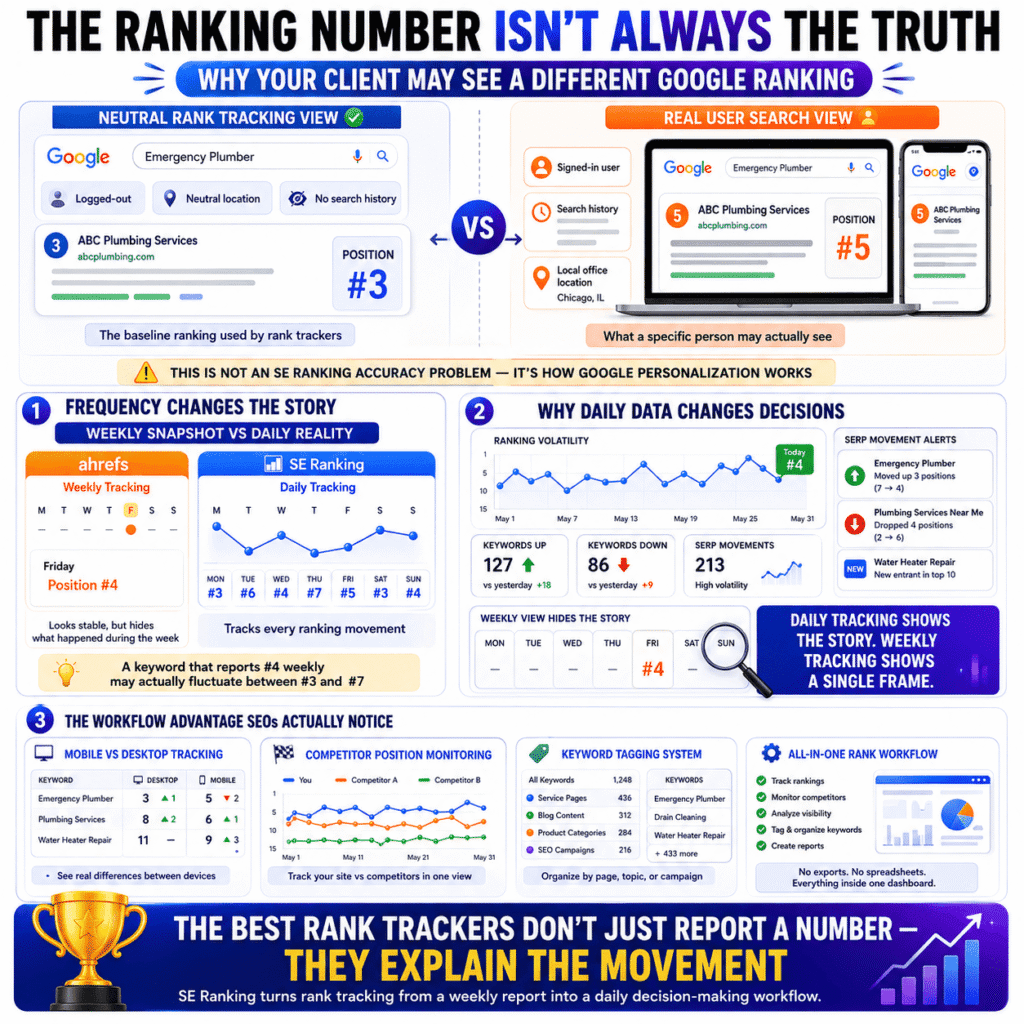
Search personalisation affects what any rank tracker reports versus what a specific user actually sees. SE Ranking — like all rank trackers — pulls rankings from a neutral, logged-out, location-matched query rather than a personalised search session. The number in your dashboard is the baseline ranking, not the ranking your client sees when they search from their office on a device with eighteen months of search history. That gap can be several positions on branded or locally competitive terms. It’s not an SE Ranking accuracy problem. It’s how rank tracking works, and understanding that distinction saves a lot of confused client conversations.
Rank tracking frequency also affects perceived accuracy. A tool checking positions weekly will show you a clean number that may represent a peak, a trough, or anything in between depending on when the crawl ran. SE Ranking’s daily tracking gives you a more honest picture of rank volatility — a term that “ranks 4” on weekly tracking might be oscillating between positions 3 and 7 daily, and knowing that changes how you interpret the data and what you report to clients.
What SE Ranking also does that Ahrefs handles clumsily: mobile vs desktop rank splits, competitor position tracking inside the same dashboard, and keyword tagging that lets you group terms by page, topic, or campaign without exporting anything. These aren’t headline features. They’re the things that make rank tracking feel like a workflow instead of a chore.
On-Page Auditing That Doesn’t Require a Tutorial
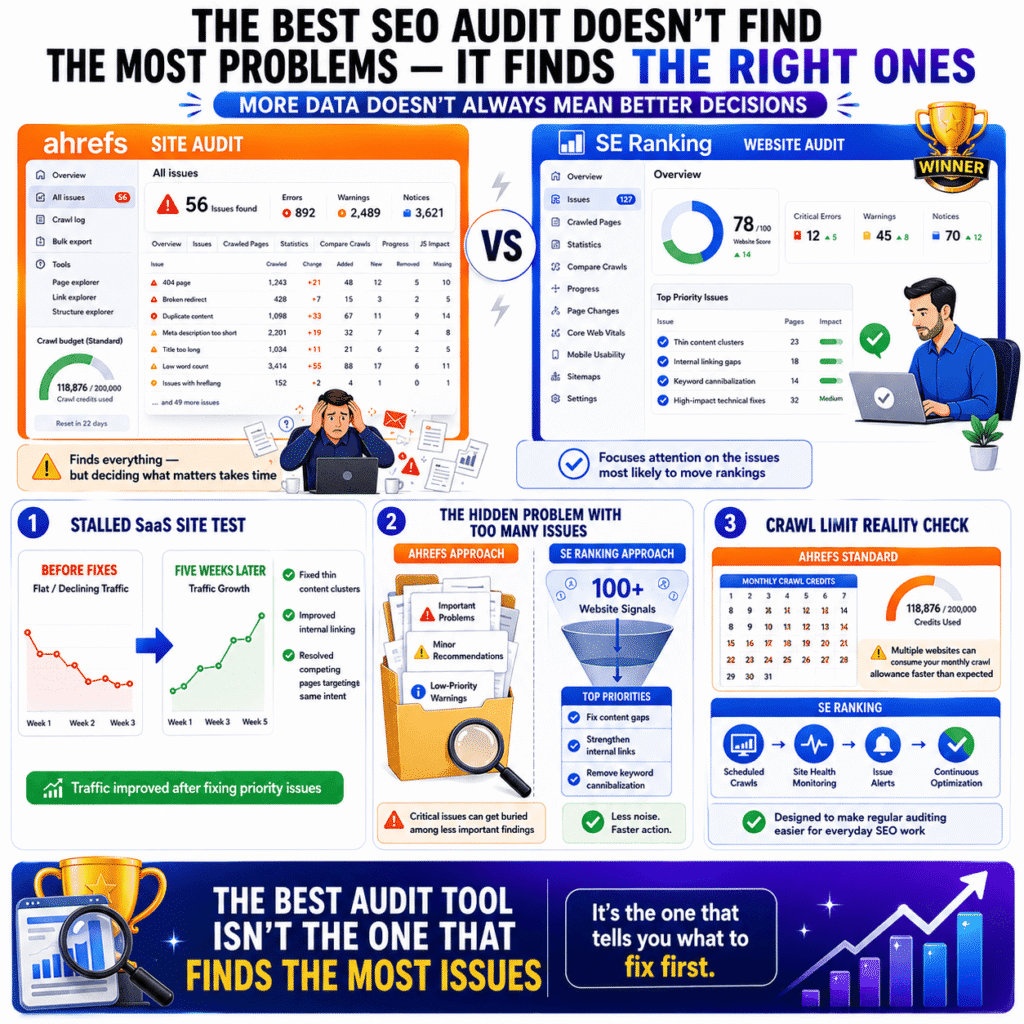
Ahrefs Site Audit finds a lot. That’s genuinely both its strength and its problem.
Run it on a mid-size site and you’ll get dozens of issue categories, color-coded severity levels, and enough tabs to keep you busy for a week. Some of those issues matter. A lot of them are the SEO equivalent of a smoke detector that goes off every time you make toast — technically correct, practically exhausting. The crawl limit on Ahrefs Standard also catches people off guard — it’s tighter than most users realize, and if you’re auditing multiple sites, you’ll be rationing crawls by mid-month.
SE Ranking’s audit surfaces fewer categories and pushes the important ones to the top. On the stalled SaaS site, the priority issues it flagged — thin content clusters pulling down page authority, internal linking gaps leaving key pages isolated, a group of posts cannibalizing the same search intent — were exactly right. Fixed them over five weeks, traffic moved. Ahrefs found the same problems. They were just harder to find, filed under a category labeled “Content” alongside fifteen other things that didn’t matter nearly as much.
The best audit tool isn’t the one that finds the most issues. It’s the one that helps you fix the right ones first.
Reporting for Clients Who Don’t Speak SEO
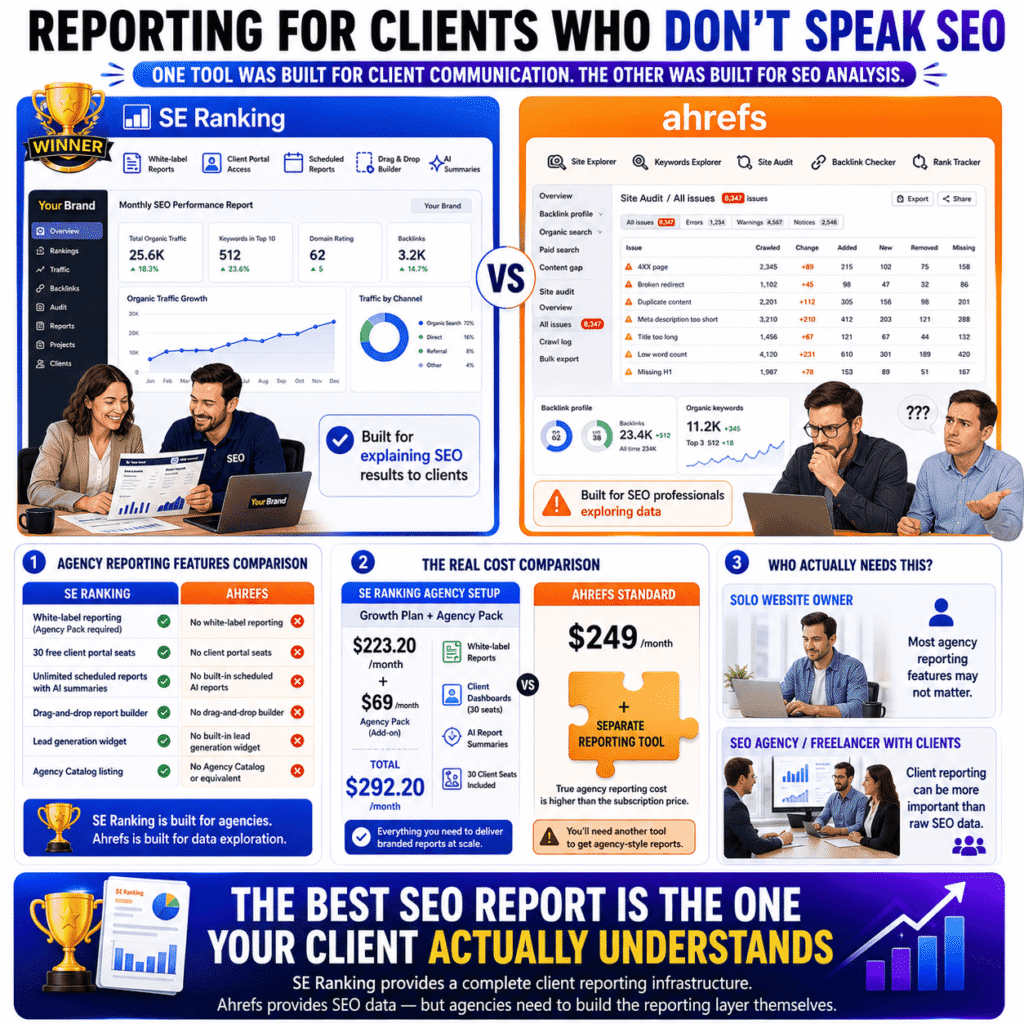
SE Ranking was clearly built by people who have had to explain SEO to a client. Ahrefs was built by people who wanted to do better SEO. Both are legitimate product philosophies — but they produce very different reporting experiences.
SE Ranking gives you white-label reports, scheduled delivery, a drag-and-drop builder, and — this is the one people don’t talk about enough — free client seats, so your client can log in and look at their own dashboard without you exporting anything. The reports look like something a business owner would read rather than a document an SEO made because they had to.
Ahrefs reporting works. The exports are clean, the dashboard sharing functions, and if you know what you’re doing you can put together something presentable. But it’s a secondary feature in a tool built around data exploration, and it feels like one. In the broader SE Ranking vs Ahrefs comparison, this is the area where the price difference makes the least sense to justify — you’re paying more for a tool that makes client communication harder, not easier.
One cost detail that catches agencies off guard: SE Ranking’s white-label reporting is not included in any base plan. It requires the Agency Pack add-on at $69/month on top of your base plan — and the Agency Pack is only available on annual billing. If you’ve been assuming white-label reporting is part of your Core or Growth subscription, it isn’t — you either signed up under a legacy plan structure that included it, or you’ve been sending SE Ranking-branded reports without realising it. Worth checking your account before you promise a client a branded dashboard.
The Agency Pack unlocks more than just white-label branding. At $69/month it adds 30 client seats — your clients can log into their own branded portal without consuming your manager seat allocation — plus unlimited scheduled reporting with AI summaries, a lead generation widget for your agency website, and placement in SE Ranking’s Agency Catalog. For an agency already on the Growth annual plan at $223.20/month, the full white-label setup costs $292.20/month combined.
Ahrefs has no equivalent to any of these features at any plan tier — no white-label reporting, no client portal seats, no lead generation widget. The agency infrastructure comparison between these two tools isn’t really a comparison — it’s SE Ranking with a dedicated agency layer versus Ahrefs with none. The only question is whether $292.20/month for the full SE Ranking agency setup makes more sense than $249/month for Ahrefs Standard plus a separate reporting tool bolted on top. For an agency comparing the true cost of white-label reporting infrastructure, the relevant SE Ranking vs Ahrefs price comparison isn’t $223.20 vs $249 — it’s $292.20(this includes $69 white-label reporting) vs $249 plus whatever third-party reporting tool you bolt onto Ahrefs to approximate what SE Ranking does natively.
If you work solo on your own sites, none of this matters. If you have even one client who expects a monthly update, it matters more than almost any other difference between these two tools.
The rank tracking, auditing, and reporting — that’s most of what SEO actually looks like week to week. SE Ranking handles all three better than a tool at its price point has any right to. Where Ahrefs earns its premium is a narrower use case than most people switching tools expect — and that’s exactly where we’re going next.
The Backlink Gap Is Real — Stop Pretending It Isn’t
SE Ranking’s backlink index has gotten meaningfully better. That’s true, worth saying, and also not the whole story.
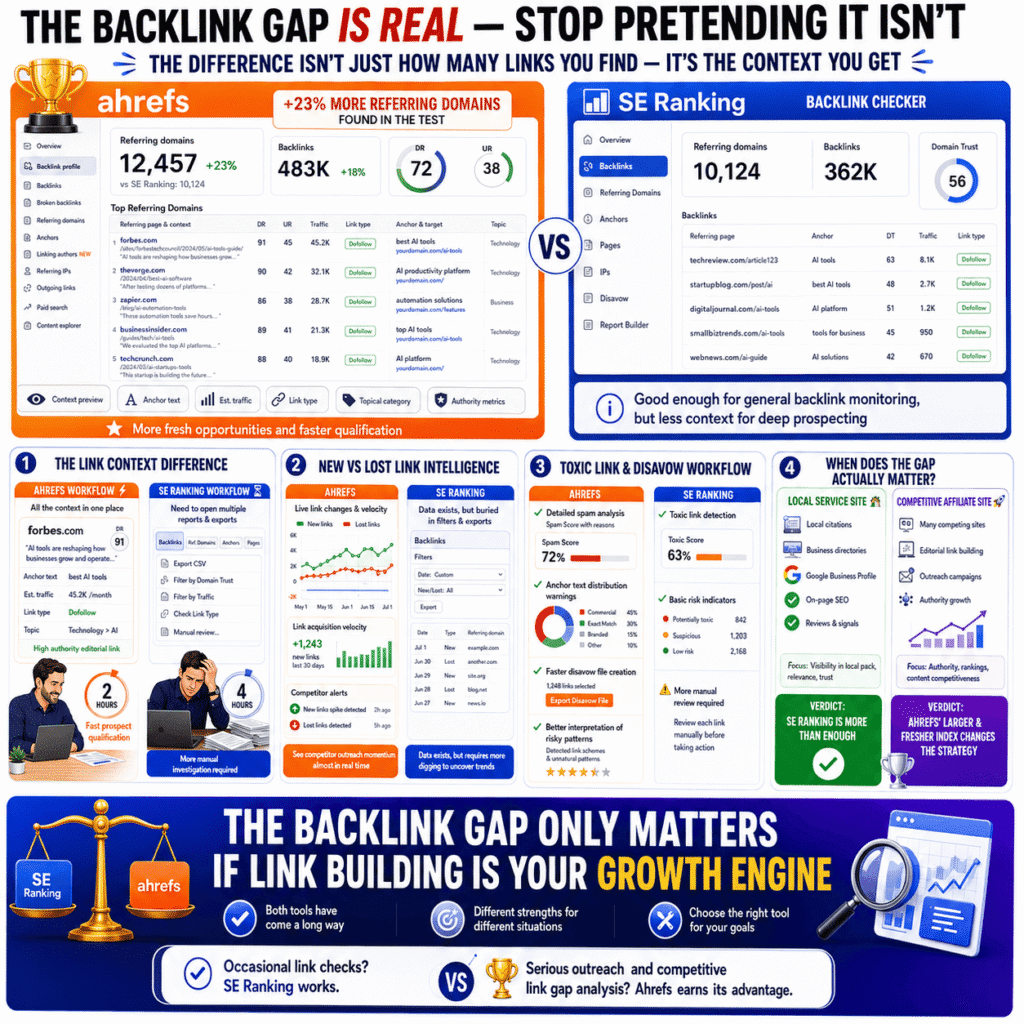
Run the same competitor domain through both tools in a contested niche and the numbers won’t be dramatically different — the days of SE Ranking missing a third of a site’s links are gone. What you’ll notice instead is subtler and more consequential: Ahrefs returns more referring domains on the same target, the freshness of those domains is more current, and the links it finds skew toward the mid-authority editorial placements that are actually worth pursuing. On the affiliate site in this test, Ahrefs surfaced roughly 23% more referring domains on the main competitor. A chunk of those were low-quality. Enough of them weren’t that the prospecting list looked meaningfully different between the two tools.
The index size gap matters less than the link context gap. In Ahrefs, every backlink entry shows you the surrounding anchor text, the estimated traffic of the linking page, the link type, and the broader topic of the source page — without opening a single tab. SE Ranking shows you the link. When you’re working through a prospecting list of 200 potential targets and trying to qualify each one quickly, that context difference isn’t cosmetic. It’s the difference between a two-hour session and a four-hour one. Ahrefs also separates new vs lost links into a dedicated view with velocity tracking — you can see when a competitor started an acquisition push almost in real time. SE Ranking buries the same data in filtered exports.
The toxic link and disavow workflow is another place the tools diverge in ways that only become obvious when you actually need them. Both flag suspicious links. Ahrefs’ spam scoring is more granular, surfaces anchor text distribution problems more clearly, and integrates with the disavow file builder in fewer clicks. SE Ranking’s version works, but it requires more manual interpretation — which is fine when your link profile is clean and becomes a real time sink when it isn’t.
Here’s what the SE Ranking vs Ahrefs conversation usually skips: the backlink gap only affects your outcomes if link building is actually how you grow. The local service site in this test needed citations, a handful of local directory links, and cleaner on-page signals. Running deep competitive link analysis in Ahrefs on that site would have been the wrong tool for the job regardless of how good the data was. SE Ranking covered everything that site needed without breaking a sweat.
The affiliate site was a different situation entirely. Competitive niches where established players run structured link acquisition programs are exactly where Ahrefs’ index depth stops being a marketing claim and starts changing what you do on Monday morning. Finding the specific editorial link your competitor has that you don’t — one you could realistically land — is a needle-in-haystack problem. A larger, fresher index finds more needles. Not twice as many. But enough more that over the course of an active outreach campaign, the difference accumulates into real results.
The practical threshold: less than ten hours a month on active link prospecting, SE Ranking is probably fine. Running outreach campaigns, building in authority-driven niches, or doing serious competitive link gap analysis — SE Ranking will start feeling like a constraint. Not on day one. But the ceiling is there, and you’ll find it.
Keyword research has a similar ceiling. It just sits at a different height.
Related reading:
SE Ranking’s Keyword Research Is Good. At Scale, It Starts Showing Cracks.
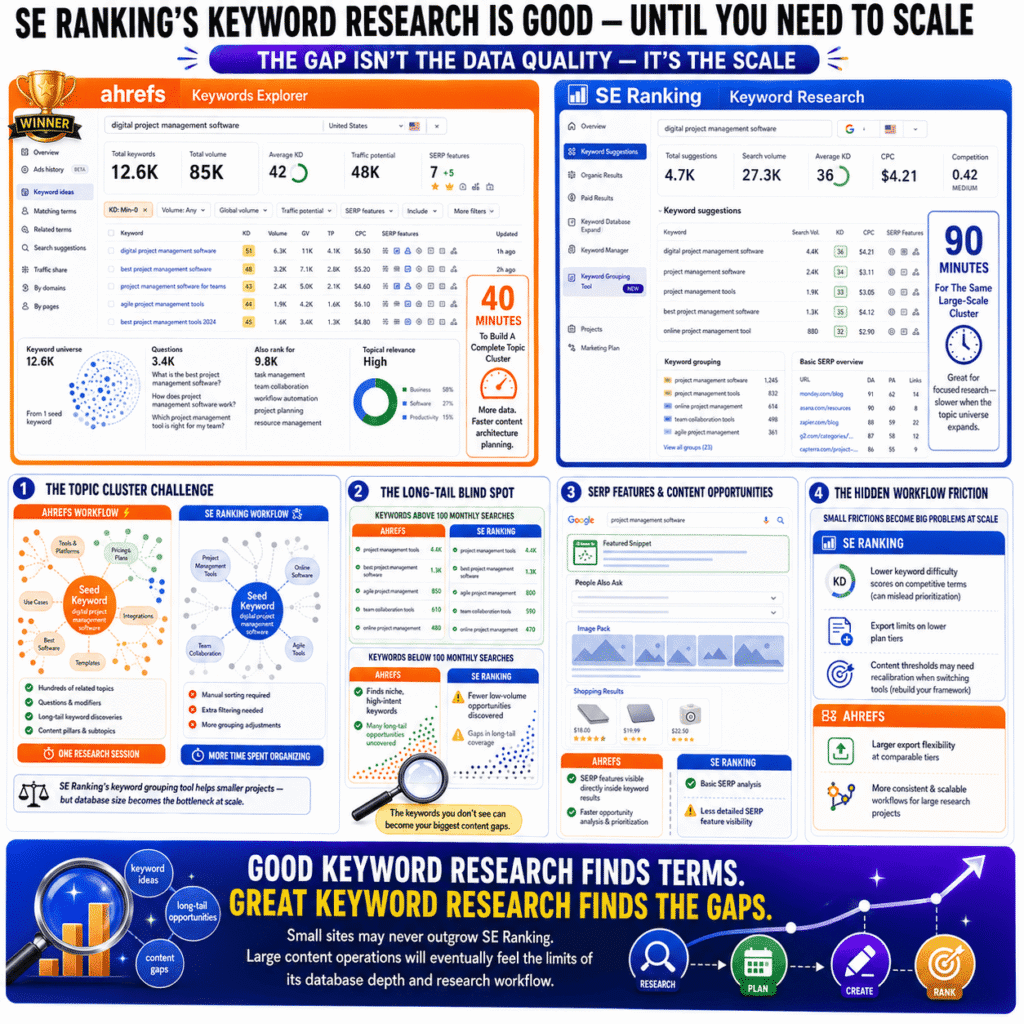
For a site publishing two or three pieces a month with a defined topic focus, SE Ranking’s keyword research will probably never feel like a limitation. Seed keywords return solid results, difficulty scores are usable, SERP analysis covers the basics. The tool does what most SEOs need it to do most of the time.
The problems show up at the edges — and the edges are where content strategy actually gets decided.
Large-scale topic cluster mapping is where the gap becomes impossible to work around. Run a broad seed through Ahrefs Keywords Explorer and you get back thousands of variations, question-format terms, and related queries with enough granularity to map a full content architecture in one session. SE Ranking returns a shorter list, the long tail thins out faster, and — this is the part that slows you down — the grouping and filtering tools require significantly more manual work to produce the same cluster output. On the B2B SaaS site in this test, mapping a content cluster around a moderately competitive topic took about forty minutes in Ahrefs. The same job in SE Ranking took closer to ninety, not because the data was wrong but because there was less of it and organizing it was harder.
Worth noting: SE Ranking actually has a dedicated keyword grouping tool that Ahrefs doesn’t natively offer. For smaller research jobs on focused topic sets, that tool saves real time. The irony is that it works well right up until the keyword universe gets large enough that the database gaps start outweighing the organizational advantage.
Below roughly 100 monthly searches, SE Ranking’s database starts returning nothing where Ahrefs returns something. Low-volume long-tail terms are often the highest-converting keywords on a site — they’re specific, they signal clear intent, and they’re the terms that thin-content competitors haven’t bothered to target. Not seeing them in your research doesn’t mean they don’t exist. It means you’re building a content strategy with blind spots you don’t know are there.
The SERP feature layer is another gap worth naming. Ahrefs shows you which keywords trigger featured snippets, People Also Ask boxes, shopping results, and image packs — directly inside the keyword results, without additional filtering. SE Ranking’s SERP analysis is functional but thinner on this. For a content operation specifically targeting featured snippet opportunities or PAA coverage, that difference changes which keywords make the priority list.
Keyword difficulty scores diverge in ways that create a specific practical problem. SE Ranking’s KD tends to run lower on competitive terms — a keyword it scores at 45 might land at 60 or above in Ahrefs. Neither tool is perfectly calibrated. But if you’ve built your content prioritization logic around SE Ranking’s KD scale and then switch to Ahrefs mid-strategy, your entire threshold framework needs rebuilding. That’s not a minor adjustment. That’s reassessing every content decision you’ve made in the last six months.
One more thing that doesn’t get mentioned in the SE Ranking vs Ahrefs keyword research conversation: export limits. SE Ranking caps keyword exports on lower plan tiers in ways that only become painful when you’re doing large-scale research and need the full dataset to work with offline. Ahrefs’ export limits are more generous at comparable price points. It’s a workflow friction issue rather than a data quality issue, but friction compounds across a content team faster than most people expect.
The AI section coming up next is a different kind of comparison entirely — less about what the data shows and more about how each tool has decided SEO work should actually get done in 2026.
Ahrefs Added AI. SE Ranking Built It Into the Core. That’s a Bigger Deal Than It Sounds.
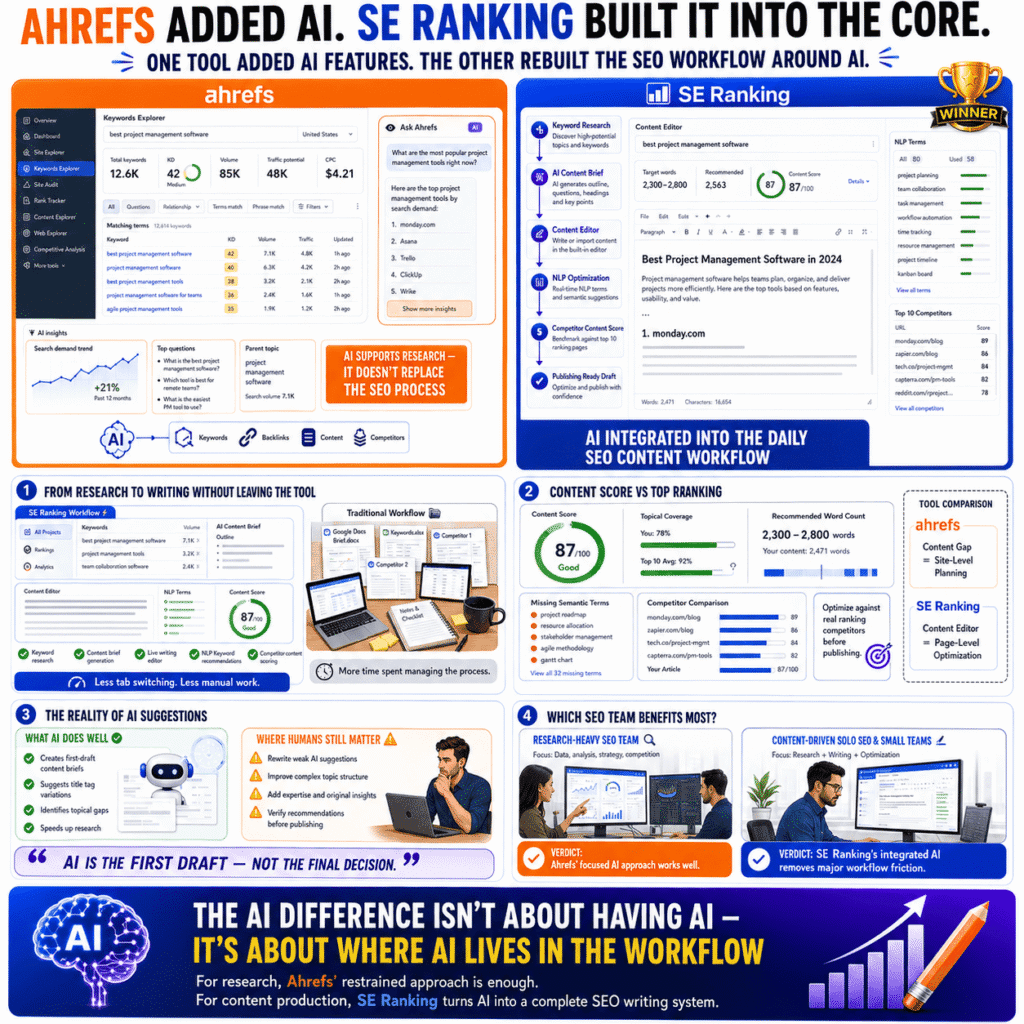
Ahrefs has been openly skeptical about AI content features — and not because they missed the trend. Their argument is that AI writing assistance doesn’t belong inside an SEO research platform, that it muddies the product’s purpose and creates a dependency that doesn’t actually improve SEO outcomes. It’s a defensible position. They’ve added AI selectively: an “Ask Ahrefs” conversational search interface that lets you query their dataset in plain language, and some generative elements in content suggestions. Useful additions, kept deliberately contained.
SE Ranking made a different bet, and in 2026 that bet is starting to look correct for a specific type of user.
The Content Editor is where the difference is most visible in daily use. It’s not a bolt-on AI writing tool — it generates content briefs, recommends target word counts based on top-ranking pages, suggests semantically related NLP terms in real time as you write, and scores your content against competitors before you publish, all inside the same interface where you did the keyword research. For a solo SEO or small team where the researcher and the writer are the same person, that’s not a feature — it’s a workflow restructure. The tab-switching, the separate brief document, the manual comparison against SERP leaders — a meaningful chunk of that overhead disappears.
The content score benchmarking deserves specific attention because it’s the part most comparisons skip. SE Ranking scores your draft against the top ten ranking pages for your target keyword, showing you where you’re thin on topical coverage, which semantically related terms you’re missing, and what word count range the ranking pages cluster around. Ahrefs has no direct equivalent inside the platform. Their content gap tool works at the site level, not the page level, and it doesn’t integrate with a live editing environment. If you’re trying to optimize a specific piece of content against specific competitors, SE Ranking’s Content Editor and Ahrefs’ toolkit are solving different problems — one is helping you write, the other is helping you plan.
Here’s the part worth sitting with: SE Ranking’s AI suggestions are about half-useful out of the box. The on-page audit on the SaaS site generated alternative title tag options ranked by predicted CTR impact — genuinely helpful as a starting point, but roughly half needed rewriting before they were publishable. The content brief outlines were better, though they consistently under-specified structure for complex topics. This isn’t a reason to dismiss the features. It’s a reason to use them as a first draft rather than a final answer — which is how any AI-assisted workflow should function anyway, but which content teams under time pressure don’t always manage in practice.
Ahrefs’ restraint on AI has a real cost and a real benefit. The cost: there’s no native environment for moving from research to content production inside the platform. The benefit: there’s no subtle pressure to accept a generated recommendation because it’s sitting right there in the interface. That pressure is easy to underestimate on a team where speed matters and the AI suggestion is always one click away from being published.
What this means for the SE Ranking vs Ahrefs decision is more specific than “one has AI and one doesn’t.” If your SEO operation is primarily research and analysis — competitive intelligence, link prospecting, technical auditing — Ahrefs’ contained approach doesn’t cost you anything. If content production is central to how you do SEO, and the same person or small team is doing research and writing, SE Ranking’s integrated AI workflow removes enough friction that it starts to look like a different category of tool rather than a cheaper version of the same one.
The pricing comparison tends to miss this completely — which is why the standard cost breakdown between these two tools produces the wrong answer more often than people realize.
What Ahrefs Costs vs What It Buys — The Honest Math
The price gap between these two tools is real, significant, and almost always framed wrong. Most SE Ranking vs Ahrefs cost comparisons lead with the monthly number and stop there. The monthly number is the least useful part of this comparison.
Plan-by-Plan Price Breakdown (SE Ranking vs Ahrefs, 2026)
Let’s put the current numbers on the table, billed monthly:
SE Ranking:
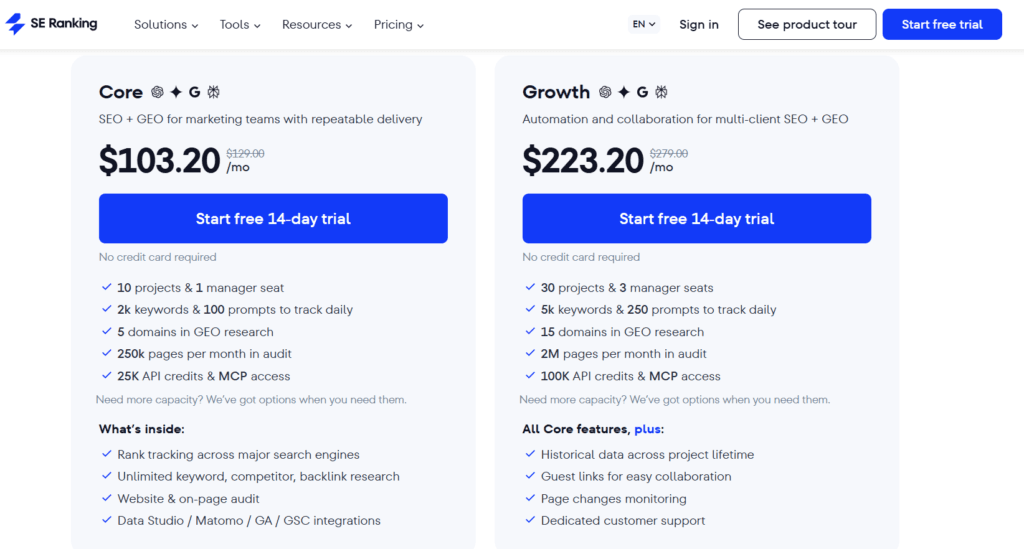
- Core — $129/month ($103.20/month when billed annually): 1 manager seat, 10 projects, daily rank tracking for 2,000 keywords, 250,000 pages/month audit, content editor, Looker Studio/GA4/GSC integrations included, 25K API credits
- Growth — $279/month ($223.20/month annual): 3 manager seats, 30 projects, daily rank tracking for 5,000 keywords, 2 million pages/month audit, 100K API credits, historical data across project lifetime, dedicated support
- Enterprise — custom pricing: flexible limits, full API, advanced integrations
- Agency Pack add-on — +$69/month (annual only): white-label reporting, 30 client seats, unlimited scheduled reports, lead generation widget — this is separate from all base plans
- Annual billing saves 20% — Core drops from $129 to $103.20, Growth from $279 to $223.20
Ahrefs:
- Starter — $29/month: Heavily restricted. Limited research only — no meaningful rank tracker, no historical data, minimal crawl credits. Not a trial — a permanently restricted tier
- Lite — $129/month: 1 user, 5 projects, 750 tracked keywords, weekly rank tracking, 100,000 crawl credits/month, 6 months historical data. Entry point for serious use but keyword and crawl limits are tight
- Standard — $249/month: 1 user, 20 projects, 2,000 tracked keywords, weekly rank tracking, 500,000 crawl credits/month, 2 years historical data, full Site Explorer and Keywords Explorer
- Advanced — $449/month: 1 user, 50 projects, 5,000 tracked keywords, 1.5M crawl credits/month, 5 years historical data, Looker Studio integration, Report Builder included
- Enterprise — $1,499/month: from 3 users, uncapped API access, unlimited historical data, SSO, advanced security
- Annual discount: up to 17% — smaller than SE Ranking’s 20%
- Report Builder is a $99/month add-on on Lite and Standard — not included until Advanced
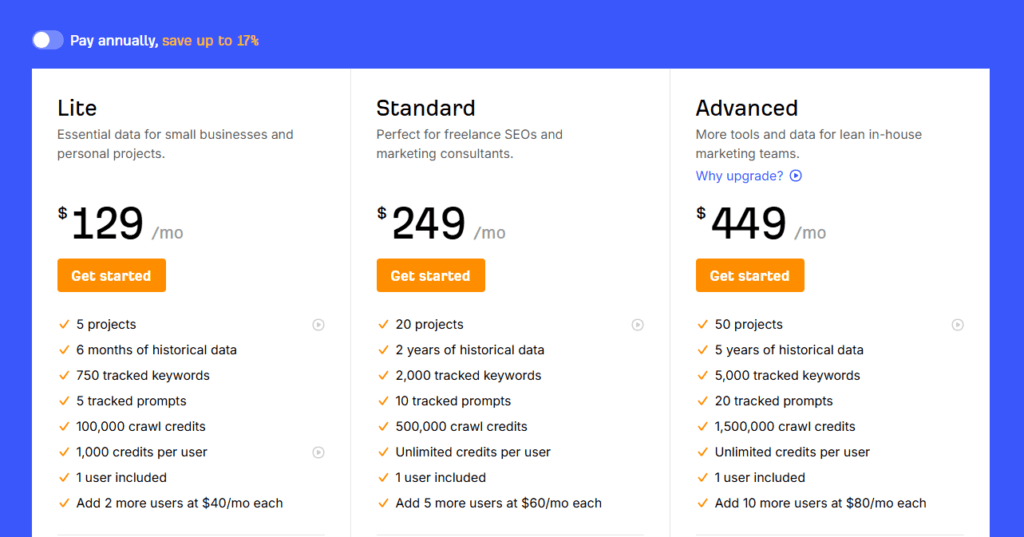
The comparison most people are actually making is SE Ranking Core at $103.2/month against Ahrefs Lite at $129/month at the entry point — identical price, very different products. SE Ranking Core includes daily rank tracking for 2,000 keywords, 10 projects, and Looker Studio integration. Ahrefs Lite gives you 750 tracked keywords, weekly rank tracking, and 5 projects. At the same price, SE Ranking Core delivers more for the workflows most SEOs use daily.
Move up one tier and the gap widens differently. SE Ranking Growth at $279/month against Ahrefs Standard at $249/month — SE Ranking is actually $30 more expensive here, but includes 3 manager seats, 5,000 daily tracked keywords, and 2M crawl credits versus Ahrefs Standard’s 1 user, 2,000 weekly tracked keywords, and 500,000 crawl credits. Add a second Ahrefs Standard user and you’re paying $249 + $60 = $309/month for capabilities SE Ranking Growth covers with 3 seats already included at $279.
The Looker Studio comparison deserves a specific call-out. SE Ranking includes Looker Studio integration on its Core plan at $129/month. Ahrefs includes it only on Advanced at $449/month — a $320/month difference for the same integration. For agencies building client dashboards in Looker Studio, that gap alone changes the cost calculation substantially.
That math changes at the top. Ahrefs Advanced at $449/month and Enterprise at $1,499/month unlock historical data depth, near-uncapped API infrastructure, and crawl volume that SE Ranking’s standard plans don’t directly match. If your operation genuinely requires five years of historical data, uncapped API access, or enterprise-grade security controls, you’re not really in SE Ranking vs Ahrefs territory anymore — you’re evaluating whether Ahrefs Enterprise is the right infrastructure investment, which is a different decision entirely.
Free Trial and Refund Policy — What Each Tool Actually Offers
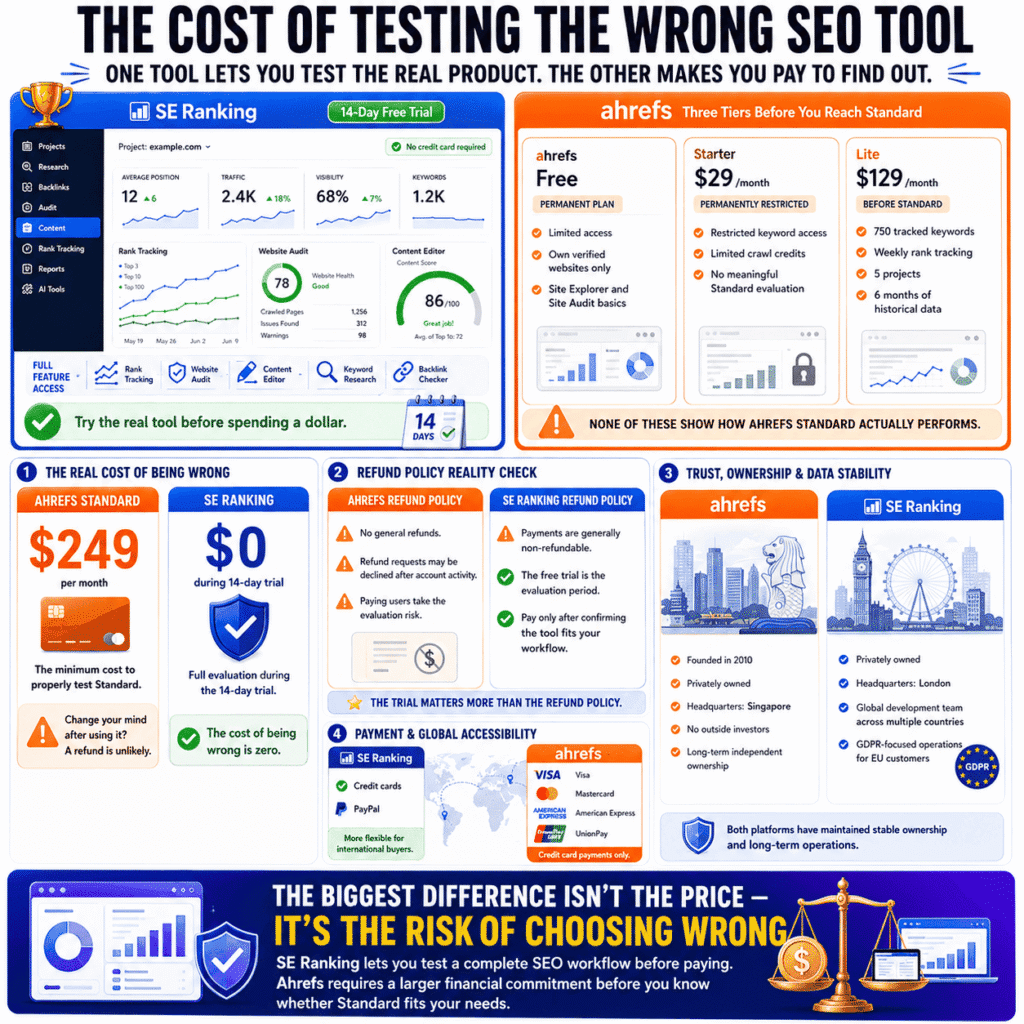
Ahrefs removed its free trial several years ago and hasn’t brought it back. What exists now across three tiers before you reach Standard:
Ahrefs Free — a permanent free plan giving limited access to Site Explorer and Site Audit on your own verified domain. It won’t help you evaluate Standard’s research capabilities, but it lets you familiarise yourself with the interface before spending anything.
Starter at $29/month — permanently restricted in ways that make it a poor proxy for Standard. The crawl credits are tighter, position history is absent, and keyword data access is capped at levels that don’t reflect how Standard actually behaves. Evaluating whether Ahrefs Standard is right for your workflow using Starter is like test-driving a base model to decide whether to buy the fully loaded version. Related, not the same.
Lite at $129/month — 750 tracked keywords, weekly rank tracking, 5 projects, and 6 months of historical data. A functional entry point for light research use, but the keyword and crawl limits make it insufficient for managing more than one or two sites seriously.
None of these three options give you a meaningful preview of how Standard performs. The only way to properly evaluate Ahrefs Standard is to pay $249 and use it — which brings us to the refund policy.
Refund policy: Ahrefs does not issue refunds in general. On monthly plans, you can request one if you haven’t used the service, but Ahrefs may decline if they see any material activity in your account. Pay for Standard, decide after two weeks it doesn’t fit, and that $249 is likely gone. Ahrefs is firm on this and has been for years.
SE Ranking’s 14-day free trial requires no credit card and gives you full access to whichever plan tier you’re evaluating — not a feature-restricted preview. The audit runs fully, the rank tracker works, the content editor is unlocked. You can complete a real workflow and make a real assessment before paying anything.
SE Ranking’s refund policy has tightened — payments are non-refundable as a general rule, with exceptions only where the service wasn’t delivered as promised. If you believe you qualify, you’d need to contact support and have your case reviewed. The 14-day free trial is the risk-free evaluation window — not a post-purchase refund period.
For the trial asymmetry alone, the cost of being wrong about Ahrefs is $249 minimum. The cost of being wrong about SE Ranking is zero.
One detail worth knowing before you hand over a credit card or pipe client data through either platform. Ahrefs is privately held and headquartered in Singapore — registered at 16 Raffles Quay, founded by Dmitry Gerasimenko in 2010 and still privately owned with no outside investment. SE Ranking is also privately held, headquartered in London with development operations across multiple countries. Neither company has gone through an acquisition or private equity transaction that would raise data continuity concerns — both have maintained consistent ownership since founding, which matters more than most buyers realise when you’re building reporting infrastructure or storing client site data inside a platform.
For agencies with clients in the EU, SE Ranking’s London headquarters means GDPR compliance is a core operational requirement rather than an optional consideration — their data processing terms reflect this explicitly. Ahrefs’ Singapore base puts it outside GDPR jurisdiction by default, though they maintain GDPR-compliant data handling for European users by policy. If data residency or compliance documentation is a requirement for any of your clients, request the current Data Processing Agreement from each tool before committing — both have them, neither advertises them prominently.
One detail worth knowing if you’re outside the US or UK: SE Ranking accepts PayPal in addition to credit card. Ahrefs accepts credit card only — Visa, Mastercard, American Express, and UnionPay. For buyers in markets where PayPal is the more accessible payment option — and there are more of those than Western SaaS companies tend to acknowledge — that’s a practical consideration, not a footnote.
The Scale Threshold Where Ahrefs Starts Making Financial Sense
Skip the vague advice about “when you’re ready to scale.” Here’s the actual threshold.
Ahrefs starts justifying its price when at least two of these apply:
Active link building is a core part of your strategy — not occasional, not aspirational, but a recurring weekly workflow where index depth and link velocity data change the outreach decisions you make. You’re mapping keyword universes large enough that SE Ranking’s database starts returning thin results on long-tail and low-volume terms. You need more than twelve months of historical ranking or traffic data for competitive analysis, penalty recovery, or client reporting. You’re running a multi-person SEO team where Ahrefs’ data quality justifies the per-seat cost over SE Ranking’s included users.
If one of those applies, the upgrade is worth evaluating seriously. If none apply — if your week is primarily rank checking, on-page fixes, content optimization, and client reporting — you are paying for ceiling you will never hit. The Ahrefs premium buys real capability. It just doesn’t buy capability you’ll use if your operation doesn’t have the scale or strategy to need it.
The mistake isn’t choosing the wrong tool. It’s choosing a tool based on what it can theoretically do rather than what you will actually do with it on a Tuesday afternoon. SE Ranking vs Ahrefs is ultimately a utilization question disguised as a features question — and the agency and multi-client scenario changes the utilization math more than almost any other variable.
The Agency and API Question Nobody Mentions
The monthly price comparison from the previous section assumes one user, one operation, one set of sites. Add client work to that picture and the entire calculation inverts.
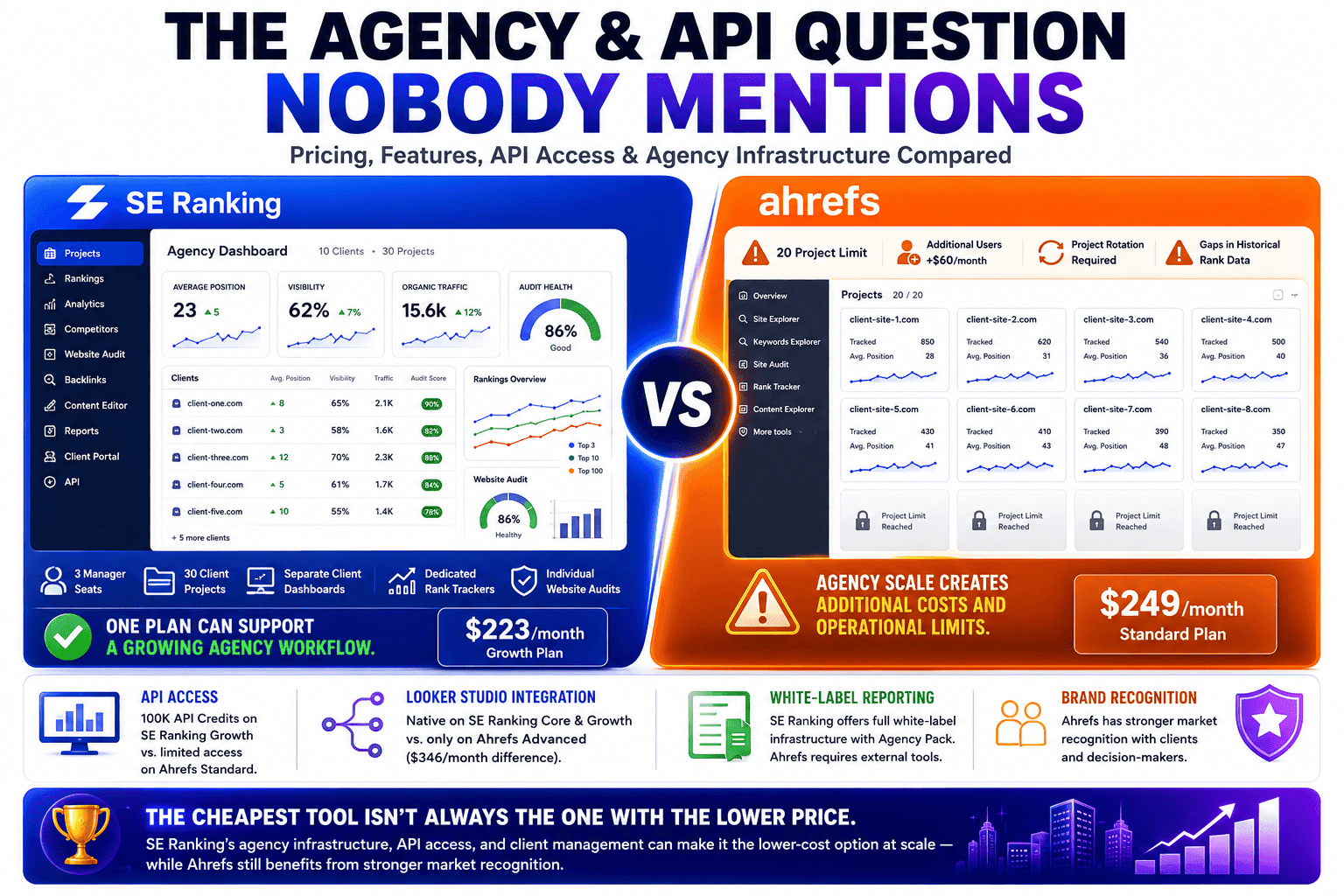
SE Ranking Growth at $223/month includes three manager seats and 30 projects. Every client gets their own project dashboard, their own rank tracker, their own audit environment, all under one plan. A ten-client agency on SE Ranking Growth pays $223/month. That same agency on Ahrefs Standard pays $249/month but hits the 20-project cap before onboarding all their clients — and unlike SE Ranking, each additional user costs $60/month on top. At that point the choice is rotating projects in and out — which creates gaps in historical rank data that are genuinely painful to explain to clients — or upgrading to Advanced at $449/month just to accommodate basic operational scale.
SE Ranking also has a dedicated Agency Pack add-on at $69/month (annual only) that adds 30 client seats, white-label reporting, unlimited scheduled reports with AI summaries, a lead generation widget, and Agency Catalog placement. It’s not widely discussed in SE Ranking vs Ahrefs comparisons because most reviewers aren’t running agencies. For those who are, a Growth plan plus Agency Pack at $292.20/month on annual billing covers the full white-label agency infrastructure — client portals, branded reports, lead capture — in one stack.
The API access gap is where the tools diverge most sharply for technical agency work. SE Ranking includes 100K API credits on its Growth plan at $223/month, with an additional API add-on available at $45/month for heavier usage. Ahrefs’ API access exists on lower plans but is severely limited — Standard gets 250 rows per API request maximum, which breaks down the moment you try to build anything automated on top of it. Serious API infrastructure on Ahrefs requires Enterprise at $1,499/month. An agency piping rank data into a custom client dashboard or internal performance tracker will hit Ahrefs’ API ceiling faster than expected. SE Ranking’s API at Growth tier isn’t unlimited, but it’s accessible enough to build real reporting infrastructure without a four-figure monthly commitment.
The Looker Studio gap deserves a specific call-out here. SE Ranking includes native Looker Studio integration on both its Core and Growth plans . Ahrefs includes Looker Studio integration only on Advanced at $449/month — a $346/month difference for the same capability. Rank data, audit results, and traffic metrics pipe directly into Data Studio on SE Ranking without exporting anything. On Ahrefs Standard, you’re relying on manual exports or third-party connectors. For an agency producing monthly reports across ten or fifteen clients, that difference isn’t a minor workflow preference — it’s several hours a month that either get billed to clients or absorbed as overhead.
Two more agency-specific features that Ahrefs simply doesn’t have at any plan tier. SE Ranking’s lead generation widget lets you embed a free site audit tool on your agency website — visitors run an audit, you capture their contact details. It’s a prospecting tool built into the SEO platform, which is either useful or irrelevant depending on how your agency generates leads, but it’s the kind of feature that signals SE Ranking was designed with agencies as a primary user rather than an afterthought. The second: role-based access controls per project, so a junior team member can access a client’s rank tracker without seeing billing information or other clients’ data. Ahrefs’ permission structure is blunter — you’re either a full user or you’re not.
Where Ahrefs genuinely holds ground in agency contexts is name recognition with clients. Some clients will ask what tool you use, and “Ahrefs” lands differently than “SE Ranking” in that conversation — not because the data is better for their specific needs, but because Ahrefs has been the industry reference point for long enough that it carries implicit credibility. That’s a real commercial consideration for agencies positioning themselves to mid-market or enterprise clients. It’s also exactly the kind of non-technical factor that causes people to overpay for a tool — so it’s worth naming clearly rather than letting it operate as an unexamined assumption.
For solo SEOs managing their own sites, this section changes nothing. For anyone billing clients, the SE Ranking vs Ahrefs decision looks almost completely different than the solo operator comparison — and SE Ranking wins it more decisively than the headline price difference suggests.

FAQ: SE Ranking vs Ahrefs
Is SE Ranking as good as Ahrefs?
For most SEO workflows — rank tracking, on-page auditing, content optimization, and client reporting — SE Ranking matches or outperforms Ahrefs at a lower price point. Where Ahrefs pulls ahead is backlink index depth, large-scale keyword research, and historical data access. Which tool is “better” depends entirely on whether those specific capabilities are central to how you do SEO.
Is SE Ranking worth it?
Yes, for the majority of solo SEOs and small agencies. SE Ranking’s Core plan at $103/month includes three users, unlimited projects, daily rank tracking, white-label reporting, API access, and an integrated content editor. For operations that don’t require Ahrefs-level backlink data or large keyword universe mapping, SE Ranking covers the job without the overhead.
Does SE Ranking have a free plan?
SE Ranking does not have a permanent free plan, but it offers a 14-day free trial with full feature access and no credit card required. This covers the complete plan tier you’re evaluating — not a restricted preview. Ahrefs has no free trial; its $29/month Starter plan is permanently restricted and not a reliable proxy for how Standard performs.
Which is better for backlink analysis — SE Ranking or Ahrefs?
Ahrefs. The gap has narrowed but it hasn’t closed. Ahrefs returns more referring domains on the same target, provides richer link context per entry — anchor text, linking page traffic, link type, source topic — and tracks new vs lost links with velocity data that SE Ranking buries in filtered exports. For serious link building operations, Ahrefs’ backlink index is still the industry standard.
Which is better for keyword research — SE Ranking or Ahrefs?
SE Ranking handles keyword research well for most sites. The database thins out below roughly 100 monthly searches, the long-tail returns fewer results on large-scale cluster mapping, and SERP feature data is less detailed than Ahrefs. For a site publishing two to four pieces a month with a defined topic focus, SE Ranking’s keyword data is sufficient. For large content operations mapping broad topic universes, Ahrefs produces more complete results faster.
Can I use SE Ranking and Ahrefs together?
Yes — and for some operations it’s the right answer. SE Ranking Core at $103/month handles rank tracking, client reporting, on-page auditing, and content workflows. Ahrefs Standard at $249/month covers deep keyword research and link prospecting. Running both costs $352/month and eliminates the compromises of choosing one. For agencies billing clients, that combined cost typically fits inside a single retainer.
Will I lose my data if I switch from SE Ranking to Ahrefs?
Yes — and this is worth factoring in before you cancel. SE Ranking rank tracking history does not transfer to Ahrefs. The day you cancel, that historical position data is gone. Rebuilding twelve months of ranking baseline in Ahrefs takes twelve months. If historical rank data matters for client reporting or competitive benchmarking, either export everything before cancelling or consider running both tools in parallel during a transition period.
Is Ahrefs worth the price over SE Ranking?
Only under specific conditions. Ahrefs justifies the premium when active link building is a core weekly workflow, when you’re mapping keyword universes large enough that SE Ranking’s database returns incomplete results, or when you need historical data beyond twelve months. If your SEO work is primarily rank tracking, auditing, reporting, and moderate content research, the price difference funds capability you will rarely use.
paragraph, before the H2 “The Verdict Nobody Wants to Hear”)
Related reading:
The Verdict Nobody Wants to Hear
After six weeks running both tools on three real sites, here’s what the data actually showed — and it isn’t the clean winner-takes-all conclusion either tool’s advocates want.
The local service site grew organic traffic 34% during the test period. The stalled SaaS site broke its traffic plateau for the first time in eight months. Both on SE Ranking. The affiliate site was different: Ahrefs’ deeper link index surfaced three outreach opportunities that SE Ranking’s database didn’t return, all three converted, and the competitive content gap analysis in Ahrefs identified a cluster of underserved topics that SE Ranking’s thinner keyword data missed entirely. That’s the real verdict — not a product comparison, a use-case comparison.
The real-site findings align closely with what the broader user base reports. SE Ranking holds a 4.7 out of 5 on G2 across over 1,000 reviews, with recurring praise for rank tracking accuracy, customer support response times, and value for money relative to competing tools. The criticisms that appear consistently — keyword database depth on niche topics, backlink index size compared to Ahrefs — match exactly what the testing found. Ahrefs sits at 4.5 on G2, with a smaller but highly committed reviewer base that skews toward experienced SEOs and agency professionals. The criticism pattern there is equally consistent: pricing, the lack of a free trial, and reporting limitations for client-facing work. Trustpilot tells a different story for Ahrefs — the score is lower and the complaints more pointed, largely around billing practices and the no-refund policy on monthly plans. SE Ranking’s Trustpilot presence is thinner but more uniformly positive. Neither platform replaces hands-on testing, but when third-party sentiment and six weeks of real-site data point in the same direction, the conclusion is harder to argue with.
So here’s the most direct version of the answer this article can give:
You should stay on SE Ranking if your work looks like any of these:
You’re running SEO for multiple clients and the reporting, project infrastructure, and white-label workflow matter as much as the data quality. You’re a content-first operation where integrated AI suggestions, content scoring, and on-page optimization in one place save more time than Ahrefs’ deeper research data would add. Your link building is opportunistic rather than systematic — you pursue links when they make sense, not as a structured weekly outreach operation. You’re on a tight budget and the $60-plus monthly difference funds other growth activities — content, tools, or simply profit margin. In any of these cases, switching to Ahrefs is a lateral move with a larger invoice.
You should switch to Ahrefs if your work looks like this:
Link building is a primary growth channel and you’re running it as a real operation — prospecting lists, outreach sequences, link velocity monitoring, the whole thing. You’re mapping large keyword universes where SE Ranking’s database starts returning incomplete term sets and you’re making content decisions on data you don’t know is thin. You need more than twelve months of historical data for competitive analysis, client reporting, or penalty recovery. You’re on a team where multiple users need full data access and Ahrefs’ per-seat cost is justified by the research output each seat produces. One important thing to factor in before switching: you will lose your SE Ranking rank tracking history. There’s no import. The day you cancel, that historical position data is gone, and rebuilding twelve months of baseline in Ahrefs takes twelve months.
The profile that should think hardest before switching: the solo SEO whose interest in Ahrefs is driven more by what they see others using than by a specific workflow problem it would solve. Ahrefs is everywhere in SEO Twitter, conference talks, and agency case studies — which creates a gravitational pull toward the tool that has nothing to do with whether it fits your actual operation. The people describing those workflows often need Ahrefs. You may not.
One option the standard SE Ranking vs Ahrefs framing ignores entirely: running both. SE Ranking Core at $103/month for rank tracking, client reporting, on-page auditing, and content workflows. Ahrefs Standard at $249/month for deep keyword research and link prospecting sessions. Total: $352/month for a genuinely complete toolkit with no compromises. For an agency billing clients, that cost disappears into the first retainer. For a solo SEO it’s a real number — but worth knowing the option exists before treating this as a binary choice.
The fit question is more useful than the quality question. Ahrefs is a more powerful research tool. SE Ranking is a more complete operational platform. If your SEO work is primarily research-driven — competitive intelligence, link prospecting, large-scale keyword mapping — Ahrefs is worth the premium. If your work is primarily execution-driven — tracking, reporting, auditing, content optimization — SE Ranking covers the job without the overhead.
That’s the SE Ranking vs Ahrefs answer. Not which tool is better. Which tool is better for the work you actually do.
Disclosure: Some links in this article maybe affiliate links. If you purchase through them I may earn a commission — at no additional cost to you. This article reflects genuine practitioner experience with the tools discussed. Affiliate relationships don’t influence the analysis, including where I’ve been critical.