
Most Semrush vs SimilarWeb comparison articles will score both tools across fifteen categories, declare a winner, and recommend you consider both. This one won’t.
Not because the tools aren’t worth comparing — they are — but because the comparison most buyers need isn’t about features. It’s about whether the tool they’re paying for maps to work they’re actually doing. For a surprising number of marketing teams, it doesn’t. They bought under pressure, renewed out of inertia, and never had the conversation that would have told them they were paying for a capability they’d never fully use. This breakdown covers what each tool actually does, who genuinely needs both, and how to audit your stack before the next renewal hits.
By the end of it, you’ll know exactly what each tool is built for, where the overlap is (and why it mostly doesn’t matter), and — more usefully — whether your current setup is a deliberate strategy or an expensive default.
Table of Contents
The Comparison Trap: Why Scoring These Tools Head-to-Head Produces the Wrong Answer
Every comparison article on Semrush vs SimilarWeb is built on the same assumption: you have a slot in your stack, two candidates for it, and a decision to make. Run the features side by side, score the winner, pick the tool. Clean framework. Wrong framework.
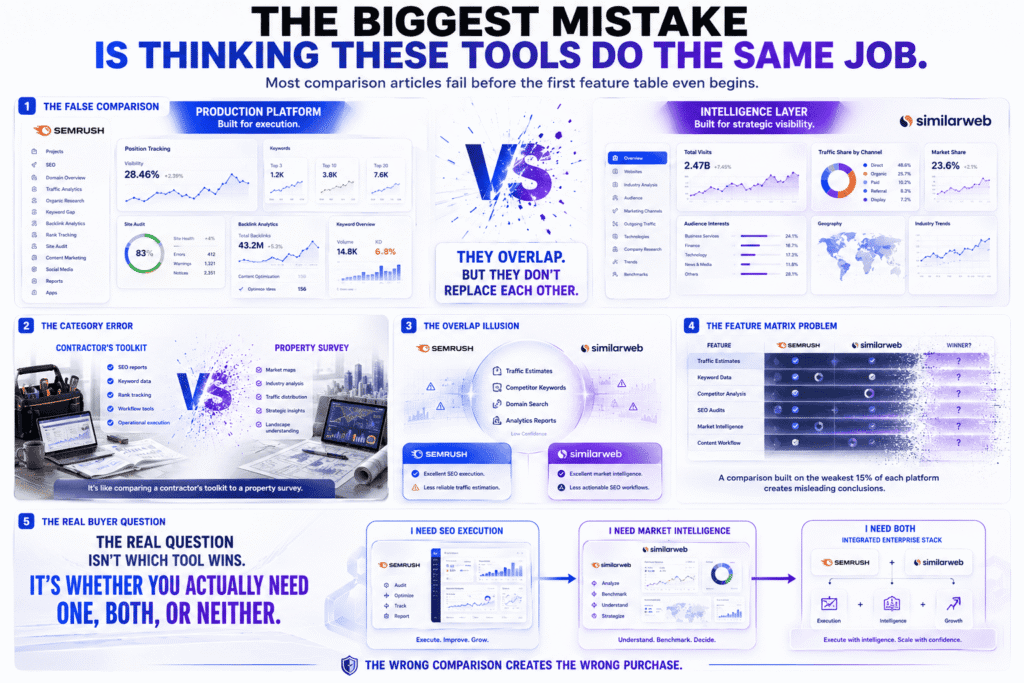
The category error happens before the first comparison point. These two tools are not competing for the same job. Semrush is a production platform — you use it to execute SEO work, run audits, build content briefs, track rankings week over week. SimilarWeb is an intelligence layer — you use it to understand market structure, estimate traffic distribution, and answer strategic questions that never make it into a campaign brief. Putting them in a head-to-head is like comparing a contractor’s toolkit to a property survey. Both involve the same building. Neither replaces the other. The question of which one “wins” only makes sense if you’ve already misunderstood what each one does.
What keeps this comparison trap alive is that the two tools share a surface. Both show traffic estimates. Both have competitor keyword data. Both let you type a domain into a search bar and get a report back. That’s enough overlap to make a feature matrix look meaningful — and feature matrices are easy to publish. But here’s what those articles don’t tell you: the overlap is where both tools perform worst. Semrush’s traffic estimates are less reliable than SimilarWeb’s core product. SimilarWeb’s keyword data is less actionable than Semrush’s. A comparison built on the weakest 15% of each tool isn’t analysis. It’s noise dressed up as research.
So the real question most buyers should be asking isn’t “which tool is better.” It’s: do I have a use case for one of these, both of these, or am I just paying for capabilities I’ve never actually needed? That’s a harder question. It doesn’t produce a tidy winner. But it’s the only question that leads somewhere useful — and the rest of this breakdown is built around it.
What Semrush Actually Is (Once You Strip Away the Marketing)
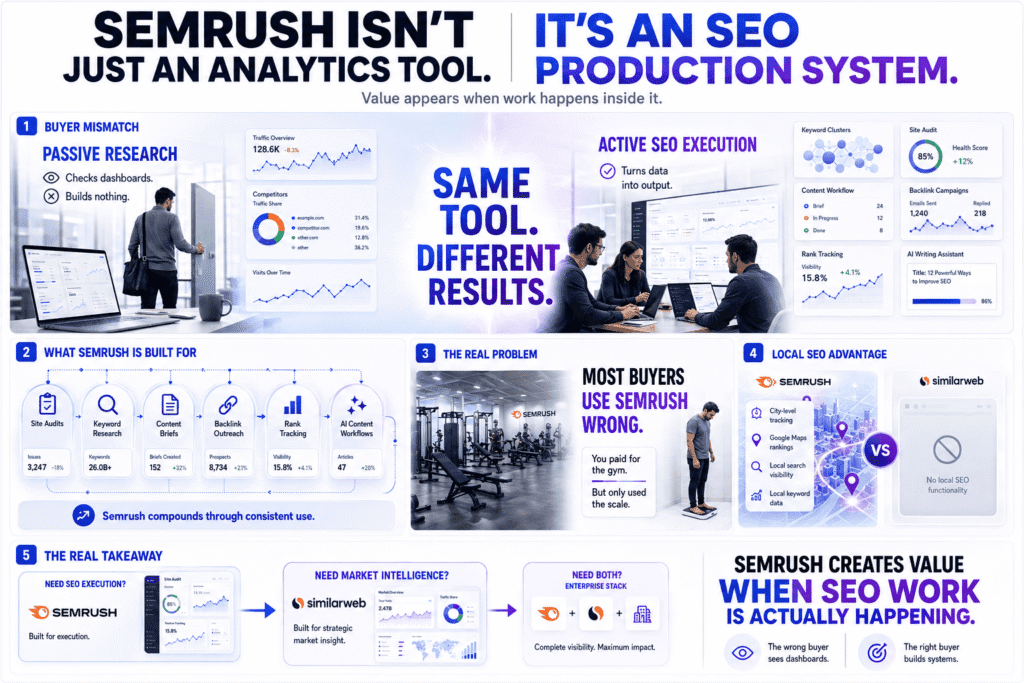
Semrush is not an analytics tool. That sounds obvious until you watch a marketing team use it like one — pulling traffic estimates, eyeballing competitor graphs, logging out, and calling it research. That’s not a Semrush failure. That’s a buyer mismatch — and it’s more common than most people running the Semrush vs SimilarWeb debate want to admit.
Strip away the “all-in-one platform” marketing and what you have is a production environment for people whose job is to produce SEO output. Audits. Content briefs. Backlink campaigns. Rank tracking. Keyword gap analysis. Every feature in the platform is oriented around a work product, not a dashboard you check. The keyword research tool doesn’t just surface volumes — it feeds directly into content workflows. The site audit isn’t a one-time report; it’s a queue. The tool compounds only if someone is actively living inside it, week over week, turning data into deliverables. Even the AI features — an AI writing assistant, content rephraser, and Ask AI for real-time content guidance — are built around active production tasks, not passive research.
A team doing exactly that — running weekly audits, building content calendars from keyword clusters, monitoring rank fluctuations — will get serious return on the subscription. A team logging in twice a month to see what a competitor’s traffic looks like will not. Same tool, completely different outcome, and the difference has nothing to do with features.
This is the part most reviews skip: Semrush’s own marketing works against buyers who should never have purchased it. The “intelligence platform” positioning attracts people who need answers, not workflows. If your actual need is a strategic market question — how big is this segment, what share does our competitor own, which channels are driving their growth — Semrush will hand you a mediocre version of that answer inside a product built for something else entirely. You’ll have paid for a gym membership and used it as a scale.
The database is genuinely large — 26 billion keywords, 190 regions, continuously updated — but scale only matters when someone is doing keyword research regularly enough to need depth. Same logic applies to the backlink index, the content tools, the position tracker. None of these are features you dip into occasionally. They’re infrastructure for ongoing work, and infrastructure only pays off when it’s actually being used.
One specific capability worth naming, especially in the context of Semrush vs SimilarWeb: local SEO. SimilarWeb has none. Semrush lets you filter keyword data down to city level on every plan — including the entry tier — and supports Google Maps rank tracking. If local search is any part of your strategy, that gap alone answers the Semrush question. The more interesting question is whether you need anything beyond Semrush at all. That depends entirely on what SimilarWeb actually is — which is not what its sales deck says it is.
Related: How to Do a Complete SEO Audit for a Small Business Website: A Proven Step-by-Step Guide
What SimilarWeb Actually Is — And Why Its Sales Pitch Obscures This
SimilarWeb’s sales pitch is designed for a boardroom, not a browser tab. We can show you your market share, your competitive position, where your rivals are gaining ground. That framing is compelling — compelling enough that a lot of marketing teams buy it, then spend the next six months trying to figure out what to actually do with it on a Tuesday afternoon when someone asks them to brief a campaign.
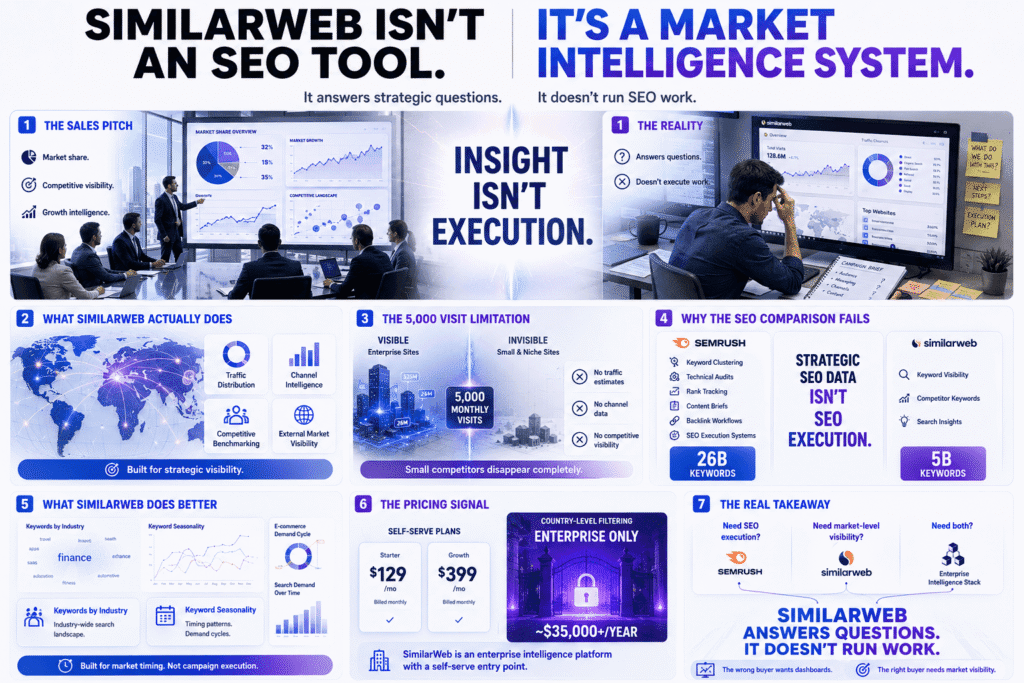
The core of what SimilarWeb does is more specific than the marketing lets on. It estimates traffic distribution across domains, channels, and geographies using external data sources — browser extensions, ISP partnerships, web crawlers — then aggregates that into competitive benchmarks. What it does well, it does genuinely well. If you need to understand how traffic flows across a competitive set without first-party access to those properties, SimilarWeb is the most credible external source available. That’s a legitimate use case. It’s just not as common as the sales cycle implies.
Before you evaluate anything else, there’s one hard limitation worth knowing: SimilarWeb doesn’t show data for websites receiving fewer than 5,000 monthly visits. Below that threshold, the tool returns nothing — no traffic estimates, no channel breakdown, no competitive data. If any of the sites you need to analyze fall under that floor, SimilarWeb can’t help you regardless of which plan you’re on. For enterprise teams benchmarking category leaders, this rarely matters. For anyone operating in a niche with smaller players, it quietly eliminates a significant portion of the competitive set before you’ve run a single report.
The buyers who actually extract value from SimilarWeb share a recognizable profile. They’re making decisions that require market-level visibility, not campaign-level execution — analysts sizing a market before an investment, product teams benchmarking their acquisition channel mix against category leaders, strategy leads building a competitive narrative for a board deck, enterprise marketers who need external validation rather than internal attribution. The thing these use cases have in common: the output is a decision or a document, not a deliverable. SimilarWeb answers questions. It doesn’t run work.
The SEO features are where the Semrush vs SimilarWeb comparison gets genuinely muddy, and they deserve a straight answer. SimilarWeb has invested seriously in keyword and competitive SEO data over the past two years — the product is better than it was. But better than it was and good enough to replace a purpose-built SEO platform aren’t the same claim. SimilarWeb’s keyword database covers around 5 billion keywords. Semrush’s covers 26 billion. There’s no keyword clustering in SimilarWeb, no content brief workflow, no technical site audit, no rank tracker you’d actually run a campaign from. The SEO layer is useful for strategic questions — which keywords is this competitor prioritizing, what does their content surface look like — but it’s an intelligence feature inside an intelligence platform. Using SimilarWeb’s keyword tools as a Semrush substitute is like using Google Analytics for content planning because it shows you which pages get traffic. Technically possible. Practically insufficient.
That said, there are two things SimilarWeb does that Semrush doesn’t replicate well. The Keywords by Industry tool pulls popular search terms across hundreds of sites in a given category — useful for market-level content mapping that isn’t anchored to a single domain. And the Keyword Seasonality report surfaces timing patterns for when specific topics peak in search demand, which matters for e-commerce teams planning promotional calendars or content teams aligning publishing schedules to demand cycles. Neither of these is a reason to buy SimilarWeb if the rest of the use case isn’t there. But if you’re evaluating the tool honestly, they’re real capabilities worth knowing about — not features Semrush renders irrelevant.
Then there’s the pricing, which is where SimilarWeb’s positioning finally becomes honest about who it’s actually for. Entry plans start from around $129 per month while the most popular plan goes for around $ 399 per month — accessible enough to feel like a self-serve tool. But country-level filtering, something most practitioners treat as table stakes, sits behind custom enterprise pricing that typically starts at $35,000 per year. That’s not an accidental gap in the pricing architecture. It’s a structural signal. SimilarWeb is an enterprise intelligence platform that also sells a self-serve tier — and most teams buying that self-serve tier are purchasing an incomplete version of a tool that may not fit their use case in the first place.
The Overlap Is Real but Smaller Than You Think — and Mostly Irrelevant
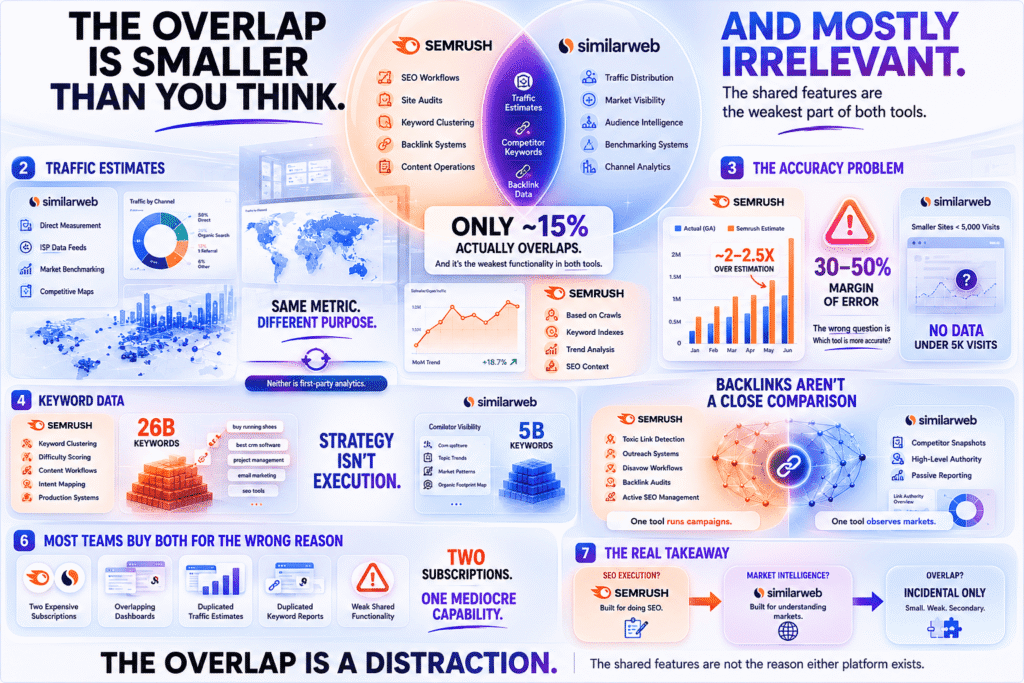
Yes, both tools show traffic estimates. Yes, both have competitor keyword data. If you’ve read enough Semrush vs SimilarWeb comparisons, you already know this — and it’s probably the reason the “they’re completely different tools” argument hasn’t fully landed yet. Fair. The overlap is real. It’s also roughly 15% of total functionality, and it’s the weakest version of what each tool does.
Start with traffic estimates, since that’s the feature that makes the two tools look most interchangeable. SimilarWeb’s traffic data is built from a methodology specifically designed for this — panel data, ISP partnerships, direct measurement feeds. It’s the closest thing available to an external source of truth on how traffic distributes across a competitive set. Semrush also shows traffic estimates, but those figures are modeled from crawl data and keyword indexes, not direct traffic measurement. Semrush traffic estimates are useful for directional context inside an SEO workflow — they are not designed to answer the question SimilarWeb is built to answer. Using Semrush to benchmark a competitor’s channel mix is like using a ruler to estimate weight. You can make an argument. You’re using the wrong instrument.
The accuracy question deserves a straight answer because it’s what most people search first. Here’s what the data actually shows: Semrush typically overestimates organic traffic by approximately 2–2.5 times the actual numbers in Google Analytics, while SimilarWeb tends to perform better on large, high-traffic sites but returns no data at all for sites below 5,000 monthly visits. Neither tool is accurate in the way first-party analytics is accurate — both carry a margin of error between 30–50% against real traffic data. Which is precisely why “which tool is more accurate” is the wrong question. Semrush traffic estimates are built for SEO context: spotting trends, comparing relative performance, identifying keyword opportunity. SimilarWeb’s are built for market-level benchmarking. Using either number as a ground truth for budget decisions is a methodology problem, not a tool problem.
Keyword data runs the other way. Semrush’s keyword database is built for execution — 26 billion keywords, advanced filtering, clustering, difficulty scoring that factors in backlink requirements, direct integration with content workflows. SimilarWeb’s keyword layer is built to answer strategic questions: what does a competitor’s organic footprint look like, which topics are they prioritizing, how wide is their content surface. It’ll tell you the shape of someone’s keyword strategy. It won’t help you build your own. The depth, filtering, and intent mapping you need for actual content production simply aren’t there. Five billion keywords is large enough for intelligence work. It’s not structured the right way for execution.
Backlinks follow the same pattern. Both tools surface backlink data — but Semrush’s backlink database is significantly larger, includes toxic link detection, and integrates directly into outreach and disavow workflows. SimilarWeb’s backlink analysis is high-level by design — useful for understanding a competitor’s link profile at a glance, not for running a link building campaign or auditing your own site’s authority. If backlink work is any part of your SEO function, this isn’t a close comparison.
Here’s what that means practically: if you’re evaluating these two tools based on the features they share, you’re evaluating them at the exact point where both are weakest. A team that buys both primarily for traffic estimates and competitor keyword data is paying for two subscriptions and getting one mediocre capability in return. The overlap isn’t a reason to buy both. It isn’t a strong reason to pick one over the other either. It’s a distraction — and the fact that most comparison articles lead with it is exactly why most buyers end up with the wrong tool, the wrong stack, or both.
The only situation where the overlap stops mattering is when it’s incidental — when a team has genuine, separate use cases for each tool’s core capability and the shared features just happen to come along. That scenario exists. It’s just considerably rarer than the dual-stack renewal rate at most mid-market companies would suggest. Which raises the question of what that scenario actually looks like — and what it costs to justify it honestly.
Related: Semrush vs SimilarWeb Accuracy Test: Which Tool Actually Gets Traffic Numbers Right?
The One Case Where You Actually Need Both — And What It Requires to Justify the Cost
There is a legitimate case for running both tools. It’s just not the case most dual-stack teams are actually making.
The scenario that genuinely justifies both looks specific when you describe it honestly: a team with an active, ongoing SEO production function — someone whose primary job is building and executing organic search strategy — and a separate, recurring need for market-level intelligence that informs decisions above the campaign layer. Not “we sometimes wonder what competitors are doing.” An actual defined use case: quarterly board reporting that requires external traffic benchmarks, a product team that needs channel mix data to inform roadmap prioritization, an enterprise marketing function defending budget allocation with data that doesn’t come from its own GA4. Two distinct jobs. Two distinct outputs. Two distinct stakeholders consuming them.
The cost math only works when that separation is genuinely true. Semrush Pro runs around $117 per month. SimilarWeb’s entry plan is in a similar range — but the version of SimilarWeb that actually delivers on the intelligence use case, with country-level filtering, extended historical data, and full competitive benchmarking, starts at roughly $35,000 per year on enterprise pricing. That’s not a tool you add to a stack. That’s a budget line that needs a business case, a named renewal owner, and a straight answer to: what decision does this data inform that we couldn’t make without it?
Before committing to that spend, one option most teams don’t evaluate honestly: Semrush .Trends. It’s Semrush’s own market intelligence add-on — covering competitor traffic analysis, market sizing, audience research, and channel benchmarking — at a fraction of SimilarWeb’s enterprise price point. It won’t replicate everything SimilarWeb does at the top tier, but for teams whose market intelligence use case is real but not enterprise-scale, it closes enough of the gap that the dual-stack case collapses. If you’re considering adding SimilarWeb primarily for competitive traffic data and market benchmarking, run a trial of Semrush .Trends first. The answer might already be inside the tool you’re already paying for.
Most teams running both can’t answer that cleanly. They have Semrush because the SEO function needs it. They have SimilarWeb because someone senior asked for competitive data during a strategy offsite, the tool got bought on the back of that conversation, and it never got cut. That’s not a two-tool strategy. That’s one tool and one orphaned subscription quietly renewing every year because nobody wants to be the person who cancelled it before the next board deck.
One more thing the dual-stack case doesn’t solve, and this matters for anyone comparing Semrush vs SimilarWeb outputs side by side: the two tools measure different things using fundamentally different methodologies. Semrush models traffic from crawl and keyword data. SimilarWeb measures it from panels, ISPs, and direct feeds. Putting their numbers in the same spreadsheet creates the appearance of comparability. It doesn’t create the reality of it. The value of running both is in keeping the use cases completely separate — Semrush for execution, SimilarWeb for market intelligence, different stakeholders, different questions, different outputs. The moment those lanes blur, you’re paying double for data you’re misreading.
If that clean separation describes your team, you already know you need both and the cost is defensible. If you’re reading that description and quietly adjusting the picture to make your situation fit — that’s the signal. And it usually shows up most clearly when you look at who’s actually logging in.
| Category | If Your Primary Need Is… | Best Tool |
|---|---|---|
| SEO Execution | Keyword research for content production | 🟦 Semrush |
| Site audits and technical SEO fixes | 🟦 Semrush | |
| Rank tracking and position monitoring | 🟦 Semrush | |
| Backlink analysis and outreach campaigns | 🟦 Semrush | |
| Local SEO and Google Maps tracking | 🟦 Semrush | |
| Content briefs and editorial workflows | 🟦 Semrush | |
| Market Intelligence | Competitor traffic benchmarking | 🟩 SimilarWeb |
| Market sizing for investment or strategy | 🟩 SimilarWeb | |
| Channel mix analysis across a category | 🟩 SimilarWeb | |
| Board-level competitive reporting | 🟩 SimilarWeb | |
| Industry keyword and seasonality trends | 🟩 SimilarWeb | |
| Edge Cases | Active SEO production + recurring market intelligence with separate stakeholders | 🟪 Use Both (if budget allows) |
| Occasional competitive data with no recurring use case | ⬜ Use Free Tools Instead |
Who Is Almost Certainly Overpaying Right Now
Three profiles show up repeatedly in stacks that are paying for more than they’re using. None of them are edge cases. If you’re running both tools right now, there’s a reasonable chance you’re one of them.
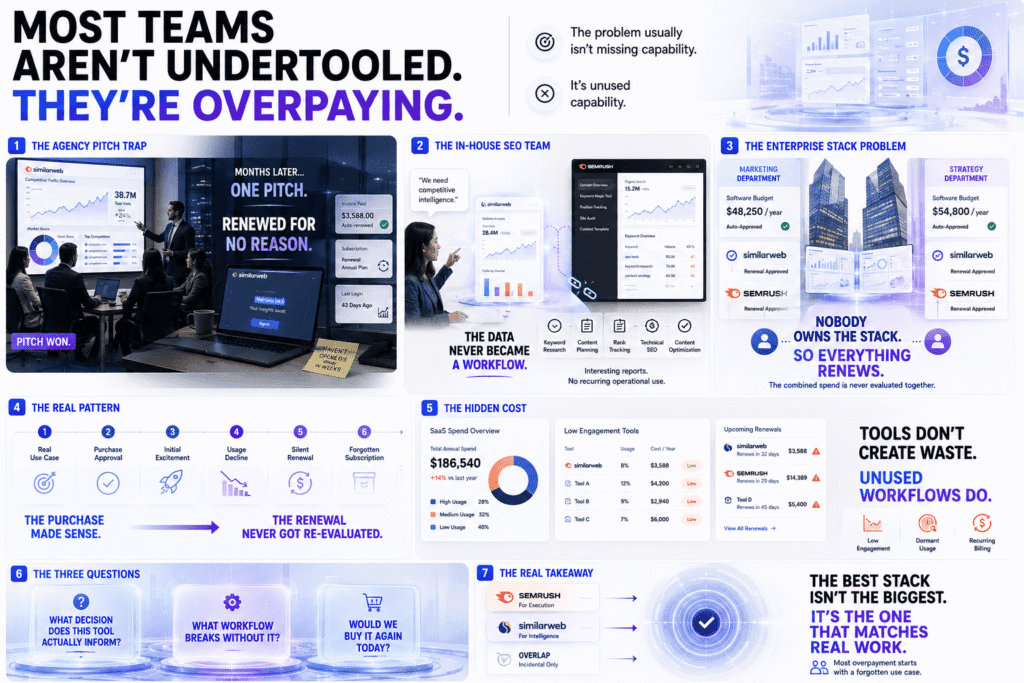
The agency that bought SimilarWeb for a pitch. A prospect asked about competitive traffic data during a sales conversation. Someone span up a trial, the numbers looked credible in a slide, and the tool got expensed before anyone asked whether there was a recurring use case behind the one-time need. That was over a year ago. The subscription has renewed twice. It gets opened when someone remembers it exists — usually to pull a single traffic graph that a free estimate tool could have produced in the same amount of time. The pitch was won or lost on other factors. SimilarWeb just stayed on the card.
The in-house SEO team that added SimilarWeb because a strategist asked for “competitive data.” This one is common because the request sounds completely reasonable — of course you want competitive intelligence, who wouldn’t — but it almost never comes with a definition of what decision that data is supposed to inform. The tool gets bought. Someone spends a week learning the interface. A report gets produced and shared in a Slack channel to mild approval. And then the use case quietly evaporates because there was no workflow that needed it on a recurring basis. Semrush already covered the competitive keyword intelligence the SEO team actually used day to day. SimilarWeb answered a question nobody was asking week to week.
The enterprise team running both because nobody owns the stack. This is the most expensive version of the problem and the hardest to fix — not because the tools are difficult to evaluate, but because the evaluation requires someone to go on record saying a tool isn’t earning its keep. In enterprise environments, that conversation carries political weight that has nothing to do with software. One tool lives in the marketing budget. The other lives in the strategy or research budget. Nobody sitting across from the other team has the full picture, and both renewals get approved because both teams will defend their own line item. The question of whether the combined spend is justified by combined utility never actually gets asked out loud.
What these three profiles share isn’t that they made a bad call when they bought. Most of these purchases made sense at the moment of sale — there was a real prompt, a plausible use case, someone with budget and intent. What they share is that the use case either never fully materialized or quietly stopped being true, and the renewal cycle doesn’t create a natural forcing function to revisit it. In the broader Semrush vs SimilarWeb conversation, this is the part that doesn’t get covered: the decision isn’t just which tool to buy. It’s whether to keep paying for what you already have. Tools renew. Budgets absorb them. The question of whether the stack still maps to actual work gets deferred until someone senior starts asking why the tools line looks the way it does.
That forcing function doesn’t have to come from a budget review. It can come from three questions — asked honestly, before the next invoice arrives.
How to Audit Your Own Stack Before the Next Renewal
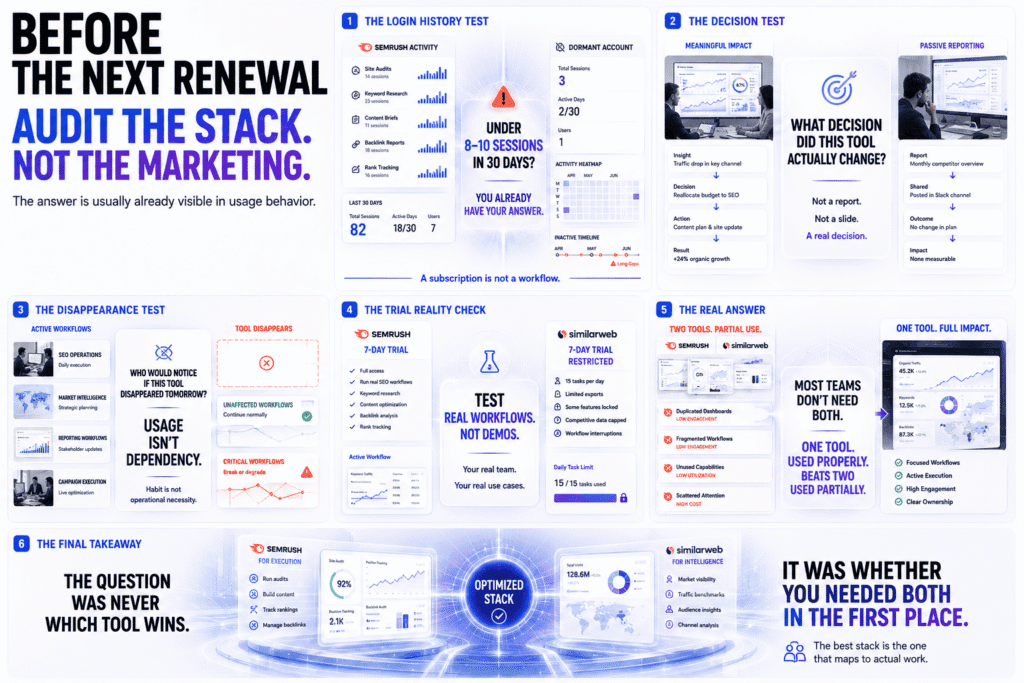
Pull up the login history for both tools. Not the feature list, not the pricing page, not the comparison article you have open in another tab. The login history. If either tool shows fewer than eight to ten active sessions in the last thirty days, you already have your answer — you just haven’t made the decision yet.
That’s not a framework. That’s how production tools behave when they’re genuinely being used. Semrush, used properly, gets opened multiple times a week — someone running an audit, pulling keyword data for a content brief, checking rank movement after a site change, building a backlink report. A team that logs into Semrush twice a month doesn’t have a Semrush workflow. They have a Semrush subscription. SimilarWeb is less frequency-dependent by design — the use cases are more episodic — but even quarterly strategic work should produce a visible cluster of sessions around planning cycles. Flat usage across three months means the episodic use case has quietly become a hypothetical one.
If the login data is ambiguous, ask the second question: can the person who uses this tool name the last decision it directly informed? Not a report it contributed to. Not a slide it appeared in. A decision — something that changed, or was confirmed, because of data that came specifically from this tool and couldn’t have come from something cheaper. If that answer takes more than thirty seconds to produce, the tool is functioning as expensive background noise. That’s a precise thing to be paying $2,000–$35,000 a year for.
The third question is the one most teams skip because it means talking to someone: who would notice if this tool disappeared tomorrow, and what specifically would they lose? This is different from asking who uses it. People use tools out of habit, familiarity, and low-grade obligation. The question is who would feel the operational gap — whose deliverable would be visibly missing something real, whose work would slow down or degrade. If the honest answer is nobody, or “we’d just use the other tool for that,” the audit is over.
These three questions will settle the Semrush vs SimilarWeb decision faster than any feature comparison. Most teams doing this exercise for the first time find that one tool stops being justifiable the moment someone asks, out loud, what it’s actually for. If you’re approaching a renewal with genuine uncertainty, both tools offer trials worth running before you commit: Semrush offers a 7-day free trial on Pro and Guru plans, with a limited free tier available beyond that. SimilarWeb’s 7-day trial is more restricted — capped at 15 tasks per day — which is worth knowing before you try to run a full competitive audit inside it and hit the wall. Use whichever trial applies to your situation, but run your actual workflows through it, not the demo scenarios from the product pages. Your real questions, your real competitive set, your real team. See what you’d genuinely miss if it wasn’t there next month.
The uncomfortable truth most Semrush vs SimilarWeb comparison articles won’t say directly: for the majority of teams reading this, the right answer is one tool, used properly — not two tools, used partially. The problem was never which one wins. It was always whether you needed both in the first place.
Related: Best SEO Tools for Small Businesses (Actually Worth Paying For)
Frequently Asked Questions
Is SimilarWeb more accurate than Semrush for traffic estimates? It depends on what you’re measuring. SimilarWeb is generally more accurate for estimating total traffic across channels on large, high-traffic sites. Semrush is more reliable for organic search and keyword-driven traffic estimates. Neither tool is accurate in the way your own Google Analytics is accurate — both carry a margin of error between 30–50% compared to first-party data, which is why neither should be the sole basis for a budget decision.
Can SimilarWeb replace Semrush? No — and the reverse is equally true. They’re built for different jobs. Semrush is an execution platform for SEO work: audits, rank tracking, keyword research, content workflows. SimilarWeb is a market intelligence layer for strategic questions: competitive benchmarking, traffic share analysis, channel mix research. Using one to replace the other means doing the wrong job with the wrong tool.
Which tool is better for agencies? Semrush, in most cases. Agencies running active SEO deliverables for clients — audits, content briefs, backlink campaigns, rank reports — need Semrush’s production depth. SimilarWeb becomes relevant only if the agency is doing ongoing competitive intelligence or market sizing work at a strategic level, typically for enterprise clients. Most agencies that have both are paying for SimilarWeb’s pitch-deck use case and not much else.
Related: Ahrefs vs Semrush vs Moz: The Complete & Honest SEO Tool Comparison
Does Semrush have a free plan? Yes. Semrush has a limited free plan with daily usage caps — enough to run basic keyword lookups and domain overviews, but not enough for ongoing production work. The Pro plan starts at $139.95/month and unlocks the full execution toolkit. SimilarWeb also offers a free tier with restricted data access and a 7-day paid trial, though the trial limits users to 15 tasks per day.
What is SimilarWeb actually used for? At its core: estimating how traffic distributes across a competitive set when you don’t have first-party access to those properties. The buyers who get genuine value from it are analysts sizing markets, strategy teams benchmarking channel mix, and enterprise marketers building competitive narratives for board-level reporting. It is not an SEO execution tool, despite the keyword and ranking features it has added in recent years.
Do I need both Semrush and SimilarWeb? Most teams don’t. The dual-stack case is legitimate only when there are two genuinely separate use cases — active SEO production and recurring market intelligence work — with different stakeholders consuming each. If you can’t point to a specific decision SimilarWeb informed in the last quarter, you probably don’t need it. Run the login audit in the final section before your next renewal.
Related: Moz for SEO: What Most Tutorials Leave Out (And How to Finally Improve Your Rankings)
Disclosure: Some links in this article maybe affiliate links. If you purchase through them I may earn a commission — at no additional cost to you. This article reflects genuine practitioner experience with the tools discussed. Affiliate relationships don’t influence the analysis, including where I’ve been critical.