
Somewhere out there is a business that opened six months ago, has a bare-bones website, and is sitting comfortably in the top three Google Maps results for a search you’ve been trying to rank for all year. If you’ve seen this and felt genuinely confused by it, you’re not alone — and you’re not missing something obvious.
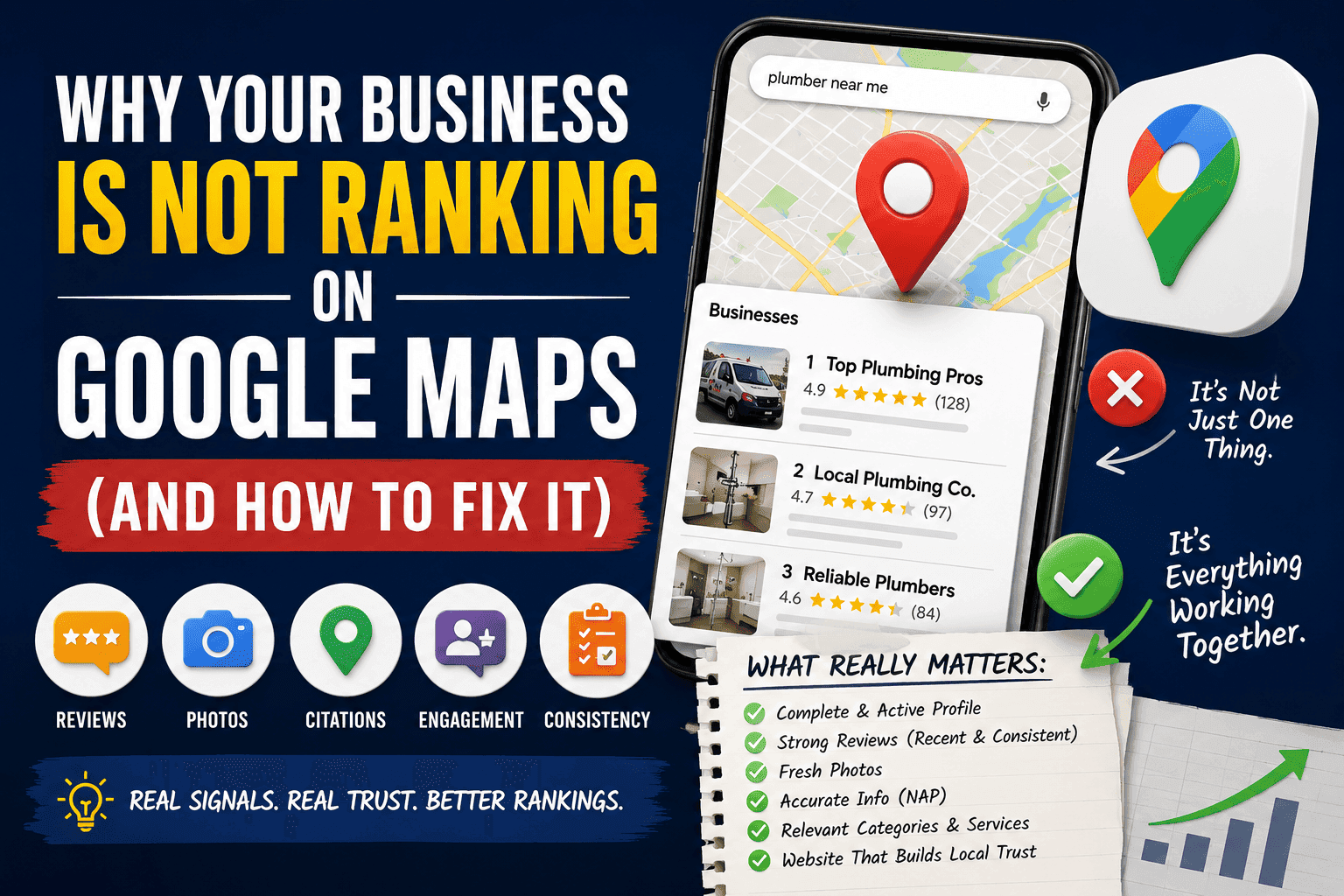
Why your business is not ranking on Google Maps is rarely a single-answer question. It’s usually several things operating at once — some fixable in an afternoon, some that take months to shift, and occasionally one or two that can’t be optimized away at all. The businesses that figure this out stop looking for the one thing they got wrong and start building the kind of local presence that makes ranking a byproduct rather than a target.
This article goes through the real reasons local visibility problems happen — not the surface-level checklist version, but the underlying dynamics that most guides skip over because they’re slower and less satisfying to explain. Some of what’s here will confirm what you already suspected. Some of it will be less comfortable. Either way, by the end you’ll have a clearer picture of what’s actually going on — and a better sense of where your effort is most likely to matter.
Table of Contents
Why your business is not ranking on Google Maps — the most common reasons:
- The Google Business Profile is incomplete, over-optimized, or has been quietly flagged by Google
- The website gives Google no local signals — no service area clarity, no location context, no confidence in what the business actually does or where
- Reviews are too old, too infrequent, or too thin to signal an actively chosen business
- Behavioral engagement — clicks, calls, direction requests — is weak relative to nearby competitors who are being chosen more consistently
- Business name, address, and phone number are inconsistent across directories and platforms
- The listing is suppressed or limited due to a guideline violation the business may not know about
- Proximity disadvantage — the business is structurally too far from where target customers are searching
- Local SEO has been treated as a one-time setup rather than an ongoing signal that requires consistent attention
Rarely is there a single cause. And rarely does a single fix resolve it — which is what the rest of this article works through.
Some Businesses Rank on Google Maps With Terrible Websites — and That Confuses Everyone
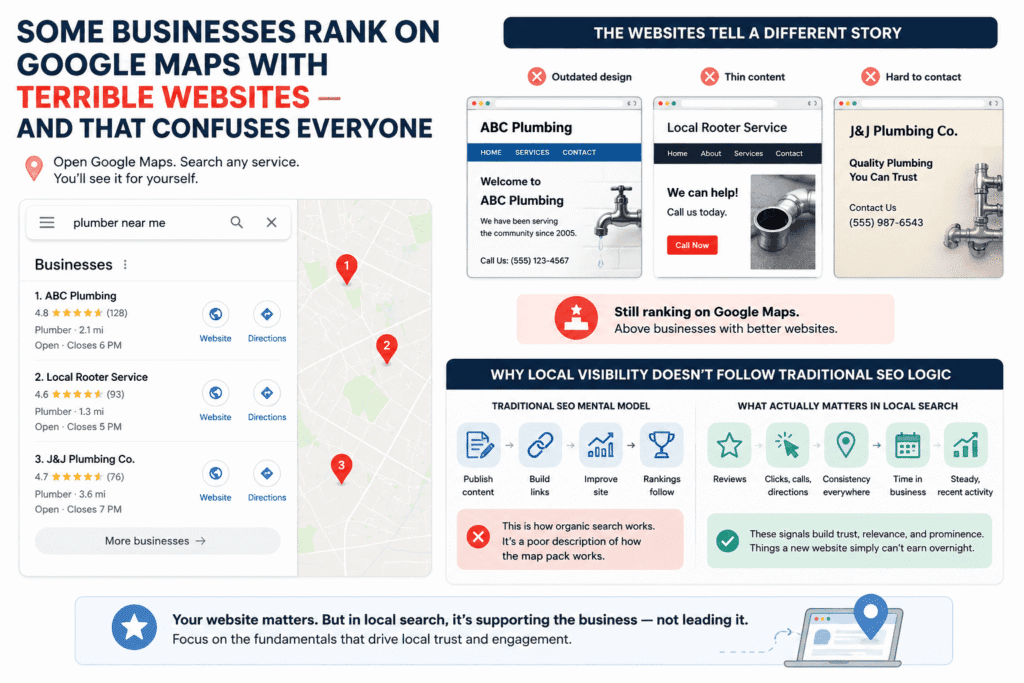
Open Google Maps right now and search for any service in your area — a plumber, a dentist, an accountant. Look at the top three results. At least one of them, probably two, will have a website that makes you wince. Outdated design, thin content, maybe a phone number that goes to voicemail. And yet there they are, sitting above businesses that have clearly spent money trying to get visible.
Nobody talks about this enough, because it complicates the story that most SEO advice is built on.
Why local visibility doesn’t always follow traditional SEO logic
The mental model most business owners absorb from reading about SEO goes something like: publish content, build links, improve your site, rankings follow. That’s a reasonable description of how organic search works. It’s a pretty poor description of how the map pack works.
Local search has its own hierarchy of what matters. Reviews carry weight that no amount of blog content replaces. Behavioral signals — whether people actually click your listing, call you, ask for directions — feed back into how Google perceives your relevance. A business that’s been operating in the same location for a decade, with consistent information everywhere it appears online and a steady stream of recent reviews, has built something that a freshly optimized website simply can’t replicate overnight.
This doesn’t mean your website is irrelevant. It means it’s playing a supporting role, not the lead.
The map pack and organic results are connected — but they’re scored differently
Here’s something that genuinely trips people up: you can rank on page one of Google organically for a keyword and be completely absent from the map pack for an almost identical search. Same Google, same query, two different systems producing two different answers about which businesses deserve to be seen.
The infrastructure is shared. The rulebook isn’t.
Organic rankings reward content depth, backlink authority, and domain trust built over time. The map pack is running a different calculation — one where whether Google trusts your business as a legitimate, active, locally relevant operation matters considerably more than how well your website performs on traditional SEO metrics. A technically excellent website attached to a neglected profile, thin reviews, and weak engagement patterns won’t drag a listing into the top three. The profile signals, the review velocity, the behavioral patterns of real customers choosing your business — these move local rankings in ways that purely on-page SEO work doesn’t touch.
This is where understanding why your business is not ranking on Google Maps starts to get useful. If you’ve been treating local visibility as an extension of your organic SEO strategy — more content, better technical structure, stronger backlinks — and wondering why the map pack hasn’t responded the way search rankings have, the disconnect isn’t random. You’ve been optimizing for one system while the other one runs on different inputs entirely.
Organic search rewards content and authority. Local search rewards trust and presence. They overlap more than people realize and less than people assume — and the businesses that figure out where one ends and the other begins tend to stop being confused about why their results look the way they do.
Why some weak-looking businesses still dominate local results
The honest answer, almost every time, is that the business has been there longer than you think. The ugly website belongs to a company that opened fifteen years ago, has 200-odd reviews, gets called regularly, and shows up consistently under the same name and address wherever Google looks. The owner has never once thought about local SEO. They’ve just been running a business.
Google doesn’t rank websites. It ranks businesses. And a business that real people in a real area keep choosing — keep searching for by name, keep calling, keep driving to — looks completely different from the inside of Google’s algorithm than a newer competitor with a cleaner website and a fresher content strategy.
What that ugly-website business has built, without meaning to, is the kind of signal profile that local SEO is actually trying to manufacture deliberately. That reframe matters, because it tells you something important about where your effort should actually go — and why the fixes that work aren’t always the ones that feel the most like “doing SEO.”
A Lot of Google Business Profiles Start Looking Identical Once Everyone Follows the Same Advice
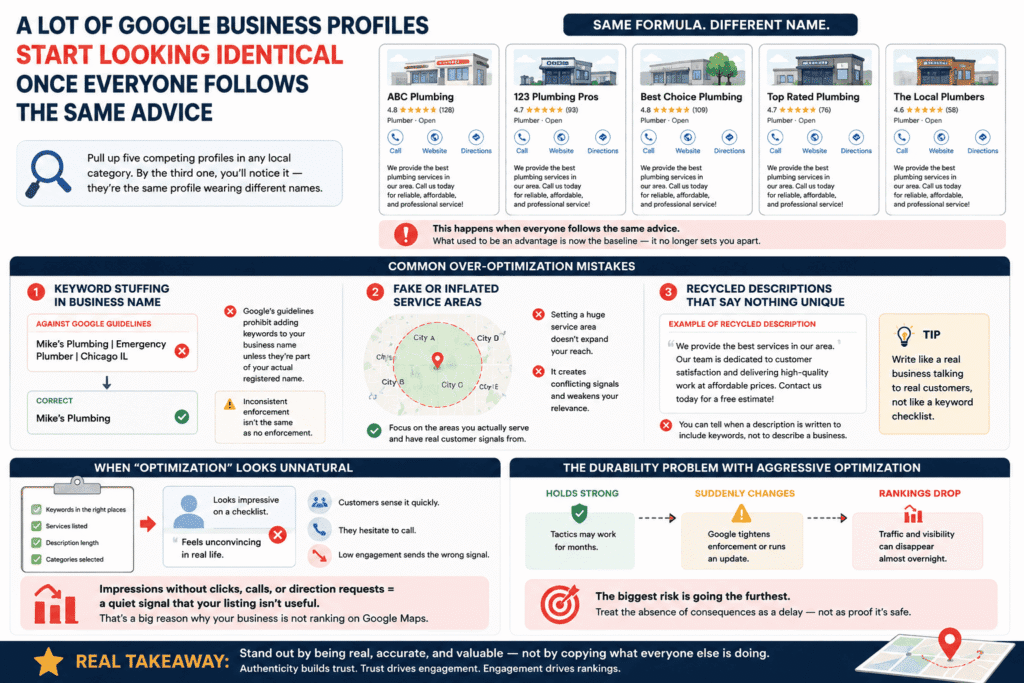
Pull up the Google Business Profiles of five competing businesses in any local category. Doesn’t matter which industry. Read the descriptions out loud. By the third one you’ll notice something that’s hard to un-notice — they’re essentially the same profile wearing different names.
This isn’t a coincidence. It’s what happens when an entire industry takes its optimization cues from the same small pool of articles, YouTube tutorials, and agency checklists. The advice wasn’t necessarily bad when it first appeared. It just got photocopied so many times that following it stopped being an advantage and started being the baseline assumption — the thing everyone does, which means it no longer differentiates anyone.
Keyword stuffing, fake service areas, and recycled descriptions
The business name field is where the arms race usually starts. “Mike’s Plumbing” becomes “Mike’s Plumbing | Emergency Plumber | Chicago IL” and suddenly every competitor in the category is doing the same thing because it seems to work, or worked once, or someone in a Facebook group said it worked for them. Google’s guidelines explicitly prohibit adding keywords to your business name unless they’re part of your actual registered name. Enforcement is inconsistent enough that people keep doing it — but inconsistent enforcement isn’t the same as no enforcement, and profiles that get flagged rarely see it coming.
Fake service areas are a separate issue that deserves more honesty than it usually gets. Setting your coverage radius to include every city within a two-hour drive doesn’t expand your reach — it muddies your relevance signal. Google builds an understanding of where a business actually operates based on a combination of signals: where your customers are coming from, where reviews are being left, where your address sits relative to search locations. An inflated service area doesn’t override that understanding. It just introduces a contradiction that Google has to resolve, usually not in your favor.
The recycled descriptions are probably the least harmful of the three but the most visible. You can tell immediately when a description was written by someone trying to include keywords rather than someone trying to describe a business. There’s a flatness to it — grammatically correct, informationally empty.
When “optimization” starts making a business look unnatural
There’s a specific kind of Google Business Profile that looks impressive in a checklist audit and unconvincing in real life. Keywords in the right places. Services listed. Description hitting the recommended character count. And yet something about it reads as assembled rather than written — engineered toward a goal rather than describing an actual business. Customers notice this faster than most business owners expect, and they respond to it in the most direct way possible: they don’t call.
This is where over-optimization creates a problem that pure profile analysis misses entirely. A description that reads like it was constructed rather than written doesn’t build the confidence that converts a profile visitor into an inquiry. It creates a moment of hesitation — is there a real business behind this, or just someone who read a guide about what a Google Business Profile is supposed to contain. That hesitation, multiplied across everyone who lands on the profile and leaves without acting, produces an engagement pattern that quietly undermines the visibility the optimization was supposed to build.
Why your business is not ranking on Google Maps despite a profile that scores well on every technical measure is sometimes exactly this — the profile generates impressions but not engagement, and a sustained pattern of impressions without clicks, calls, or direction requests is its own kind of signal. Not a penalty, not a flag, just a quiet accumulation of evidence that the listing isn’t particularly useful to the people seeing it. Google is trying to surface results that searchers find worth acting on. A profile that looks optimized but doesn’t get acted on is, from that perspective, not doing its job regardless of how complete it is.
The durability problem with aggressive optimization tends to show up later and more abruptly than the engagement problem does. Profiles built around keyword insertion in business names, inflated service areas, category selections chosen for search volume rather than accuracy — these sometimes hold their positions for months before anything changes. The issue isn’t that the tactics stop working gradually. It’s that they stop working suddenly, when Google tightens enforcement in a category or runs an update that catches what previous crawls didn’t. The businesses most exposed are almost always the ones that went furthest — the ones that treated the absence of consequences as confirmation that the approach was safe rather than as a delay before consequences arrived.
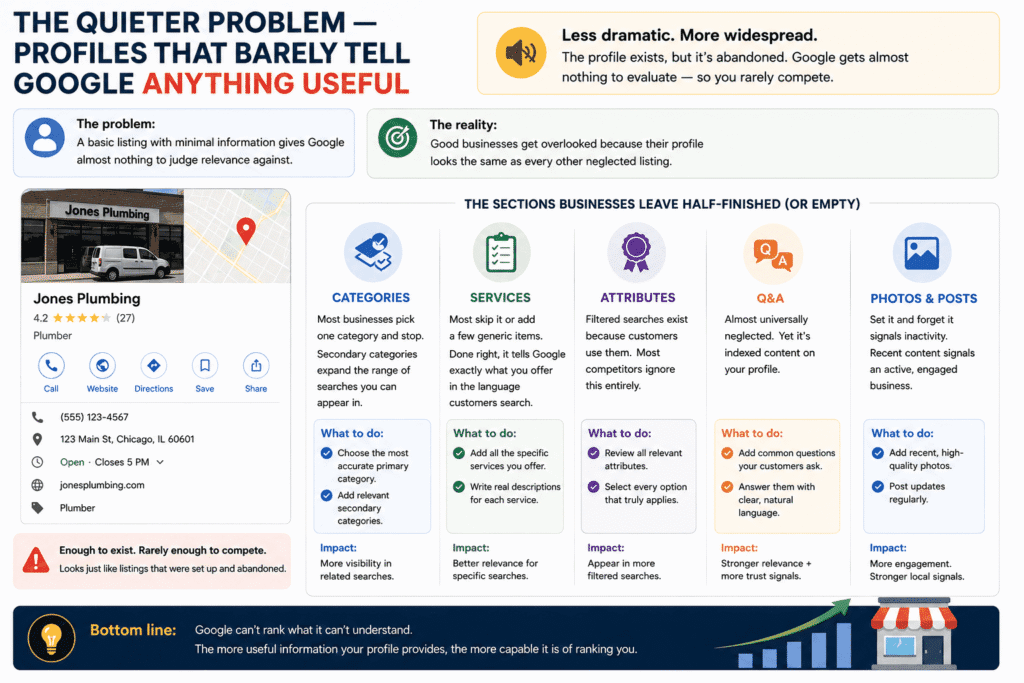
The quieter problem — profiles that barely tell Google anything useful
This one gets less attention because it’s less dramatic, but in practice it’s probably more widespread. The profile exists. It was claimed, the basic information was filled in, maybe a few photos were uploaded. And then nothing. The owner moved on, assuming the work was done.
What you end up with is a listing that gives Google almost nothing to evaluate relevance against. No services listed. No description that explains what the business actually does. No attributes, no Q&A, no posts, no recent photos. Just a name, a phone number, and a category — which is enough to exist in the index but rarely enough to compete seriously in it.
The frustrating part is that these profiles often belong to genuinely good businesses. The problem isn’t the business. It’s that the profile, as Google sees it, looks indistinguishable from a listing that was set up and abandoned.
Categories, services, attributes, and Q&A sections that businesses leave half-finished
Your primary category is probably the most consequential single field in your entire profile. Most businesses pick a reasonable one and stop there, which is fine as far as it goes. What they miss are secondary categories — and these aren’t minor. A business that adds relevant secondary categories expands the range of searches it’s considered for without weakening its primary positioning. A dental practice listing “Teeth Whitening Service” and “Emergency Dental Service” as secondary categories shows up in searches that the primary category alone would never trigger.
The services section is where the gap between thorough and careless becomes most obvious. Google lets you list individual services with names and descriptions. Most businesses either skip it entirely or add three generic entries and call it done. What it actually is — if you treat it seriously — is a structured way to tell Google exactly what you offer in language that matches how customers search. Specific service entries with real descriptions outperform vague category-level listings because they give Google something concrete to match against specific queries.
Attributes feel minor until you realize that filtered searches exist precisely because some customers use them. Women-led business. Free consultations. Accessible entrance. Outdoor seating. These aren’t decorative — they’re the fields that determine whether your business appears when someone narrows their search in ways that most of your competitors aren’t accounting for.
The Q&A section is almost universally neglected, and the businesses that actually use it get an advantage that’s genuinely disproportionate to the effort involved. You can populate it yourself with the questions customers ask most often — and the answers, written in natural language, become indexed content attached directly to your profile. Most profiles in most categories have either no Q&A entries at all or a few that were answered years ago and never touched since. In a category where every profile looks the same, that one section done well can make a profile feel noticeably more alive than everything around it.
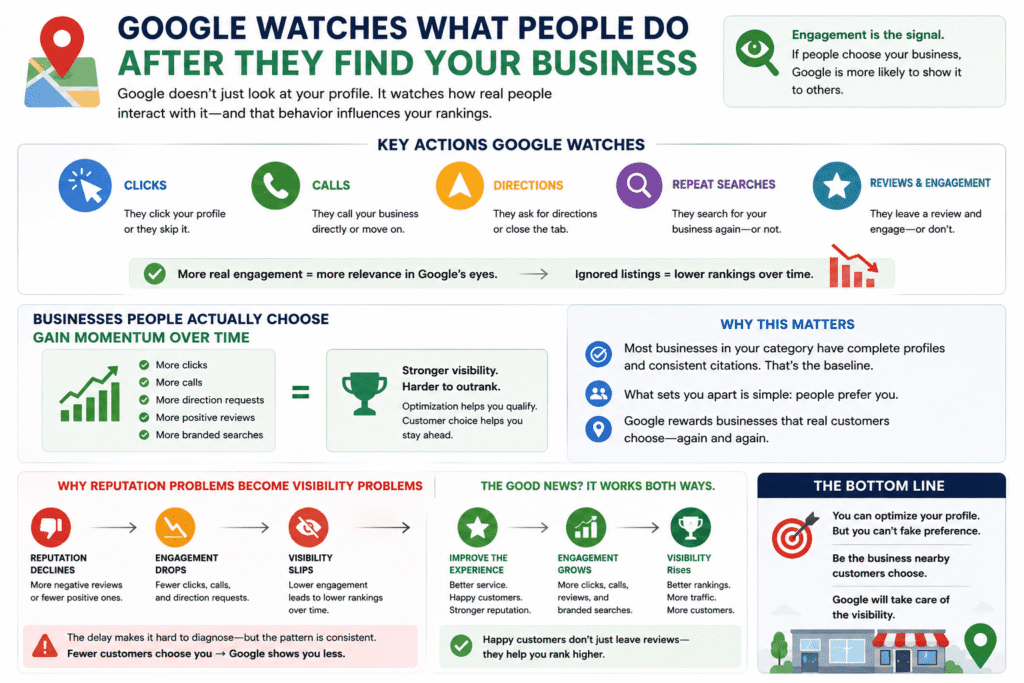
Google Watches What People Do After They Find Your Business
Optimization gets most of the attention in local SEO conversations, but there’s a layer underneath it that most advice skips over almost entirely. Google isn’t just evaluating your profile when it decides where to rank you. It’s watching what real people do when they encounter your listing — and that behavior feeds back into where you appear next time.
Clicks, calls, direction requests, repeat searches
When your business shows up in a local search, the interaction doesn’t end there as far as Google is concerned. Someone clicks through to your profile or they don’t. They call directly from the listing or they scroll to the next result. They ask for directions or they close the tab. They search for your business by name three weeks later, or they never think about you again.
Google hasn’t published a clean list confirming exactly which of these signals influence rankings — that’s not how Google communicates about its algorithm. But the pattern across businesses that track their Maps performance carefully is consistent enough that ignoring it seems naive. Listings that generate regular, genuine engagement tend to maintain or improve their visibility. Listings that appear in results but get passed over tend to quietly slide.
Think about what that pattern looks like from Google’s side. If your listing ranks above a competitor but their listing gets the clicks and calls while yours gets ignored, that’s information. It suggests the ranking might not be serving the searcher particularly well. Google’s entire business depends on showing people useful results, and usefulness — at some level — gets measured by whether people actually use what they’re shown.
The part that makes this genuinely difficult is that you can’t game it in any straightforward way. You can make your profile more compelling — sharper photos, a description that communicates something real, a primary category that actually fits — but the engagement either comes from real customers making real decisions, or it doesn’t come at all. There’s no shortcut that replicates the signal of someone genuinely choosing your business.
Businesses people actively choose tend to gain momentum over time
Local search visibility has a compounding quality that almost never gets acknowledged in the same breath as profile optimization and citation building — but it’s probably the most important dynamic in the whole system. A business that people consistently prefer, that gets called and visited and searched for by name and reviewed by customers who didn’t need to be asked, builds a behavioral signal profile that becomes genuinely difficult to displace. Competitors can optimize their profiles perfectly and still find themselves stuck behind a business that, on paper, looks like it shouldn’t be winning.
The technical elements matter. Profile completeness, category selection, citation consistency, website local signals — none of this is irrelevant. But in competitive markets these things are increasingly table stakes rather than differentiators. Most of the serious businesses in any local category have reasonably complete profiles. Most have claimed their major directory listings. Most have done at least some of the things that local SEO guides recommend. What separates the businesses holding strong map pack positions from the ones perpetually trying to break in is usually something that optimization alone can’t manufacture: people actually choose them, repeatedly, and Google has been watching long enough to notice.
This is part of why why your business is not ranking on Google Maps resists the kind of clean diagnostic answer most people are hoping for. It’s not always a profile problem or a citation problem or a website problem. Sometimes it’s a preference problem — the business simply isn’t the one nearby customers are gravitating toward, and the algorithm is reflecting that reality rather than causing it.
That’s a harder conversation to have than “your primary category is wrong” or “your NAP is inconsistent across directories.” Those problems have solutions you can implement this week. A preference problem has solutions too, but they run through the actual customer experience — the quality of the work, the responsiveness, the follow-through — rather than through anything that happens inside a Google Business Profile dashboard. Fixing the profile of a business that customers aren’t choosing doesn’t make customers choose it. It just makes the profile of a business customers aren’t choosing look slightly better.
Why reputation problems often become visibility problems later
The delay between a reputation deteriorating and rankings following is probably the most disorienting part of this whole dynamic. A business starts collecting negative reviews, or just stops collecting positive ones. The profile looks fine. The optimization is intact. Nothing seems to have changed. And then, gradually, over the following months, something shifts.
Engagement drops. Fewer people click. Fewer people call. The listing is still appearing in searches but it’s started losing the quiet competition for attention against listings that look more trustworthy. Direction requests thin out. And eventually, without any single obvious cause, rankings soften.
What you’ll notice when businesses try to diagnose this is that they almost always look in the wrong place first. More keywords in the description. Citation audit. A website refresh. None of it moves anything because the profile was never really the problem — the problem is that real people stopped choosing the business, and the algorithm caught up to that reality.
The more encouraging version of this same dynamic is that it runs in both directions. Businesses that genuinely address what negative reviews are pointing to, that make it easier for satisfied customers to share their experience, that respond to feedback in ways that show someone is actually paying attention — these businesses often see ranking improvements that seem out of proportion to whatever technical SEO work accompanied them. The profile didn’t change much. The business became more worth choosing, and the signals reflected that.
Reputation isn’t a soft metric sitting beside the real ranking factors. For most local businesses, it’s quietly running the whole thing.
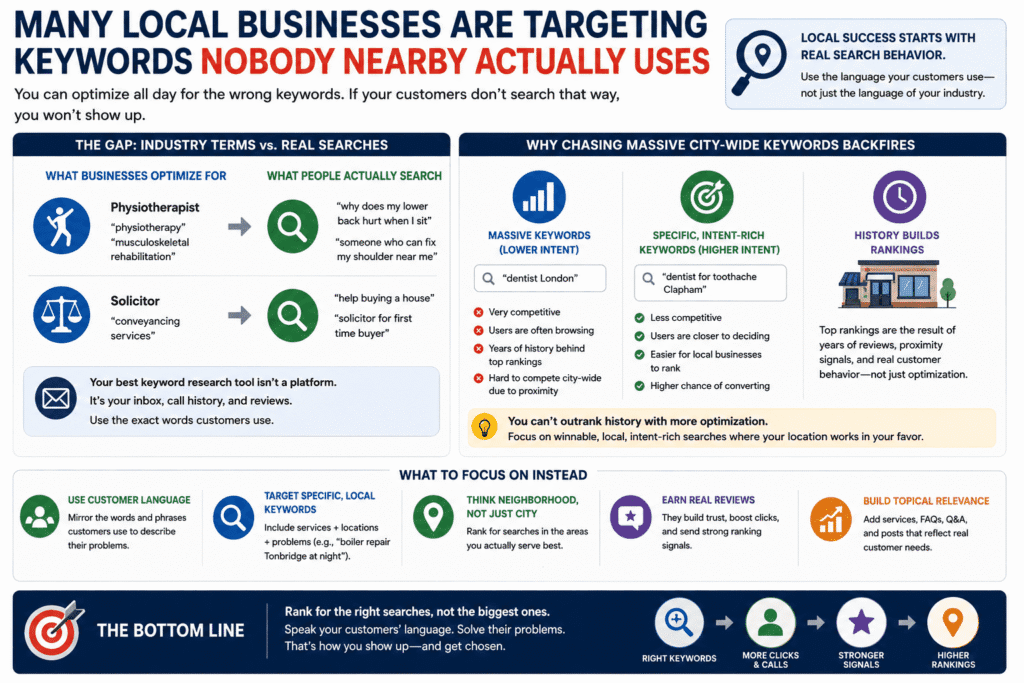
Many Local Businesses Are Targeting Keywords Nobody Nearby Actually Uses
There’s a specific kind of keyword research failure that’s hard to catch because it looks like success. The business has done the work, identified terms, optimized around them. Everything feels intentional. The searches just aren’t coming — because the terms the business chose are ones their actual customers rarely type.
The gap between industry terminology and real search behavior
Every profession develops its own vocabulary over time, and the people inside it stop noticing how specialized it sounds. The problem surfaces when those same professionals write their Google Business Profile descriptions, service listings, and review responses — all in the language of their industry, none of it matching how a nearby customer describes the problem they’re trying to solve.
A physiotherapist optimizes for “physiotherapy” and “musculoskeletal rehabilitation.” Their customers search “why does my lower back hurt when I sit” or “someone who can fix my shoulder near me.” A solicitor builds their profile around “conveyancing services.” Their customers type “help buying a house” or “solicitor for first time buyer.” The gap between those two sets of language is where a lot of local visibility quietly disappears.
What makes this particularly frustrating is that the searches customers actually make are almost always more specific, more conversational, and more revealing about intent than the polished terms most profiles are built around. And specific, intent-rich searches are exactly the ones that convert — the person typing “emergency boiler repair at night” isn’t browsing, they have a problem and they need it solved today.
The most useful research tool for this isn’t a keyword platform. It’s your own inbox, your call history, your reviews. Read the exact words customers use when they describe what they needed. That language — unpolished, sometimes grammatically loose, occasionally misspelled — is closer to what your profile should reflect than anything a tool suggests.
Why trying to rank for massive city-wide keywords usually backfires
The ambition makes sense. “Dentist London” or “plumber Chicago” — the search volume is real, the intent is clear, and ranking there feels like it would solve the visibility problem permanently. What the volume figure doesn’t show is what’s actually sitting behind every business currently holding those positions: years of reviews accumulating naturally, proximity signals built from a physical location that’s been there long enough to matter, behavioral history that reflects thousands of real customers choosing that business over time. You’re not looking at a profile that optimized its way to the top. You’re looking at the residue of a decade of operating.
Broad city-wide keywords aren’t just competitive — they’re competitive in a way that more optimization doesn’t fix. The gap between a business that’s been operating in the same location for ten years and a business that opened eighteen months ago isn’t a profile gap or a citation gap. It’s a history gap. It closes with time, not with tactics — and the businesses that spend their early months chasing city-wide positions instead of building the foundation that eventually makes those positions possible are usually doing both things poorly as a result.
The search intent dimension of this is worth sitting with separately. Someone typing “accountant Manchester” might be browsing, comparing options, nowhere near ready to pick up the phone. Someone typing “accountant for limited company Didsbury” has already done most of their thinking — they know what they need, they have a location preference, they’re close to a decision. The second search has a fraction of the volume and considerably higher intent, and it’s a search that a newer, well-optimized local business can actually compete for rather than one where it’s perpetually outgunned by established competitors with years of signal advantage.
This is one of the more honest answers to why your business is not ranking on Google Maps for the searches you most want to rank for — it’s not always a fixable problem. Proximity makes city-wide targeting harder than the competition level alone suggests. Google weights distance heavily enough in local results that trying to rank city-wide for a service people search near their current location means competing with geography as much as with other businesses. A newer business two miles from the city center is structurally disadvantaged for searches originating in the city center regardless of how well its profile is built — and recognizing that boundary early, then focusing effort on the searches where location works in your favor rather than against you, tends to produce better results than optimizing harder for positions the current landscape isn’t going to give you.
Smaller, more specific searches are often where visibility starts
The local businesses that build real map pack momentum almost never start by winning broad terms. They start by becoming the clearest answer to something narrow — a specific service, a specific neighborhood, a specific customer type — and expand from there as their profile accumulates the signals that make broader rankings possible.
A new accounting firm probably can’t touch “accountant Chicago.” But “accountant for freelancers Wicker Park” is a different conversation entirely. Lower competition, higher proximity relevance, and the customers it attracts are more likely to be an exact fit — which means they’re more likely to call, more likely to become regulars, and more likely to leave reviews that use specific language reinforcing exactly the relevance signals the profile needs.
Specificity compounds in ways that broad targeting doesn’t. Each well-matched customer who finds you through a narrow search and has a good experience adds a layer to the signal profile that makes the next search a little more winnable. It’s not fast. But it’s the actual path — and it starts with being honest about what searches a business can realistically compete for right now, rather than what searches it wishes it could win.
The businesses stuck asking why their visibility hasn’t improved are often the ones that skipped this stage entirely — went straight for the city-wide terms, found themselves invisible, and assumed the problem was technical. Sometimes it is. But often the issue is simpler and harder to hear: they’re optimizing for searches their customers aren’t making, in language their customers don’t use, for positions their profile hasn’t yet earned the right to hold.
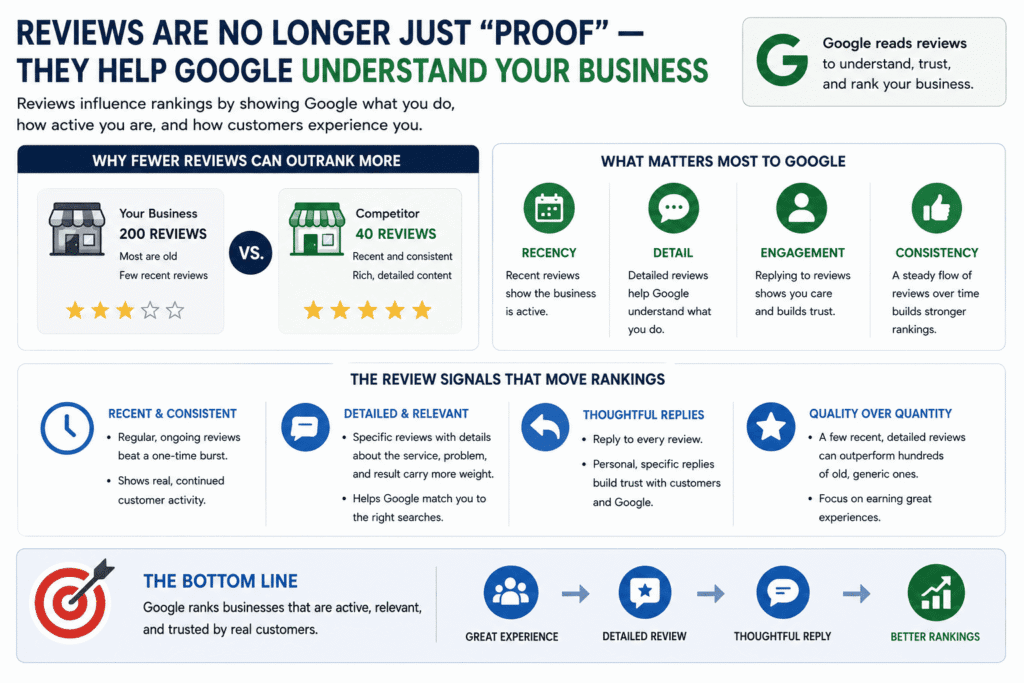
Reviews Are No Longer Just “Proof” — They Help Google Understand the Business Itself
Somewhere along the way, reviews got filed mentally into the “reputation management” category — something you monitor, respond to occasionally, and try to accumulate enough of that customers feel reassured. That’s a reasonable way to think about them if you’re a customer. It’s a surprisingly limited way to think about them if you’re trying to understand why your listing ranks where it does.
Why a competitor with fewer reviews can still outrank bigger businesses
The number on the profile — 200 reviews, 340 reviews, whatever it says — is probably the most visible review metric and one of the less meaningful ones once you get past a baseline threshold. Businesses get genuinely confused when a competitor with 40 reviews sits above them in the map pack, and the confusion is understandable because count feels like it should matter more than it does.
What Google appears to care about considerably more is whether the review activity looks current, whether the reviews themselves contain language that helps Google understand what the business does, and whether the business seems to be engaging with the people leaving them. A profile with 200 reviews, 170 of which arrived in the first two years and a trickle since, is telling a different story than a profile with 40 reviews spread consistently across the past fourteen months.
Recency isn’t just a freshness signal — it’s a proxy for whether the business is still actively choosing customers and being chosen by them. A dormant review profile and a dormant business look similar from the outside of the algorithm. That’s not always fair, but it’s worth understanding.
The content of reviews is where the gap between count-focused and signal-focused thinking becomes most obvious. When a customer writes something like “called them at 8pm on a Wednesday about a leak under the sink, someone arrived within the hour, explained everything clearly, didn’t try to upsell” — that sentence is doing something a five-star rating with no text can’t do. It’s attaching specific, service-relevant, behaviorally rich language directly to your profile, written by someone with no optimization agenda. Google can read that. It contributes to Google’s understanding of what your business actually does and for whom — in a way that your carefully written profile description, however good, doesn’t quite replicate because Google knows you wrote it about yourself.
This is the mechanism behind why your business is not ranking on Google Maps despite having more reviews than competitors. The reviews you have might be older, thinner, or less specific — and a competitor with half the count but richer, more recent content is sending a stronger signal on the dimensions that actually move rankings.
Recency, detail, reply consistency — the review signals most businesses underestimate
The businesses that hold strong map pack positions over years rather than months almost never got there through a review campaign. They got there through a review cadence — a steady, unglamorous accumulation of feedback from real customers over real time that reflects ongoing business activity rather than periodic optimization pushes. Thirty reviews arriving in two weeks followed by four months of silence looks different to Google than ten reviews arriving consistently across a year. The burst might even trigger scrutiny. The cadence builds trust. These are not the same thing and treating them as interchangeable is one of the more common review mistakes businesses make.
Detail is the signal most businesses have the least control over, which is probably exactly why it carries the weight it does. You can ask for a review — Google permits it, done correctly it’s fine — but you cannot tell someone what to write. Specific, detailed reviews come from customers whose experience was strong enough that they wanted to describe it, and no follow-up sequence or review generation tool changes that underlying reality. The implication, uncomfortable as it is, is that the most effective review strategy isn’t really a review strategy. It’s a service quality strategy. The ask, the timing, the reminder — these reduce friction between a good experience and the customer spending two minutes writing about it. They don’t manufacture the good experience itself.
Timing matters more than most businesses act on. Someone asked for a review immediately after a positive experience — while the details are specific and the goodwill hasn’t faded — writes something categorically different from someone who receives a follow-up email three weeks later when the interaction has blurred into a general impression. The first person remembers what happened. The second person gives four stars and a sentence. The gap between those two reviews, in terms of the signal value they carry, is larger than it looks.
Reply consistency is where most businesses fall furthest behind without realizing it. The two failure modes are mirror images of each other. The first is responding to everything with slight variations of the same template — which reads exactly as automated as it is, to customers and to Google. The second is responding sporadically, leaving stretches of reviews unanswered and occasional bursts of replies that don’t reflect any real pattern of attention. Neither communicates what consistent replies are actually supposed to communicate: that a real person is paying attention, regularly, and finds what customers say worth responding to.
A thoughtful reply to a negative review — one that acknowledges specifically what went wrong rather than defaulting to a generic apology and an invitation to continue offline — does more for profile trust than a hundred templated thank-yous on positive ones. People read those replies before deciding whether to call. They make judgments based on them that don’t show up in any metric but absolutely show up in whether the phone rings.
Something almost nobody mentions about replies: the language you use becomes indexed content attached to your profile. A response that naturally references a service name, a neighborhood, something specific about what the customer experienced — written the way a person actually responds, not engineered for keywords — adds to the pool of terms Google associates with your business. Marginal in isolation. Across months and years of genuine responses, less marginal than it sounds.
This is part of why why your business is not ranking on Google Maps despite having a reasonable number of reviews is often a review quality problem rather than a review quantity problem. The count looks adequate. But the reviews are old, or thin, or unreplied to, or arrived in a burst that Google treated with appropriate skepticism — and the signal profile they’re producing is weaker than the number on the profile suggests. Reviews are one of the few local ranking inputs where consistent, genuine effort over time produces something competitors genuinely struggle to replicate quickly. You cannot manufacture a year of specific, detailed feedback from real customers who had real experiences worth describing. You can only create the conditions where that kind of feedback happens naturally — and then make sure you’re paying enough attention to respond to it when it does.
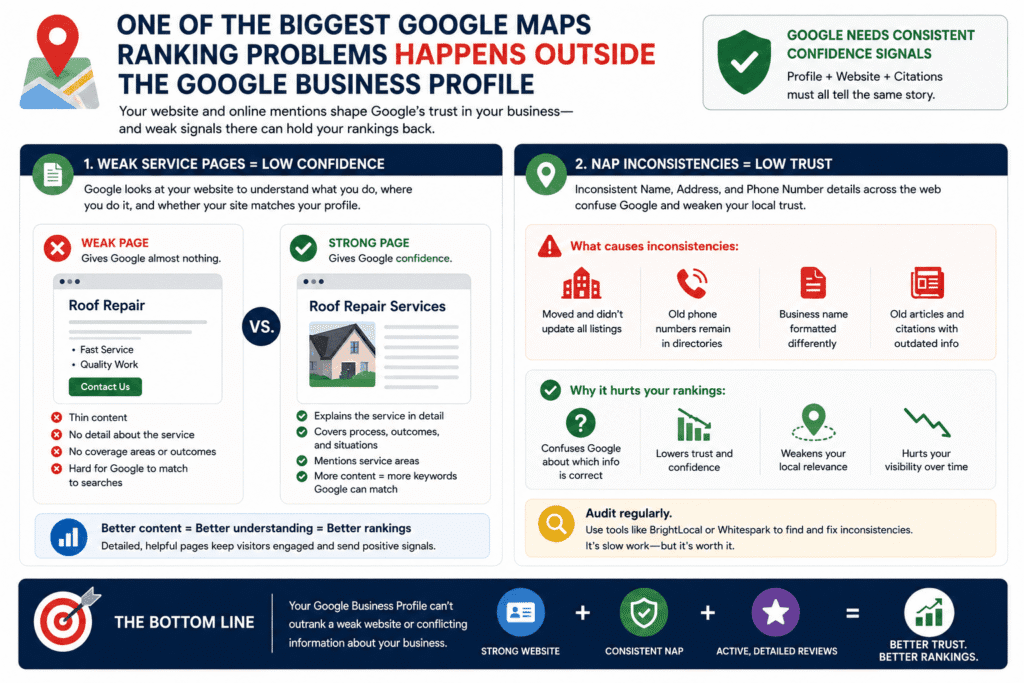
One of the Biggest Google Maps Ranking Problems Happens Outside the Google Business Profile
The profile gets the attention because it’s the obvious place to look. Something isn’t working, so you go back to the categories, the description, the photos — the things you can see and edit. What’s harder to see is that the website sitting behind the profile is often doing more damage to local visibility than anything inside the profile itself. And because the two feel like separate things, businesses fix one while the other quietly undermines everything.
Weak service pages that give Google no confidence
Google doesn’t evaluate your Business Profile in a vacuum. It looks at the website the profile points to and tries to build a coherent picture of what the business actually does, where it does it, and whether the two sources are telling the same story. When the profile claims ten services and the website has a single page listing them in bullet points with no further explanation, that coherence breaks down.
A service page that consists of a heading, two sentences, and a contact form isn’t really a service page — it’s a placeholder. It gives Google almost nothing to match against the specific searches your potential customers are making. Compare that to a page that explains the service the way a knowledgeable person would explain it to someone genuinely considering hiring them — covering what’s involved, what outcomes to expect, which situations it applies to, which locations it covers — and the difference in what Google can do with that content is significant.
The resistance to building this out properly is real and worth acknowledging. A lot of service businesses feel like detailed website content is unnecessary because the work speaks for itself and the phone number is right there. That reasoning made sense in a different era of local search. What it means now is that every competitor who wrote three decent paragraphs about each service they offer has a structural advantage that compounds quietly over time. The page exists, it ranks, it sends signals, it keeps working. The placeholder page does none of that.
There’s also a subtler problem with thin service pages that goes beyond rankings. When someone lands on a page that barely describes what you do, they leave. That bounce behavior is its own signal — and not a helpful one.
NAP inconsistencies that slowly erode local trust
Name, address, phone number consistency is one of those foundational local SEO concepts that gets covered in every beginner’s guide and then treated as permanently resolved once a business has claimed its main listings. In practice it’s an ongoing maintenance problem that most businesses stop paying attention to after the initial setup.
Here’s what actually happens over time. A business moves premises and updates Google but forgets the Yelp listing from four years ago. The phone number changes and gets updated everywhere obvious, but a local directory that scraped the old number keeps serving it. The business name appears with “Ltd” in some places and without it in others. A local newspaper article from the opening still shows the original address.
None of these feel like serious problems individually. Together they create a version of your business in Google’s index that doesn’t quite add up — slightly different details appearing in slightly different places, enough contradiction that Google’s confidence in what it knows about you becomes fuzzier than it should be. Local search rewards businesses that look unambiguously real and consistently described. Ambiguity, even minor ambiguity, tends to work against you.
What makes this particularly frustrating as a diagnosis is that the inconsistencies are often invisible from inside the business. You updated everything you remembered to update. The ones you didn’t update are the ones you forgot existed. An audit using something like BrightLocal or Whitespark usually surfaces a longer list than most business owners expect — and the correction process, once you have the list, is just slow careful work with no shortcut. It also doesn’t produce results quickly enough to feel satisfying, which is probably why it sits unfinished on more to-do lists than any other local SEO task.
Websites that never clearly explain where the business actually operates
A business builds a website. They describe what they do. They put the address in the footer. They assume Google will connect the dots between the website and the location — and move on.
Google needs more than that.
Location signals embedded in actual page content carry weight that footer addresses and metadata alone don’t replicate. A website whose service pages could belong to a business operating anywhere — no specific areas mentioned, no local context in the copy, nothing that anchors the business to a real geography — gives Google very little to work with when deciding whether to surface it for location-specific searches. The profile says one thing. The website is essentially silent on the question of where.
This isn’t an argument for stuffing city names into every other sentence. It’s an argument for writing website content that reflects where the business actually operates, naturally, the way any real local business would. A roofing contractor whose site mentions the specific areas they cover, references local building regulations, describes projects in neighborhoods their customers recognize — that’s not manipulation. That’s a website that sounds like it belongs to a business that actually exists in a specific place.
What you’ll notice when you spend time looking at websites that hold strong local rankings is that location isn’t something they added at the end. It runs through the content because the business is genuinely local and the writing reflects that without trying. The businesses perpetually asking why your business is not ranking on Google Maps, despite months of profile work, are often the ones whose websites present a version of the business that could be anywhere — and Google, following the thread from profile to website, finds nothing that confirms the local picture the profile is trying to project.
The profile and the website are supposed to corroborate each other. When they don’t — when the profile claims a strong local presence and the website says almost nothing to support it — Google is left with a contradiction it tends to resolve conservatively. Conservative resolutions in local search usually mean lower visibility, not higher.
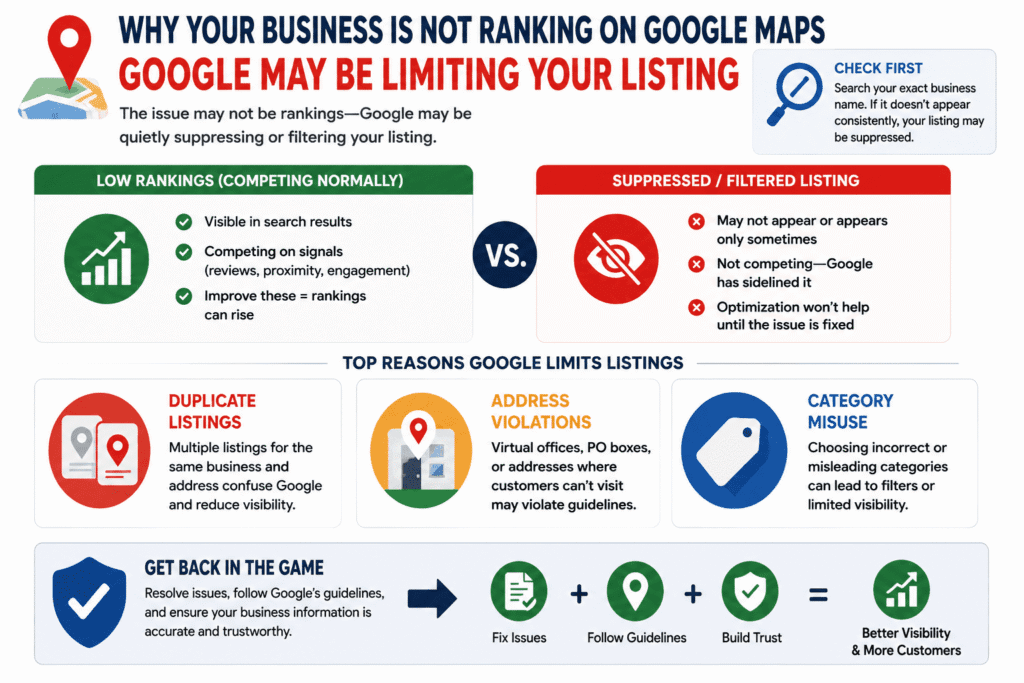
Some Businesses Aren’t Ranking Because Google Is Quietly Limiting the Listing
There’s a category of local visibility problem that standard optimization advice doesn’t touch — not because the advice is wrong, but because it’s answering a different question. The business isn’t losing a fair competition for rankings. It’s not really competing at all. Google has quietly decided something about the listing doesn’t add up, and until that gets resolved, everything else is largely beside the point.
The difference between low rankings and partial invisibility
Low rankings and suppression feel identical from the outside — you search, you don’t appear, you start troubleshooting. But they’re different problems with different causes and almost no overlap in how you fix them.
A business ranking poorly is visible to Google, in the index, competing normally, and losing on signals — reviews, proximity, engagement, profile completeness. Work on those things and rankings move. Slowly sometimes, but they move.
A suppressed or filtered listing is something else. The dashboard looks fine. Verified, green checkmark, no alerts. But in actual search results the listing either doesn’t show up or appears so intermittently it might as well not exist. The profile isn’t losing the competition — it’s been quietly removed from it. Pouring effort into optimization at that point doesn’t help because the listing’s problem isn’t quality, it’s status.
The first thing worth checking when visibility drops unexpectedly is whether your listing appears for a direct search of your exact business name. Not a category search, not a service search — your name. If it doesn’t appear, or appears only sometimes, or only shows up when the searcher is physically close to your address, that’s not a rankings signal problem. That’s a suppression problem, and recognizing which one you’re dealing with determines everything about what you do next.
Duplicate listings, address violations, and category misuse
Google doesn’t always tell you when something is wrong. Sometimes there’s a notice in the dashboard. More often the listing just quietly stops performing and the business spends weeks tweaking a profile that Google has already sidelined.
Duplicates are a more innocent problem than they sound. A listing created years ago by a previous owner and never claimed. An automatic profile Google generated from a third-party data source before the business got around to claiming it. A second profile created accidentally during a rebrand when someone forgot the original existed. Google’s response to two listings claiming the same business at the same address is almost always to reduce the visibility of both — not to pick the better one, not to merge them automatically, just to treat the contradiction as a trust problem and act accordingly.
Address violations catch businesses off guard because the rules aren’t always obvious until you’ve run into them. Virtual offices and co-working spaces used as business addresses have triggered suspensions consistently enough that it’s become well-documented — Google’s guidelines require an address where the business actually operates and where customers can genuinely show up during stated hours. Home-based businesses in certain categories face stricter scrutiny than others. The violation doesn’t have to be deliberate to cause a problem. Plenty of listings get limited for address reasons the owner never knew were issues when they filled out the form years ago.
Category misuse tends to show up later and more gradually than the other two. A primary category chosen because it has better search volume associations than the accurate one, secondary categories stacked aggressively to capture broader coverage — these sometimes work for months before Google catches up. When the consequence arrives it tends to arrive without warning, and businesses that have been optimizing around a mismatched category suddenly find themselves invisible for the searches they’d built their entire profile around.
What reinstatement looks like in practice — and why it can take time
The appeals process starts with the Google Business Profile reinstatement form, which is easy to find and genuinely difficult to navigate well. You confirm your business information, explain why the listing should be active, and upload documentation showing the business is legitimate and operating where it says it is.
What documentation works is less clear than Google’s guidance implies. In practice — utility bills, business licenses, bank statements, photos of the premises with visible signage — these tend to support successful appeals. But there’s no definitive list and outcomes aren’t consistent. Some appeals resolve in three days. Others sit for six weeks with no communication and no clear indication that anyone has looked at them.
The experience of waiting through a suppression while customers who search for you find nothing is genuinely awful in a way that’s hard to convey to someone who hasn’t been through it. There’s no urgent escalation path for most businesses. No direct line. The dashboard shows “under review” and then either resolves or doesn’t, on Google’s timeline, with minimal explanation either way.
A few things that tend to make a difference in appeal outcomes: every document submitted should show exactly the same business name and address as the listing — even minor formatting differences create questions you don’t want Google asking. Photos should show the business actually operating at the location, not just the building. And the written explanation works better when it reads like someone honestly describing their situation rather than someone trying to argue Google out of a decision. The appeals that tend to fail are the ones that sound defensive. The ones that tend to work are the ones that sound like a real business owner saying “here’s what we are, here’s where we are, here’s the evidence.”
For duplicate issues specifically — the process involves flagging the unwanted listing for removal through the interface rather than a formal appeal. Before doing anything, make sure the listing you want to keep is the verified one. Removing the wrong listing and being left with an unverified duplicate is a problem that takes considerably longer to untangle than the original duplicate did.
Ultimately, understanding why your business is not ranking on Google Maps sometimes leads somewhere completely unexpected — not to a profile gap or a citation inconsistency or a website problem, but to a listing that Google has quietly decided it doesn’t fully trust. Everything else in this article assumes the listing is in fair competition. This section exists because that assumption is wrong often enough that it’s worth checking before you spend another three months optimizing a profile that isn’t actually competing.
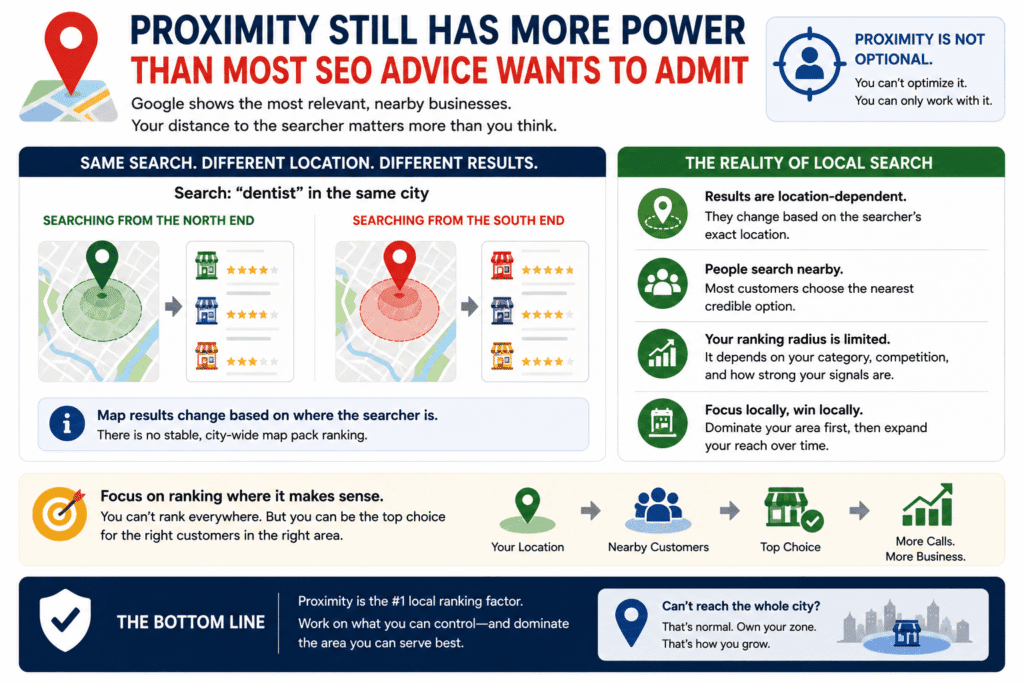
Proximity Still Has More Power Than Most SEO Advice Wants to Admit
Proximity is the local ranking factor that gets mentioned early in most guides and then quietly dropped. There’s a practical reason for that — there’s nothing to optimize, nothing to fix, no checklist to work through. Your address is your address. So the content moves on to things that feel more actionable, and proximity gets treated as a minor variable rather than the significant one it actually is.
The uncomfortable reality of trying to rank across an entire city
Search “dentist” from the north end of any major city and then search the same word from the south end. The map packs that come back will be almost entirely different businesses. Same search intent, same city, same Google — different results because the algorithm is responding to where the searcher physically is, not just what they typed.
There is no stable city-wide map pack position. This is worth saying plainly because a lot of local SEO effort is built around an assumption that doesn’t hold up. The map pack isn’t a leaderboard with fixed positions you climb by accumulating signals. It’s a dynamic set of results that shifts with every search depending on the searcher’s location, device, time of day, and search history. The business appearing in the top three for someone searching from two streets away may not appear at all for someone searching the identical term from two miles away.
Which means “ranking in London” or “ranking in Chicago” isn’t really the right frame. What’s actually achievable is ranking well within a realistic geographic radius around your physical location — and the size of that radius depends heavily on your category, your competition density, and how strong your signal profile is relative to businesses closer to where your customers are searching from.
For most fixed-location businesses, that radius is shorter than they’d prefer. A hair salon, a GP surgery, a dry cleaner — people search for these things near where they currently are. They’re not cross-referencing options across a city. They’re looking for the nearest credible option and making a decision. Pouring effort into ranking for searches originating five miles away, in an area with its own cluster of established local businesses, is a version of why your business is not ranking on Google Maps that has nothing to do with optimization and everything to do with geography.
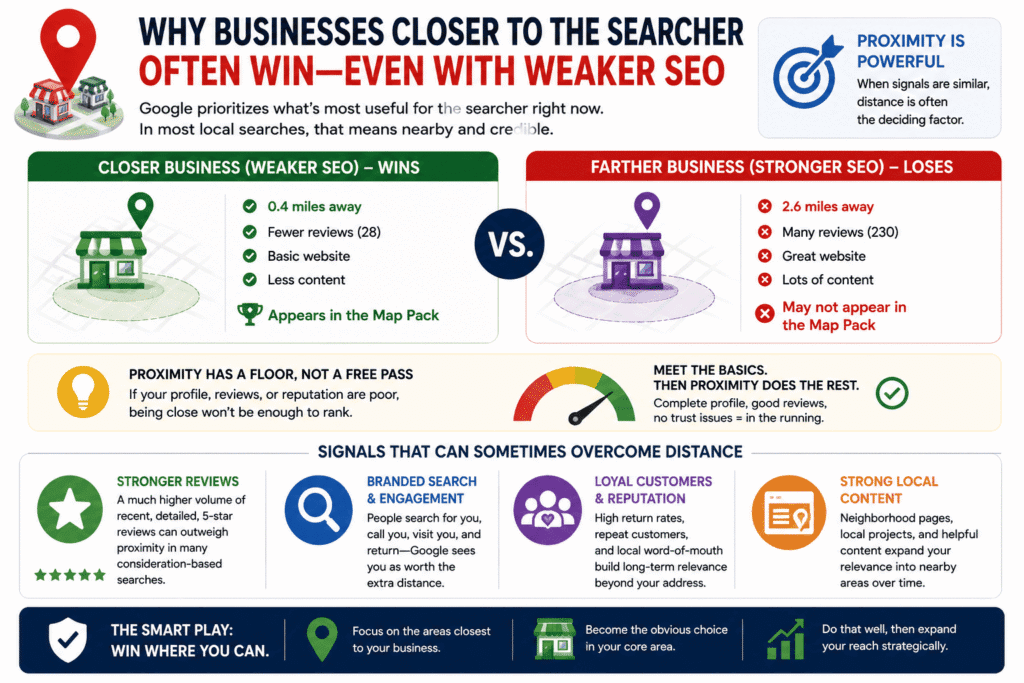
Why businesses closer to the searcher often win even with weaker SEO
The frustrating version of proximity is watching a competitor with a thinner profile, fewer reviews, and a worse website sit above you consistently — and eventually realizing the main reason is that they’re half a mile closer to where most of your target customers are searching from.
Proximity doesn’t just nudge results. In categories where several businesses have broadly similar signal profiles — similar review counts, comparable profile completeness, no major trust issues — it can be the deciding factor between appearing in the map pack and not appearing at all. Google is trying to surface the most useful result for a specific person in a specific place. For a lot of everyday service searches, “nearby and credible” is a very accurate approximation of “most useful” — and nearby is doing more of that work than most SEO content wants to acknowledge.
The credible part is real though. Proximity isn’t a pass for businesses with genuinely weak profiles or persistent reputation problems. There’s a floor of signal quality below which being close doesn’t help much. But once a business is above that floor — reasonable reviews, complete profile, no trust flags — additional optimization effort produces diminishing returns compared to what proximity is doing in the background, quietly and consistently, on every search.
If you map where your current customers are actually coming from against where your top-ranking competitors are located, the picture that emerges is often less about SEO gaps and more about location gaps. That doesn’t mean nothing can be done. It means the question shifts — from “how do I optimize harder” to “am I focusing my effort on the geographic area where I can actually compete.”
The signals that can sometimes compensate for distance
Sometimes. Not always, not reliably, not completely — but the gap between what proximity gives you and what other signals can contribute is real enough that understanding it matters, particularly for businesses that have genuinely strong profiles and are still losing ground to closer competitors with weaker ones.
Reviews are the strongest compensating signal, but only when the quality difference is substantial rather than marginal. A business with 280 detailed, recent reviews can outrank a closer competitor with 35 thin ones — not because review count overrides proximity, but because for certain searches the trust calculation outweighs the convenience calculation. A solicitor, an accountant, a specialist medical practice — these are searches where the person is spending real time evaluating options before deciding, and a significantly stronger review profile can tip that evaluation in favor of the business that’s slightly further away. For lower-consideration searches — a coffee shop, a petrol station, somewhere to get lunch — proximity dominates almost regardless of review quality, because convenience isn’t just one factor among many, it’s essentially the whole point of the search.
Behavioral signals extend this further over time, but not in a way you can engineer deliberately. A business that people consistently decide is worth traveling for — that gets searched from further away, called, visited, returned to — gradually builds a relevance signal that reaches beyond its immediate address radius. This happens as a consequence of being genuinely worth the distance, not as a result of any optimization tactic. It’s one of those local SEO dynamics that looks like a ranking strategy from the outside and looks like running a good business from the inside.
Service-area businesses sit in a different position entirely. A tradesperson, a mobile service, anyone who goes to the customer rather than waiting for the customer to arrive — service area settings give Google explicit permission to surface your listing for searches across the geography you actually cover, rather than weighting results purely around a registered address that customers never visit anyway. The returns depend entirely on accuracy. A service area that extends to every postcode within a two-hour drive doesn’t expand reach — it introduces a relevance contradiction that tends to work against rankings rather than for them.
Local website content is the slowest compensating signal and the one that requires the most sustained effort for the least immediate feedback. Neighborhood references woven naturally into service pages, project descriptions anchored to specific areas, content that reflects genuine local knowledge rather than city names inserted into otherwise generic templates — these extend the geographic relevance signal gradually, in ways that become meaningful over months rather than weeks. For businesses in categories where the competition immediately surrounding their physical location is too established to displace quickly, expanding the content footprint into adjacent areas is sometimes the most realistic path to incremental visibility growth.
The businesses that navigate proximity most effectively tend to share a specific orientation — they stopped trying to rank everywhere and started focusing on being the obvious choice in the area where the algorithm is already predisposed to favor them. That means concentrating review generation on customers who actually visited the location. Building content around the neighborhoods that immediately surround it. Measuring visibility where it’s genuinely winnable rather than across a city radius that the current signal profile was never going to support.
Why your business is not ranking on Google Maps in certain areas will sometimes have an answer that none of these compensating signals changes — you’re simply too far from where those searches are originating, competing against businesses whose proximity advantage is too significant for review quality or content depth to overcome. Knowing that boundary exists, and where it sits for your specific business and category, is more useful than optimizing indefinitely for positions that geography has already decided. The effort that goes into chasing unreachable positions is effort that isn’t going into dominating the positions that are actually available — and for most local businesses, the available positions are more valuable than they look while attention is focused elsewhere.
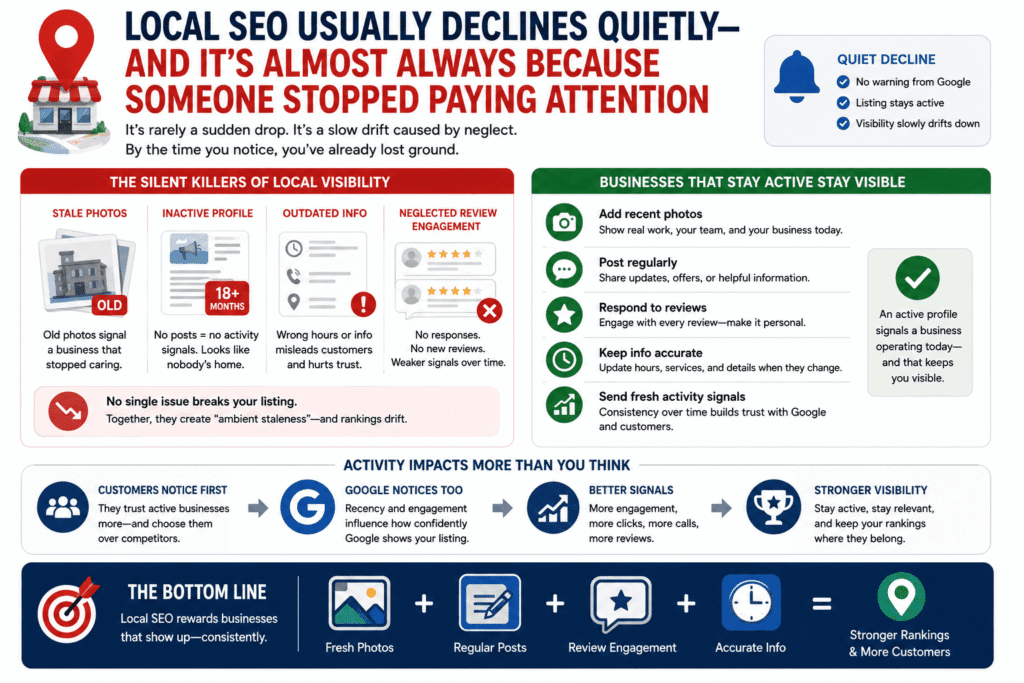
Local SEO Usually Declines Quietly — and It’s Almost Always Because Someone Stopped Paying Attention
Most businesses that discover their Google Maps visibility has dropped significantly didn’t experience a drop. They experienced a drift — slow, gradual, happening in the background while everyone was focused on other things — and by the time it registered, it had already been going on for the better part of a year.
Stale photos, inactive profiles, outdated information
There’s a particular kind of Google Business Profile that’s easy to recognize once you’ve seen enough of them. Cover photo from whenever the account was first claimed. Last post from eighteen months ago, promoting something seasonal that’s long since passed. Photos that haven’t been updated since a previous member of staff handled “the social media stuff.” Hours that no longer reflect what the business actually does.
No single one of these things breaks anything. Google doesn’t send a warning. The listing doesn’t disappear. What happens instead is that the profile starts accumulating a kind of ambient staleness — it looks, to anyone paying attention, like a business that stopped caring about its own presence at some point and never quite resumed. That impression affects customers making decisions from the profile, and it affects how confidently Google is willing to surface it to people searching right now rather than right then.
Photos are a useful example because businesses consistently underestimate what they signal. The value isn’t aesthetic — it’s temporal. Recent photos of real work, real premises, real people tell a different story than three images uploaded during setup and nothing since. A profile with current photos looks active. A profile with old ones looks like nobody’s home. Customers notice this before they’ve read a single review, and Google notices it before customers do.
Wrong hours are a more direct problem and a surprisingly common one. A business that changed its opening times and updated everything except the Google profile is actively misleading people who check before visiting. The customer who shows up to find the door locked when the listing said open doesn’t usually call to complain — they just leave, sometimes with a review that mentions it, sometimes without. Either way the experience damages the behavioral signals that matter for local visibility in ways that take a long time to repair.
Businesses that keep sending fresh activity signals tend to stay visible longer
The businesses that hold strong local positions over years rather than months tend to share something that’s less about what they do and more about what they never stopped doing. They add photos from recent work. They respond to reviews — not with identical templated replies, but with responses that acknowledge what the customer actually said. They update their hours when things change. They occasionally post something relevant. None of it is dramatic. It’s just the difference between a profile that looks like it belongs to a business operating today and one that looks like it belongs to a business that was optimized at some point in the past.
This matters because Google’s local algorithm isn’t just evaluating the quality of what’s in your profile — it’s evaluating whether the profile reflects a currently active business. Recency of activity feeds into that assessment in ways that aren’t perfectly documented but show up consistently in how profiles perform over time. A business that posts once a quarter, adds photos every few weeks, and keeps its information current is sending a fundamentally different signal than one that does none of those things, even if every other element of the profile is identical.
The frequency question comes up a lot and the honest answer is that consistency matters more than volume. Posting something genuine once every two weeks outperforms a burst of ten posts in one week followed by three months of silence — because the burst looks like a campaign and the consistency looks like a business. Google has seen enough of both to know the difference.
What you’ll also notice, if you look at inactive profiles in competitive local categories, is that the activity gap tends to show up in reviews too. A business that stopped engaging with its profile usually stopped actively encouraging reviews around the same time. The review cadence slows. The recency signals weaken. And the whole profile starts moving in the same direction — quietly, steadily backwards.
Why local rankings often slip gradually instead of collapsing overnight
The reason gradual decline is so hard to catch early is that local rankings have enough natural day-to-day variance that early movement genuinely looks like noise. A drop from position two to position four over six weeks, in a market where one or two position swings happen regularly for no obvious reason, doesn’t feel like a trend — it feels like fluctuation. By the time the pattern is undeniable, the business is sitting at position eight and wondering what happened.
What actually happened, in most cases, is that nothing dramatic happened. A competitor started adding photos more regularly. Another one’s review cadence picked up. A third refreshed their service pages. None of these are aggressive SEO moves — they’re just normal business activity that produces normal activity signals, and a profile that was previously competitive starts losing ground incrementally because the businesses around it are generating more of the signals that local search rewards while it generates fewer.
Google’s algorithm updates complicate diagnosis further. A weighting shift that starts favoring recency or engagement signals more heavily doesn’t produce a sudden drop for businesses with stale profiles — it produces a slow relative disadvantage that widens gradually over the months following the update. The business never knew the update happened, never connected the timing, and spent months looking for a technical explanation for something that was fundamentally an attention explanation.
Why your business is not ranking on Google Maps the way it used to — after a period where it was performing reasonably well — is often this quiet, accumulated story rather than a specific event. The profile drifted. The activity signals thinned out. Competitors who kept showing up pulled ahead in ways that weren’t visible until the gap had already become significant.
The recovery path is straightforward in principle and slow in practice. Resume the activity that built the visibility in the first place — consistent photos, genuine review responses, accurate information, occasional posts — and wait for the signal profile to rebuild. It will, usually, over roughly the same timescale it took to decline. There’s no shortcut that compresses months of inactivity into a week of catch-up optimization. The algorithm responds to sustained behavior over time, not to bursts of effort, and the businesses that understand that tend to stop treating local SEO as something you fix and start treating it as something you maintain.
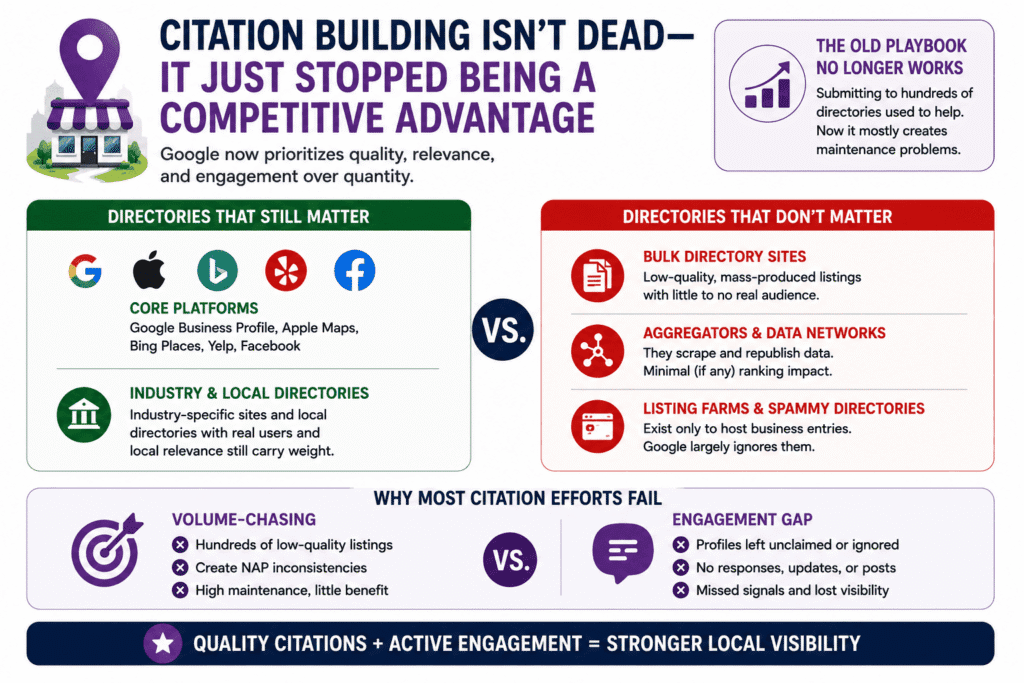
Citation Building Isn’t Dead — It Just Stopped Being a Competitive Advantage
Ten years ago, building citations aggressively was one of the more reliable things a local business could do to move rankings. Submit your details everywhere, keep the information consistent, watch visibility improve. It worked because the signal was relatively easy to produce and Google hadn’t yet developed better ways to assess whether a business was genuinely locally established or just well-listed. That gap closed. The advice didn’t.
The directories that still carry genuine local weight vs the ones that stopped mattering years ago
The honest version of the citation conversation starts with acknowledging that most directories don’t matter — not in a marginal way, but in a “Google has largely stopped treating them as meaningful signals” way. The listings exist. The data gets crawled. Nothing much happens as a result.
What still carries weight is a shorter list than most citation guides suggest. Google Business Profile, Apple Maps, Bing Places — these are non-negotiable and most businesses already have them. Yelp matters in the US more than people give it credit for, partly because of its own search traffic and partly because of its data relationships with other platforms. Facebook still functions as a citation source with genuine reach. Beyond that, the directories worth caring about are the ones with actual users — people who visit the platform specifically to find businesses, not just search engines crawling it for structured data.
Industry-specific platforms are where this gets more interesting. A plumber listed on Checkatrade or Houzz, a restaurant on TripAdvisor and OpenTable, a solicitor on a legal directory that real people use to find solicitors — these listings exist inside an ecosystem where the citation has actual context. Someone finding a business through one of these platforms and clicking through to contact them generates a behavioral signal that a listing on a generic directory nobody visits generates nothing close to. Google can tell the difference between a citation that reflects genuine real-world presence and one that reflects a spreadsheet submitted to fifty directories on a Tuesday afternoon. It’s been able to tell for a while now.
Local directories — chambers of commerce listings, regional business associations, local newspaper business sections — sit in their own category. Domain authority is often modest. Geographic specificity is real. For a business trying to establish strong local relevance in a specific city or region, a listing in a directory that genuinely covers that area carries different weight than a national generic listing. Not dramatically different. But the margins in competitive local categories are often slim enough that different and marginal are the same thing.
The directories that stopped mattering are easy to identify in retrospect and harder to avoid in the moment because citation tools include them in audits and make their absence look like a gap worth filling. Bulk directory sites, aggregator networks that republish scraped data, listing farms that exist for no purpose except hosting business entries — these were weak signals when they were new and have become weaker every year since. Filling them in produces the sensation of doing something useful without producing much evidence that anything useful happened.
Why volume-chasing and engagement gaps explain most citation failures today
The businesses that invest seriously in citation building and see nothing move almost always fit one of two descriptions. They either built a large volume of listings on directories that stopped mattering years ago and are now wondering why a hundred new citations produced no visible result — or they built accurate listings on platforms that genuinely matter and then treated those listings as finished rather than ongoing.
Volume-chasing is the older failure mode and still the most common. The appeal is logical on the surface: more citations should mean more signals, more signals should mean stronger local presence. What a sprawling citation profile across low-quality directories actually produces is maintenance liability rather than ranking benefit. Every listing is another place where a business name, address, or phone number can drift out of sync when details change. A phone number changes, the major platforms get updated, and eighteen months later an audit surfaces fourteen directories still showing the old number — quietly generating the NAP inconsistencies that erode local trust in ways that are genuinely difficult to trace back to their source. The directories creating the inconsistency problems are almost never the ones that were producing any ranking benefit. They were just places where information was deposited and then forgotten.
The engagement gap is where the more consequential citation failures are happening right now, and it gets considerably less attention than volume-chasing despite being the more interesting problem. Yelp, TripAdvisor, Facebook, Houzz, industry-specific directories with real user traffic — these have evolved into something closer to secondary business profiles than directory listings, and profiles that sit unclaimed, unresponded-to, and functionally abandoned for years tell a specific story to anyone paying attention. Fourteen reviews on a Yelp listing with zero owner responses across three years isn’t just a missed reputation management opportunity. It’s a visible signal, on a platform Google monitors and draws data from, that the business either doesn’t know the listing exists or has decided it isn’t worth engaging with.
Why your business is not ranking on Google Maps despite what looks like a solid citation foundation is sometimes precisely this — the listings exist, the information is accurate, but the platforms carrying the most weight have shifted from data sources into active profiles that reward engagement the same way a Google Business Profile does. Treating them purely as a consistency exercise — submit, verify, move on — captures maybe half of what they’re now capable of contributing. The other half comes from the same things that make a Google Business Profile perform well: responses, activity, updated information, the general appearance of a business that’s paying attention.
Citation building in its original form ran out of meaningful returns years before most local SEO content acknowledged it had. What replaced it isn’t a new tactic — it’s a different orientation toward the same platforms. Fewer directories, chosen for actual relevance rather than domain authority scores. Maintained accurately when details change. Engaged with consistently on the ones where real customers are leaving real feedback. Treated as part of a local presence that requires ongoing attention rather than a submission exercise that gets completed once and filed away. That shift — from campaign thinking to maintenance thinking — is less exciting than a new tactic would be, and it tends to produce results on the same slow timeline that most genuinely useful local SEO work operates on.
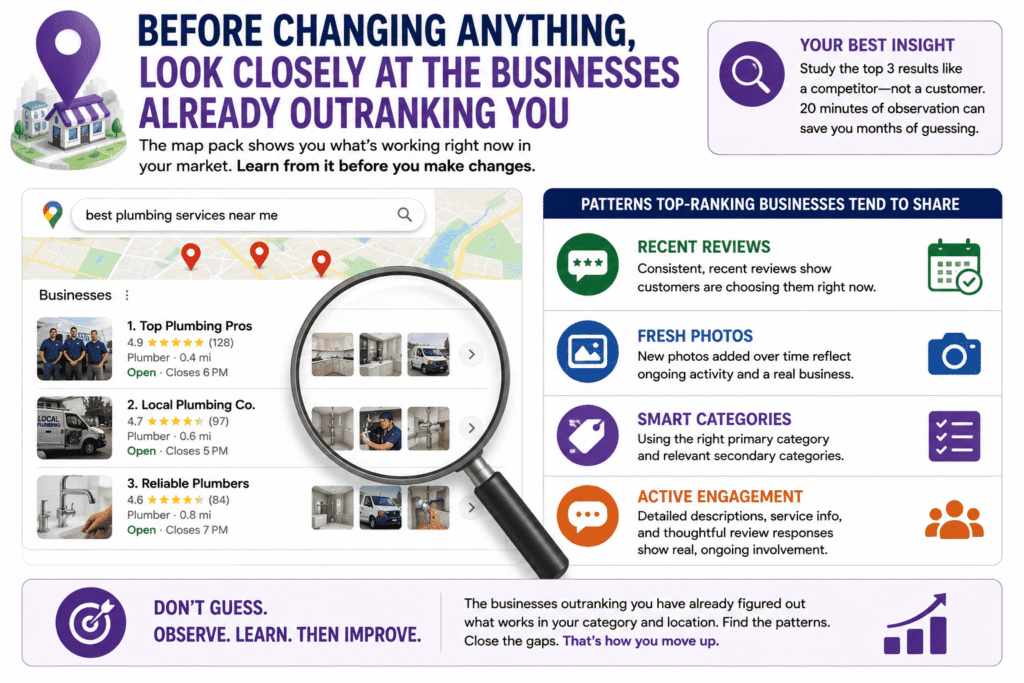
Before Changing Anything, Look Closely at the Businesses Already Outranking You
The businesses sitting above you in the map pack have already solved the problem you’re trying to solve. Not perfectly, not permanently, but well enough to be winning right now in your specific category and location. That’s more useful information than any general guide about local SEO best practice — and most businesses never look at it seriously before they start making changes.
Patterns top-ranking local businesses tend to share
Search the term you most want to rank for on Google Maps. Look at the top three results not as a potential customer but as someone trying to understand what those profiles have that yours doesn’t. Do this before touching anything on your own profile. Twenty minutes of honest observation will tell you more about what’s actually working in your market than most of what you’ll read about local SEO in general.
Review recency almost always shows up as a pattern. Not necessarily the highest total count — the businesses holding top positions usually have a consistent cadence of recent reviews rather than a large historical archive that tapered off. A profile with three hundred reviews, two hundred and sixty of which arrived before last year, looks different to Google than a profile with a hundred and twenty reviews spread across the past eighteen months. The second profile is telling a story about a business people are currently choosing. The first is telling a story about a business that used to be chosen.
Photo recency follows the same logic. Scroll through the photos on top-ranking profiles and check the upload dates. What you’ll typically find is that the profiles holding strong positions have photos added recently — not a single batch from setup, but additions over time that reflect ongoing business activity. This isn’t a coincidence.
Category selection is worth examining carefully and specifically. What primary category are the businesses above you using? Are they consistent with each other? Are they using secondary categories you haven’t considered? If every top-ranking competitor in your category is using a primary category you aren’t, that’s worth understanding before assuming your own selection is correct. Category mismatches between what you’ve selected and what the market leaders are using sometimes explain ranking gaps that look mysterious from every other angle.
The written content across their profiles — descriptions, service listings, how they respond to reviews — tends to share a quality that’s easy to recognize once you’re actively looking for it rather than just reading as a consumer. It sounds like it was written by someone who actually runs the business. Specific details, occasional imperfections, language that reflects real customer interactions rather than keyword research. That texture is itself a signal — it reflects genuine, sustained engagement with the profile rather than a one-time optimization exercise.
The gaps that become obvious once you compare profiles side by side
Direct comparison produces two kinds of insight, and the less obvious one is usually more useful.
The obvious gaps are visible immediately — review count difference, photo recency, whether service listings are detailed or sparse. These are real and worth addressing. But they’re also the gaps everyone notices, which means they’re the ones most businesses are already working on. Finding out you have fewer reviews than your top competitor doesn’t tell you much you didn’t already know.
What the comparison reveals that general advice doesn’t is the specific decisions the top-ranking businesses made that you weren’t aware were factors. The Q&A section populated with real answers in natural language. The attributes selected carefully rather than left at whatever the defaults were. The review responses that mention specific services and locations without reading like they were written by someone thinking about SEO while writing them. These aren’t in any checklist you’ve read because they’re not dramatic enough to feature in a guide about ranking factors — they’re just the accumulated effect of someone treating the profile as a living thing rather than a form that got filled out once.
Something else the comparison occasionally surfaces is that the businesses outranking you aren’t doing everything right. Some have thin website content. Some have unanswered reviews from months ago. Some have descriptions that are mediocre at best. The profile above yours isn’t necessarily better across every dimension — it’s better on the specific dimensions that are doing the explanatory work in your category. A competitor with two hundred reviews and a weak description isn’t ranking because of the description. The review gap is the story and the description is irrelevant to it.
This matters because it focuses effort in a way that general best practice advice doesn’t. If the gap is primarily in review recency while your profile completeness is comparable, spending three weeks rewriting your service listings isn’t going to move anything. The comparison tells you which variable is actually explaining the outcome — and that’s information you only get by looking directly at what’s working, not by reading about what should work.
Start auditing instead of guessing — most ranking problems become visible quickly
Audit sounds technical. It isn’t. It’s opening your profile and a competitor’s profile side by side and going through them with the specific intention of finding differences rather than confirming that you’re broadly similar.
Categories first — primary and secondary. Then reviews — not just total count but the distribution over time, the response rate, what the responses actually say. Photos — quantity matters less than recency and what they show. Service listings — are they specific enough to match real search queries or generic enough to match nothing in particular. Then the descriptions, read out loud if that helps, just to hear which one sounds like a person and which one sounds like a document.
What you’ll find, more often than not, is that the gaps explaining a ranking difference become visible within the first fifteen minutes. Not all of them — behavioral signals and historical authority don’t show up in a profile comparison — but enough of them that the exercise ends with a specific list of differences rather than a vague sense that something needs improving.
Occasionally the audit produces a finding that’s useful in a different way: the businesses above you don’t have dramatically better profiles. Similar review counts, similar completeness, similar engagement patterns — and the ranking difference comes down to proximity, or years of operating history, or behavioral signals that accumulated long before you started competing in that market. That finding is uncomfortable but valuable. It means the answer to why your business is not ranking on Google Maps in certain positions isn’t more optimization — it’s a geography problem or a history problem, and the more useful response is adjusting which searches to prioritize rather than continuing to optimize for positions the current competitive landscape isn’t going to give you.
The comparison doesn’t resolve everything. But it consistently turns a vague visibility problem into a specific list of things that are different between your profile and the ones winning above you — and a specific list, however incomplete, is a better starting point than guessing based on what worked for someone else in a different market.
Frequently Asked Questions
Why is my business not showing up on Google Maps at all?
A business that doesn’t appear even for a direct search of its own name isn’t ranking poorly — it’s not competing at all. The most common reasons this happens:
- The listing has been suspended or suppressed due to a guideline violation — common triggers include duplicate listings, an address that doesn’t meet Google’s requirements, or a primary category that misrepresents the business
- The listing was created but never properly verified, leaving it in a state where Google won’t surface it reliably
- A duplicate listing exists somewhere in the system, creating a trust contradiction that Google resolves by limiting both
- The listing was verified but has since been flagged through a competitor report or an automated quality check
How to check: Search your exact business name on Google Maps. If the listing doesn’t appear, appears only sometimes, or only surfaces when searching from directly outside your address, open your Google Business Profile dashboard and look for any alerts or status flags. A listing showing as “suspended” or “under review” needs to go through the reinstatement process before any other optimization work will matter.
How long does it take to rank on Google Maps?
Honestly, longer than most guides suggest. For low-competition categories in areas without many established competitors, meaningful movement can happen in six to twelve weeks of consistent effort. For competitive categories in dense urban markets, the more realistic timeframe is six to twelve months — and that’s assuming the underlying signals are being built properly throughout. The delay between doing the right things and seeing the right results is one of the most disorienting parts of local SEO, because the work produces effects that accumulate invisibly before they show up in rankings. Businesses that abandon the effort at the three-month mark because nothing visible has changed are often the ones that would have started seeing movement at month four or five.
Does my website affect my Google Maps ranking?
Yes, but not in the way most people assume. A technically excellent website won’t carry a weak or neglected profile into the top three results — the profile, reviews, and behavioral signals carry more weight in local rankings than website authority does. What your website does affect is the local context signals Google uses to understand what your business does and where it operates. Weak service pages, no mention of your service area, and content that could belong to a business operating anywhere rather than specifically in your location — these create friction that limits local visibility. The website’s job in local SEO is to corroborate and reinforce what the profile claims, not to substitute for the profile signals that actually drive map pack rankings.
How many reviews do I need to rank on Google Maps?
There’s no threshold number that unlocks rankings, and chasing a specific count tends to produce the wrong behaviors. What matters more than total reviews is review recency — whether reviews are arriving consistently rather than in bursts — and review quality, meaning whether the content is specific enough to help Google understand what your business does and who it serves. A business with forty detailed, recent reviews from the past year will often outperform a competitor with two hundred reviews, most of which arrived two or three years ago. Focus on building a consistent cadence of genuine reviews from real customers rather than hitting a number, and the count will follow as a byproduct.
Can I rank on Google Maps without a website?
Technically yes — Google Business Profile doesn’t require a website link and some businesses rank without one, particularly in low-competition categories where other local signals are strong enough to carry the listing. In practice, operating without a website creates several disadvantages that compound over time. Google has no website to cross-reference your profile claims against, which limits its confidence in your business’s legitimacy and local relevance. You lose the service page and location signal opportunities that a website provides. And customers who find your profile and want to learn more before calling have nowhere to go — which affects the behavioral engagement patterns that influence rankings. A basic, well-structured website with real service pages and clear location information will almost always strengthen map pack performance compared to operating without one.
Why do businesses with fewer reviews outrank me?
Review count is one local ranking signal among many, and it’s not always the most important one. A competitor with fewer reviews may be winning on review recency — their reviews are more recent, suggesting an actively chosen business. They may be winning on proximity — they’re simply closer to where your target customers are searching from. They may have stronger behavioral signals — more clicks, calls, and direction requests relative to their impressions. Or their profile may be more completely and accurately filled out in ways that yours isn’t. When a business with fewer reviews consistently outranks you, the answer is almost never that the review count gap is the only explanation. Compare the full profiles directly — categories, photos, service listings, website quality, location relative to search density — before assuming reviews are the primary variable.
Is Google Maps SEO different from regular SEO?
Yes, significantly. Organic SEO is primarily a content and authority competition — who has the most relevant, well-linked content for a given query. Google Maps ranking is primarily a trust and relevance competition — which business Google is most confident is a legitimate, active, locally relevant operation for a given search. The signals are different: reviews, behavioral engagement, profile completeness, proximity, and citation consistency matter far more in local than they do in organic. The timeline is different: local rankings respond to trust signals that accumulate through real customer behavior rather than content publishing. And the geographic dimension is different: there’s no stable city-wide map pack position the way there are stable organic rankings — the results shift based on where the searcher is located when they search.
Should I use keywords in my Google Business Profile description?
Yes, but not in the way most guides mean when they say it. The goal isn’t to insert keywords strategically into your description the way you might optimize a page title or meta description. It’s to write a description that accurately and specifically describes what your business does, for whom, and where — in language that reflects how your actual customers talk about the service rather than how your industry talks about it. Descriptions that read as engineered for keywords rather than written for customers create friction at exactly the moment someone is deciding whether to contact you. Natural, specific, human-sounding descriptions that happen to include relevant language perform better than keyword-heavy ones that read as optimized — both with Google and with the customers whose behavior influences rankings.
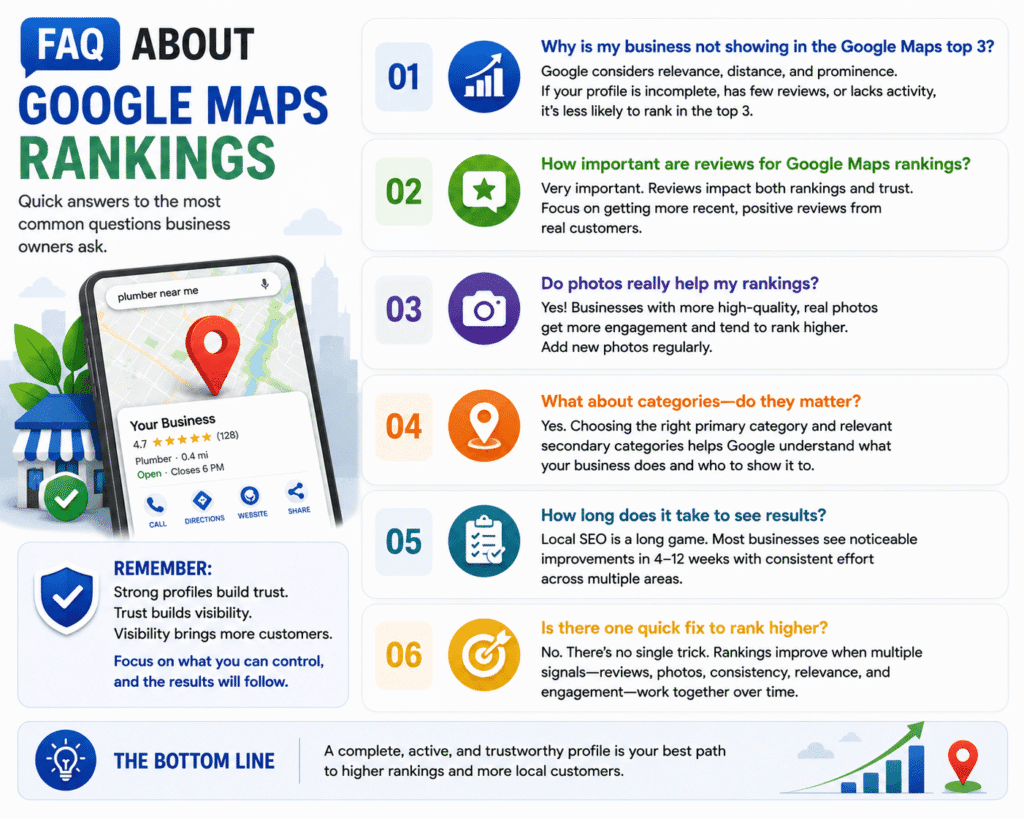
The Businesses That Win on Google Maps Usually Feel More Legitimate From Every Angle
Spend enough time looking at local search results across different categories and cities and a pattern emerges that’s hard to articulate precisely but easy to recognize once you’ve seen it enough times. The businesses holding strong map pack positions don’t just have better profiles — they feel more real. More present. More like something that actually exists and operates in the world rather than something that was set up to rank.
Reputation, activity, consistency, and relevance reinforcing each other
None of the individual signals that influence Google Maps rankings are particularly powerful in isolation. A strong review profile without an active, complete profile doesn’t perform as well as it should. A perfectly optimized profile attached to a website that gives Google no local context underperforms its completeness. Citations without behavioral engagement are largely inert. The businesses that rank well consistently aren’t winning on any single dimension — they’re winning because multiple signals are pulling in the same direction at the same time.
This is genuinely difficult to communicate to someone looking for a specific fix, because it means the honest answer to most local ranking questions is “several things, working together, over time” — which is less satisfying than “update your primary category” or “build twenty more citations.” But the compounding quality of aligned signals is real, and understanding it changes how you approach the problem.
What legitimacy looks like in practice — the kind Google’s algorithm is trying to detect — is a business that behaves consistently across every surface it appears on. The name is the same everywhere. The address matches. The phone number hasn’t changed across platforms. The website says what the profile says. The reviews reflect what the description promises. The photos show what the service listings describe. None of this requires perfection — it requires consistency, and consistency over time produces a signal profile that looks fundamentally different from a business that optimized in a burst and then drifted.
Reputation feeds activity because businesses with strong reputations attract more customers, who generate more behavioral signals, who leave more reviews, which strengthens the reputation further. Activity feeds relevance because a profile that keeps receiving engagement looks currently relevant rather than historically relevant. Relevance feeds consistency because a business that’s genuinely serving its local market tends to accumulate accurate, specific information across the web naturally — through mentions, reviews, directory listings, local press — rather than through deliberate citation campaigns. These things reinforce each other in ways that are slow to build and slow to unravel, which is both the frustrating and reassuring thing about them.
Why Google Maps rankings rarely improve from a single tweak
The single-tweak mentality is understandable. Something is wrong, you want to fix it, you want to know which specific thing to fix. It’s how most problems outside of SEO actually work — the car makes a noise, you find the part, you replace it, the noise stops. Local rankings don’t work that way, and businesses that approach them expecting a direct cause-and-effect relationship between a specific change and a specific outcome usually end up confused about why nothing seems to move.
A profile that gets a new set of photos might see a small uptick in engagement. A business that resolves its NAP inconsistencies might gradually recover some of the local trust signal it had been losing. A renewed focus on generating reviews might start shifting the recency balance over a few months. Each of these changes does something. None of them does enough on its own to produce the kind of visible ranking movement that feels proportionate to the effort involved. The movement comes when several of them are happening simultaneously and have been happening long enough that the cumulative signal shift registers.
This is also why businesses often feel like nothing is working right up until it starts working. The changes are producing effects, but the effects are distributed across multiple signals that each move slowly — and the ranking outcome that reflects all of those signals moving together shows up later than any individual change would suggest it should. The lag between doing the right things and seeing the right results is real and consistent enough that it’s worth knowing about in advance rather than discovering it mid-effort when the temptation to abandon what’s working and try something different is at its highest.
There’s also a competitive dimension to this that single-tweak thinking ignores. Rankings don’t just reflect your signal profile — they reflect your signal profile relative to the businesses around you. A change that would move rankings in a low-competition category might produce no visible movement in a competitive one, not because the change didn’t work but because the businesses you’re competing against are making similar improvements at the same time. Progress in competitive markets sometimes looks like holding position while everyone else tries to catch up rather than climbing visibly.
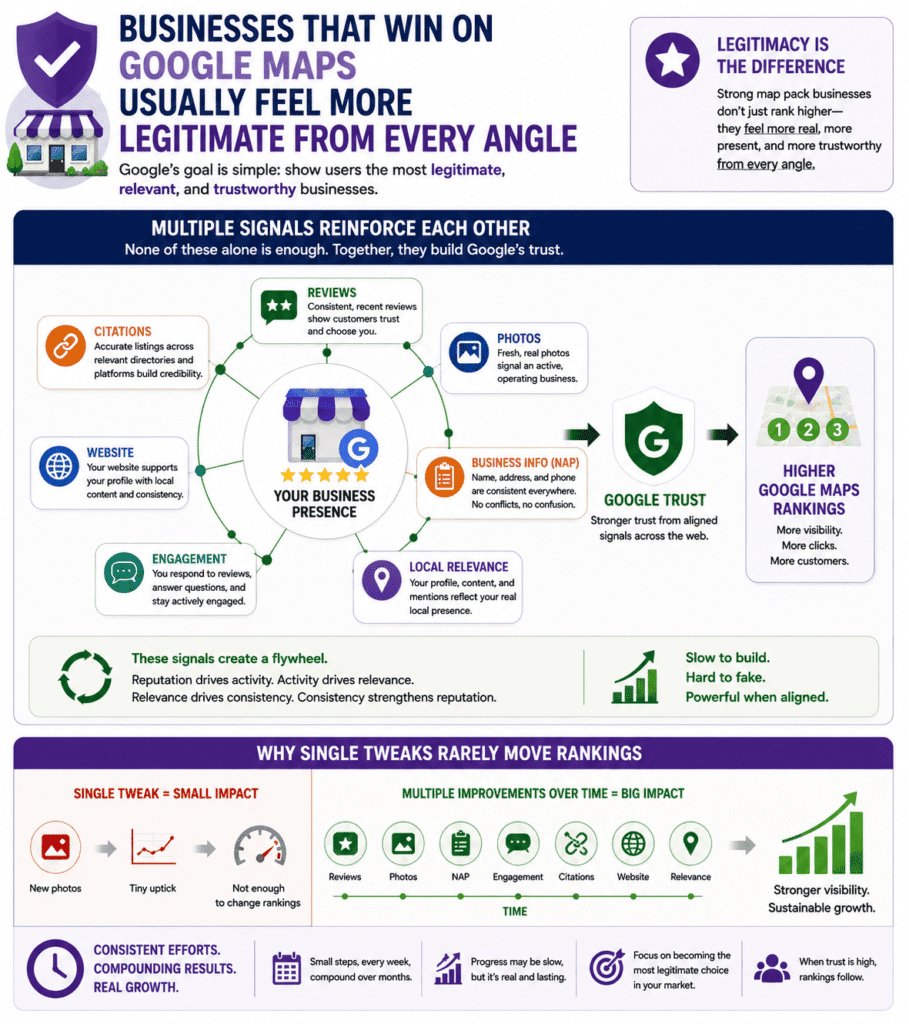
The frustrating reality — local SEO often looks slow right before progress starts showing
The timing problem in local SEO is real and underappreciated. Changes made today don’t show up in rankings tomorrow — sometimes they don’t show up clearly for weeks or months, depending on how significant the change was, how competitive the category is, and how frequently Google is refreshing the local index for that market.
What this produces, practically, is a period after a genuine improvement push where nothing visible has changed yet — and that period is exactly when most businesses either give up or pivot to a different tactic. The reviews are coming in more consistently. The profile has been properly completed. The website has real service pages now. The NAP inconsistencies have been cleaned up. And the rankings look almost identical to how they looked three months ago.
This is the moment that separates businesses that build sustained local visibility from businesses that cycle through tactics without ever accumulating the compound effect that visibility requires. The signal profile has improved. The ranking outcome hasn’t caught up yet. And the gap between those two things, in the weeks before the results become visible, is where most local SEO efforts get abandoned.
What you’ll notice, if you’ve been through this cycle enough times, is that the businesses which hold strong map pack positions over years almost never got there through a single campaign or a specific insight. They got there by doing reasonable things consistently for long enough that the accumulated signal mass became difficult to displace — and then they stayed there by continuing to do those things after the motivation of early progress had faded.
Why your business is not ranking on Google Maps the way you want it to often comes down to something less technical and less specific than most diagnostic advice suggests. The profile has gaps, yes. The citations have inconsistencies, probably. The website could do more local signaling work, almost certainly. But underneath all of those fixable specifics is usually a simpler problem: the business hasn’t yet built the kind of accumulated, multi-dimensional legitimacy signal that Google’s local algorithm is trying to find — and that signal doesn’t get built through optimization alone. It gets built through time, through genuine customer relationships, through consistent presence across every surface a local business appears on, and through the kind of sustained attention to local visibility that most businesses maintain only in bursts.
The fixes in this article are real. The timeline they operate on is slower than anyone wants. And how to rank higher on Google Maps in any lasting way almost always turns out to be less about finding the right tactic and more about being the kind of business — visible, consistent, engaged, trusted locally — that the algorithm was designed to surface in the first place.
Related Articles
These articles cover the topics this guide references but doesn’t go deep on — each one picks up where a specific section here leaves off.
How to Find Keywords You Can Actually Rank For Most local businesses are optimizing for searches their customers aren’t making. This article covers how to find the specific terms worth targeting — the ones with real local intent rather than impressive volume figures.
On-Page SEO in 2026: What Google Actually Rewards Now Your Google Business Profile points to your website, and your website either supports or undermines everything the profile claims. This covers what Google is actually looking for on the pages behind your listing — and what most small business websites are still getting wrong.
How to Do A Complete SEO Audit for a Small Business Website Before fixing anything, you need to know what’s actually broken. This is a step-by-step audit process built specifically for small business websites — covering the local signals, technical issues, and content gaps that compound quietly until they start affecting visibility.
Best SEO Tools for Small Businesses in 2026 The tools that make local SEO manageable without requiring an agency budget or a full-time specialist. Covers citation management, rank tracking, review monitoring, and the keyword research tools worth using at this stage of building a site.
Disclosure: This article may contain affiliate links. If you make a purchase through these links, I may earn a commission at no extra cost to you. All opinions are based on hands-on testing and independent research.