
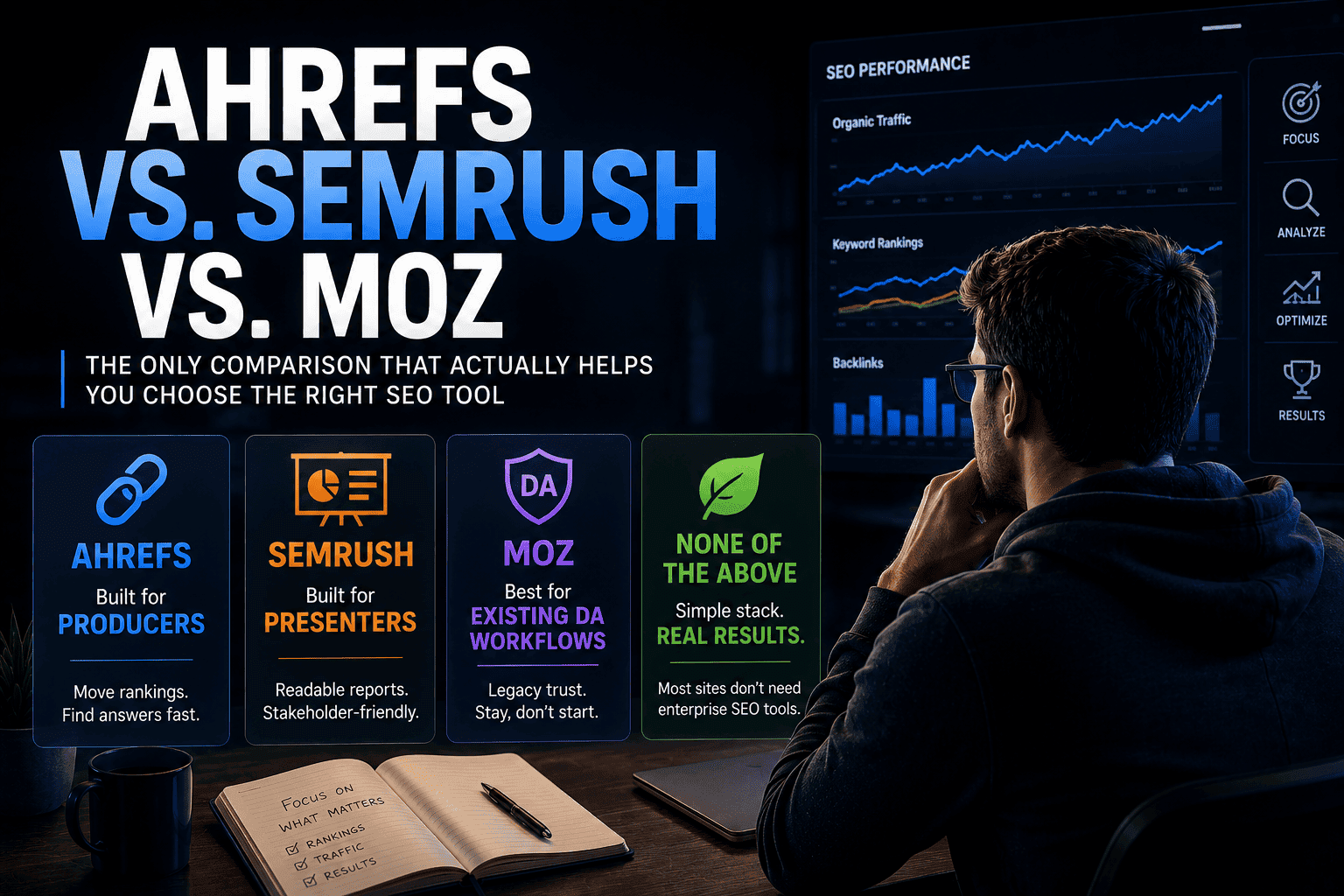
Every few months someone publishes a definitive Ahrefs vs Semrush vs Moz comparison, ranks the three tools across fifteen categories, and concludes that Semrush wins on features, Ahrefs wins on link data, and Moz is a solid choice for beginners. Then they publish it again the following year with updated screenshots and the same conclusion.
This isn’t one of those.
Not because the feature comparisons are wrong — most of them are accurate enough. But accurate isn’t the same as useful, and a comparison that ranks tools without knowing what job you’re hiring them for is like a car review that scores every vehicle on top speed and trunk space without asking whether you’re commuting alone or moving a family. The scores are real. The framework is broken.
The tool you should be using is almost entirely determined by what you’re accountable for producing. Not your budget. Not which platform has the longer feature list. Not which one your favorite SEO newsletter recommended. What leaves your hands at the end of the week — and who it has to make sense to when it gets there — routes this decision more cleanly than any side-by-side comparison table ever will.
What follows isn’t a feature tour. It’s an argument. It starts with why the comparison format itself fails, moves through what actually differentiates these three platforms at the level that matters for real work, and ends with a decision filter you can apply to your own situation in about thirty seconds. If you’ve already read two or three of these comparisons and still aren’t sure what to buy, that’s not a research problem. It’s a framework problem — and that’s what this is here to fix.
Table of Contents
Here’s where each tool lands before we get into why:
| Tool | Best for | Weakest fit |
|---|---|---|
| Ahrefs | Link builders, content researchers, technical SEOs who own their workflow end to end | Anyone who needs to present findings regularly to non-SEOs |
| Semrush | Agencies, in-house SEOs with regular reporting obligations, multi-channel visibility | Solo practitioners doing pure analysis with no client-facing output |
| Moz | Teams already reporting on Domain Authority who face real switching costs | Anyone making a fresh tool decision in 2026 |
| None of the three | Solo site owners, bloggers, small business owners with modest traffic goals | Anyone doing link building or competitive analysis at volume |
Why every Ahrefs vs Semrush vs Moz review reaches the same useless conclusion
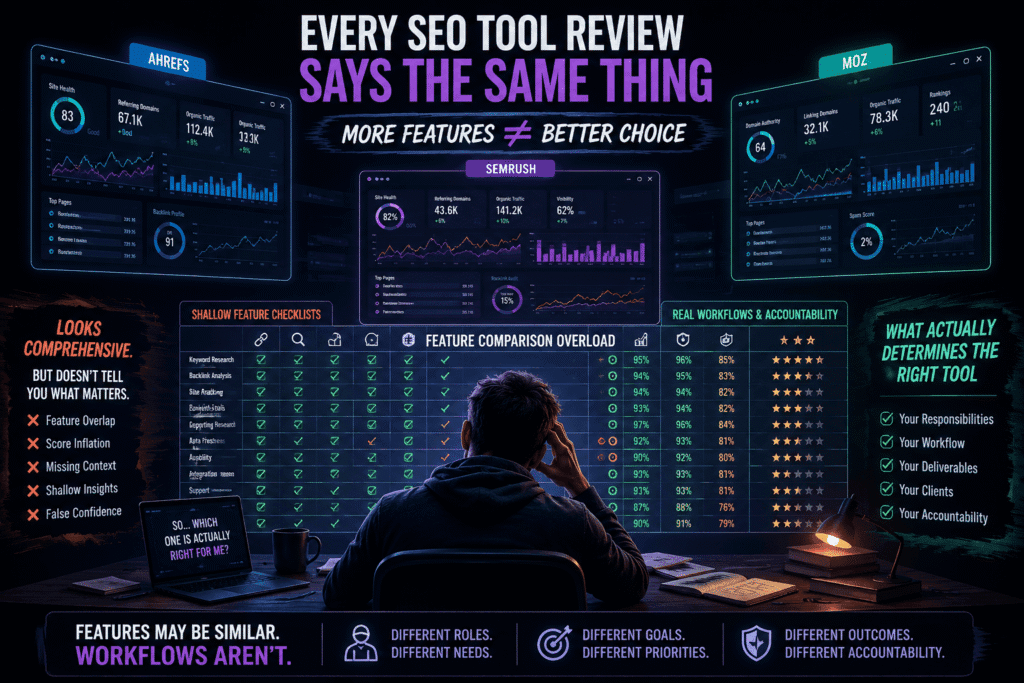
The format is the problem, and it’s hiding in plain sight. Almost every Ahrefs vs Semrush vs Moz comparison you’ll find follows the same playbook: pick a dozen features, run all three tools through them, score the results, name a winner. It’s a sensible structure — for comparing things that are actually different from each other.
These aren’t. Not meaningfully. All three do keyword research, backlink analysis, site auditing, rank tracking. The feature lists diverge at the edges, but the core overlap is substantial enough that scoring them on coverage is like judging three competent restaurants on whether they have a menu. Of course they do. That’s not the question.
So what happens when you run a parity-based comparison on three tools that have all converged on the same capabilities? You get noise that looks like signal. Semrush edges out on breadth. Ahrefs wins on link data. Moz trails both but scores well on ease of use. Every review lands in roughly that neighborhood. Which is fine, except you’ve probably already read two or three of them and you’re still not sure what to actually buy — which suggests the format isn’t giving you what you need.
The distinction that actually matters isn’t between features that exist and features that don’t. It’s between features that are good enough to build a real workflow around and features that are technically present but not something you’d stake a client deliverable on. A site audit tool and a reliable site audit tool are not the same product. Keyword data and current keyword data aren’t either. Reviews that score on presence collapse that gap into a rating, and the rating feels authoritative right up until you’re six months into the wrong subscription.
What none of these comparisons ask — and what actually determines which tool fits — is what you’re responsible for producing. The accountability question shapes everything: which capabilities need to be genuinely excellent, which can be adequate, and which you’ll never open at all. A freelancer doing outreach and link prospecting has a completely different answer than an in-house SEO who spends half their week in reporting. The tool that’s right for one is probably an expensive mismatch for the other. That’s the variable the feature matrix leaves out.
Backlink data isn’t equal across these tools, and the gap matters more than you think
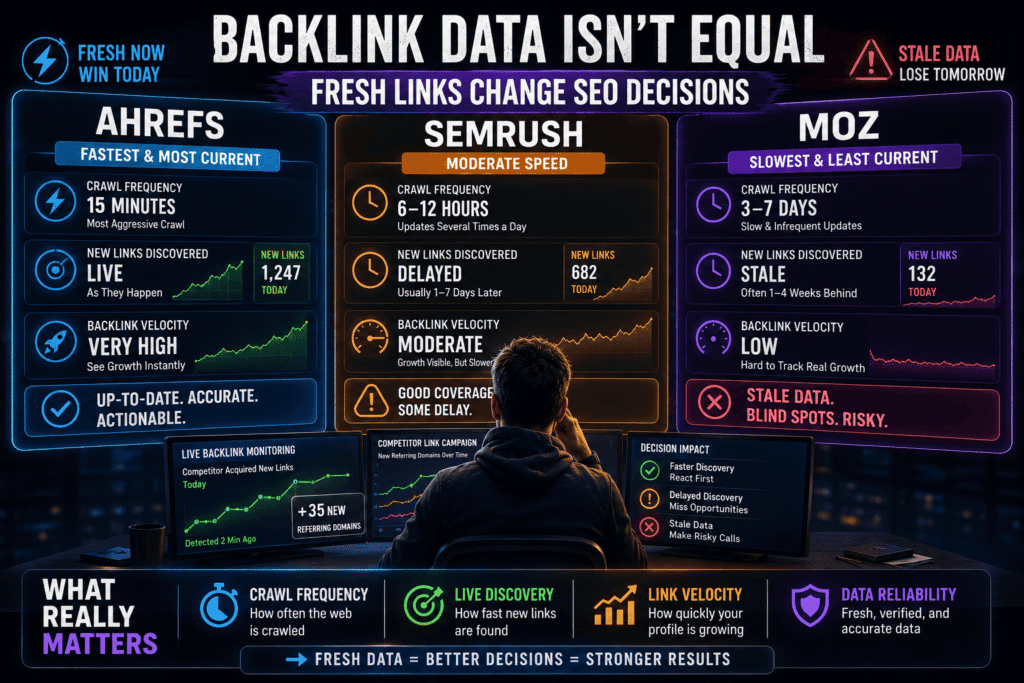
Here’s what the feature matrices don’t show you: backlink indexes are not interchangeable. The three tools don’t just differ on how many links they’ve crawled — they differ on how fast new links surface, how often they recheck whether a link is still live, and how reliably they handle things like redirect chains and nofollow attribution. For most SEO work most of the time, those differences sit below the threshold of consequence. For specific workflows, they aren’t minor at all.
Ahrefs runs the most aggressive crawl of the three, and it shows in two places: how quickly new referring domains appear after acquisition, and how current the data is when you’re tracking a competitor who’s actively building links. If your work involves live outreach campaigns or competitive link monitoring, the crawl frequency gap between Ahrefs and the other two becomes a practical problem — not a benchmark stat. It’s the reason most practitioners who’ve tested the two-tool version of this debate — Ahrefs vs Semrush specifically — land on Ahrefs when link velocity is the deciding factor.
Semrush’s index is large enough that you won’t feel the difference on most keyword research or monthly reporting work. Where it shows up is in fresh link discovery — new referring domains tend to surface later in Semrush than in Ahrefs, sometimes by a week or more. That’s irrelevant for some workflows. For anyone tracking a fast-moving competitor or confirming a link placement in near real-time, it matters.
Moz’s link data is the hardest to defend with a straight face. Link Explorer has a smaller index and slower update frequency than either Ahrefs vs Semrush, and that gap hasn’t closed — if anything it’s widened as the other two have invested heavily in crawl infrastructure. For occasional link profile checks or light competitive research, it’s functional. For any workflow where link data needs to be current — outreach, digital PR, velocity monitoring — Moz produces blind spots that affect actual decisions, not just dashboard aesthetics.
The thing that gets buried in index size comparisons: volume isn’t the variable that matters most. A large index of stale links produces confidently wrong data. What distinguishes Ahrefs at the top isn’t just that it’s crawled more of the web — it’s that it’s crawled more of it recently. That distinction is invisible until something changes fast and you need to know about it before your next scheduled report.
Moz sold an idea that became more valuable than its platform
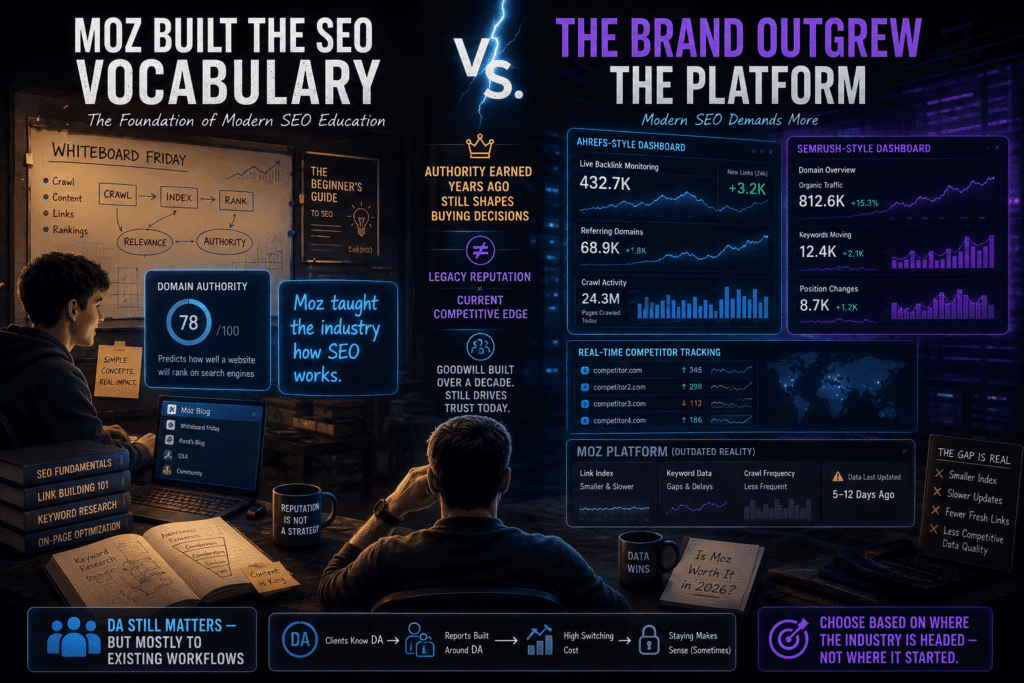
Moz’s most successful product was never the software. It was the idea that SEO could be explained clearly enough for non-technical people to act on it. Whiteboard Friday, the Beginner’s Guide, DA as a universal shorthand — Moz built the conceptual vocabulary the entire industry still runs on, including people who’ve never logged into Moz once. That’s a remarkable thing to have pulled off. It’s also completely separate from whether the platform is worth paying for in 2026.
The software has drifted. Link Explorer’s index is smaller and updates more slowly than either Ahrefs or Semrush — not marginally, but by enough that if you’re doing anything where link recency matters, you’re working with a slightly blurry picture. The keyword data has gaps that show up when you push it on competitive queries. The site audit hasn’t introduced anything that meaningfully changes how you’d use it. None of this is fatal for every use case. But it’s a significant distance from where the brand’s reputation puts the product in most people’s minds.
Here’s what actually happens in practice: someone recommends Moz because they learned SEO through Moz’s content, or because DA is the metric their client already understands, or because it showed up well in a comparison article that was scoring on breadth rather than depth. The recommendation is real — it’s just based on a version of the company that was more competitive three or four years ago than it is now. The brand earned its authority. The current platform is living off it.
That gap matters most at the mid and upper pricing tiers. At the entry level, the tools are close enough that the choice is almost arbitrary. But once you’re paying for the tier where Moz becomes genuinely useful for non-trivial work — multiple users, higher crawl limits, fuller API access — you’re paying Ahrefs and Semrush prices for a product that isn’t competing with them on data quality. That’s the calculation most comparisons skip, because it requires saying something unflattering about a company that the SEO industry has a lot of goodwill toward. If you’re genuinely asking ‘is Moz worth it’ in 2026 and you don’t already have a DA-dependent reporting environment, the honest answer is probably not — at least not at the tiers where it becomes competitive with the other two.
The scenario where Moz still makes sense is narrow but real: your reporting is built around DA, your clients speak DA, and the switching cost of retraining stakeholders on a different metric isn’t worth the capability gain. That’s a legitimate reason to stay. It’s just not a reason to choose Moz from scratch in 2026 — which is a different question, and the one most people reading an Ahrefs vs Semrush vs Moz comparison are actually trying to answer.
Semrush is for SEO work that needs to survive contact with non-SEOs
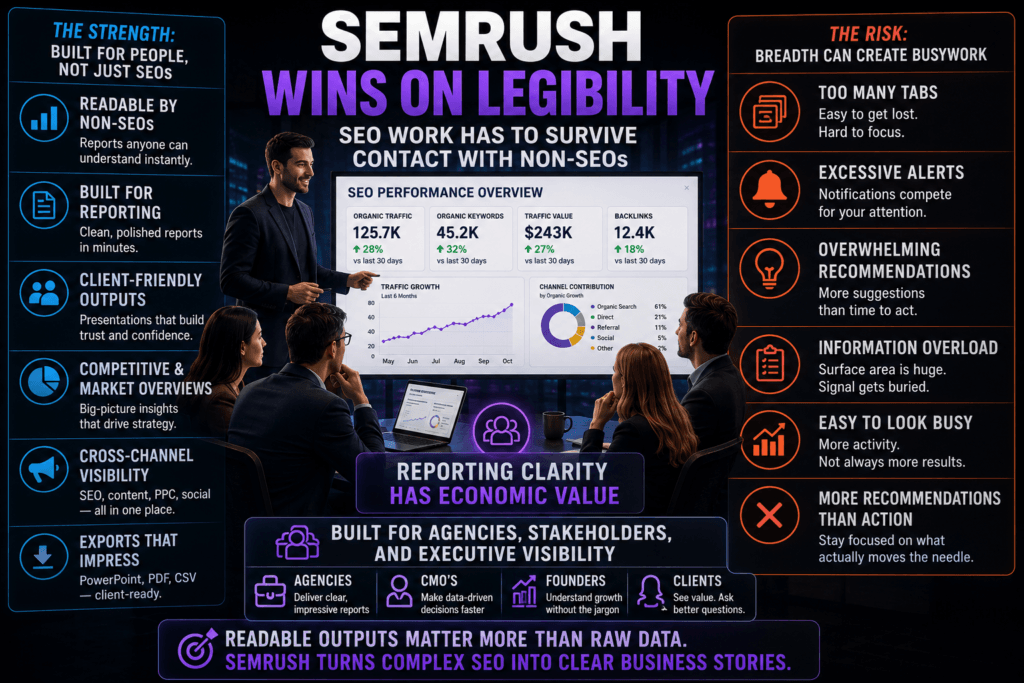
Semrush doesn’t win on data. It wins on legibility. That’s not a concession — it’s the most useful thing you can know about the tool before deciding whether to pay for it. The dashboards export in formats non-SEOs can open without asking questions. The reports look like business documents rather than crawl outputs. The interface rewards breadth over depth in a way that feels like a limitation until the moment a client asks for a competitive overview by Friday and you realize you can produce it in two hours instead of six.
If that scenario doesn’t exist in your work life — if nobody else ever sees your data, if your deliverable is rankings rather than decks — Semrush’s core advantages simply don’t apply to you. You’ll navigate a busier interface to access data that Ahrefs surfaces more cleanly, and pay roughly the same price for the privilege. The tool isn’t worse in that context. It’s just solving a problem you don’t have.
The moment that changes is the moment your work has to survive contact with someone who doesn’t think in keywords and crawl budgets. A CMO approving a content strategy. A founder asking why organic traffic dropped. A client who wants to understand what they’re paying for without sitting through a tutorial. Semrush produces outputs those people can read without a translator — and in agency or in-house environments where that translation work happens constantly, that has real economic value that a pure data quality comparison completely misses. It’s also why Semrush for agencies has become something close to a default recommendation — not because it’s the most powerful tool in the comparison, but because it’s the one that produces outputs a client can read without a tutorial.
There’s a trap built into this, though. Semrush’s breadth makes it genuinely easy to look productive while accomplishing very little. The platform will generate scores, recommendations, content ideas, and competitor alerts faster than you can act on any of them. Spend a day inside it without a specific question you’re trying to answer and you’ll have a lot of open tabs and not much to show for it. That’s true of most tools at some level, but the surface area in Semrush is large enough that the risk is real — especially for people who are newer to structured SEO workflows.
So where does this land in an Ahrefs vs Semrush vs Moz comparison? Semrush is the right answer when reporting, client management, or cross-channel visibility are part of what you’re accountable for — not as a consolation prize for people who don’t need Ahrefs’ link depth, but as a genuine fit for a specific kind of SEO work. The mistake is evaluating it against tools built for different accountability structures and concluding it’s losing a race it wasn’t trying to win.
What Ahrefs does that the others don’t — and the workflows where that actually matters
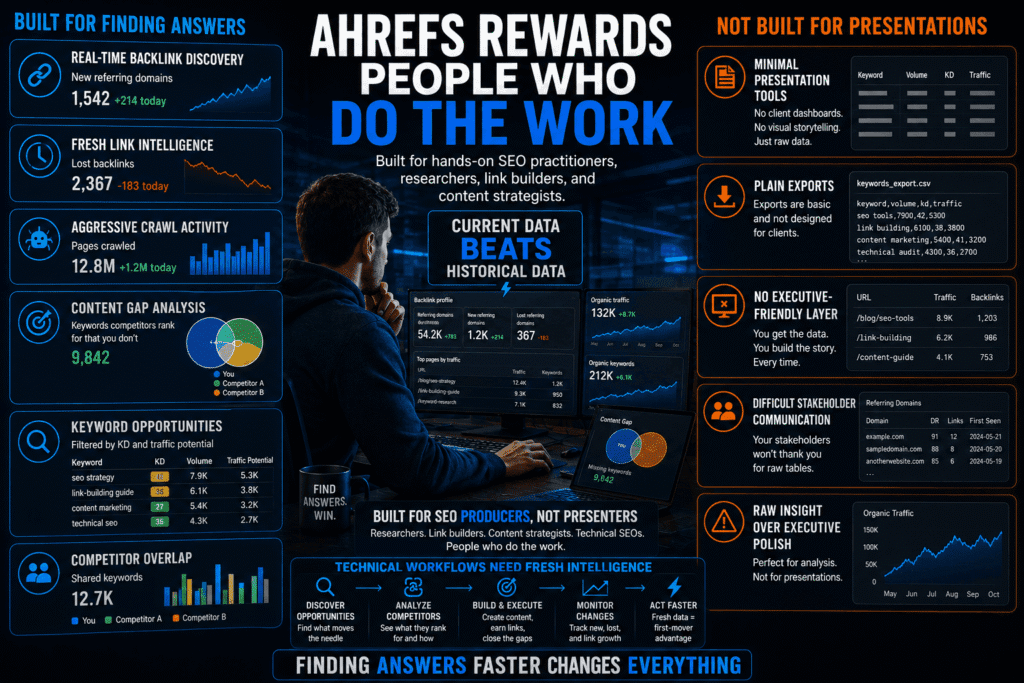
Ahrefs rewards people who do the work themselves. That sounds like a compliment, and it mostly is — but it also explains why some people find it cold and others find it indispensable. The interface isn’t built for producing deliverables. It’s built for finding answers. If those two things are the same in your workflow, Ahrefs fits like nothing else in this category. If they’re not — if finding the answer is step one and presenting it to someone else is step two — you’ll feel the gap.
The link intelligence is the obvious differentiator, but the more precise thing to say is this: Ahrefs doesn’t just have more backlink data, it has more current backlink data. New referring domains surface faster, lost links drop out sooner, and the crawl frequency is aggressive enough that the index reflects something closer to the present than the recent past. For monthly reporting, that distinction barely registers. For active link building or competitor monitoring — tracking a site that’s moving fast — knowing something a week earlier than your tool tells you is the difference between a useful insight and a historical footnote.
Content gap analysis is where Ahrefs earns its price for a specific type of practitioner. The workflow — finding keywords a competitor ranks for that you don’t, filtered by difficulty and traffic potential, in a view that doesn’t require three intermediate steps — is faster and cleaner than the equivalent in Semrush. Not because Semrush can’t produce the same data, but because Ahrefs was designed around that question rather than adding it to a platform designed around something else. The difference is subtle until you’re doing it daily, at which point it’s not subtle at all.
Here’s what Ahrefs doesn’t do well, and it’s worth saying plainly: the reporting layer is nearly nonexistent. No client dashboards, no white-label exports, no mechanism for making your analysis readable to someone who didn’t do it with you. For a technical SEO or a link builder who owns their process end to end, this is a non-issue. For anyone who spends meaningful time turning findings into presentations, it’s a genuine tax on your workflow that Semrush eliminates and Ahrefs simply doesn’t address.
Which brings the Ahrefs vs Semrush vs Moz comparison to the question that actually routes the decision: not which tool has more features, but whether the primary SEO output you’re responsible for is something you produce or something you present. Producers — researchers, outreach specialists, content strategists, technical auditors — tend to find Ahrefs quietly irreplaceable once they’ve built a workflow around it. Presenters tend to find it frustrating for reasons that have nothing to do with data quality. Both reactions are correct. They’re just describing different jobs.
For anyone running a specific Ahrefs vs Semrush evaluation on link data alone, the gap is real — but its size depends entirely on how frequently you need the data to be current rather than recent.
The real pricing question: what does each tool cost at the tier where it becomes useful?
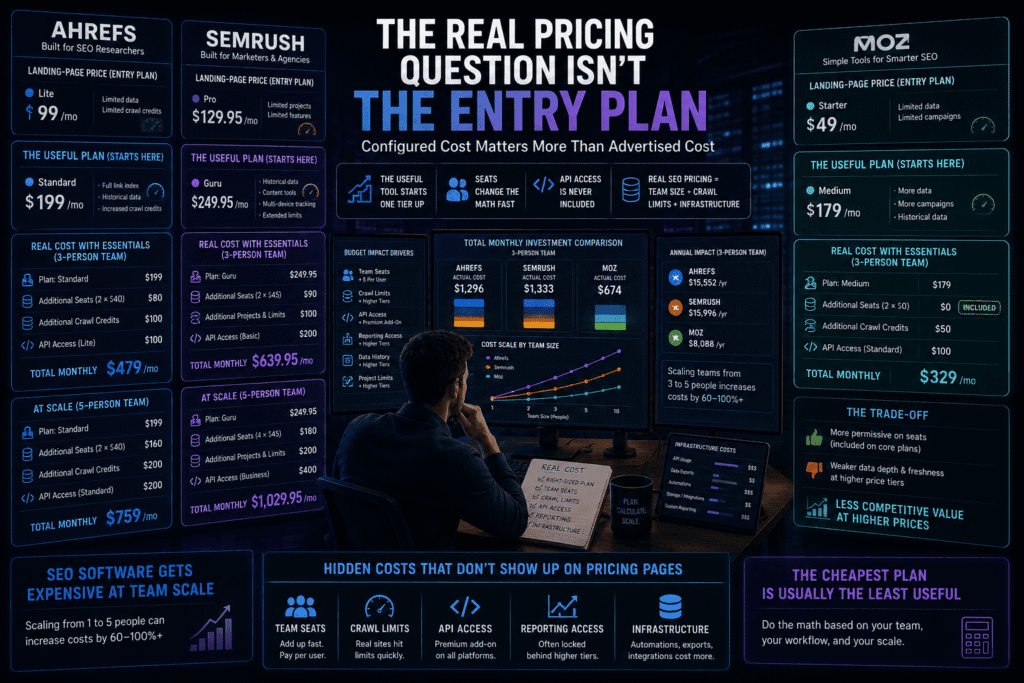
Ahrefs pricing and Semrush pricing look comparable on the landing page. The comparison that actually matters starts one tier up, where the tools stop rationing their core functionality. Nobody talks about the tier where these tools actually become useful, because that’s not the number that gets featured on the pricing page. The entry price on all three platforms is essentially a decision fee — it gets you access to the interface, a taste of the data, and crawl limits low enough that a mid-sized site will hit the ceiling before the month is out. That’s not cynicism, it’s just how the pricing is structured. The useful tool starts one tier up, and that’s the number worth comparing.
For Ahrefs, the jump that matters is from Lite to Standard — that’s where historical data, full crawl credits, and the complete link index become available for sites that aren’t tiny. For Semrush, the equivalent unlock is Guru, which is also where the features that justify Semrush for agency work specifically — content marketing tools, historical comparisons, multi-device tracking — stop being add-ons and become part of what you’re paying for. Moz’s equivalent tier is where the value argument gets hardest to make, because you’re at Ahrefs-adjacent pricing for data that isn’t competing with Ahrefs on the dimensions that pricing implies it should.
Here’s the variable that blows up team budgets and almost never appears in a comparison article: seats. Ahrefs and Semrush both charge per additional user at higher tiers, and the math deteriorates quickly. A three-person team — one SEO, one account manager, one who needs read access for reporting — is paying materially more than the listed plan price on either platform. Sometimes significantly more. Moz is more permissive on seats at comparable tiers, which is one of the few specific scenarios where its value calculation actually improves relative to the other two.
API access is the other line item that doesn’t show up until it’s already a problem. If your workflow involves pulling data programmatically — dashboards, automated reporting, custom analysis — none of the three platforms treats API access as standard. It’s a premium feature on all of them, priced accordingly. Ahrefs’ API is the most capable and the most expensive. Semrush’s is broader in scope with tiered volume pricing that starts accessible and gets costly fast. Moz’s has the smallest surface area of the three, which caps what you can build with it but also makes the cost more predictable — a real consideration if predictable infrastructure spend matters to you.
The comparison that actually belongs in a budget conversation isn’t Ahrefs vs Semrush vs Moz at the price you found on a landing page. It’s what each platform costs fully configured for the work you’re actually doing — right-sized seats, sufficient crawl limits, API access if your workflow needs it. Run that number for each tool before you commit, because the gap between the landing page price and the real price varies enough across the three that it occasionally changes which tool makes sense.
Related Article: If the tool gap is real but the budget isn’t there yet, getting on-page SEO right in 2026 moves the needle more reliably than a subscription you’ll underuse.
When the answer is none of the above
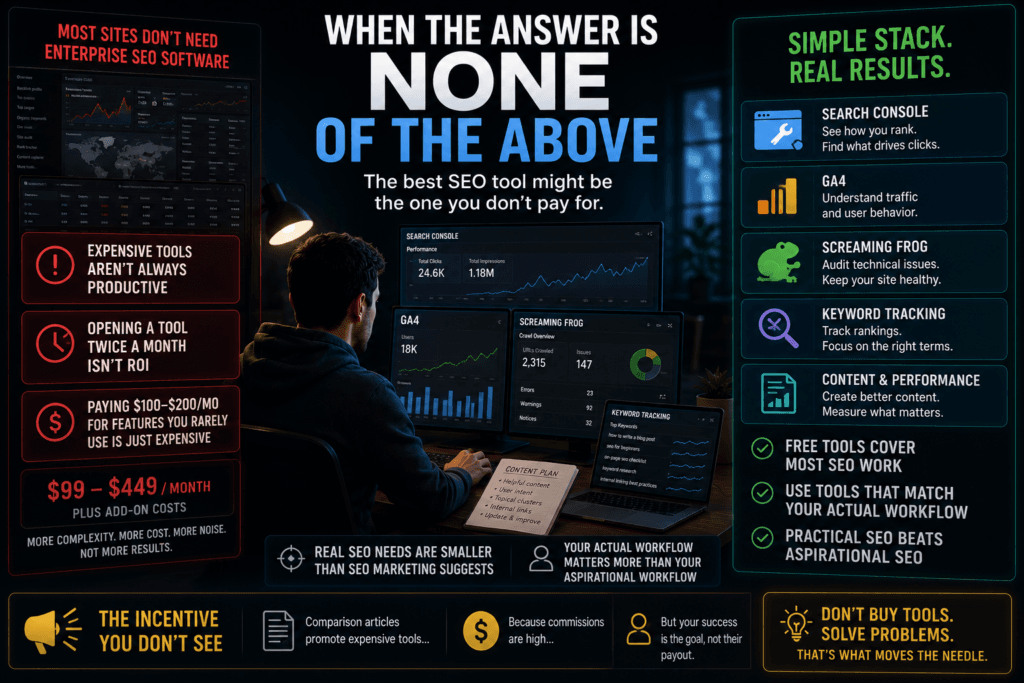
Most people who land on a comparison article like this one don’t need any of the tools in it. That’s not a disclaimer — it’s the thing that’s most useful to say before walking someone toward a $120/month subscription. If you’re running a single site, publishing content without industrial keyword research volume, and not doing active link building, the stack you actually need costs a fraction of what any of these platforms charge at a useful tier: Search Console for ranking and click data, GA4 for what happens after the click, Screaming Frog for technical issues. That’s most of what a solo practitioner or small site owner actually opens these platforms for — and it runs on a $250 annual Screaming Frog license and two free tools.
The gap is real but narrower than the paid platforms’ marketing implies. You lose competitive backlink analysis, keyword discovery at scale, and the kind of historical data that lets you spot trend shifts before they hit your traffic. If those are central to what you do, the gap matters. If they’re not — if you’d use those features occasionally rather than as the foundation of your workflow — you’re paying a monthly subscription to access capabilities you treat as occasional extras.
Here’s the part of this conversation that almost never gets said directly: there’s a structural reason comparison articles don’t recommend free tools. The affiliate commission on an Ahrefs or Semrush signup is meaningful. The commission on “configure Search Console properly” is zero. That’s not a conspiracy — it’s just an incentive that shapes what gets written, and it’s worth knowing about when you’re reading any Ahrefs vs Semrush vs Moz comparison, including this one. The free stack recommendation doesn’t serve the article’s economics. It might serve yours. For someone running a single content site, the question isn’t which of these three to choose — it’s whether any paid tool is justified yet. Most of the time, the honest Ahrefs alternative or Semrush alternative for early-stage sites is just Search Console configured properly, not another $100/month platform.
The profile of someone who genuinely needs one of these platforms is more specific than the marketing suggests: you’re doing keyword research across dozens or hundreds of topics regularly, you’re running competitive analysis as a core deliverable, you’re managing technical SEO for sites large enough that crawl depth matters, or you’re producing work for clients who expect professional tooling and need to see the source. That’s real work that justifies real tooling spend. It’s also a smaller category of practitioner than the entry-tier pricing is designed to make you feel you’re in.
Paying $100–200 a month for a platform you open twice a month isn’t an economical version of the right decision. It’s the wrong decision, slightly cheaper. If the description above fits your actual week — not your aspirational week, your actual one — then the choice between these three tools is worth making carefully. If it doesn’t, the more productive question is what you’d do with that $1,400 a year pointed at something that maps to work you’re already doing.
The one-variable decision filter
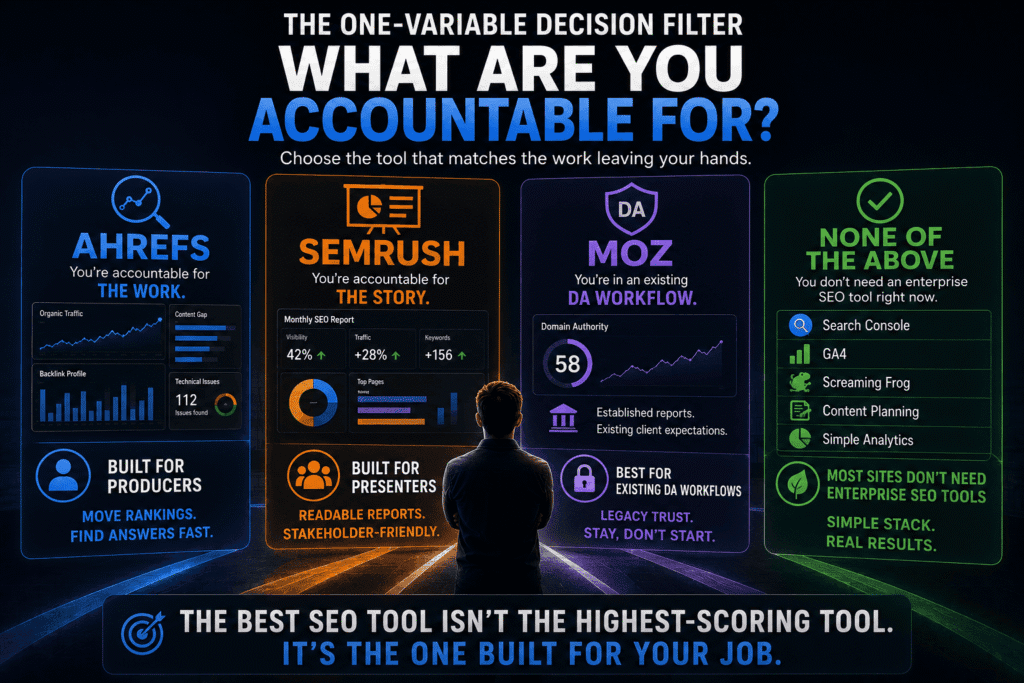
Forget the feature scores. The only question that routes this decision cleanly is what you’re accountable for producing — not what you do inside the tool, but what leaves your hands at the end of the week and lands in front of someone else.
If that thing is the work itself — rankings moved, links acquired, content gaps closed, technical issues found and fixed — Ahrefs is built for your accountability structure. The link index depth, the crawl frequency, the content gap workflow: these exist for practitioners whose job is to move metrics rather than explain them. The fact that the reporting layer is thin isn’t a limitation in this context. It just doesn’t come up.
If that thing is a deck, a dashboard, a client report, or a monthly update to someone who doesn’t think in keywords — Semrush is built for that handoff. The data quality argument between Ahrefs and Semrush is real but narrower than most comparisons suggest. The reporting argument isn’t close. If translation work — turning SEO findings into something a CMO or client can act on — is a consistent part of your week, Semrush eliminates friction that Ahrefs makes you solve yourself.
Moz’s decision is different in kind. It’s not a starting point — it’s a staying point. If you’re already in an environment where Domain Authority is the shared metric, where clients track it and stakeholders report on it, switching away carries a switching cost that may not be worth the capability gain. That’s a legitimate reason to stay. It’s not a reason to choose Moz if you’re starting fresh.
And if none of these accountability structures map cleanly to how you actually work — some analysis, some reporting, no single output that dominates the week — the tool choice matters less than any comparison article, including this one, implies. The differences are real at the margins. They’re not decisive for someone whose SEO work is genuinely mixed. Pick the interface that costs you less frustration and spend the saved mental energy on the work itself.
The frame underneath the entire Ahrefs vs Semrush vs Moz comparison is simpler than eight sections of analysis might suggest: these tools are not interchangeable, but they’re also not competing for the same job. Ahrefs, Semrush, and Moz each fit a specific kind of practitioner well and a different kind poorly. The mistake isn’t choosing the wrong tool — it’s evaluating tools as if the right one is the one with the highest score, when the score was never measuring what your job actually requires.
Related Article: Why Your Business Is Not Ranking on Google Maps in 2026 If local search is the actual goal, ranking on Google Maps operates on different rules — and different tools — than the ones this comparison covers.
A few questions that come up often:
Which is better, Ahrefs or Semrush?
Neither is objectively better — they’re built for different accountability structures. Ahrefs fits practitioners who do the analytical work themselves and need deep, current link and content data. Semrush fits teams where SEO output has to be legible to non-SEOs — clients, executives, stakeholders. If your work involves regular reporting to people who don’t do SEO, Semrush’s reporting layer justifies its cost. If it doesn’t, Ahrefs’ data depth usually wins.
Is Moz still worth it in 2026?
In specific circumstances, yes. If you’re in an environment where Domain Authority is already the shared metric — clients who track it, reporting built around it — the switching cost of moving away may not be worth the capability gain. If you’re making a fresh decision with no legacy reporting to consider, Moz is harder to recommend at its mid and upper tiers, where you’re paying Ahrefs-adjacent prices for an index that isn’t competing with Ahrefs on freshness or depth.
Which SEO tool is best for agencies?
Semrush. The client dashboard functionality, clean exports, and multi-channel visibility are built for environments where findings need to survive contact with people who don’t think in crawl budgets and keyword difficulty scores. Ahrefs is the stronger analytical tool — but analytical strength doesn’t help you when a client needs a Monday morning report they can actually read.
Which SEO tool is best for beginners?
Depends on what “beginner” means. If you’re new to SEO and learning the fundamentals, Moz’s educational resources — Whiteboard Friday, the Beginner’s Guide — remain genuinely useful, and the tool itself has a gentler learning curve. If you’re new to paid tools but already understand SEO well enough to have a workflow, start with whatever tool matches that workflow rather than optimizing for ease of onboarding.
What is the cheapest option among the three?
Entry prices are similar across all three — close enough that price alone shouldn’t drive the decision at that tier. The more relevant question is what each tool costs at the tier where it becomes useful for non-trivial work, which is one tier up on all three platforms and meaningfully higher than the entry price once you account for seats and crawl limits.
Can I use Semrush for free?
Semrush has a limited free tier that gives you access to a small number of daily searches and basic keyword data. It’s useful for getting a feel for the interface but too restricted for any sustained workflow. The same is roughly true for Ahrefs’ free tools and Moz’s free tier — enough to evaluate, not enough to work with seriously.
Do I actually need any of these tools?
Possibly not. If you’re running a single site, publishing content without industrial keyword research volume, and not doing active link building, Search Console, GA4, and Screaming Frog cover most of what you’d realistically open a $100–200/month platform for. The paid tools are built for a volume and complexity of work that not every site owner is doing — and the entry-tier pricing is specifically designed to make you feel like you’re in that category before you’ve verified that you are.
Related Articles
Semrush vs Ahrefs: Which SEO Tool is The Best in 2026 If this comparison narrowed your decision to two tools, this goes deeper on the specific matchup.
Ahrefs for Beginners Guide Already decided on Ahrefs? This covers what to actually focus on in the first month.
Best SEO Tools For Small Businesses Not sure any of these three is the right fit yet? Start here for the broader landscape.
How To Do a Complete SEO Audit For a Small Business Website Before committing to a tool, know what your site actually needs from one.
Keyword Search For New Websites: How to Find Keywords You Can Actually Rank For In 2026 If you’re in early-stage territory, this is a more useful next step than any subscription.
📖 Related: The 15 Best SEO Tools in 2026 (Free & Paid) Looking beyond Ahrefs, Semrush, and Moz? This guide covers all 15 of the best SEO tools available in 2026 — including free options, budget alternatives, and recommendations by use case.
Disclosure: This article may contain affiliate links. If you make a purchase through these links, I may earn a commission at no extra cost to you. All opinions are based on hands-on testing and independent research.