
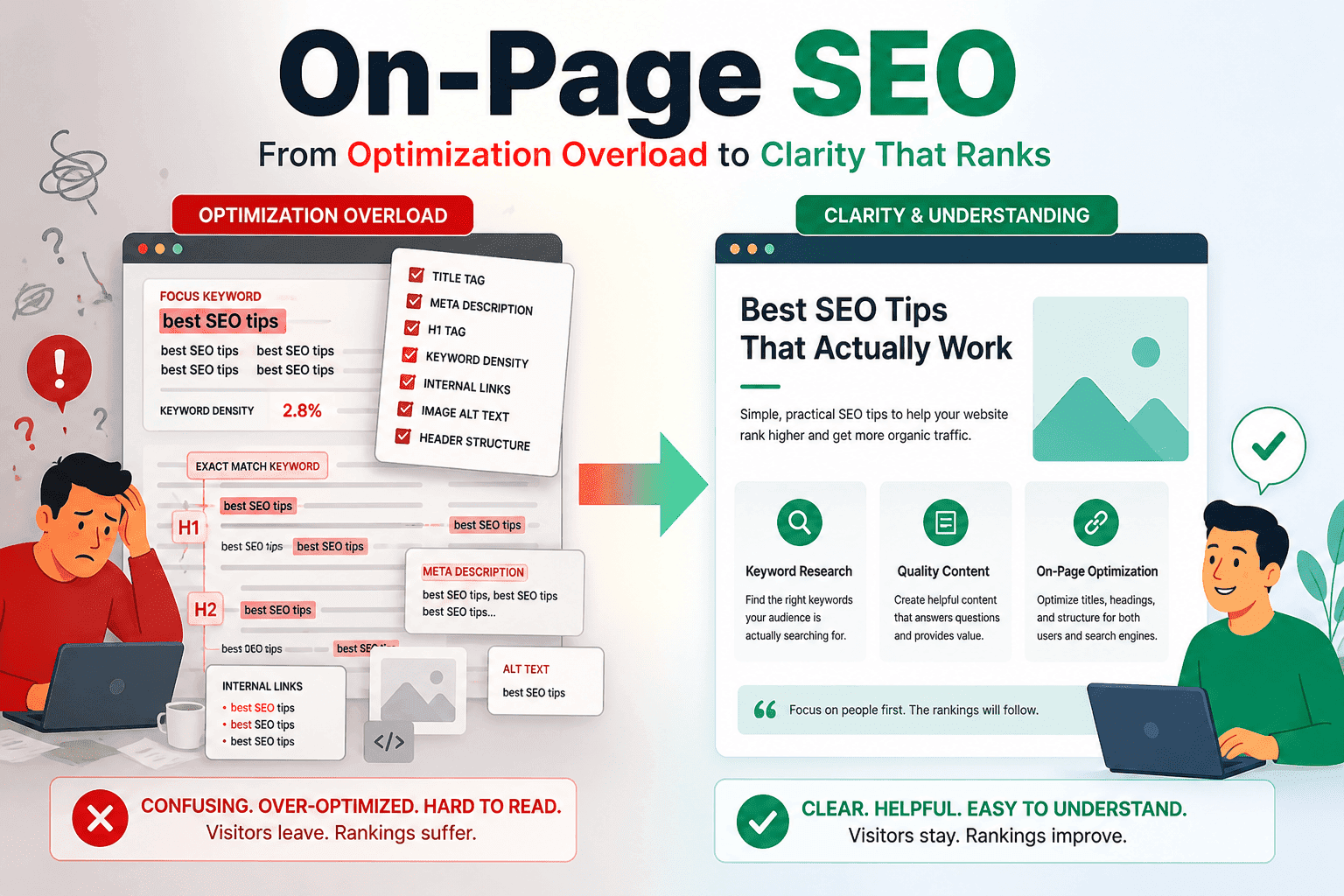
Most On-Page SEO advice sounds right… until you try it and nothing really changes.
You follow the structure. You place the keywords. You optimize everything the way you’re supposed to.
And still, your page just sits there.
That’s usually the moment you realize:
something about the advice isn’t wrong—it’s just incomplete
Because what actually moves rankings now isn’t how well your page is “optimized” on the surface.
It’s whether the content feels clear, useful, and good enough that someone doesn’t need to keep searching.
This article breaks down what’s actually working in On-Page SEO today, what’s quietly losing relevance, and how to approach your content in a way that makes sense to real people—not just search engines.
What is on-page SEO today
If you ask ten people what On-Page SEO is, you’ll still get the same kind of answers—keywords, headings, optimization, structure.
None of that is wrong. It’s just… not the full picture anymore.
Because if you look at what actually works now, On-Page SEO isn’t really about optimizing pages—it’s about removing friction from understanding.
That’s the shift.
At a basic level, yes—you’re still:
- organizing your content
- making your topic clear
- helping search engines understand what the page is about
Definition:
On-Page SEO today is the process of making your content clear, relevant, and easy to understand—so users don’t need to keep searching.
But that’s not what makes a page perform.
What makes it perform is this:
how easily someone can land on your page and feel like they “get it” without effort
That part is harder to define, which is why people ignore it.
In my experience, you can take two pages about the same topic:
- both well-structured
- both “optimized”
- both technically correct
…and one will still outperform the other.
Not because of better keyword placement.
But because one feels clearer, faster, easier to move through.
That’s why thinking about On-Page SEO as a checklist doesn’t really work anymore.
Search engines aren’t just scanning for signals—they’re interpreting how the content comes together as a whole.
They’re trying to figure out:
- does this actually match what the user was looking for?
- does it reduce confusion or add to it?
- does it make the user stay—or go back and keep searching?
Relevance today is less about matching words, and more about matching understanding.
And that changes how you approach everything.
You stop obsessing over:
- exact keyword placement
- perfect structure
- hitting optimization scores
…and start paying attention to:
how the page feels when someone reads it for the first time
There’s a limitation here, though—and it’s important to be honest about it.
You can do everything “right” from an On-Page SEO perspective and still not rank.
Because rankings aren’t controlled by content alone. There’s competition, authority, timing… things you don’t fully control.
But within what you can control, this is where most of the leverage is now:
making your content easy to understand, easy to follow, and hard to replace
Not perfect.
Just… clear enough that someone doesn’t feel the need to look elsewhere.
That’s what On-Page SEO has quietly become.
Most “On-Page SEO Advice” Is Quietly Outdated — Here’s Why
There’s a weird pattern you start noticing after a while. A lot of On-Page SEO advice floating around isn’t exactly wrong — it’s just… behind. It’s based on what worked, not necessarily what still moves the needle.
And the frustrating part? It still looks right on the surface.
The lag between what ranks and what actually works
One of the biggest misconceptions in On-Page SEO is assuming that what ranks today reflects what works today.
It doesn’t. Not always.
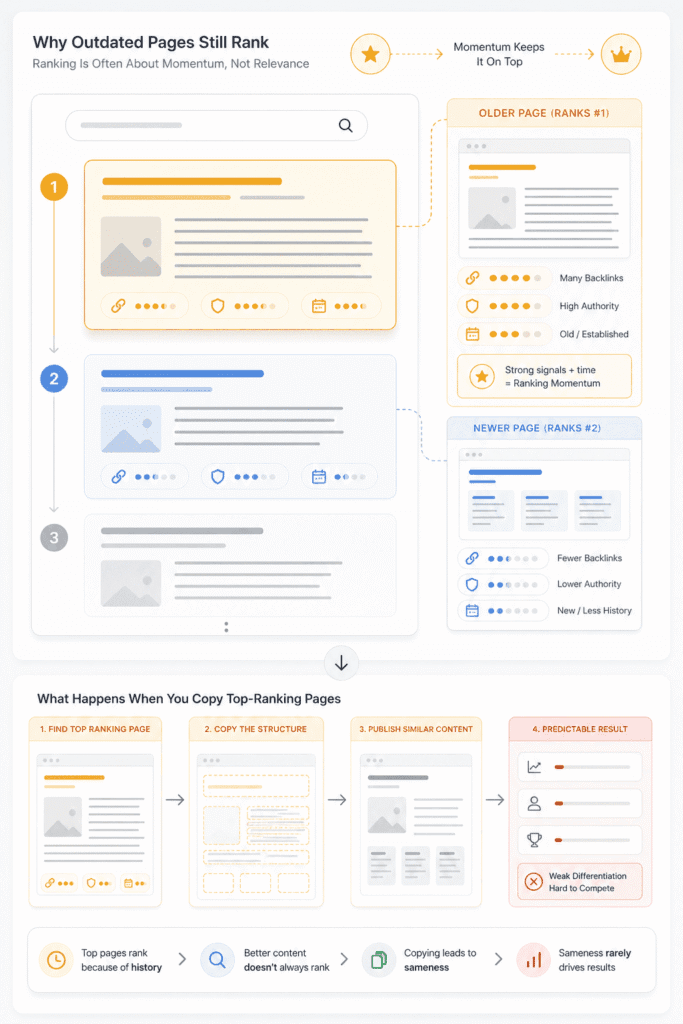
Ranking pages are often the result of momentum, not precision. They’ve been around longer, picked up links, built trust, and accumulated engagement over time. So even if parts of them are outdated, they’re still sitting comfortably at the top.
That creates a trap.
You look at those pages and think:
“This is what I should be doing.”
But what you’re really seeing is:
what worked well enough in the past to keep holding position
—not necessarily what would help a new page break through today.
If you pay close attention, newer content that does perform well often feels different. It’s:
- more direct
- less bloated
- less obsessed with ticking SEO boxes
It doesn’t try to prove it’s optimized. It just works.
And that’s the shift a lot of people miss.
Why copying top-ranking pages can quietly hold you back
On paper, this strategy makes sense:
Find what ranks → do something similar → improve it.
In reality, it usually leads to safe but forgettable content.
You end up recreating the same structure:
- similar headings
- similar talking points
- slightly longer explanations
Nothing is technically wrong. But nothing stands out either. And that’s the problem.
Because On-Page SEO today isn’t just about being correct — it’s about being useful in a way that feels obvious to the reader.
When your content feels like a remix of what’s already out there, two things happen:
- Google has no strong reason to prefer it
- readers don’t feel any difference when they land on it
There’s also something people don’t talk about enough:
Top-ranking pages often have advantages you can’t replicate — authority, backlinks, brand recognition. So even if you write a “better” version, you’re still competing from behind.
I’ve seen this play out many times. You follow the structure of a top page, improve it, publish it… and nothing happens. Not because your content is bad — but because it’s predictable.
And predictable content rarely wins anymore.
The pages that tend to break through now usually do something slightly uncomfortable:
they stop trying to look like SEO content, and start trying to actually help someone understand something clearly.
That sounds simple, but it’s a very different approach in practice.
What Google Actually Wants From a Page (Even If It Doesn’t Say It Clearly)
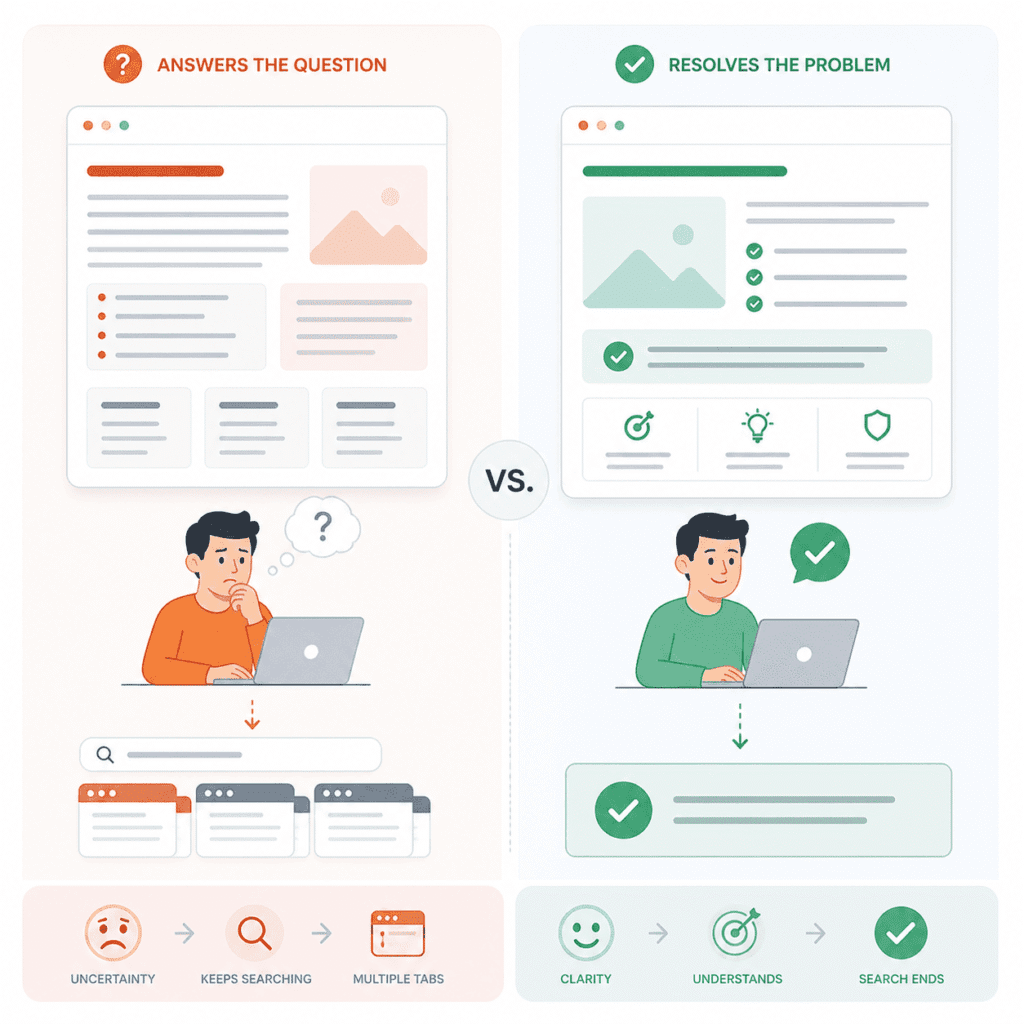
If you step back and look at it simply, Google isn’t trying to reward “optimized pages.” It’s trying to send people somewhere that makes them stop searching. That’s it.
Everything else people obsess over in On-Page SEO — formatting, keyword placement, structure — only matters if it contributes to that outcome. If it doesn’t, it’s just noise.
The difference between answering a query and ending a search
Most content does a decent job of answering questions. That’s not the hard part anymore.
The hard part is this:
does the person feel done after reading your page?
That’s a completely different standard.
You can answer a question and still leave someone unsure. They might understand what you said, but still feel like they need to double-check, compare, or look for a “better explanation.” That’s where most pages lose.
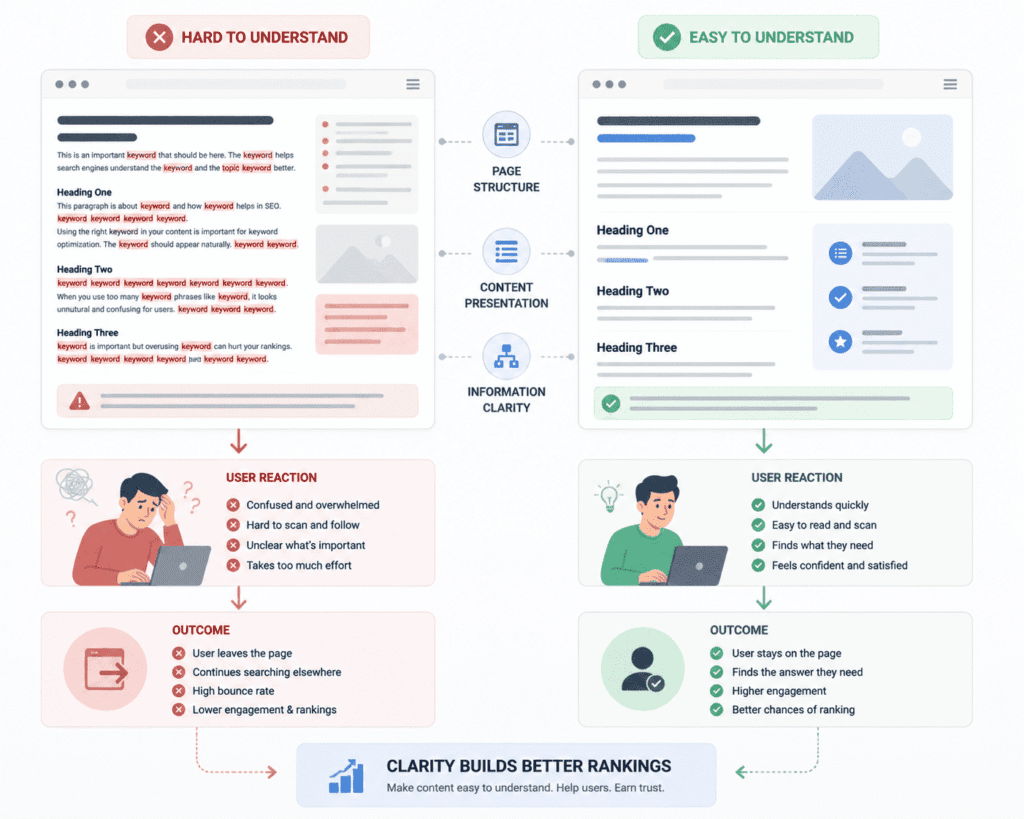
What tends to work better now in On-Page SEO isn’t just giving information — it’s removing doubt.
You’ll notice this when you land on a page and think:
“Okay… this actually makes sense.”
Not “this is detailed.” Not “this is long.” Just… clear.
And clarity does something interesting. It reduces that instinct to open another tab.
A lot of writers assume they need to add more:
- more sections
- more examples
- more explanations
But often, what’s missing isn’t more content — it’s a clearer point of view.
In my experience, the pages that perform best are the ones that quietly answer the next question before the reader even asks it. Not by adding bulk, but by being deliberate with what they include.
In practice, the difference is easier to see than explain.
A typical “optimized” page might say something like:
“On-Page SEO techniques include keyword placement, meta tags, and content optimization strategies.”
It’s technically correct—but it doesn’t really help someone move forward.
A clearer page might say:
“If your page is already structured and still not ranking, the issue is usually clarity—not missing keywords.”
Same topic. Very different impact.
One explains. The other resolves something.
Why clarity beats completeness more often than people expect
There’s still this lingering idea that a “good” page has to be comprehensive. Cover everything. Leave nothing out.
Sounds reasonable. Doesn’t always work. Because completeness can easily turn into clutter.
You start adding things that might help, just in case:
- extra sections
- expanded explanations
- edge cases that barely apply
And before you know it, the page feels heavier than it needs to be. The irony is, this often makes the content worse — not better.
What actually performs well in On-Page SEO today is usually the opposite:
content that feels easy to move through
Not necessarily shorter. Just… cleaner.
You don’t have to stop and reread sentences.
You don’t have to figure out what matters.
You don’t feel like you’re working to understand it.
That ease matters more than people think.
Because when a page is clear:
- people stay
- they scroll
- they don’t bounce back to search results
Not because it’s “perfectly optimized,” but because it’s effortless to consume.
There’s a trade-off here that’s easy to ignore.
If you try to cover everything, you risk watering down what actually matters. The core idea gets buried under supporting details.
I’ve seen simpler pages outperform more detailed ones for this exact reason. Not because they knew more — but because they respected the reader’s attention.
That’s the shift.
It’s not about writing more anymore.
It’s about making what you write land immediately.
The Real Ranking Factor No One Can Fully Measure
There’s a part of On-Page SEO that doesn’t show up in any dashboard. No score, no metric, nothing you can neatly track.
But it’s there — and it quietly decides whether your page sticks… or slips.
It’s not the click.
It’s what happens after the click.
What happens after the click matters more than the click itself
Getting someone to click feels like progress. And it is — but only barely.
Because the real decision happens right after.
Someone lands on your page and, within seconds, they’re already judging it. Not consciously, not analytically — just a quick internal reaction:
“This feels right” or “No, this isn’t what I expected.”
And once that second thought kicks in, you’ve already lost them.
This is where a lot of On-Page SEO conversations fall apart. People focus on how to get the click — titles, meta descriptions, positioning — but don’t think enough about what the page feels like when someone actually arrives.
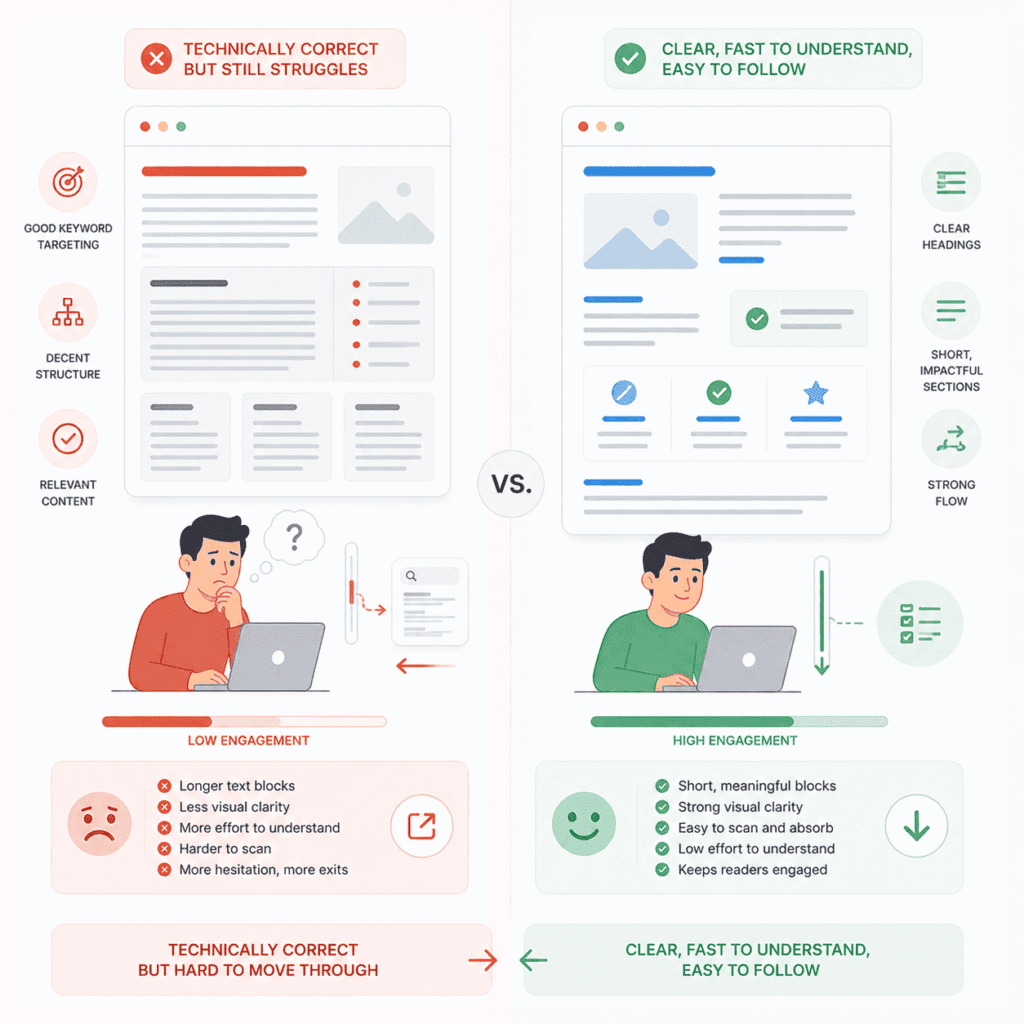
I’ve seen pages that do everything “right” on paper:
- solid keyword targeting
- decent structure
- relevant content
…and still struggle.
Not because they’re bad — but because they don’t settle the reader quickly.
There’s a subtle difference between a page that looks relevant and a page that immediately feels useful. The second one doesn’t make you think twice. You just continue reading.
The first one? You hesitate. Maybe scroll a bit. Maybe go back.
And that hesitation is everything.
What tends to work better now are pages that quietly signal:
“You’re in the right place. Keep going.”
No over-explaining. No delay. Just alignment.
Writing for scanning behavior, not deep reading
Here’s something most people underestimate:
almost nobody reads your content the way you wrote it.
They skim. They jump. They look for anchors — words or phrases that catch their attention.
And if they don’t find those quickly, they disengage.
That changes how On-Page SEO content needs to be written.
It’s not just about being clear — it’s about being instantly clear in fragments.
Someone might only read:
- a heading
- half a paragraph
- one sentence in the middle
…and still decide whether your page is worth their time.
That’s why certain phrases matter more than entire sections. You’ll notice that strong pages tend to have lines that stand on their own. Even when skimmed, they still communicate something useful.
At the same time, there’s a balance here that’s easy to get wrong.
If you over-optimize for scanning — short lines, punchy phrases, constant breaks — your content can start to feel disjointed. Like it’s trying too hard to hold attention.
But if you ignore scanning behavior completely, you risk losing people before your point even lands.
The better approach sits somewhere in between:
write in a way that rewards both skimming and reading
In practice, that means:
- ideas that don’t rely on long buildup
- sentences that carry meaning on their own
- structure that guides without forcing
What you’re really doing is reducing effort.
Because at the end of the day, the pages that perform best in On-Page SEO aren’t necessarily the most detailed — they’re the ones that are easiest to move through without friction.
And that’s something no tool can fully measure… but you can feel it when it’s missing.
Where Most People Still Over-Optimize (Without Realizing It)
Over-optimization doesn’t feel like a mistake when you’re doing it. It feels like you’re being careful. Thorough. “Doing SEO properly.”
That’s the trap.
A lot of what people call On-Page SEO best practices slowly turns into habits — and those habits don’t always age well.
When structure becomes mechanical instead of helpful
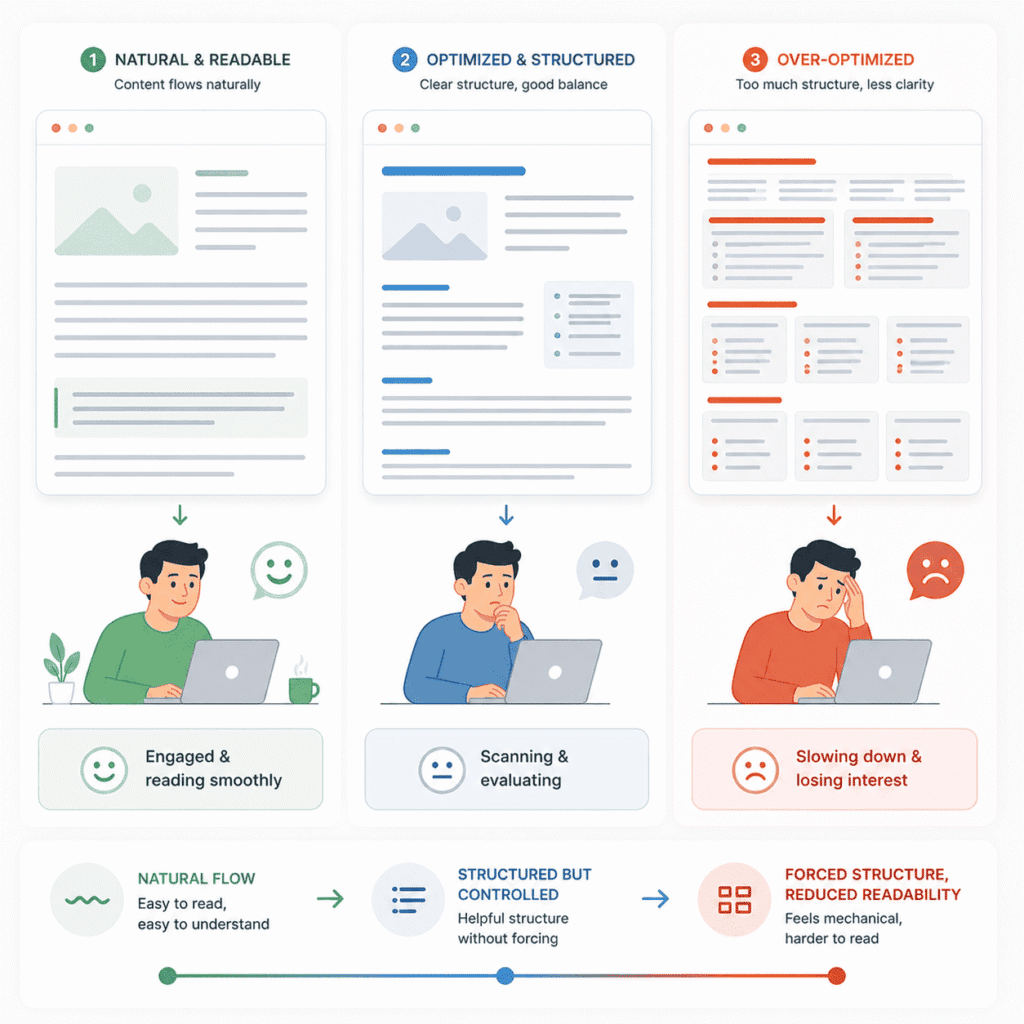
Structure is supposed to make things easier.
But somewhere along the way, people started building structure for SEO, not for readers.
You end up with pages where everything looks right:
- neatly spaced sections
- keyword-aligned headings
- consistent formatting
…and yet, it feels oddly rigid.
Like the content is following a script.
What you’ll notice is that it doesn’t flow — it steps. One section to the next, predictably. Almost like you’ve read it before, even if you haven’t.
That’s usually a sign that the structure is no longer helping — it’s controlling the writing.
In On-Page SEO, this happens when you start thinking:
“What should come next?” instead of “What actually needs to be said next?”
That small shift changes everything.
Because real clarity doesn’t always follow a perfect structure. Sometimes you need to pause on a point longer. Sometimes you need to skip what would normally be a “section” entirely.
The best content I’ve seen doesn’t feel structured — even though it is. It feels like someone is thinking clearly and explaining as they go.
That’s very different from filling in sections.
The point where optimization starts hurting readability
There’s a moment — and it’s easy to miss — where optimization starts to backfire.
It usually begins with good intentions:
- adding keywords into headings
- making sure everything is “SEO-friendly”
- tightening structure so it’s easier to scan
Nothing wrong with that.
But then the writing starts to sound… slightly off.
Headings become repetitive. Sentences feel a bit forced. The tone shifts from natural to “this was written to meet criteria.”
And even if the reader can’t explain it, they feel it.
When content feels engineered, people engage less.
That’s the trade-off most people don’t talk about in On-Page SEO.
You can make a page perfectly optimized — and at the same time, make it less enjoyable to read.
I’ve come across pages where everything is technically “correct,” but you find yourself slowing down, rereading, losing interest. Not because the information is bad — but because the delivery has friction.
That friction matters more than people think.
Because at a certain point:
readability becomes the optimization
If someone can move through your page easily, understand it quickly, and not feel like they’re working to keep up — that’s doing more for your rankings than perfectly placed keywords ever will.
The tricky part is knowing where that line is.
There’s no tool that tells you, “you’ve optimized too much.” You only notice it when the content starts to feel less like communication… and more like construction.
And once it starts feeling like that, it’s usually already gone too far.
What’s Stopped Mattering as Much (But People Still Obsess Over)
Some SEO habits don’t disappear — they just quietly lose their impact. People keep doing them because they used to work, or because tools still reinforce them. But if you pay attention to how pages actually perform now, a few of these things matter a lot less than they used to.
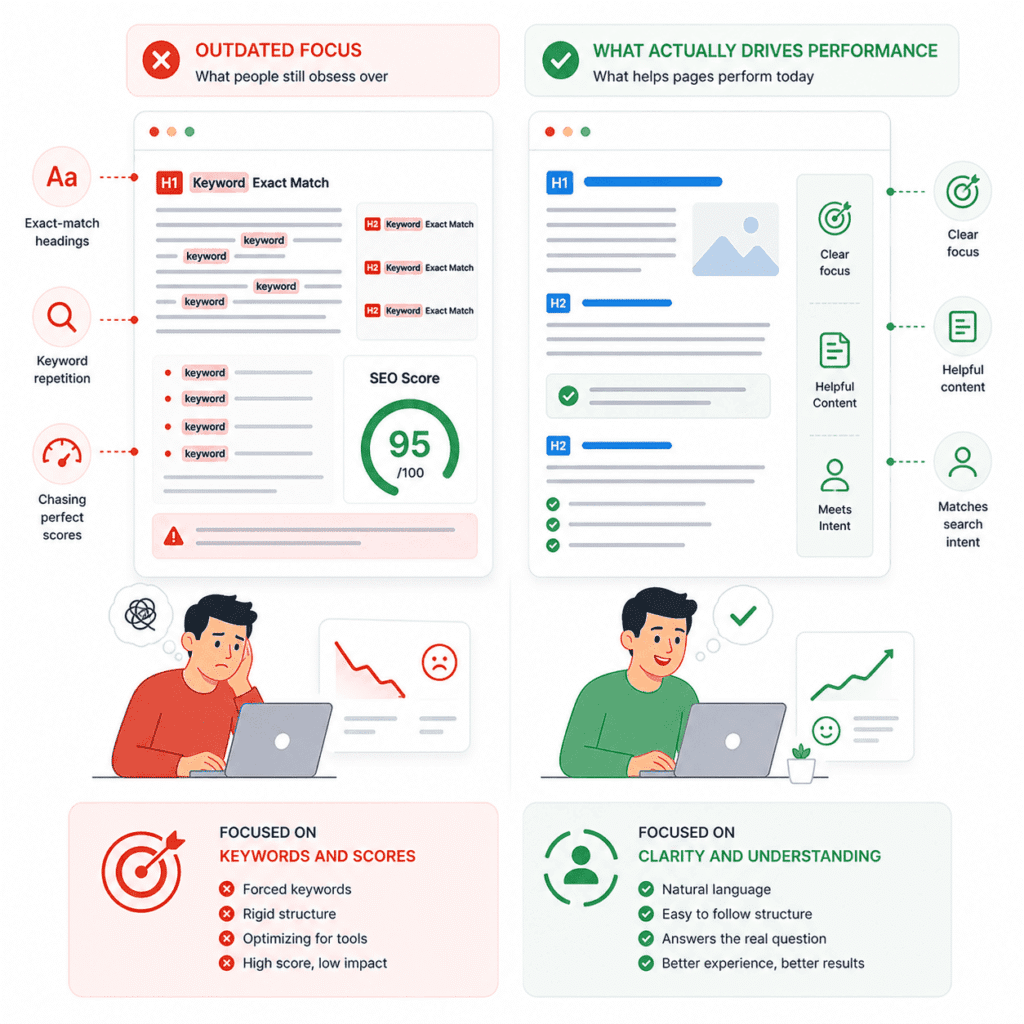
The slow decline of keyword placement obsession
There was a time when On-Page SEO felt very mechanical. Put the keyword in the title, in the first paragraph, in a few headings, and you were on the right track.
That logic hasn’t completely disappeared, but it’s not the lever it used to be.
What’s changed is how search engines interpret content. They don’t rely on exact wording the same way anymore — they look at context, meaning, and how well a page aligns with what someone is trying to find.
And yet, you’ll still see people stressing over things like:
- exact-match keywords in every H2
- repeating the same phrase multiple times just to “reinforce relevance”
- rewriting sentences just to squeeze the keyword in
In my experience, that kind of effort rarely moves the needle anymore. Sometimes it even makes the content worse.
Because the moment you start forcing keywords, the writing becomes slightly unnatural. Not obviously bad — just a bit off. And that subtle friction adds up.
Relevance today is about alignment, not repetition.
If your content clearly addresses what the user is looking for, you don’t need to keep reminding Google what your topic is. It already knows.
That doesn’t mean keywords don’t matter at all. They still help frame the topic. But they’ve shifted from being something you “place strategically” to something that should appear naturally if you’re explaining the topic well.
If you’ve used content optimization tools before, this Surfer SEO review shows exactly where they help—and where they can quietly mislead you.
Why “perfect scores” don’t translate to real performance
SEO tools have made optimization feel measurable. You write something, run it through a plugin, and get a score — green, orange, red.
It feels reassuring. Like you’ve done the work correctly.
But here’s the uncomfortable part:
a high score doesn’t mean a page will perform
It just means the page meets a certain set of predefined criteria.
Those criteria are useful — they catch obvious gaps. But they don’t account for things like:
- how easy the content is to follow
- whether it actually answers the reader’s underlying question
- how it compares to other pages in the same space
I’ve seen pages with near-perfect optimization scores struggle to rank. And I’ve seen others with average scores perform surprisingly well.
The difference usually comes down to how the content feels to the reader.
When you optimize too heavily for a score, you start making decisions based on what the tool wants — not what the reader needs. You add keywords where they don’t quite fit. You tweak headings to match formulas. You adjust structure to satisfy a checklist.
And slowly, the content becomes less natural.
Tools measure compliance. Readers respond to clarity.
That’s the trade-off.
The goal isn’t to ignore tools completely — they’re still helpful. But they should guide your work, not define it.
Because at the end of the day, performance isn’t decided by a score. It’s decided by whether someone reads your page and feels like they got what they came for — without having to think too hard about it.
If you’re relying on tools, it helps to understand which ones are actually worth using—here’s a breakdown of the best SEO tools for small businesses.
📖 Related: The 15 Best SEO Tools in 2026 (Free & Paid) The tools that make on-page SEO faster and more accurate — from free WordPress plugins to AI-powered content optimisers — all covered in one honest guide.
A Simple Way to Tell If Your On-Page SEO Is Actually Working
Most people try to judge their pages using tools, scores, or checklists. That’s fine—but it only tells you if something is technically correct.
It doesn’t tell you if the page actually works.
And in On-Page SEO, that difference matters more than people think.
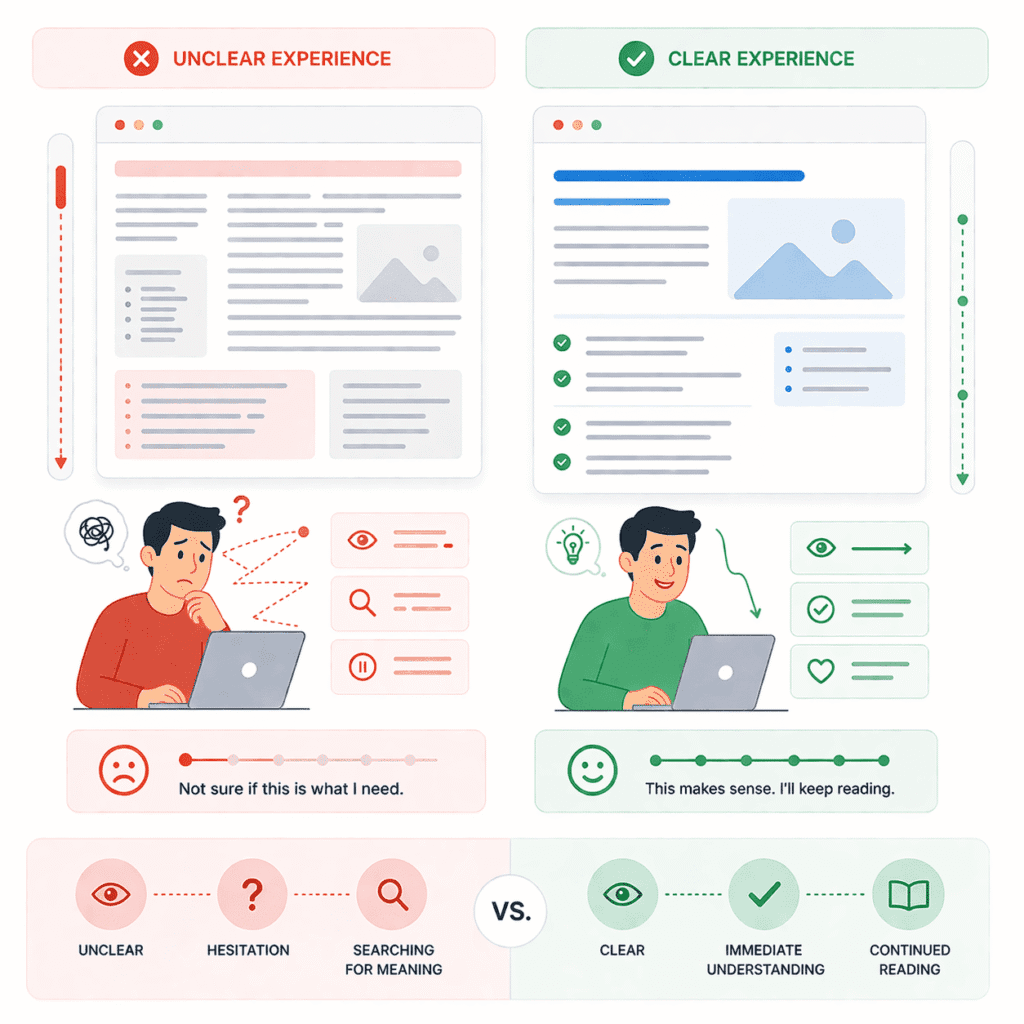
The “first-time visitor” test
A simple way to cut through the noise is this:
look at your page like you’ve never seen it before.
No context. No assumptions. Just you, landing on it from search.
What’s your first reaction?
Not what you think—what you feel.
“I get this” or “Wait… what is this really saying?”
That reaction happens fast. Usually within a few seconds.
If the page is working, it clicks almost immediately. You don’t have to search for the point. You don’t have to adjust mentally. It just… makes sense.
If it’s not working, you’ll notice small things:
- you skim instead of reading
- you scroll looking for clarity
- you hesitate before committing
Nothing dramatic. Just a slight lack of confidence.
And that’s enough.
In my experience, this is where a lot of On-Page SEO falls apart. Not because the content is bad—but because it doesn’t orient the reader quickly enough.
A well-optimized page doesn’t make you think about it—it lets you move through it effortlessly.
That’s the difference.
You can test this yourself.
Open two articles on the same topic.
On one page, you’ll notice you’re:
- scanning
- jumping between sections
- trying to “find the point”
On the other, you just keep reading without thinking about it.
No friction. No effort.
That difference has nothing to do with how many keywords are used—and everything to do with how clearly the idea is presented.
Signs your content is doing too much (or not enough)
Another way to look at it is this:
Does your page feel heavy… or incomplete?
Both are problems. And both are surprisingly common.
When a page is doing too much, you can feel it dragging:
- sections that exist “just in case”
- explanations stretched longer than they need to be
- points repeated in slightly different ways
Everything looks useful—but not everything actually is.
The result?
more content, but less clarity
On the flip side, some pages don’t go far enough. They explain the surface of something but stop before it becomes truly useful. You understand the topic—but you don’t feel confident about it.
That’s just as limiting.
The balance is subtle:
enough depth to remove confusion, but not so much that it creates it
And that balance doesn’t come from rules. It comes from paying attention.
What you’ll notice, especially when reviewing your own content, is that strong pages feel light and direct. Not shallow—just efficient. Every part of the page earns its place.
Weak pages, on the other hand, tend to feel either:
- overloaded
- or underdeveloped
There’s rarely a middle ground.
And this is one of those areas in On-Page SEO where no tool can really help you.
You only catch it when you step back and ask:
“If I landed on this page, would I actually feel satisfied—or would I keep searching?”
That answer is usually more honest than any score.
If you want a more structured way to evaluate what’s actually holding your page back, read this complete SEO audit for a small business website.
What On-Page SEO Looks Like When You’re Actually Writing
This is where things get real.
It’s one thing to understand On-Page SEO conceptually. It’s another to sit down and actually write something that doesn’t feel like SEO content.
Because the moment you start thinking too much about “optimizing,” the writing usually gets worse.
Starting with the real question behind the keyword
Most people start with the keyword and try to build around it.
That’s fine—but it’s also where things start to drift.
Because a keyword is just a label. It doesn’t tell you what the person actually wants. It only hints at it.
And if you’re not careful, you end up writing something that technically matches the topic… but doesn’t really help anyone in a meaningful way.
What tends to work better is asking a slightly uncomfortable question:
“Why would someone search this in the first place?”
Not the obvious answer. The real one.
Someone searching about On-Page SEO might be:
- confused by conflicting advice
- trying to fix a page that isn’t performing
- wondering if what they’re doing is outdated
That’s very different from someone just looking for a definition.
Once you lock into that, your writing shifts almost automatically.
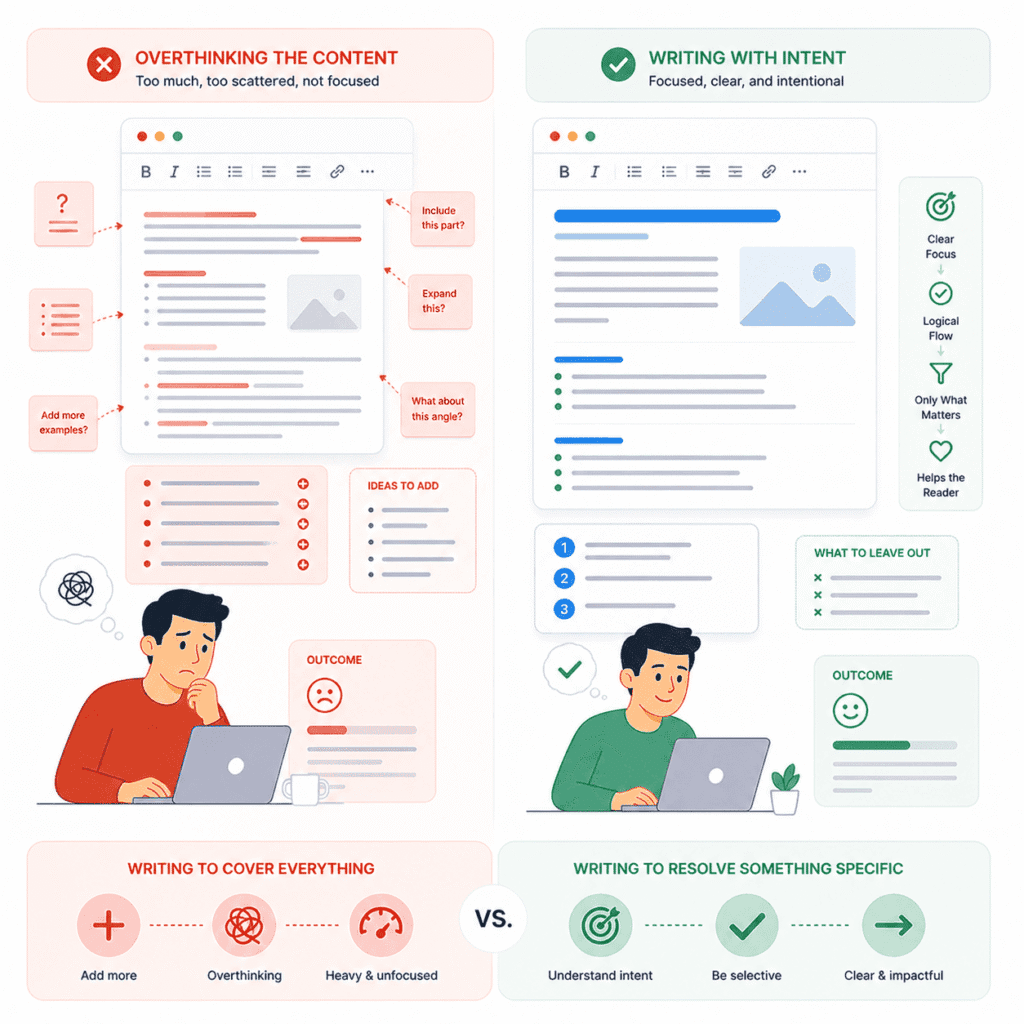
You stop trying to “cover everything” and start trying to resolve something specific.
And that changes the tone completely.
Instead of sounding like a guide, it starts sounding like an explanation that actually matters.
Deciding what to leave out (this is harder than it sounds)
This is where most people lose control of their content.
Not because they don’t know enough—but because they know too much and try to include all of it.
There’s always that voice saying:
- “I should probably add this too”
- “What if someone needs this part?”
- “Let me just expand this a bit more”
And before you realize it, the page starts to feel heavier.
Not necessarily longer—just… slower.
More information doesn’t automatically mean more value.
In fact, it often does the opposite.
What you’ll notice, especially if you reread your own content after a break, is that certain parts don’t really move anything forward. They’re not wrong—they’re just not necessary.
And those are the parts that quietly weaken the page.
In On-Page SEO, this is one of the hardest skills to develop:
knowing when to stop
Because stopping feels risky. It feels like you’re leaving something out.
But the truth is, strong content usually feels a bit restrained. Like it could go further—but doesn’t need to.
That restraint is what keeps it clear.
There’s a balance here, though.
Cut too much, and the page feels thin. Leave too much in, and it feels cluttered.
You don’t find that balance through rules. You find it by paying attention to one thing:
does this actually help the reader move forward, or just make the page look more “complete”?
If it’s the second, it probably doesn’t belong.
And once you start writing with that mindset, your On-Page SEO improves without you even trying to optimize it.
The Trade-Off Nobody Mentions: Clarity vs. Coverage
This is where a lot of On-Page SEO advice quietly contradicts itself.
You’re told to be thorough. Cover everything. Don’t miss any angle.
At the same time, you’re told to be clear, concise, and easy to read.
Those two don’t always go together.
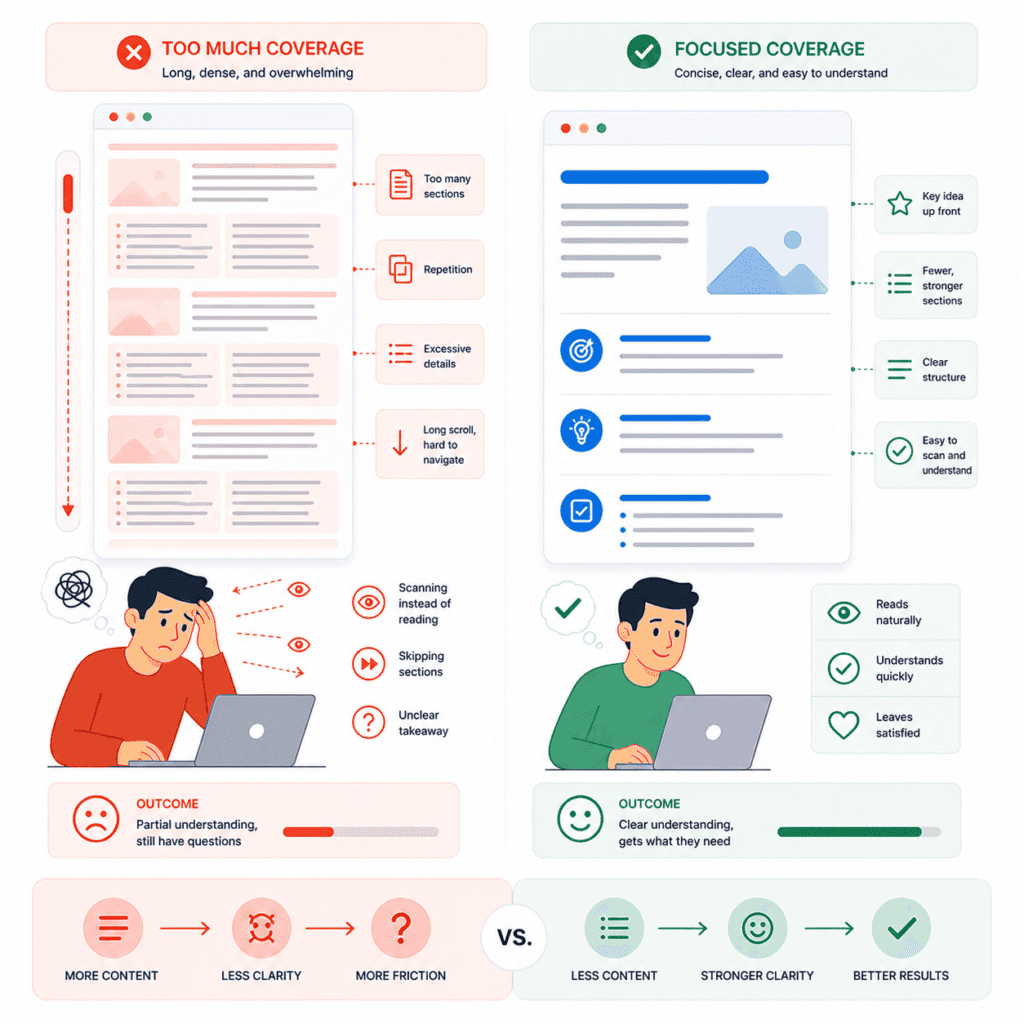
Why trying to include everything weakens your page
There’s this pressure—sometimes subtle, sometimes obvious—to make your content feel “complete.”
So you keep adding:
- another explanation
- another example
- another section just to be safe
It feels responsible. Like you’re making the page better.
But something starts to happen.
The core idea gets pushed further down. The page becomes slower to move through. You’re no longer guiding the reader—you’re loading them with information.
And the weird part is, nothing you added is technically wrong.
It’s just… unnecessary.
The moment your content tries to do everything, it stops doing anything particularly well.
You’ll notice this when reading certain pages. They’re long, detailed, and technically “high quality”… but you don’t feel clear after reading them. You feel slightly overwhelmed.
That’s not a lack of information. That’s too much of it without enough focus.
In On-Page SEO, this is one of the easiest mistakes to make because it feels like progress.
More sections = more value.
Except it doesn’t work like that anymore.
When shorter content quietly outperforms longer guides
There’s still a strong belief that longer content automatically performs better.
Sometimes it does. But not for the reason people think.
It’s not the length that helps—it’s the depth and clarity inside that length.
And sometimes, a shorter page delivers that better.
You’ve probably experienced this yourself. You land on a page, and within a few minutes, you think:
“That’s exactly what I needed.”
No scrolling through endless sections. No digging for the point. Just… clarity.
That’s what strong On-Page SEO content does now.
It reduces effort.
I’ve seen shorter pages outperform longer ones simply because they don’t waste your attention. Every part of the content feels like it’s there for a reason.
Compare that to a long guide where:
- you skim most of it
- you skip entire sections
- you’re constantly trying to find the “useful part”
That’s friction.
And friction kills engagement faster than people realize.
Length doesn’t win. Ease wins.
That said, this isn’t an argument for writing less just for the sake of it.
Cut too much, and the page feels thin. Leave out key context, and the reader is left guessing. That’s just as bad.
The real skill is knowing:
what actually moves the reader forward—and what just makes the page look more “complete”
That line isn’t always obvious. But once you start noticing it, your content changes.
You stop trying to impress with volume.
And start focusing on making things land quickly and clearly.
If you’re trying to choose between tools, this Semrush vs Ahrefs comparison breaks down how they actually differ in practice.
Where Beginners Go Wrong (And Why It’s Not Their Fault)
If you’re new to this, it can feel confusing in a very specific way.
You follow what seems like solid On-Page SEO advice… and then nothing really happens.
No rankings. No traction. Just silence.
And the instinct is to assume:
“I must be doing something wrong.”
Most of the time, you’re not.
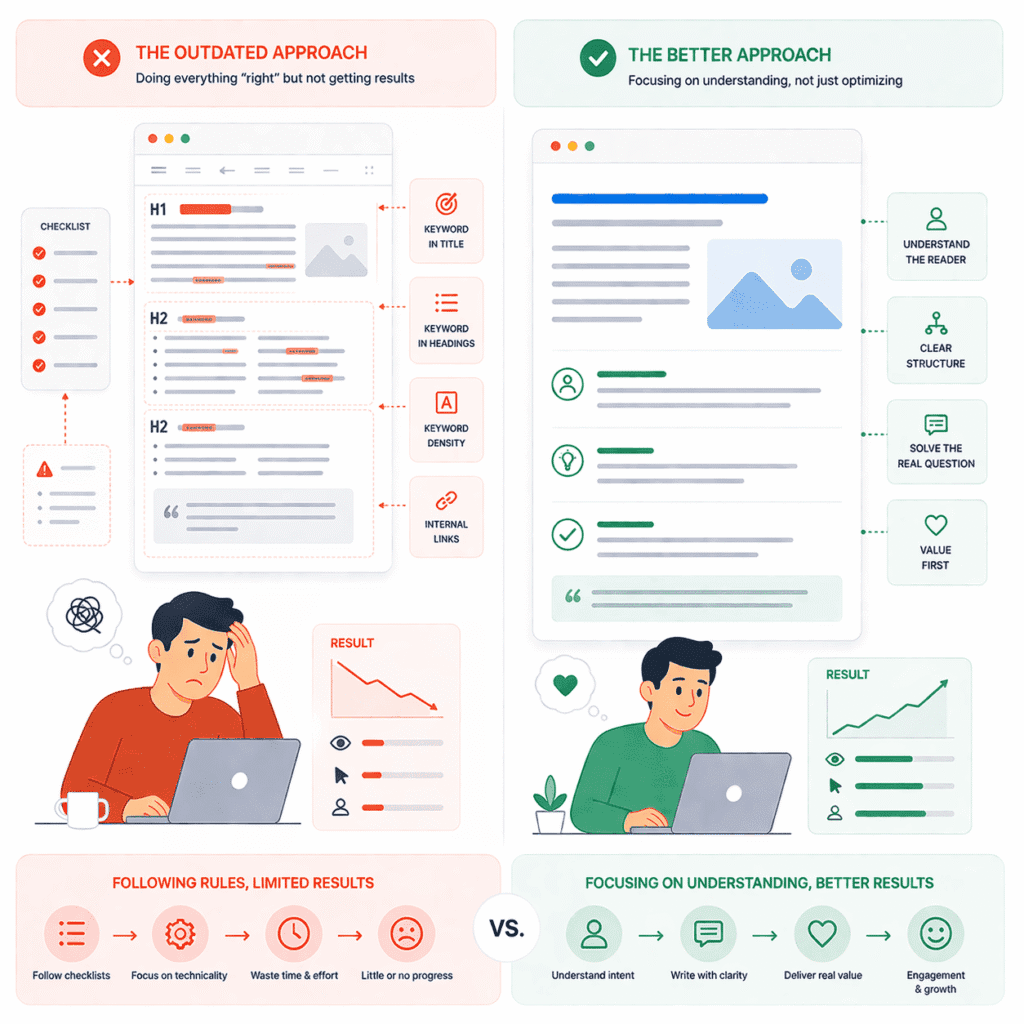
Learning SEO in a system that rewards outdated advice
Here’s the uncomfortable part that doesn’t get talked about enough:
A lot of what you learn about On-Page SEO comes from content that’s still ranking—but not necessarily still relevant.
Those pages didn’t get there yesterday. They’ve been building authority for years. Links, trust, history… all of that keeps them in place.
So when you search for guidance, you’re often learning from content that reflects:
what worked well enough to stay ranking—not what works best right now
That’s a big difference.
And it creates a strange situation where beginners are trying to apply advice that looks current but is slightly behind.
You’ll see it in patterns like:
- rigid keyword placement rules
- overly structured templates
- checklists that feel more technical than practical
None of it is completely wrong. It’s just… not where things are anymore.
In my experience, this is why a lot of beginners feel stuck. They’re putting in effort, following instructions, doing everything “right”—but still not seeing results.
You’re not failing. You’re just working from a slightly outdated playbook.
And that’s hard to notice unless someone points it out.
Confusing optimization with understanding
Another trap is thinking that if your content is optimized, it must be good.
It’s a very logical assumption.
You structure your headings, place your keywords, make everything “SEO-friendly”… and the page looks solid.
But something still feels off.
That’s because optimization and understanding are not the same thing.
You can optimize a page perfectly and still not explain anything clearly.
You can follow every On-Page SEO guideline and still leave the reader unsure.
And that’s the part most people don’t realize early on.
What you’ll notice—especially if you reread your own content later—is that some sections sound right but don’t really land. They explain, but they don’t clarify. They inform, but they don’t resolve anything.
Content that looks right isn’t the same as content that makes sense.
That gap matters.
Because readers don’t care how well-structured your page is. They care whether they understand what they came for—quickly and without effort.
The shift happens when you stop asking:
- “Is this optimized?”
…and start asking:
“Would this actually make sense to someone seeing this for the first time?”
Once you get that right, your On-Page SEO improves almost as a side effect.
Not because you tried harder—but because the content finally works the way it’s supposed to.
If you’re still trying to make sense of SEO as a beginner, this Ahrefs for beginners guide breaks down what most people don’t realize early on.
If You Only Remember One Thing From This Article
If you forget everything else—and honestly, most people will—this is the part that actually matters.
Not a tactic. Not a checklist. Just a way to look at your page differently.
The one principle that aligns with how Google evaluates content today
If someone lands on your page and still feels the need to keep searching… something didn’t work.
That’s the simplest way to think about On-Page SEO now.
Not:
- “Did I include the keyword?”
- “Is my structure correct?”
- “Did I optimize everything properly?”
Those things help—but they’re not the deciding factor anymore.
The real question is:
“Does this page make the search feel finished?”
That’s it.
And it’s harder than it sounds.
Because it forces you to be honest about your content.
Not whether it’s correct—but whether it’s actually useful in a way that feels complete.
You can explain something accurately and still leave people unsure. You can write something detailed and still not help someone decide what to do next.
That’s where most pages fall short.
Information isn’t enough. Resolution is what matters.
In my experience, the pages that perform well don’t feel like they’re trying to rank. They feel like they’re trying to help someone figure something out clearly.
There’s a difference.
And it shows up in small ways:
- the point is obvious early
- the explanation doesn’t wander
- you don’t feel the need to “double-check somewhere else”
You just… get it.
There’s a trade-off here that people don’t like.
To write like this, you have to leave things out. You can’t cover every angle. You can’t make the page feel “complete” in the traditional sense.
And that feels risky.
But trying to include everything usually leads to the opposite:
more content, less clarity
What you’re aiming for instead is something simpler:
a page that removes doubt quickly and doesn’t create new confusion
That’s what On-Page SEO has quietly shifted toward.
Not perfect optimization.
Not maximum coverage.
Just:
clear, useful content that makes the reader stop looking elsewhere
If you can do that consistently, a lot of the usual SEO concerns start to matter less.
Not disappear—but fade into the background where they belong.
If you’re considering an all-in-one platform, this Semrush review explains what it’s actually useful for—and what it doesn’t solve.
Disclosure: This article may contain affiliate links. If you make a purchase through these links, I may earn a commission at no extra cost to you. All opinions are based on hands-on testing and independent research.
I’m amazed, I must say. Rarely do I come across a blog that’s both equally educative and engaging, and without a doubt,
you have hit the nail onn the head. The issue is something which not enough men and
women are speaking intelligently about. Now i’m very happy that I found this during my
hunt for something relating to this.
Wow, thank you so much — that’s one of the nicest things someone can say about a blog! You’re right that this topic doesn’t always get the thoughtful discussion it deserves, which is exactly why I felt compelled to write about it. So glad your search led you here, and I hope you find more posts worth your time!
Very interesting points you have observed, thanks for posting.