
Let me save you some time: if you’re googling “SEMrush vs Ahrefs,” you’ve probably already read five articles that all say the same thing. “Both are great tools! It depends on your needs!” — then they list features in a table and call it a day.
That’s not what this is.
I’ve actually spent money on both platforms — not just trial accounts, but real paid subscriptions while doing keyword research, auditing client sites, and stalking competitors at 11pm. So when I tell you one has a clear edge in certain areas, I mean it.
Here’s the thing nobody says out loud: these tools overlap about 70% of the time. The battle really comes down to that remaining 30% — and whether that 30% matters to your specific situation.
Table of Contents
Pricing Comparison: Let’s Talk Money First (Because It’s Awkward But Important)
Pricing is where most comparisons get weirdly vague. They’ll say “plans start at $X” without telling you that the features you actually need are locked behind a higher tier.
SEMrush vs Ahrefs pricing isn’t just about the monthly number — it’s about what’s included at each level and how quickly costs climb once you add users or projects. That’s the part worth paying attention to, and I’ll break it down without the fluff.
🔹 SEMrush Pricing: What You’re Actually Paying For
Okay, real talk — SEMrush isn’t cheap. And I think it’s important to just say that plainly instead of dressing it up as “a robust investment for serious marketers.” You’re going to feel it in your wallet, especially if you’re just starting out.
That said, here’s how the plans actually break down:
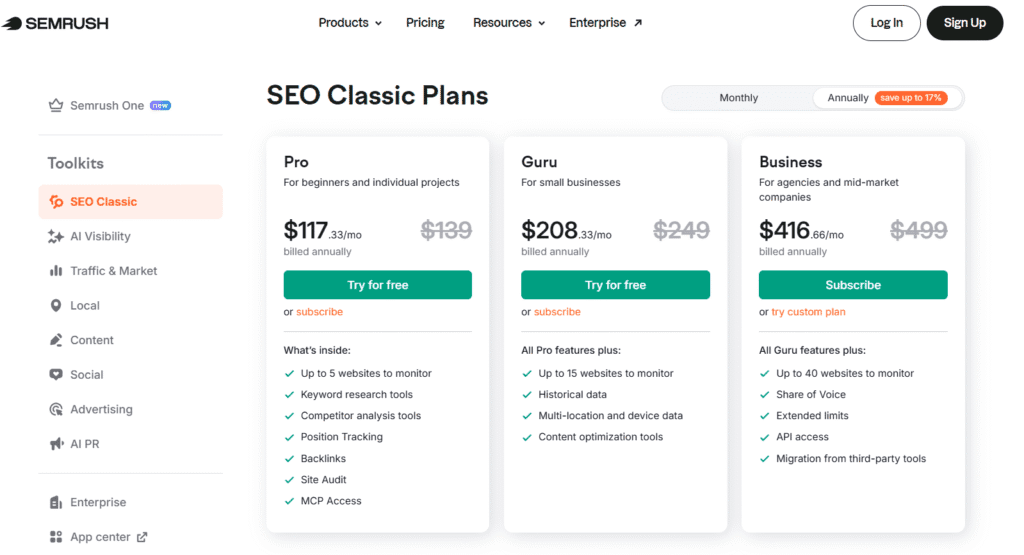
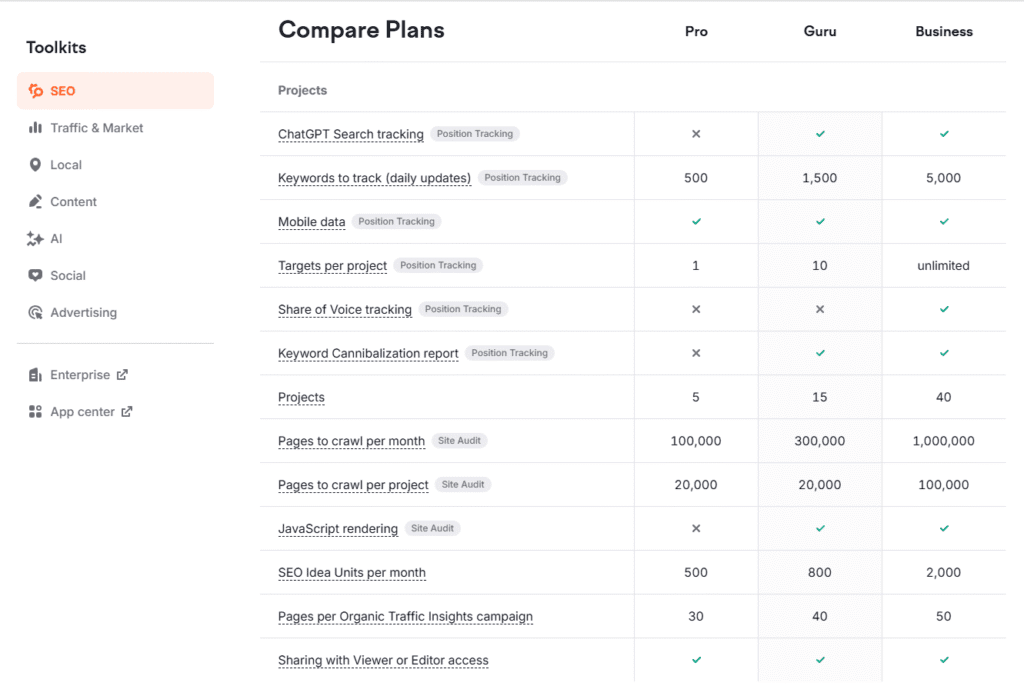
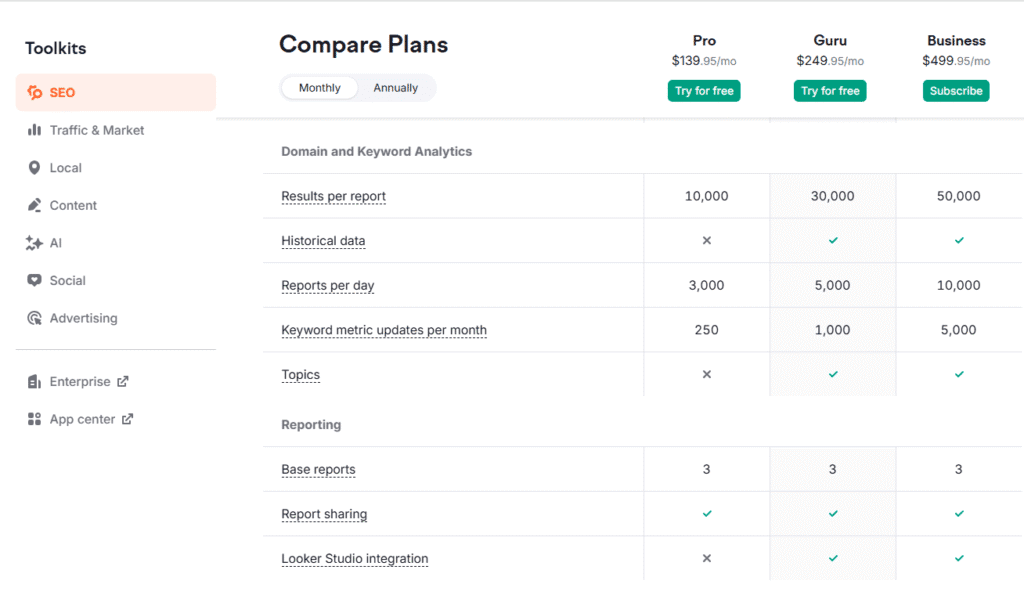
The Pro Plan at $117.33/month is the entry point. It covers the essentials — keyword research, site audits, position tracking. If you’re a freelancer or running a small site, this is probably where you’d land. It’s functional, but you’ll bump into its limits faster than you’d expect.
Step up to the Guru Plan at $208.33/month and things get more interesting. This is where SEMrush starts pulling ahead in the SEMrush vs Ahrefs debate for content-focused teams — you get historical data, content marketing tools, and more refined reporting. Most growing agencies live here.
Then there’s the Business Plan at $416.66/month. At that price, you’d better be running serious campaigns for multiple clients. It’s built for scale — API access, extended limits, white-label reporting. Makes sense for agencies. Feels excessive for everyone else.
One thing I’ll genuinely credit SEMrush for? Their 7-day free trial is actually useful. Not one of those “here’s a stripped-down demo” situations — you get real access to keyword tracking, site audits, and competitive research. I used mine to run a full content gap analysis before deciding to subscribe. Worth taking advantage of before you commit.
Ahrefs Pricing: More Entry Points, But Read the Fine Print
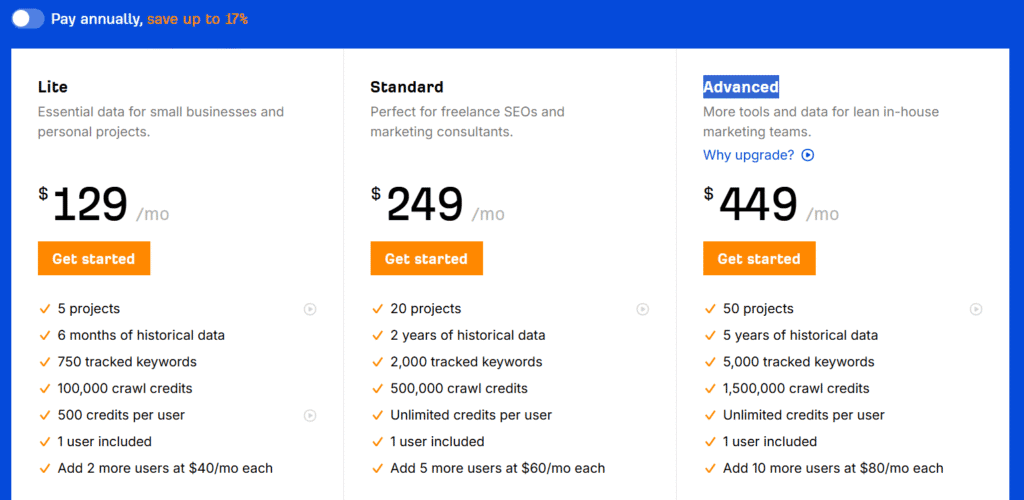
This is where Ahrefs does something interesting — and honestly, something SEMrush doesn’t. They’ve built out more pricing tiers, which sounds great on paper. And in some ways, it is. But let me walk you through what each level actually means before you get excited about that $29 price tag.
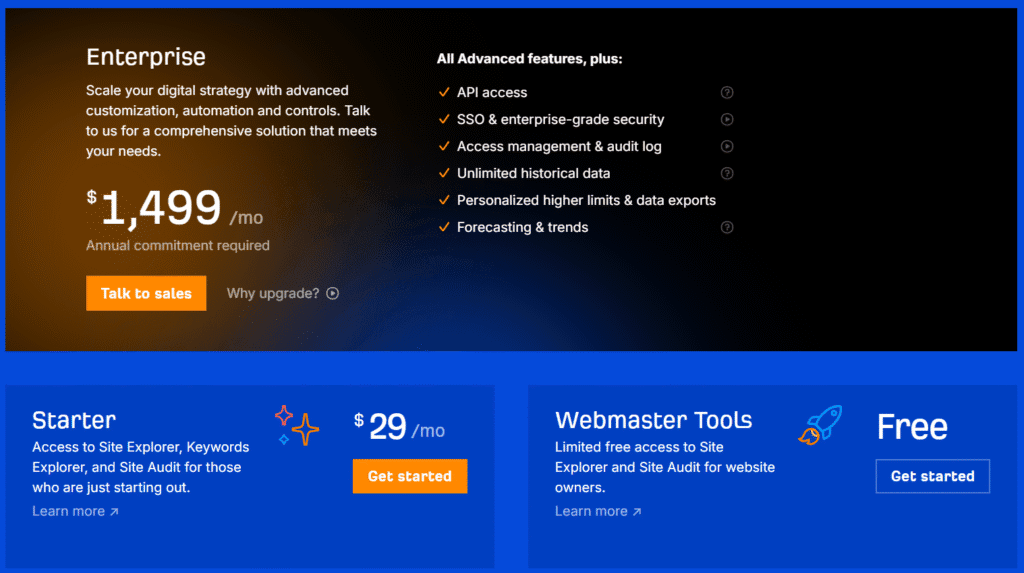
The Starter Plan at $29/month exists, yes. But temper your expectations. It’s a step above their free Webmaster Tools — useful if you’re just poking around or running a single personal site. Don’t expect to do serious keyword research or backlink analysis at this level. You’ll hit walls quickly.
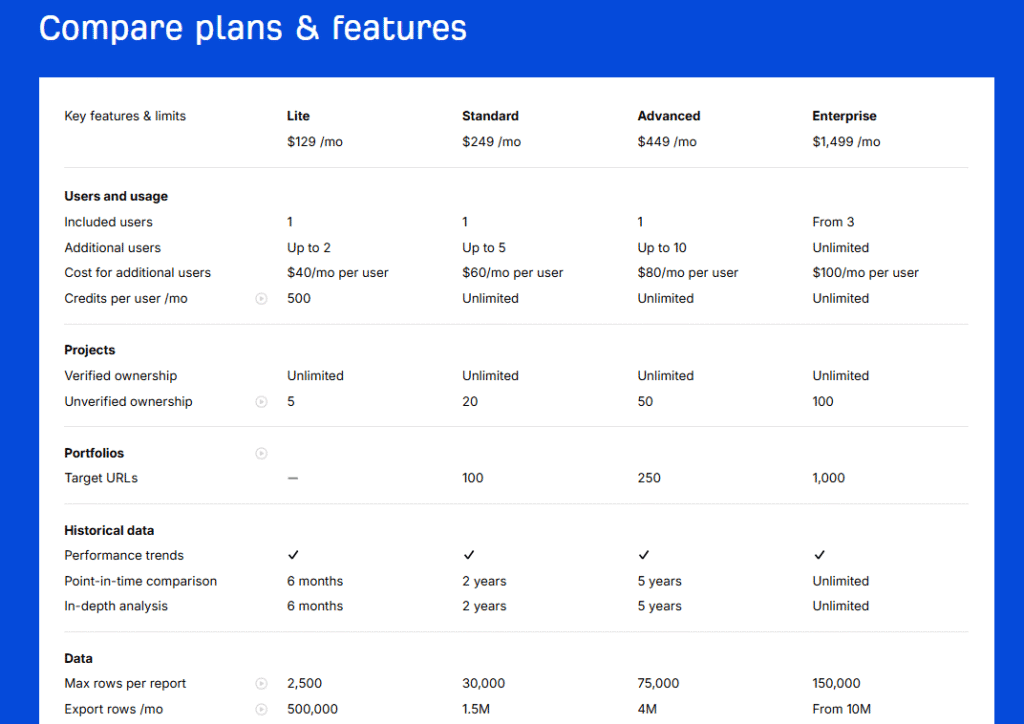
The Lite Plan at $129/month is where Ahrefs starts becoming a real tool. Solo marketers and bloggers who need reliable keyword data and backlink insights will feel at home here. In the SEMrush vs Ahrefs pricing conversation, this is actually Ahrefs’ strongest argument — you’re getting solid core functionality for $10 less than SEMrush’s entry plan.
At $249/month, the Standard Plan is where small agencies tend to settle. More historical data, higher crawl limits, better reporting. This is the sweet spot for teams doing consistent client work without enterprise-level volume.
The Advanced Plan at $449/month steps things up for professional SEO teams juggling multiple clients and needing deeper data access. Comparable territory to SEMrush’s Business Plan, though the toolsets diverge meaningfully at this tier.
Then there’s the Enterprise Plan at $1,499/month. I’ll be honest — at that price, you’re in a completely different conversation. Large organizations with custom data needs and dedicated SEO teams. Not worth discussing for most people reading this.
Here’s the part that might sting a little: Ahrefs no longer offers a free trial. They used to have a $7 seven-day trial, which was genuinely one of the better deals in SEO tools. That’s gone now. You’re essentially committing blind unless you’re willing to pay a full month upfront to test it — which, fair or not, is a real disadvantage compared to SEMrush’s 7-day free trial.
Always double-check their official site for the latest pricing — these numbers have shifted before and could again.
So Where Does the Real Difference Actually Show Up?
Forget the feature checklists for a second. After using both tools on real projects — client audits, content campaigns, link building pushes — here’s where SEMrush vs Ahrefs stops being theoretical and starts actually mattering.
SEMrush is the tool that does more things. Sometimes that’s a strength. Sometimes it’s overwhelming. But if you’re running paid campaigns alongside your organic strategy, or you want PPC analysis, social media tracking, and content marketing insights all living in one dashboard — SEMrush genuinely delivers that without forcing you to stitch together five different tools. For agencies especially, that consolidation has real dollar value.
The flip side? When you’re paying for everything, you’re sometimes paying for things you’ll never touch.
Ahrefs, on the other hand, does fewer things — but the things it does, it does better than almost anyone.
Specifically: backlinks. The Ahrefs crawler is widely considered the most comprehensive in the industry outside of Google itself. The link index refreshes faster, the data runs deeper, and when you’re trying to understand why a competitor is outranking you, Ahrefs tends to give you a clearer, more honest picture.
I’ve had moments where I pulled backlink data on the same site in both tools and got noticeably different numbers. Ahrefs was right more often.
Here’s the honest summary nobody wants to write:
If your world revolves around content strategy and paid traffic, SEMrush is probably worth the extra cost. If link building and organic authority are your primary battlefield, Ahrefs gives you a sharper weapon.
The “it depends on your needs” answer is annoying — but in this case, it’s genuinely true. The mistake is paying for the wrong tool because a comparison article told you one was universally better.nic search authority are your priorities, Ahrefs gives you unparalleled precision and data reliability. Pricing comes down to which features matter most to you—content and PPC tools (SEMrush) or deep backlink data (Ahrefs).
Semrush Pricing Plan Features
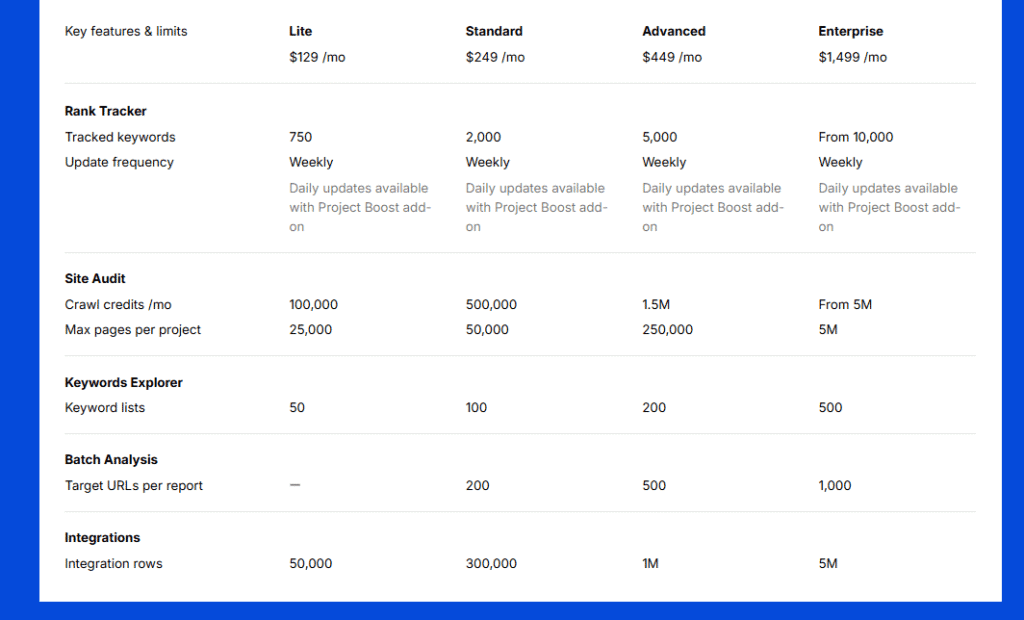
Ahrefs’s Pricing Plan Features
Keyword Research Capabilities
When comparing SEMrush vs Ahrefs, one of the most important features to evaluate is keyword research — the backbone of every successful SEO strategy. After testing both platforms extensively for client projects and content planning, I found that each tool brings something unique to the table.
SEMrush Keyword Research
In my experience, SEMrush offers one of the most comprehensive keyword tools in the SEO world — the Keyword Magic Tool. It’s designed for marketers who want both scale and precision when discovering new keyword opportunities.
Here’s what you can do with it:
- Explore over 26 billion keywords from multiple databases.
- Group keywords by topic, intent, or phrase match for organized campaigns.
- Filter results by search volume, difficulty, or SERP features.
- Find question-based keywords that are perfect for blog content or FAQs.
- View seasonal trends to plan campaigns around peak demand periods.
I especially like how it integrates directly with the Keyword Manager and Position Tracking tools — making it easy to track ranking progress after publishing content.
Ahrefs Keyword Research
Ahrefs takes a slightly different, data-driven approach with its Keywords Explorer. I’ve found it to be extremely reliable for understanding click metrics and ranking potential.
Key features include:
- Access to a massive database of 10+ billion keywords across 171 countries.
- Unique insights into click-through metrics — showing how often users actually click on results.
- The Parent Topic feature, which uncovers broader keyword opportunities.
- Highly accurate keyword difficulty scores paired with backlink estimates.
- Support for multiple search engines like Google, YouTube, Amazon, and Bing.
In my testing, Ahrefs consistently provides more realistic traffic potential data, especially when evaluating highly competitive search terms.ng potential based on backlink needs.
Key Differences
Here’s the short version:
- SEMrush is ideal for content marketers. It offers better tools for topic clustering, intent targeting, and content-driven SEO.
- Ahrefs is perfect for analysts who value data accuracy, global coverage, and click metrics.
If you’re scaling content production and want quick keyword clusters, go with SEMrush. But if your focus is precise, data-heavy SEO research, Ahrefs will feel more powerful.
Finding high-intent keywords is only half the battle — converting that traffic into paying customers depends heavily on which marketing platform you build your funnels in.
Backlink Analysis: This Is Where the Gap Between Them Gets Real
If there’s one area where the SEMrush vs Ahrefs debate stops being close, it’s backlinks. Not because SEMrush does a bad job — it doesn’t. But because Ahrefs has spent years making backlink analysis its entire identity, and it shows in ways that matter when you’re doing serious link work.
Let me break down what each tool actually gives you.
SEMrush Backlink Tools: Practical, Actionable, and Surprisingly Useful
SEMrush approaches backlinks the way it approaches most things — with usability front and center. The Backlink Analytics suite gives you a solid, comprehensive view of any domain’s link profile without requiring you to be a link-building veteran to interpret it.
What works well in practice:
You can analyze any domain’s backlinks in real time — yours, your competitors’, or a site you’re researching before an outreach pitch. New and lost backlink monitoring is genuinely useful for catching problems early — a sudden spike in lost links often signals something worth investigating immediately.
The bulk backlink comparison across five domains is something I’ve used more than I expected. Being able to pull up your site alongside four competitors and see the link gap visually changes how you prioritize outreach targets.
Where SEMrush genuinely surprised me was the Link Building Tool. It doesn’t just show you backlinks — it actively suggests outreach opportunities based on your keyword targets and competitors. For agencies running multiple link building campaigns simultaneously, that automation removes a meaningful chunk of manual prospecting work.
The Backlink Audit Tool for detecting and disavowing toxic links rounds things out. Not the most exciting feature, but when a client comes to you with a penalty or a suspicious link profile, you’ll be glad it’s there.
Ahrefs Backlink Tools: This Is What “Best in Class” Actually Looks Like
There’s a reason experienced SEOs reach for Ahrefs first when they need to understand a site’s link profile. The Site Explorer isn’t just good — it’s the benchmark everything else gets measured against.
Here’s what sets it apart:
The backlink index updates every 15 to 30 minutes. That’s not a marketing claim — you actually notice it when you’re monitoring a fresh campaign or tracking a competitor’s link velocity in real time. SEMrush’s index is solid but it doesn’t move at that speed.
Domain Rating and URL Rating have become something of an industry standard for measuring link strength — not because they’re perfect, but because they’re consistent and widely understood. When you’re evaluating a prospective link opportunity, DR and UR give you a fast, reliable gut-check.
The dofollow vs nofollow breakdowns, referring IP diversity, and TLD distribution are the kind of details that look like noise until you’re doing a serious audit and suddenly they’re exactly what you need. Ahrefs surfaces all of it cleanly without making you dig.
What I find most valuable though is the historical link data. Being able to see how a site’s backlink profile grew over time — slowly and naturally, or in suspicious spikes — tells you a story about that domain that raw numbers alone never could.
Where They Actually Differ
Here’s the honest version: if you’re analyzing backlinks, Ahrefs wins. The data is fresher, deeper, and more reliable. Full stop.
But if you’re actively building links — prospecting, outreaching, managing campaigns — SEMrush gives you more tools to act on the data. Ahrefs tells you what exists. SEMrush helps you do something about it.
The ideal setup, if budget allowed? Both. But since that’s not a useful answer, choose based on whether you spend more time studying link profiles or building them.
SEMrush vs Ahrefs Backlink Features Comparison
| Feature | SEMrush | Ahrefs |
|---|---|---|
| Backlink Index Size | Large, updated regularly | One of the largest and freshest in the industry |
| Update Frequency | Updates daily | Updates every 15–30 minutes |
| Referring Domains Analysis | Yes, with authority metrics and historical growth | Yes, with detailed breakdown of DR, links lost/gained |
| New & Lost Backlink Tracking | ✅ Yes | ✅ Yes |
| Anchor Text Analysis | ✅ Yes | ✅ Yes, with detailed percentage distribution |
| Backlink Audit Tool | ✅ Yes, with toxicity score and disavow file generation | ❌ Not included |
| Link Building Tool | ✅ Yes, helps find outreach opportunities | ❌ Not available |
| Historical Data | ✅ Available | ✅ Available, with better timeline filtering |
| Broken Backlink Detection | ✅ Yes | ✅ Yes |
| Backlink Gap (Competitor Comparison) | ✅ Compare up to 5 domains | ✅ Through Site Explorer + Content Gap tools |
| Export Options | ✅ CSV, PDF, Google Data Studio | ✅ CSV, PDF |
| Reporting & Visualization | Custom reports, branded PDF exports | Visual graphs within tool; no native report builder |
| Ease of Use | Beginner-friendly, guided insights | Cleaner UI, preferred by advanced users |
Site Audits: The Unglamorous Part of SEO That Actually Moves the Needle
Nobody gets excited about site audits. But here’s the truth — you can have the best content strategy in the world and still wonder why you’re not ranking. Nine times out of ten, there’s something broken under the hood. That’s why when I’m evaluating SEMrush vs Ahrefs, how each tool handles technical audits matters more to me than most people admit.
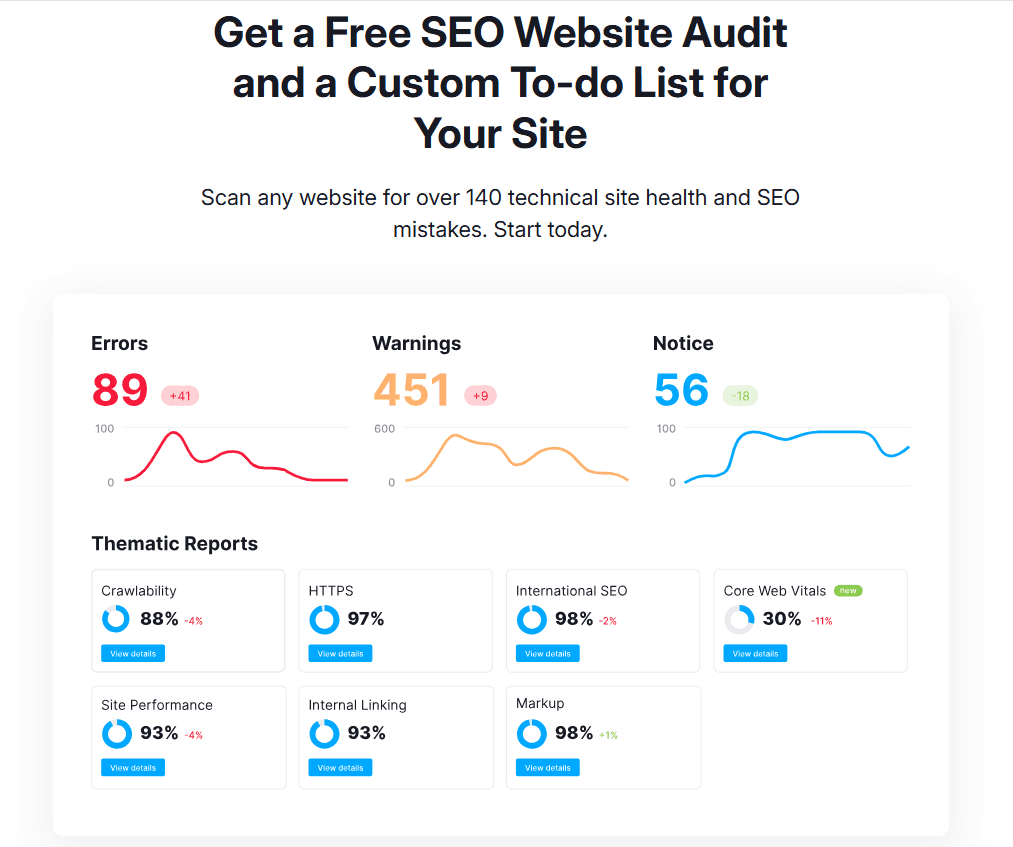
SEMrush Site Audit: Built for People Who Don’t Want to Guess
I’ll say this clearly: SEMrush has one of the most approachable audit interfaces I’ve used. And I don’t mean that as a backhanded compliment. For teams that include non-technical stakeholders — clients, content managers, marketing directors who glaze over at the word “crawl budget” — SEMrush translates technical problems into language that actually makes sense.
Under the hood, it scans for over 140 technical issues. That sounds like a lot because it is. We’re talking:
- Crawlability and indexability errors — is Google even seeing your pages?
- Core Web Vitals (LCP, FID, CLS) — the metrics that now directly influence rankings
- HTTPS and security issues — still surprisingly common even on established sites
- Internal linking gaps and broken links — silent killers for crawl efficiency
- Duplicate content and missing metadata — the kind of stuff that quietly suppresses rankings
- Image optimization problems — often overlooked, always impactful
What I found genuinely useful in practice was the Site Health Score — a single number that tells you how your site is doing overall, paired with prioritized recommendations so you’re not left wondering what to fix first. That prioritization is doing real work. Most audit tools dump problems on you. SEMrush at least tries to tell you which fires to put out first.
The automated weekly audits are a nice touch too. Set it, forget it, get alerted when something breaks. Especially useful when you’re managing multiple client sites and can’t manually recheck everything every week.
Ahrefs Site Audit Tools
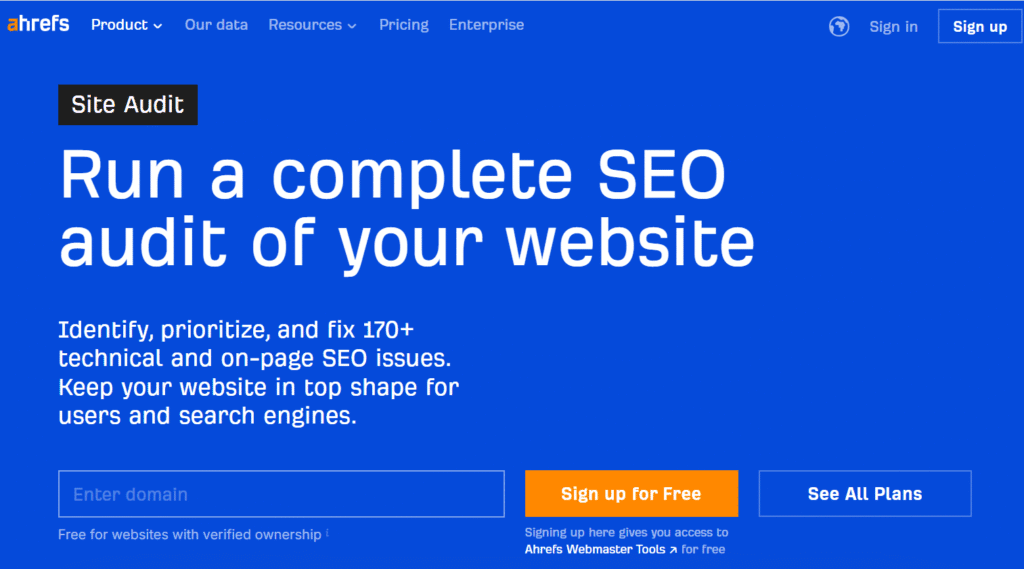
Ahrefs’ Site Audit tool is more technical but extremely powerful. It uses a JavaScript rendering engine — similar to Googlebot — which helps identify issues hidden behind dynamic content.
It checks for:
- Crawl depth and internal linking
- Broken pages and redirects
- Orphaned and slow-loading pages
- HTTP status and resource blocking
- Meta tag and structured data issues
Ahrefs displays this data in visual charts and graphs, which makes it easy to interpret even complex site structures. It also supports custom crawl settings, perfect for large or multi-site setups.
Key Differences
- SEMrush is best for marketers who want simple, actionable reports with clear fixes.
- Ahrefs is tailored to technical SEOs who want flexibility and control.
If you’re managing SEO for clients or teams, SEMrush’s ease of use is a big win. But for technical deep dives, Ahrefs gives you more granularity.
SEMrush vs Ahrefs: Which One Is Actually Better in Tracking?
Let me be straight with you — both tools work. I’ve used them enough to stop being impressed by either and start noticing where each one quietly outperforms the other.
SEMrush’s Position Tracking is the one you set up on a Monday morning without reading any documentation. Daily or weekly tracking, desktop vs. mobile splits, local SEO down to city level — it’s all there, cleanly laid out. The part I genuinely didn’t expect to like? The Competitor Discovery feature. It just finds who’s eating your lunch on the SERPs. No manual setup. That’s the kind of lazy-smart design that saves real time.
Ahrefs does the same core job but goes wider. Multi-search-engine support, SERP feature tracking (think featured snippets, local packs), custom keyword grouping — it’s built for people who want to configure things. If you’re running international SEO campaigns across multiple markets, Ahrefs handles that without breaking a sweat. SEMrush feels slightly boxed-in by comparison.
Quick honest take: local business or solo content creator → SEMrush. Multinational brand or SEO agency → Ahrefs.
Content Tools: This Is Where They Actually Split
Rank tracking is table stakes. Content tools are where SEMrush vs Ahrefs stops being a close call.
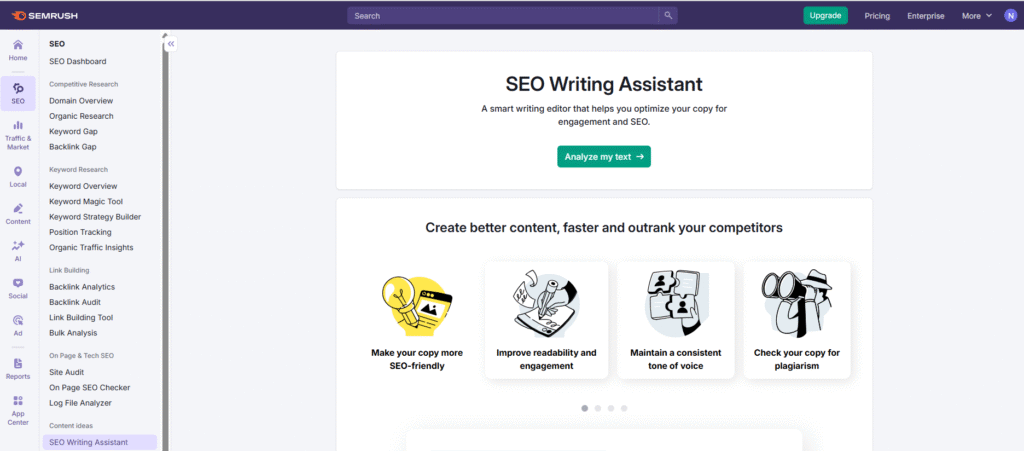
SEMrush built an entire content layer into the platform — and it shows. The SEO Writing Assistant gives you real-time feedback as you write (yes, inside Google Docs). Readability, tone, keyword density — it flags issues before your editor does. The SEO Content Template reverse-engineers what Google’s top 10 results are doing so you can match or beat it. For anyone managing a content team, this alone justifies the subscription.
Ahrefs doesn’t try to compete here — it goes the research route instead. It’s better at helping you find what to write rather than how to write it. Different problem, different tool.
Bottom line: If your workflow is write → optimize → publish, SEMrush fits that loop. If you’re hunting content gaps and topic opportunities first, start in Ahrefs.
Ahrefs Content Tools
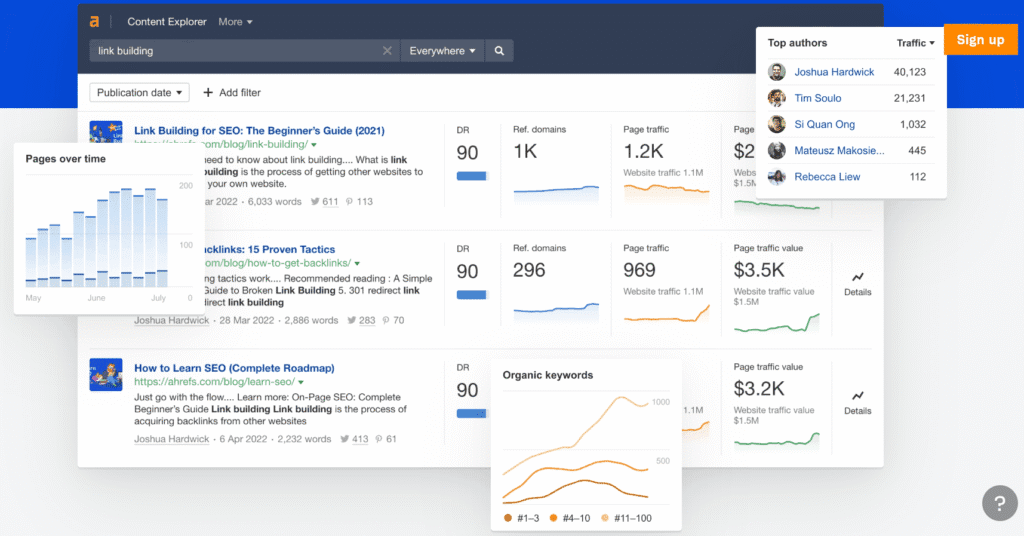
While Ahrefs doesn’t have a writing assistant, it shines in content discovery and analysis with:
- Content Explorer: Search over a billion pages to find what’s performing best.
- Top Pages Report: Identify top traffic-driving pages on any domain.
- Keyword Insights: Analyze which keywords offer the best content potential.
Ahrefs is perfect for understanding what type of content ranks, while SEMrush helps you create content that ranks.
Key Differences
- SEMrush is best for content creators who want to optimize as they write.
- Ahrefs is better for content strategists who focus on data-driven research.
If you’re a writer or marketer publishing frequently, SEMrush is the more complete tool. For competitive content research, Ahrefs is invaluable.
Competitor Analysis Features
Both SEMrush vs Ahrefs are fantastic for uncovering what’s working in your niche — but they approach competitor data differently.
🔹 SEMrush Competitor Tools
With SEMrush, you can easily identify and benchmark against your competitors through:
- Domain Overview for traffic and keyword data.
- Traffic Analytics for engagement metrics.
- Organic Research for ranking keywords and SERP features.
- Keyword Gap and Backlink Gap tools for missed opportunities.
The ability to compare multiple domains at once makes SEMrush ideal for agencies or teams running cross-market analyses.
Ahrefs Competitor Analysis Tools
Ahrefs focuses on deep, SEO-specific insights with tools like:
- Site Explorer for backlinks and organic keywords.
- Content Gap for missing keyword opportunities.
- Top Pages Report for traffic-driving content.
- Competing Domains Report for identifying similar sites.
Ahrefs gives you the precision to reverse-engineer competitor strategies effectively.
Key Differences
- SEMrush provides broader analytics and marketing insights.
- Ahrefs delivers deeper SEO data and backlink intelligence.
If you want traffic estimates and multi-domain comparisons, SEMrush wins. For pure SEO analysis, Ahrefs is the clear choice.
Reporting and Dashboards
Finally, reporting is what ties everything together. When comparing SEMrush vs Ahrefs, both offer strong dashboards — but SEMrush takes the lead for custom reporting.
SEMrush Reporting
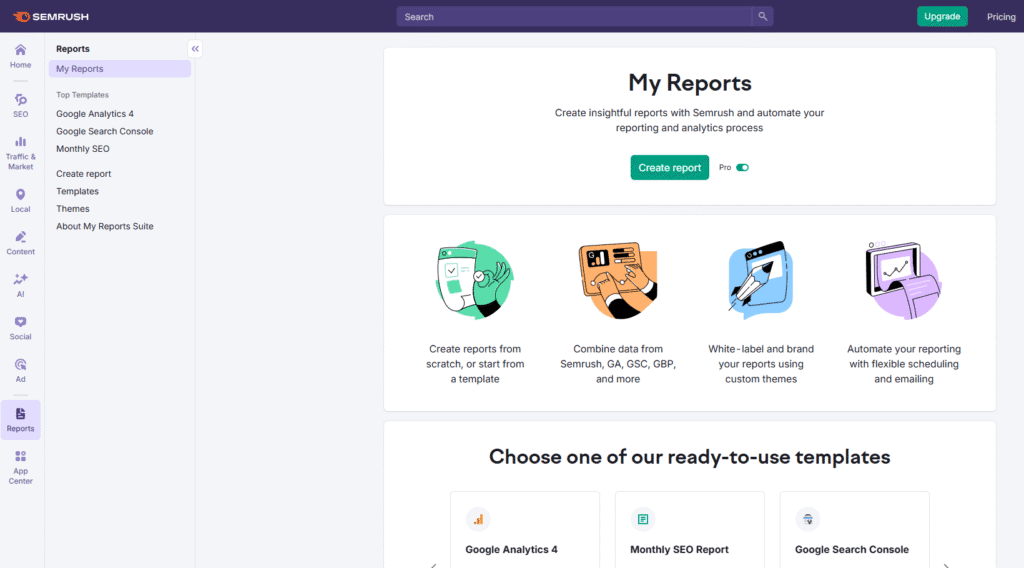
I love SEMrush’s My Reports feature. It allows you to:
- Create drag-and-drop custom PDF reports.
- Use ready-made templates (SEO audit, keyword, backlink, etc.).
- Schedule automated reports (daily, weekly, monthly).
- Integrate with Google Analytics and Search Console.
The main SEMrush dashboard also gives you a quick pulse on project health, ranking changes, backlinks, and audit results — perfect for clients or teams.
Ahrefs Reporting and Dashboards
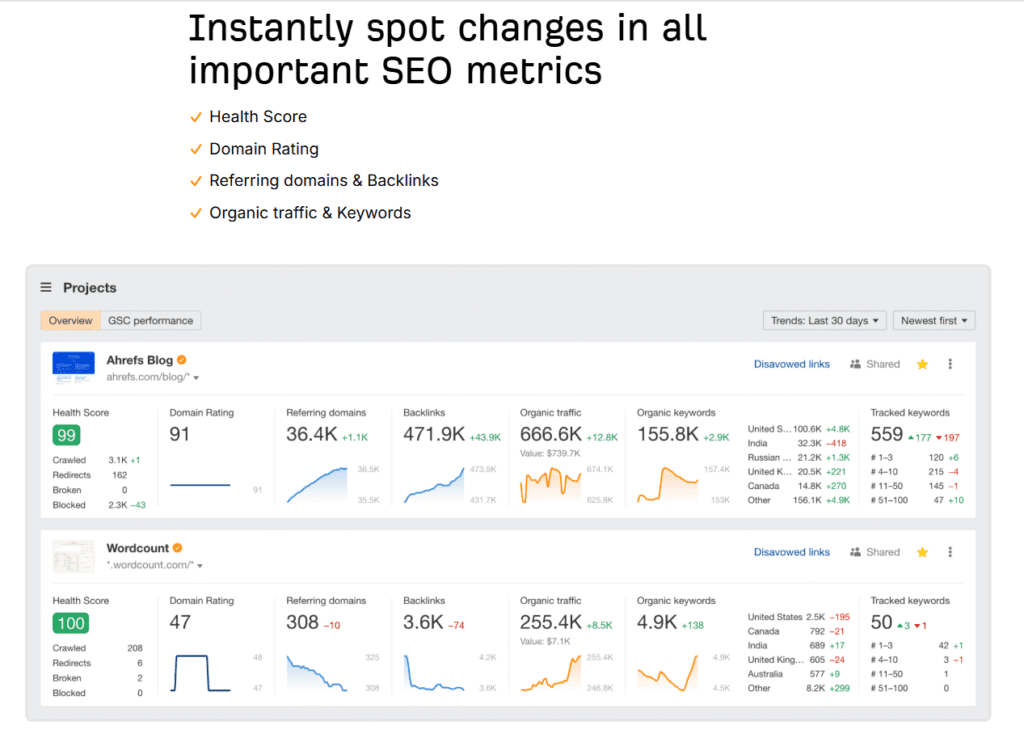
In my experience testing both platforms, I found that Ahrefs takes a more data-focused approach to reporting compared to SEMrush. While it doesn’t include a traditional drag-and-drop report builder, Ahrefs shines with its interactive dashboards and quick-access exports — ideal for SEOs who prefer analyzing data directly or integrating it into their own systems.
Here’s what stands out in Ahrefs’ reporting and dashboard capabilities:
- Real-Time Dashboards: Every core tool — including Site Explorer, Rank Tracker, and Site Audit — displays live, visual performance metrics for faster insights.
- Quick Data Exports: You can easily export reports in CSV or PDF format, making it simple to analyze results externally or share them with clients.
- Visual Insights: Ahrefs includes built-in graphs, bar charts, and trend lines that make it easier to visualize performance trends and backlink growth.
- Scheduled Email Reports: For ongoing tracking, Ahrefs allows automated email summaries for Rank Tracker and Site Audit — a great feature for staying updated without logging in daily.
In my experience, this structure is perfect if you value speed, simplicity, and raw data access over branded, client-facing reports. While it’s not as customizable as SEMrush, the efficiency and accuracy of Ahrefs’ reporting make it a go-to for professionals who prefer working with real-time SEO insights.
Key Differences
- SEMrush is the better choice if you need polished, client-ready reports with templates, branding, and scheduled automation.
- Ahrefs, on the other hand, is built for hands-on SEOs who prefer live dashboards, quick exports, and direct data manipulation.
If you manage multiple clients and want presentation-ready reports, SEMrush will save you time. But if you thrive on data-driven SEO analysis and custom insights, Ahrefs delivers the flexibility and precision you’ll appreciate.orting tools.
Integrations and APIs: Which Tool Actually Plays Well With Others?
Here’s something that doesn’t get enough attention in most SEMrush vs Ahrefs comparisons: it’s rarely just about the tool itself. It’s about how well it fits into everything else you’re already using. Your CMS, your reporting stack, your project management setup, your client dashboards. A great SEO tool that lives in isolation is only half as useful as it should be.
This is an area where the two platforms have made very different decisions — and honestly, it shows.
SEMrush: Built to Connect
SEMrush clearly designed its platform with the assumption that you’re already using a dozen other tools — and it wants to talk to all of them. In practice, that means:
Google Analytics and Search Console plug directly in, pulling live performance data into SEMrush so you’re not constantly switching tabs to cross-reference numbers. Google Data Studio integration means you can build automated, live SEO dashboards that update without you touching them — a genuine time-saver when you’re producing regular client reports.
The WordPress plugin is something I’ve found underrated. Being able to run the SEO Writing Assistant inside WordPress while you’re actually writing — rather than copy-pasting between tools — removes a lot of unnecessary friction from the content workflow.
Then there’s the Trello and Monday.com integration. Sounds minor. It isn’t. Being able to push SEO recommendations directly into your team’s project management system means technical fixes actually get actioned instead of sitting in a spreadsheet nobody checks.
For advanced users, the SEMrush API (unlocked on the Business plan) opens up custom integrations, automated reporting pipelines, and direct access to raw keyword, backlink, and domain data. If you’ve got a developer on your team or you’re building internal tools, this is where SEMrush gets seriously powerful.
Ahrefs: Fewer Connections, But Intentionally So
Ahrefs doesn’t try to integrate with everything. That’s not an oversight — it’s a philosophy. The platform is built around the idea that its data is the product, and your job is to extract it cleanly and use it however you need.
In practice, that means:
Google Search Console integration for cross-referencing your actual performance data with Ahrefs’ metrics — useful for spotting gaps between what GSC reports and what Ahrefs sees. CSV and PDF exports that are clean and reliable — not glamorous, but when you’re pulling data into your own reporting setup, you just want it to work. Email alerts for rank tracking and new backlinks — simple, but effective for staying on top of changes without logging in every day.
The Ahrefs API is genuinely powerful — Site Explorer data, full backlink index access, keyword metrics — but there’s a catch worth mentioning plainly: it’s locked behind the Enterprise plan or a separate subscription. For smaller teams or solo operators, that’s not a realistic option. You’re not getting API access unless you’re already spending significantly.
The Real Difference Here
SEMrush is built for marketers who need plug-and-play connectivity across their entire stack. If you want your SEO tool talking to your CMS, your analytics, your social scheduler, and your project management tool — SEMrush does that without requiring technical heavy lifting.
Ahrefs is built for people who know exactly what data they need and have the setup to use it. Less hand-holding, less native connectivity, but cleaner data access for those who know how to work with it.
Neither approach is wrong. They just assume very different kinds of users on the other end.
Customer Support & Training: SEMrush vs Ahrefs
Reliable customer support and accessible training resources can make a big difference—especially when you’re using complex SEO tools. When comparing SEMrush vs Ahrefs, both platforms offer support and learning materials, but their approaches differ in depth and accessibility.
SEMrush Customer Support & Training
SEMrush provides multi-channel customer support, including:
- Live chat support
- Email support
- Phone support (for higher-tier plans)
SEMrush also excels in training and onboarding, offering:
- SEMrush Academy: Free, in-depth courses and certifications on SEO, content marketing, PPC, and using the platform.
- Webinars & Live Demos: Regular sessions covering new features and SEO trends.
- Help Center: Detailed articles, how-to guides, and troubleshooting resources.
For users who are new to SEO or the platform, SEMrush offers step-by-step tutorials and onboarding emails, making it very beginner-friendly.
Ahrefs Customer Support & Training
Ahrefs provides email-based customer support, which is reliable but not as immediate as live chat. It does not currently offer live chat or phone support.
In terms of training and resources, Ahrefs delivers excellent value through:
- Ahrefs Blog: Highly detailed guides and case studies written by SEO experts.
- YouTube Channel: One of the best free learning hubs for SEO tutorials, strategies, and tool walkthroughs.
- Help Center: Offers documentation and FAQs on using Ahrefs effectively.
Ahrefs focuses on self-paced learning and provides actionable content geared toward intermediate and advanced SEO users.
Key Differences
- SEMrush offers more direct support options, including live chat and phone, along with structured courses for certification.
- Ahrefs leans into community education, offering expert-level content via blog and YouTube, but with limited support contact options.
If you value real-time support and guided learning, SEMrush is a better choice. If you’re comfortable with learning through content and video tutorials, Ahrefs provides plenty of depth.
Pros and Cons of SEMrush and Ahrefs
Every tool has weaknesses. The problem with most SEMrush vs Ahrefs comparisons is they list “cons” that are so mild they barely register — like saying a Ferrari’s con is “it’s fast.” So here’s my actual take, based on real usage, not press releases.
SEMrush: What It Gets Right and Where It Frustrates
The genuine strengths:
It’s the closest thing to an all-in-one marketing platform in this space. SEO, PPC research, content marketing, social scheduling — it all lives under one roof. For agencies especially, that consolidation has real operational value. Fewer subscriptions, fewer logins, fewer tools to train new team members on.
The content marketing toolkit — SEO Writing Assistant, Topic Research, Content Audit — is something Ahrefs simply doesn’t match. If you’re producing content at volume and need guidance baked into your writing workflow, SEMrush built those features with you specifically in mind.
Reporting is genuinely good. Drag-and-drop builder, branded templates, automated delivery to clients. If you’ve ever spent a Sunday afternoon manually compiling an SEO report, you’ll understand why this matters more than it sounds.
The integration depth — Google Analytics, Search Console, WordPress, Data Studio — means SEMrush fits into an existing marketing stack without forcing you to change how you work.
And for newer SEOs: the guided, project-based interface with tooltips and tutorials makes the learning curve far less steep than it could be given the platform’s complexity.
Where it genuinely falls short:
Let’s be straight — $139.95/month to start is a real commitment. For a freelancer with two or three clients, or a small business owner just getting into SEO, that price tag creates genuine pressure to justify the spend every single month.
The other honest critique: SEMrush can feel like a lot. Open it for the first time and you’re staring at dozens of tools, reports, and menu items. If all you need is keyword research and a site audit, the sheer volume of features can feel more like noise than value. Power users love the depth. Everyone else sometimes just wants to find what they’re looking for without a five-minute navigation session.
Ahrefs: What It Nails and Where It Falls Short
The genuine strengths:
The backlink index is the best available outside of Google. That’s not hyperbole — it’s the industry consensus, and it holds up in practice. Frequent updates, massive scale, and data you can actually trust when you’re making decisions about link building strategy.
The interface is fast and clean in a way that feels intentional. Ahrefs made a deliberate choice to not be everything to everyone, and the product reflects that. Experienced SEOs who know what they’re looking for can move through it quickly without fighting the UI.
Something that doesn’t get enough credit: Ahrefs’ educational content is genuinely excellent. Their blog and YouTube channel have taught a meaningful percentage of working SEOs how to do their jobs better. That’s a strange thing to list as a product advantage, but when you’re learning the platform, having world-class learning resources attached to it matters.
Keyword data and click metrics are among the most reliable in the industry. The keyword difficulty scores feel grounded in reality rather than inflated to make targets seem achievable. And the international database coverage makes it a serious tool for anyone doing global SEO — not an afterthought feature.
Where it falls short:
No free trial anymore. That one still stings. Paying a full month upfront just to properly evaluate the tool is a real barrier, especially when SEMrush lets you test drive for seven days at no cost.
And despite its strengths, Ahrefs isn’t built for content marketers or PPC managers. If your SEO work doesn’t exist in isolation — if it connects to paid campaigns, content calendars, or social strategy — you’ll constantly feel the edges of what Ahrefs is designed to do.
SEMrush vs Ahrefs: Which One is Right for You?
After everything we’ve covered, I want to give you a straight answer — not a cop-out “it depends” wrapped in bullet points. So let me put it this way: the right tool is the one that matches how you actually work, not the one with the longest feature list.
Here’s how I’d think about it honestly.
You’ll probably be happier with SEMrush if…
You’re wearing multiple hats. If your week involves writing content, running Google Ads, tracking social performance, and doing SEO — SEMrush is built for that reality. The SEO Writing Assistant, Topic Research tool, and branded client reporting aren’t just nice extras. For content-heavy teams and agencies, they’re genuinely part of the workflow. SEMrush is also the more forgiving tool if you’re still finding your footing in SEO. The guided experience and integrations with Google Analytics, Google Search Console, and WordPress mean less time figuring out the tool and more time actually using it.
You’ll probably be happier with Ahrefs if…
You know exactly what you’re doing and you want data — clean, fast, and deep. If backlink analysis, keyword gap research, and reverse-engineering competitor content make up the core of your SEO work, Ahrefs just gets out of your way and lets you do it. There’s no clutter. No PPC dashboard you’ll never open. No social media tracker quietly judging you. Just sharp, reliable SEO data presented without unnecessary noise. Experienced SEOs tend to gravitate here for a reason.
The budget angle — since we’re being honest
If money is genuinely tight right now, Ahrefs gives you a lower entry point with the Starter and Lite plans. But don’t choose purely on price — a cheaper tool that doesn’t fit your workflow costs you more in wasted time than the price difference ever saves you.
My actual take on SEMrush vs Ahrefs?
They’re not really competing for the same person. SEMrush is a marketing platform that includes powerful SEO tools. Ahrefs is an SEO tool that does one thing at an elite level. Once you see it that way, the decision usually makes itself.
Pick the one that fits the work you’re already doing — not the work you imagine you might do someday.
If you’re choosing between email tools, this breakdown of email marketing platforms like MailerLite vs ActiveCampaign can help you decide.

👉 Try The Leading SEO Tools
If you’re exploring email marketing tools, Constant Contact for email marketing is a popular option for small businesses.

Disclosure: This article may contain affiliate links. If you make a purchase through these links, I may earn a commission at no extra cost to you. All opinions are based on hands-on testing and independent research.