
I’ll be straight with you — I almost went with Kartra.
The sales page looked great, the feature list was impressive, and everyone in the marketing communities I’m part of seemed to swear by it. But something made me pause and dig deeper. That’s when Systeme.io showed up on my radar, and what followed was weeks of testing both platforms inside actual campaigns — not just clicking around dashboards.
Here’s what surprised me: the price difference between Systeme.io and Kartra is massive, but the gap in features? Much smaller than I expected. And depending on what you’re actually trying to build, the “expensive” option isn’t always the smarter one.
This Systeme.io vs Kartra comparison isn’t a feature-by-feature checklist you could find anywhere. It’s based on what I ran into while setting up real funnels, automating email sequences, and trying to get things done without a dev team. I’ll tell you where each platform genuinely shines, where it frustrated me, and — most importantly — which one is worth your money based on where you are right now in your business.
Table of Contents
Ease of Use & Interface: First Impressions Matter More Than You Think
Let me tell you what happened the first time I logged into each platform — because the contrast was immediately obvious.
Systeme.io: You’re Up and Running Before You Expect To Be
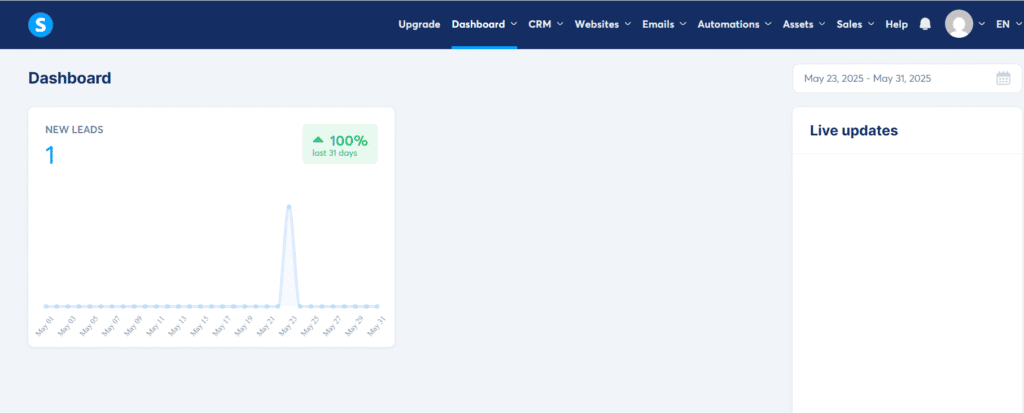
I logged into Systeme.io on a Tuesday afternoon with no tutorial, no onboarding call — just me and the dashboard. Within about 20 minutes, I had a basic funnel skeleton set up. That’s not me bragging about my tech skills; that’s genuinely how straightforward the interface is.
Everything lives where you’d logically expect it to. Funnels, emails, courses, automation — they’re all one click away from the main dashboard, not buried inside submenus or hidden behind upgrade prompts. The drag-and-drop editor doesn’t try to be fancy, and honestly, that’s a feature not a flaw. It loads fast, responds well, and doesn’t crash when you’re mid-edit — which, if you’ve used some other builders, you know isn’t guaranteed.
What I appreciated most was that Systeme.io doesn’t assume you know what you’re doing — and it doesn’t make you feel bad about it either. The templates are practical rather than just pretty, and building your first funnel in this Systeme.io vs Kartra comparison genuinely feels like the platform is working with you.
One honest observation though: if you’re used to highly customized, pixel-perfect design control, the simplicity can feel slightly limiting after a while. It’s a tradeoff — you gain speed, but you give up some creative flexibility.
Kartra: More Powerful, But It Demands Your Attention
I’m not going to sugarcoat this — my first hour inside Kartra was genuinely confusing.
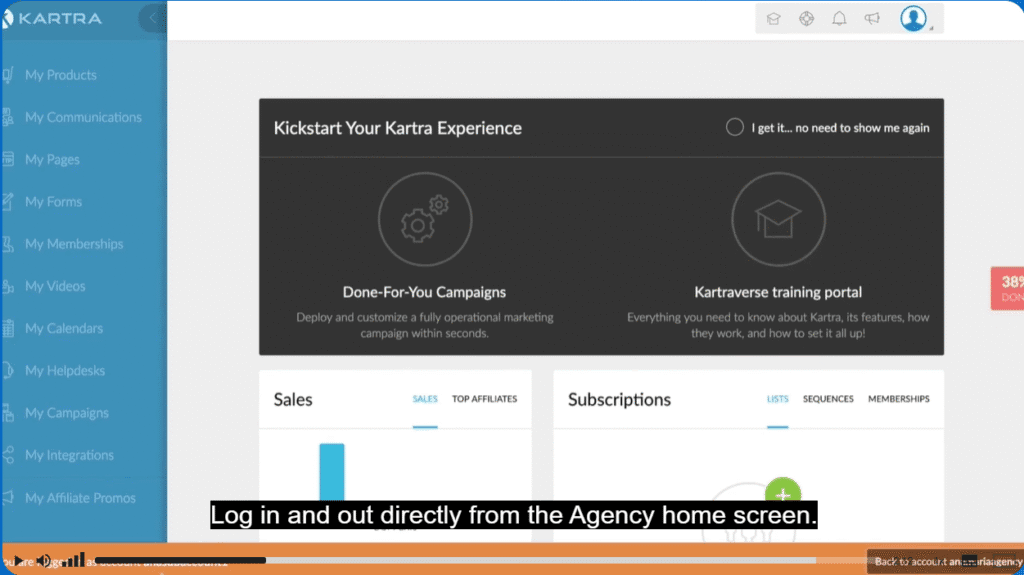
Not because the platform is poorly built. It’s actually impressively put together. But when you log in for the first time, you’re looking at a dashboard that’s trying to hand you everything at once — CRM, video hosting, helpdesk, calendar scheduling, behavioral automation, membership portals. It’s like walking into a professional kitchen when you asked for a place to make toast.
I actually closed the tab, made a coffee, and came back.
The second session went better. And by the third, something clicked — Kartra’s complexity starts making sense once you understand that it’s designed for marketers who think in systems, not just tools. Every feature connects to another. Your emails talk to your funnels. Your funnels talk to your CRM. Your CRM triggers your automations. Once you see that logic, the busy dashboard stops feeling chaotic and starts feeling deliberate.
That said, there’s no pretending the onboarding is smooth. Some features require you to watch a walkthrough before they’re even usable — not because they’re broken, but because they assume a certain level of marketing knowledge going in. If you’re comparing Systeme.io vs Kartra as a beginner, this gap will feel significant in the early weeks.
The guided setup prompts help, but they only go so far. Where Systeme.io holds your hand, Kartra hands you a manual and expects you to read it.
Is that a dealbreaker? For the right person, absolutely not. But you need to walk in with realistic expectations — and probably block out a proper learning weekend before you go live with anything.
Sales Funnel Builder: Where the Two Platforms Think Very Differently
If there’s one area where the Systeme.io vs Kartra difference becomes crystal clear, it’s the funnel builder. Not because one is broken and one isn’t — but because they were clearly designed with completely different users in mind.
Systeme.io: Built for Getting Live Fast
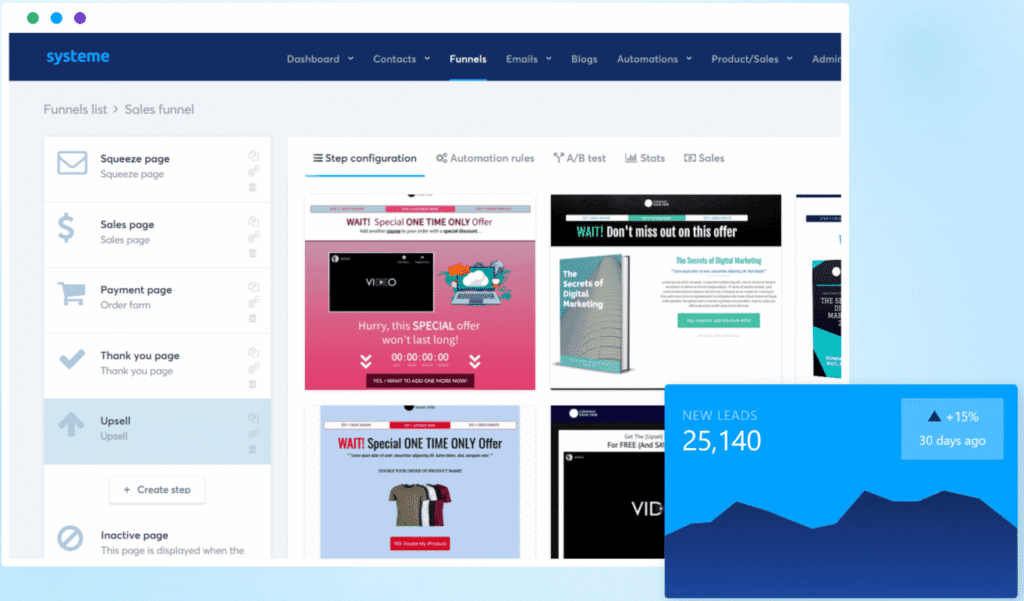
Here’s something I genuinely didn’t expect — I had a working sales funnel live in under 20 minutes the first time I used Systeme.io. Opt-in page, sales page, thank-you page, email sequence triggered on signup — all of it, inside one interface, without touching a single line of code or opening a YouTube tutorial.
The funnel builder is drag-and-drop, but what makes it actually useful isn’t the drag-and-drop part — it’s the fact that your funnel steps, automation rules, and email sequences are all connected in the same workflow. You’re not jumping between five different sections to wire things together. You set up a step, attach a rule, move to the next. It flows.
The templates are practical rather than flashy. You get solid starting points for lead generation, product launches, webinar signups, and course sales — nothing groundbreaking, but everything is set up in a way that a first-timer can actually understand and customize without accidentally breaking something.
Now, where does it fall short? The A/B testing and funnel analytics are genuinely basic. You can run a split test, but the data you get back is fairly surface-level. If you’re the type of marketer who makes decisions based on heatmaps, scroll depth, and conversion rate by traffic source — you’re going to hit a ceiling here fairly quickly. For a solopreneur launching their first offer? Probably not a dealbreaker. For someone scaling an established funnel? It might be.
Kartra: The Funnel Builder That Rewards You for Knowing What You’re Doing
Let me tell you what changed my opinion of Kartra’s funnel builder — because my first impression wasn’t great.
Initially, it felt like too much. Too many options, too many settings, too many places where one wrong click sent me down a rabbit hole I wasn’t ready for. But after spending more time inside it — actually building a funnel from scratch rather than just exploring the interface — I started to see why experienced marketers are so loyal to this platform.
Kartra’s funnel builder isn’t just a page editor. It’s a system. You can set conditional redirects based on what a visitor did or didn’t do. You can build branching logic that sends one buyer down a completely different path than another based on which product they purchased. Upsells, downsells, and order bumps are baked natively into the checkout flow — you’re not patching together third-party tools to make a one-click upsell work. It just works, out of the box.
The feature that genuinely impressed me was Kartra Campaigns. The idea is simple — instead of building a funnel from scratch every time, you can import a pre-built campaign that includes landing pages, email sequences, and automation rules all wired together. Some of these come from well-known marketers, and the quality shows. For anyone managing campaigns across multiple clients, this alone can save hours of setup time per project.
Where Kartra also pulls ahead in this Systeme.io vs Kartra comparison is analytics. The split testing goes deeper than a basic winner/loser report — you’re looking at behavioral data, lead scoring, and engagement tracking that actually helps you make smarter decisions about where your funnel is leaking.
But here’s the honest part: none of this is useful to you if you’re not ready for it. If you’re still figuring out what a thank-you page redirect is supposed to do, Kartra’s advanced setup will slow you down, not speed you up. The power is real — but it comes with the assumption that you already understand funnel strategy at a reasonable level. Walk in underprepared and you’ll spend more time inside help docs than inside actual campaigns.
Email Marketing & Automation: Where Your Relationship With Subscribers Actually Gets Built
Funnels get the glory, but email is where the money actually lives — and how each platform handles automation tells you a lot about who it was built for.
Systeme.io: No Setup Headaches, Just Send
The thing that struck me most about Systeme.io’s email tools wasn’t any single feature — it was how little stood between me and a live email sequence. No third-party integrations to configure, no API keys to copy-paste, no deliverability settings to stress about before sending your first campaign. You connect your list, write your emails, set your triggers, and you’re running.
For someone who’s spent time wrestling with Mailchimp integrations or debugging why ActiveCampaign isn’t talking to their funnel builder, this kind of built-in simplicity is genuinely refreshing.
The automation is trigger-based and straightforward — someone joins your list, buys a product, or fills out a form, and a sequence fires. Tag-based segmentation lets you organize subscribers without building complicated logic trees. And the fact that even the free plan includes unlimited email sends is something worth stopping on — most competitors gate that feature behind paid tiers.
Where it shows its limits is in behavioral depth. If you want to trigger an email based on whether someone opened your last three messages, or visited a specific page but didn’t buy — Systeme.io isn’t quite there yet. The triggers are solid for standard workflows but thin for anything that requires reading between the lines of subscriber behavior.
For coaches, solo creators, and small business owners who want a clean, functional email system without a learning tax — Systeme.io does the job well and gets out of your way.

Kartra: Email Automation That Actually Thinks With You
Here’s where Kartra starts pulling noticeably ahead for a specific type of marketer — and I want to be precise about who that is, because it’s not everyone.
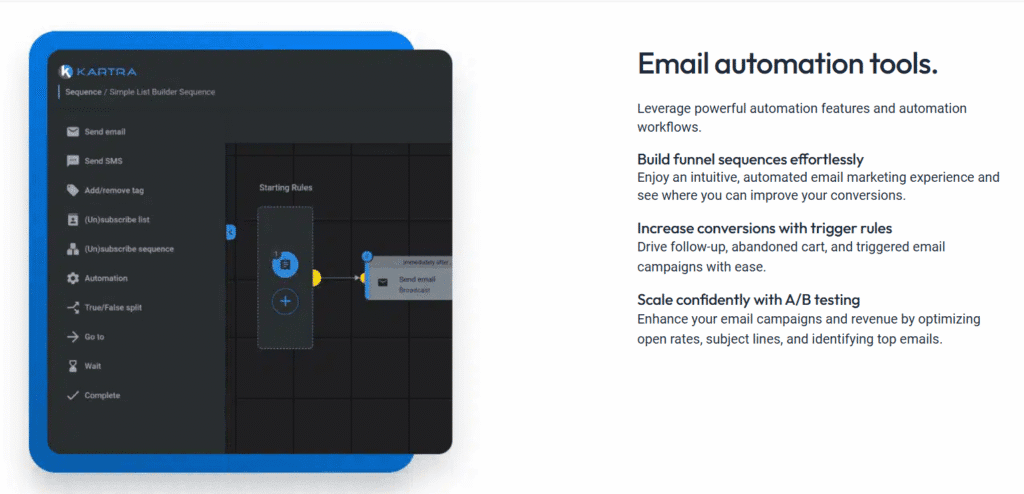
When I got into Kartra’s automation builder properly, the first thing I tested was behavior-based triggers — and the difference from Systeme.io became immediately obvious. In Kartra, you’re not just reacting to what someone did. You’re reacting to the combination of what they did, what they didn’t do, and how engaged they’ve been over time. Someone clicked your email but didn’t buy? Trigger a different follow-up sequence. Someone watched 75% of your sales video but still hasn’t checked out? Send them a specific nudge — not your generic broadcast. That level of responsiveness isn’t a luxury for serious campaigns. It’s the difference between email marketing that feels personal and email marketing that feels like a newsletter blast.
The lead scoring system was another thing that genuinely impressed me during testing. As subscribers interact with your emails, pages, and products, Kartra quietly assigns scores in the background. Your hottest leads — the ones opening everything, clicking links, watching videos — bubble up automatically. You’re not guessing who to follow up with. The platform tells you.
What also stood out in this Systeme.io vs Kartra comparison is how the email tools don’t exist in isolation. Your automation sequences talk directly to your funnels, your helpdesk, your calendar, and your CRM. If a lead books a call through Kartra’s calendar, an automation can fire immediately — tagging them, shifting them into a new sequence, updating their lead score. Everything is connected because it was all built inside the same system, not stitched together through integrations.
Now the honest part — setting all of this up takes real time. The visual automation builder is genuinely well-designed, but building a branching sequence with conditional logic from scratch isn’t something you knock out in an afternoon if you’re new to this. You need to understand your customer journey before Kartra’s depth becomes an asset. Walk in without that clarity and you’ll spend more time building automations than running them.
For marketers who are past the basics and running campaigns where every subscriber touchpoint needs to be deliberate — Kartra’s email system is hard to argue against.
Landing Page & Website Builder: Speed vs Creative Control
Before I get into the specifics, let me say something that most comparisons skip over — a page builder is only as good as how quickly it gets out of your way. The best one isn’t necessarily the most feature-rich. It’s the one that lets you go from blank canvas to live page without losing momentum. That framing matters a lot in this Systeme.io vs Kartra comparison.
Systeme.io: The Builder That Respects Your Time
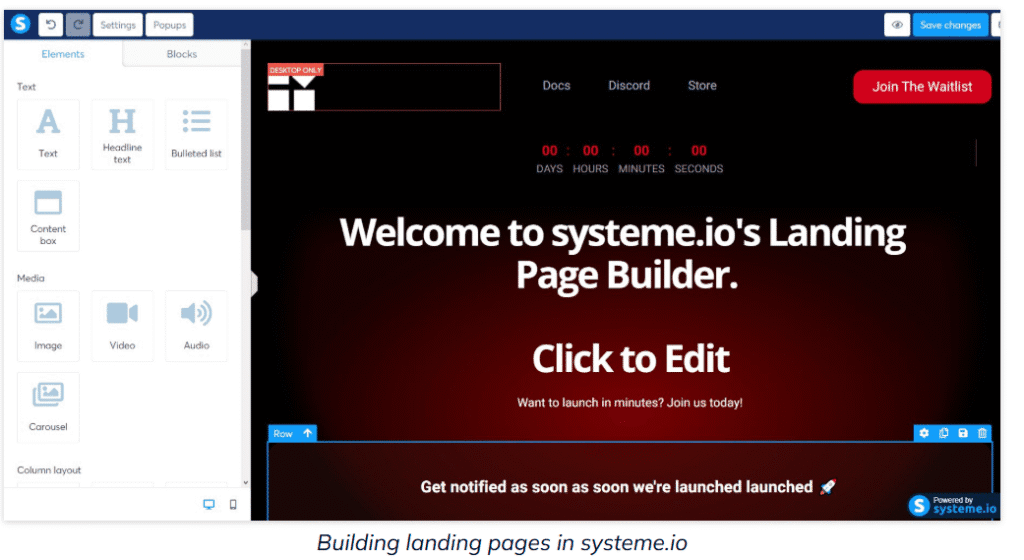
I’ll be direct — Systeme.io’s page builder won’t win any awards for design sophistication. But that’s almost beside the point for the audience it’s built for.
What it does exceptionally well is remove friction. I opened a blank funnel, picked a template, and had a customized opt-in page live in about 15 minutes — including swapping out colors, rewriting the headline, and connecting it to an email sequence. No mysterious settings panel, no elements that refuse to align properly, no mobile preview that looks nothing like the desktop version. It just behaves the way you expect it to.
The templates cover the essentials cleanly — opt-in pages, sales pages, checkout pages, thank-you pages, webinar registrations. They’re not the most visually striking designs you’ve ever seen, but they’re structured around conversion logic rather than aesthetics, which honestly matters more when you’re trying to build something that performs.
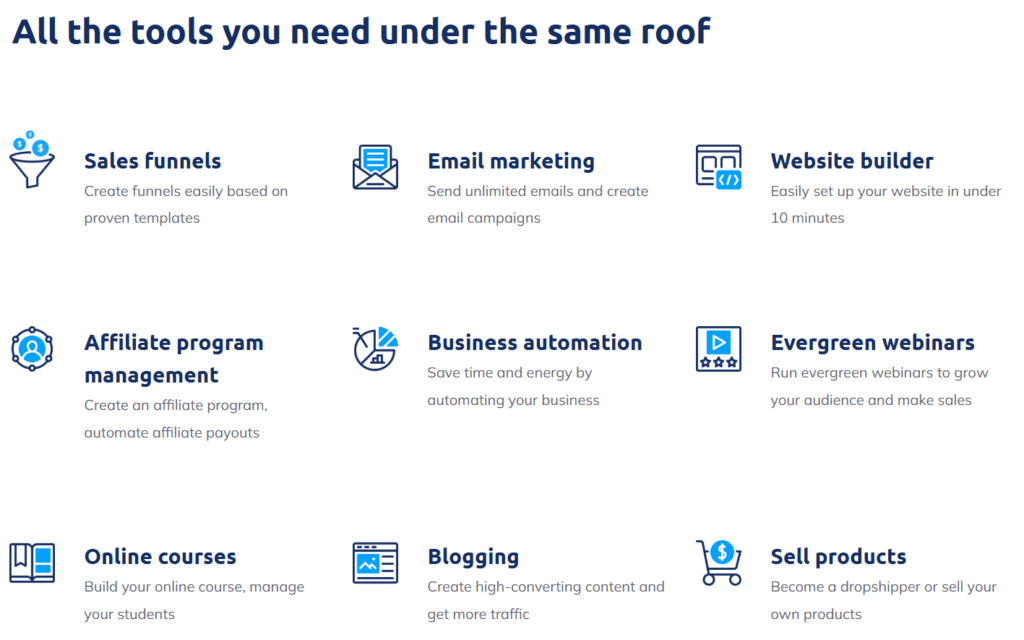
What surprised me was discovering that Systeme.io isn’t just a landing page tool — you can build a fully functional website with it. Custom URLs, navigation menus, multiple interconnected pages — the whole thing. For a coach, course creator, or affiliate marketer who doesn’t want to pay separately for a website platform and a funnel builder, this effectively solves two problems with one subscription.
The honest limitation? Design flexibility has a ceiling. If you have a strong brand identity and you want pixel-perfect control over spacing, custom fonts, or complex section layouts — you’ll hit that ceiling faster than you’d like. The builder is fast and reliable, but it trades creative freedom for simplicity. For most beginners, that’s a reasonable tradeoff. For anyone with a more established brand presence, it can start feeling restrictive.
Kartra: When Your Page Builder Needs to Do More Than Look Good
I want to start with something honest — Kartra’s page builder has a steeper entry point, but once you’re past it, the gap between what you can build here versus Systeme.io becomes very visible.
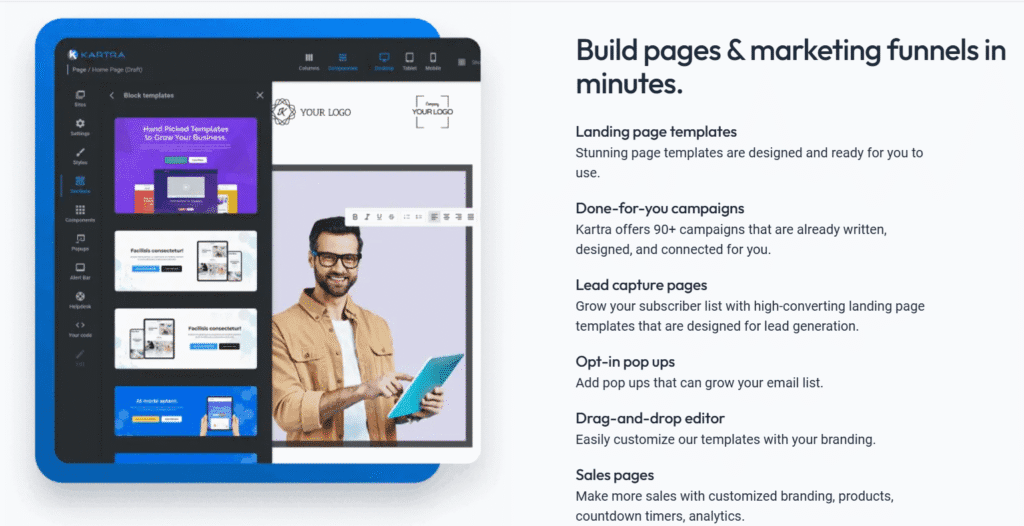
The first difference I noticed wasn’t the design options — it was the template organization. Rather than dumping every template into one scrollable gallery, Kartra organizes them by campaign objective. Product launch, lead generation, event signup, webinar registration — you’re not just picking something that looks nice, you’re picking something built around a specific conversion goal. That’s a subtle but meaningful distinction when you’re trying to build pages that actually perform.
The editor itself gives you a level of control that Systeme.io simply doesn’t offer. Spacing, layering, custom fonts, section backgrounds, element positioning — you can get genuinely precise here. And the dynamic content blocks — countdown timers, video embeds, testimonial sections, pricing tables — aren’t just cosmetic additions. They’re built to be dropped into a page and connected to your broader campaign logic without needing a separate tool for each one.
What stood out most during my testing was the built-in A/B split testing. In Systeme.io, split testing exists but the data you get back is fairly basic. In Kartra, you’re running tests with actual statistical context — comparing page variants based on real conversion data and making decisions from a place of evidence rather than gut feeling. For anyone running paid traffic, this feature alone can pay for the platform’s higher price tag if it helps you improve conversion rates even marginally.
The SEO and metadata controls also deserve a mention — particularly in this Systeme.io vs Kartra comparison. Being able to manage page titles, descriptions, and indexing settings from inside the same platform where you’re building your funnels means one less tool, one less login, one less thing to forget to update when you make changes.
The real limitation isn’t the builder itself — it’s the time investment required to use it properly. Building a high-quality page in Kartra takes longer than building one in Systeme.io. Not because the interface is broken, but because the options are genuinely extensive and using them well requires knowing what you want before you start. Come in without a clear plan and you’ll spend more time tweaking than publishing.
For marketers running serious campaigns where brand consistency, data-driven optimization, and design precision all matter — Kartra’s page builder is in a different league. Just make sure you’re ready to use what it’s offering.

Course & Membership Features: Building Something People Actually Stay For
Selling a course is one thing. Building an experience that students complete, talk about, and come back for — that’s a different challenge entirely. And how each platform handles this reveals a lot about their priorities.
Systeme.io: Gets Your Course Live Without the Complexity Tax
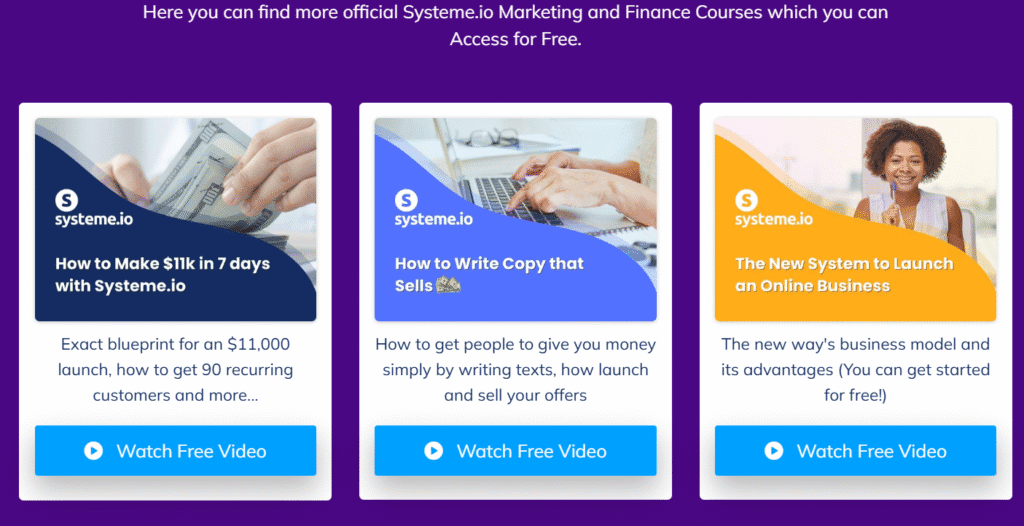
When I built a test course inside Systeme.io, the thing that struck me wasn’t any single feature — it was how few decisions I had to make before the course was actually functional. Create a course, add modules, upload lessons, connect a checkout page, set up a welcome email sequence. Done. No plugin conflicts, no separate membership platform to sync, no wondering whether your payment processor is properly connected to your access control settings.
The free plan supporting unlimited courses is genuinely unusual in this space. Most platforms either cap the number of courses, limit enrolled students, or lock course features behind higher tiers. Systeme.io doesn’t, which makes it a surprisingly capable starting point for creators who are still testing whether their course idea has legs before investing in more expensive infrastructure.
Drip content scheduling works cleanly — you set lessons to unlock on specific days after enrollment and it just runs without you touching it. Password-protected member areas are straightforward to set up. And because everything lives inside the same ecosystem as your funnels and email sequences, the post-purchase experience flows naturally. Someone buys, gets access, receives their welcome sequence, and starts their first module — all without you manually doing anything.
Where Systeme.io shows its limits is in the student experience layer. There’s no progress tracking that gives students a visual sense of how far they’ve come. No certificates on completion. No quizzes or assessments built into the lesson flow. No gamification elements that keep engagement high across a longer course. For a short, focused course where students just need the content delivered cleanly — none of that matters much. But if you’re building a flagship program where completion rate and student transformation are central to your reputation, these gaps start to matter more than you’d like.
In the broader Systeme.io vs Kartra comparison, Systeme.io’s course tools are best understood as a solid foundation — not a complete solution for everyone, but more than enough to validate an idea, launch a first product, and start generating revenue without overcomplicating the setup.

Kartra: Where Your Course Becomes a Complete Learning Business
Systeme.io is the go-to choice for creators who want to launch fast without technical complexity. The free plan’s unlimited courses is a standout advantage, and the seamless connection between checkout, access, and email automation makes the post-purchase experience effortless. The tradeoff is a limited student experience — no progress tracking, no completion certificates, no assessments — which is fine for simple, short courses but starts to show for more ambitious programs.
Kartra is built for creators who are running a learning business, not just hosting content. Multi-tier membership access, visible student progress tracking, customizable member dashboards, and native helpdesk and calendar integration all point to a platform designed for the long game. The setup takes more time and the price is higher — but for established course creators where student experience directly affects reputation and retention, that investment makes sense.
The one-line verdict:
- Choose Systeme.io if you’re validating your first course idea and need to launch without overthinking it.
- Choose Kartra if you’re building a professional learning environment where student experience, branding, and automation all need to work together at scale.
CRM & Contact Management: Knowing Your Leads vs. Actually Understanding Them
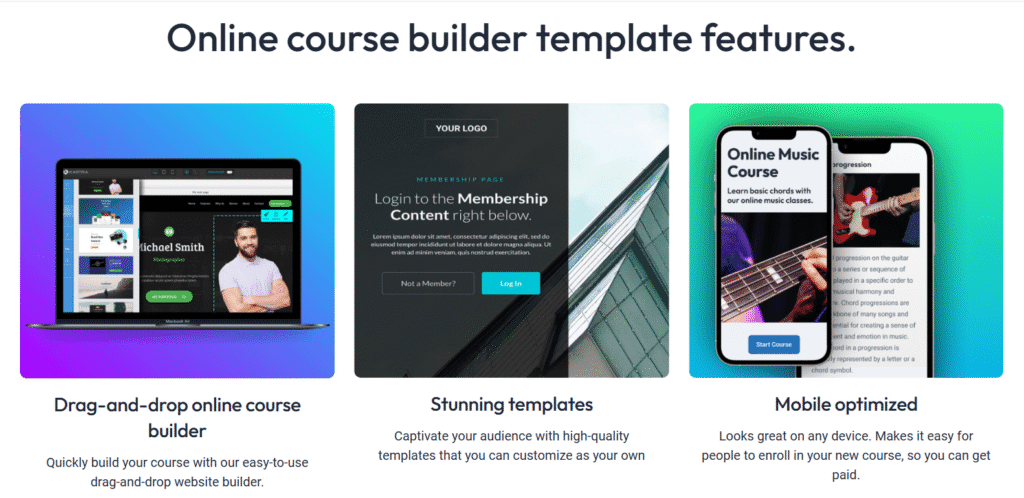
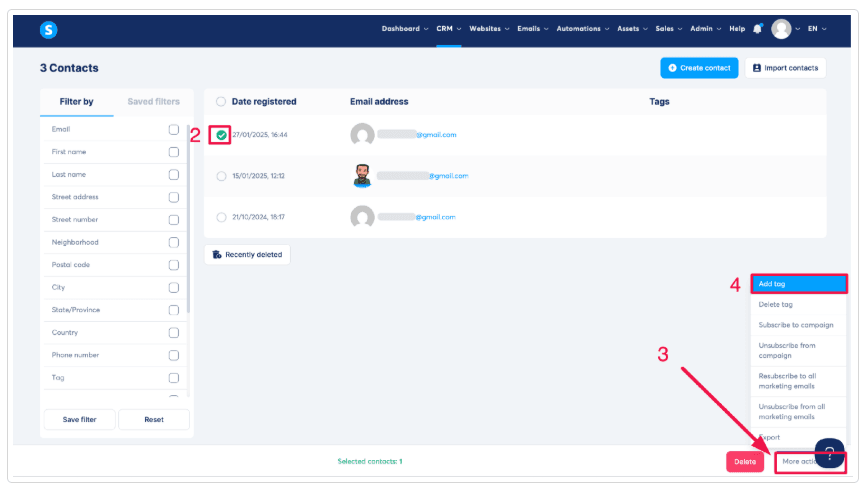
Systeme.io’s CRM isn’t trying to compete with dedicated tools like HubSpot or Salesforce — and honestly, for most of its users, it doesn’t need to. Tag-based segmentation, behavioral triggers, and automatic contact updates from funnel activity cover everything a solo operator or small team needs to manage leads without overcomplicating the process.
The gaps are real but predictable — no visual pipeline, no deal forecasting, no deep activity timeline. If your sales process involves multiple team members tracking deals through defined stages, you’ll outgrow this quickly. But if you’re a creator, coach, or solo marketer whose “CRM” mostly means knowing who’s hot, who’s cold, and what to say to each — Systeme.io handles that cleanly and without friction.
One-line verdict: It’s not a CRM for running a sales team — it’s a CRM for running a marketing funnel. Know which one you need before you decide it’s not enough.
Kartra: The CRM That Treats Every Contact Like a Story, Not a Row in a Spreadsheet
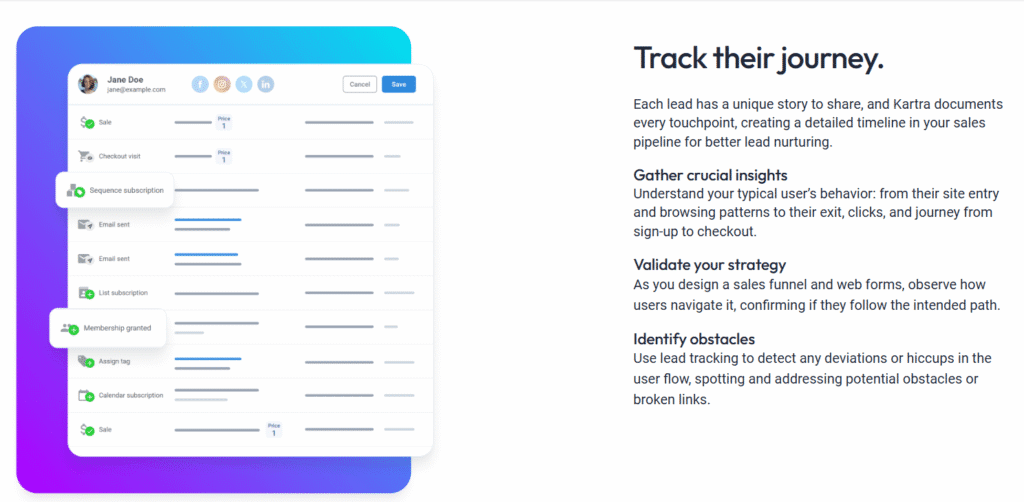
Kartra’s CRM operates on a fundamentally different level than Systeme.io’s. It doesn’t just store contact information — it builds a behavioral profile on every lead automatically. Page visits, video watch time, email clicks, cart abandonment — every interaction is logged, scored, and connected to automation triggers without any manual input from you.
The lead scoring system is the standout practical advantage — your highest-intent leads surface automatically, so you’re never guessing who to prioritize. And the full activity timeline on each contact means you always know exactly what a lead has seen and engaged with before you reach out — which changes the quality of every follow-up conversation.
The tradeoff is time. Getting Kartra’s CRM to work at its full potential requires real setup investment — defining scoring thresholds, building behavioral triggers, configuring custom fields. It’s not a system you plug in and run on day one.
One-line verdict: Systeme.io’s CRM tells you what your contacts did. Kartra’s CRM tells you what they’re likely to do next — and that difference is worth a lot if you’re running serious campaigns.
Final Verdict on CRM & Contact Management
If there’s one section in this Systeme.io vs Kartra comparison where the gap between the two platforms is most honest and most obvious — it’s this one.
Systeme.io gives you what you need to stay organized and follow up intelligently without spending three days configuring a system. For solo operators and small teams, that’s genuinely enough — and there’s real value in not overbuilding before your business actually demands it.
Kartra gives you something closer to a marketing intelligence layer — one that learns from your contacts’ behavior, scores their intent automatically, and tells you who to talk to, when, and with what message. That’s not a feature set for everyone. But for marketers running serious campaigns where timing and personalization directly affect revenue — it’s hard to put a price on.
Know what stage your business is at. Then pick accordingly.
Affiliate Management System
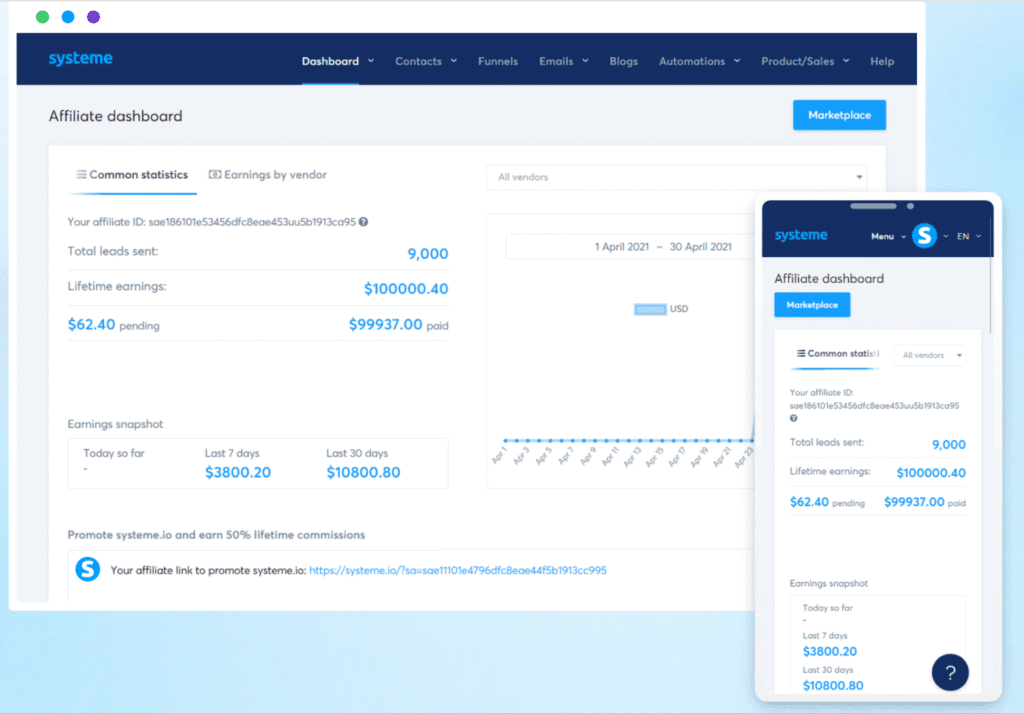
Here’s something that genuinely stands out in this Systeme.io vs Kartra comparison — Systeme.io gives you full affiliate management on the free plan. No upgrade required, no third-party tool to integrate, no monthly fee just to let partners promote your products. For a platform at this price point, that’s an unusual level of generosity.
Setting up an affiliate program took me under ten minutes during testing. Assign a commission rate, activate tracking on your funnel, generate affiliate links — done. Each affiliate gets their own dashboard showing clicks, conversions, and earnings in real time, which means fewer “how am I doing?” emails landing in your inbox.
The limitations are real but predictable. Commission structures are fairly flat — you’re not building multi-tier affiliate hierarchies or performance-based escalating rates here. And payouts are manual, which works fine at small scale but becomes tedious as your affiliate base grows.
For creators launching their first affiliate program and wanting partners promoting their products without expensive affiliate software — Systeme.io handles it cleanly and gets out of your way.
Affiliate Management: Kartra
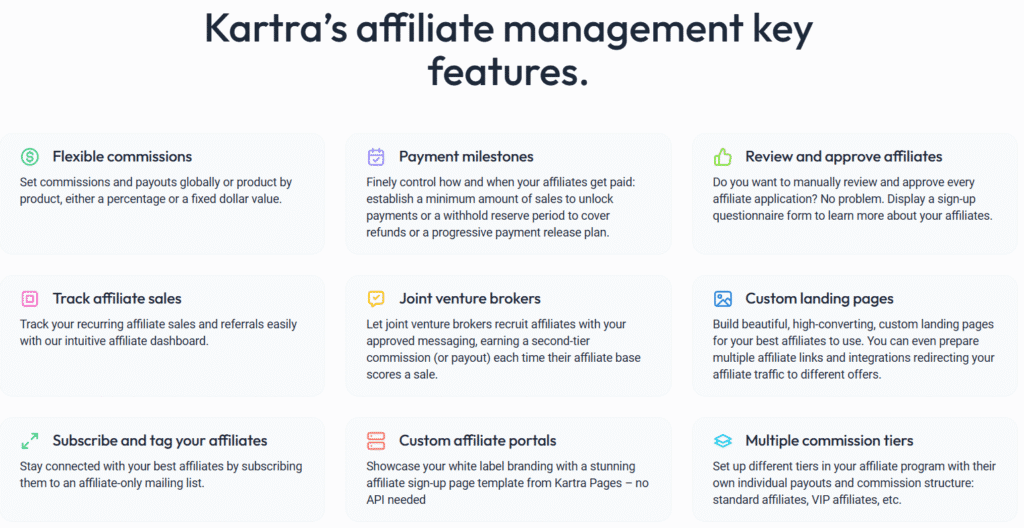
Where Systeme.io gives you a clean, functional affiliate system, Kartra gives you one you can actually architect around your business model.
The biggest practical difference I noticed during testing was commission flexibility. Instead of a flat rate applied across all products, Kartra lets you build tiered structures — different rates for different products, performance-based escalations, custom approval workflows for who gets to promote what. For businesses running multiple offers across different price points, this level of control stops being a luxury and starts being a necessity.
What also sets Kartra apart in this Systeme.io vs Kartra comparison is how deeply the affiliate system connects to the broader platform. Your affiliates aren’t just tracked by clicks and sales — they’re tagged inside your CRM, their referred leads move through your funnels with full attribution intact, and your analytics show you exactly which affiliates are bringing in buyers versus just browsers. That distinction matters enormously when you’re deciding where to invest your affiliate relationship-building time.
The reporting depth is genuinely useful rather than just impressive on paper — you can see conversion rates by affiliate, by product, and by campaign stage, which means your decisions about who to reward, who to coach, and who to quietly remove from your program are based on real data.
The tradeoff is setup time. Building a properly configured Kartra affiliate program takes longer than Systeme.io’s — but for businesses where affiliates represent a serious revenue channel rather than a side experiment, that investment pays for itself quickly.
Pricing Plans & Value
Pricing is often the deciding factor for entrepreneurs and small businesses choosing between marketing platforms. In this Systeme.io vs Kartra comparison, we’ll look at how each tool structures its pricing and what kind of value you get at each level.
Systeme.io: Affordable, Transparent Pricing — Even a Free Plan
Systeme.io is well-known for its budget-friendly pricing, especially for beginners. It’s one of the few funnel builders that offers a completely free plan with generous features.
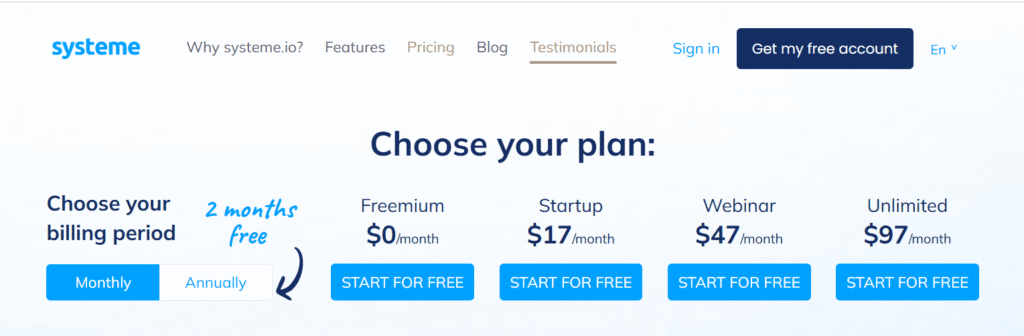
| Plan | Price/Month | Key Features |
|---|---|---|
| Free | $0 | Up to 2,000 contacts, 3 sales funnels, unlimited emails |
| Startup | $17 | 5,000 contacts, 10 funnels, 5 courses |
| Webinar | $47 | 10,000 contacts, evergreen webinars |
| Unlimited | $97 | Unlimited everything + priority support |
Even on the free plan, users can run full email campaigns, create sales funnels, and launch courses—making it an unbeatable value for beginners and lean startups.
Kartra: Premium Pricing for All-in-One Professionals
Kartra doesn’t offer a free plan, but it delivers advanced features for users who need deeper functionality and scalability.
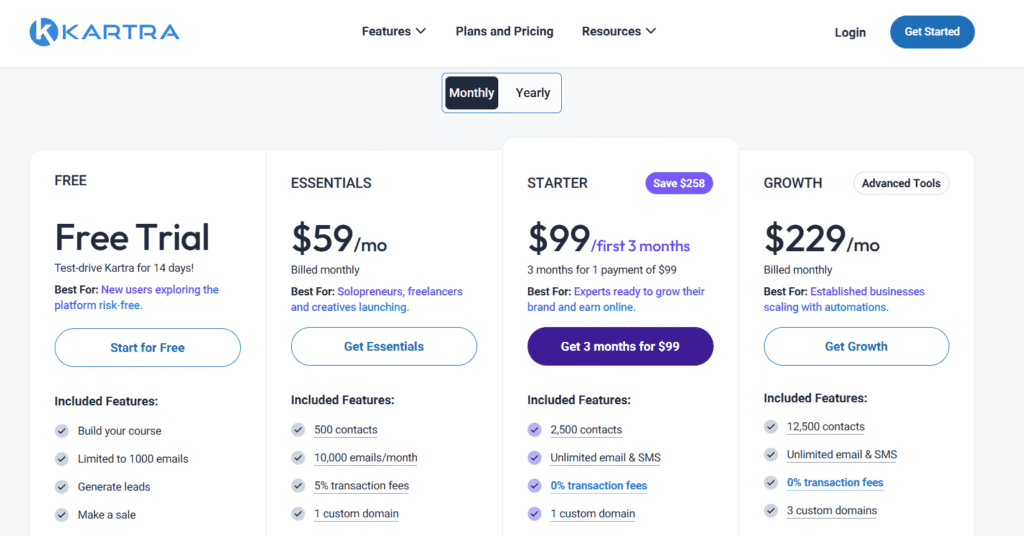
Kartra is best suited for established businesses and digital agencies that require a high-performance marketing suite with CRM, helpdesk, and video hosting all in one place.
Pros & Cons: The Honest Summary
After everything tested and documented in this Systeme.io vs Kartra comparison, here’s where each platform genuinely stands.
Systeme.io: More Capable Than It Gets Credit For
The free plan alone makes Systeme.io worth serious consideration — funnels, email automation, course hosting, and affiliate management without spending a dollar is an offer most competitors simply don’t match. The interface is fast, the learning curve is shallow, and the time between “I have an idea” and “this is live” is shorter here than anywhere else I’ve tested.
The tradeoffs are real but honest. The CRM is basic, the analytics are surface-level, and the design flexibility has a ceiling. If you’re running simple campaigns and growing an audience, none of that will slow you down. If you’re scaling aggressively and making data-driven decisions across complex funnels — you’ll feel those limits sooner than you’d like. Customer support being email-only is also worth knowing upfront, especially if you’re someone who needs fast answers when something breaks mid-launch.
Kartra: Powerful, But Only If You’re Ready For It
Kartra’s strongest quality is also its biggest risk — it gives you everything, whether you need it or not. The behavioral CRM, tiered affiliate system, advanced split testing, video hosting, helpdesk, and calendar tools are genuinely impressive when used together by someone who knows what they’re building. For that person, the higher price is easy to justify.
But there’s no free plan, the learning curve is real, and the billing structure is rigid. If you’re early stage and still validating your offers, paying Kartra’s entry price to use 20% of its features is a poor investment. The platform rewards preparation and penalizes guesswork.
The Honest Bottom Line
Systeme.io is where you start. Kartra is where you scale. Not because one is better than the other in absolute terms — but because they were built for different moments in a business’s growth. Knowing which moment you’re in right now is the only decision that actually matters.
Systeme.io vs Kartra: Which One Actually Makes Sense For You?
I’ll be direct — this isn’t a decision where one platform is objectively better. It’s a decision about where you are right now and what you actually need to move forward.
If you’re still building toward your first consistent revenue — Systeme.io is the smarter starting point. Not because it’s the most powerful tool available, but because it removes every technical barrier between you and a live campaign. The free plan is genuinely functional, the setup is fast, and you won’t lose weeks learning a system before you’ve validated whether your offer even sells. Start here. Build momentum. Worry about advanced features when your business actually demands them.
If you’re already past that stage — if you’re running paid traffic, managing a growing list, and making decisions based on where your funnel is leaking — Kartra gives you infrastructure that Systeme.io simply can’t match. The behavioral CRM, advanced automation, tiered affiliate system, and deep analytics aren’t features you’re paying for out of ambition. At that stage, they’re tools you’ll use every single day.
The mistake most people make in this Systeme.io vs Kartra decision is choosing based on where they want to be rather than where they are. Kartra in the hands of someone who isn’t ready for it is an expensive distraction. Systeme.io in the hands of someone who’s outgrown it is a ceiling that quietly limits growth. Once you’ve picked your marketing platform, the next piece of the puzzle is making sure your content and pages actually get found — which is where choosing the right SEO tool becomes critical.
Be honest about your stage. Then the decision makes itself.
If you’re still weighing your options, it’s also worth exploring dedicated email marketing platforms — our Constant Contact review breaks down whether a standalone tool might serve your business better than an all-in-one solution.
Before you even build your first funnel, finding the right keywords is what determines whether anyone finds it — here’s how Semrush and Ahrefs compare for that job.

Disclosure: This article may contain affiliate links. If you make a purchase through these links, I may earn a commission at no extra cost to you. All opinions are based on hands-on testing and independent research.