
Most Moz for SEO guides start with a tour. Here’s the dashboard, here’s Domain Authority, here’s how to run a keyword report. By the end you know where every button lives and your rankings haven’t moved.
That’s not a Moz problem. It’s a usage problem.
In 2026, that problem is sharper than it’s ever been. Google has rolled out multiple core updates already this year — including a March 2026 core update and a spam update in the same month — and every one of them has rewarded sites that make consistent, data-informed decisions and punished sites that are going through the motions. Moz gives you the data. The motions part is still entirely on you.
This guide isn’t a tour. It’s built around a single argument: Moz is not a research tool — it’s a decision-forcing system. Every metric it surfaces, every report it generates, every score it assigns is only useful at the moment it forces you to do something differently. Used any other way, it’s an expensive way to feel informed.
What follows is what the tutorials leave out — not features, but the thinking behind the features. The specific decisions each part of Moz should be forcing, why most workflows are structured to avoid those decisions, and what it looks like when the tool is actually working.
If you landed here looking for a Moz Pro review — a verdict on whether the subscription is worth it — that answer is in here. It comes at the end, after the argument, because the answer depends entirely on how you use it. And if budget is a constraint right now, several of the diagnostic moves in this guide can be started with Moz free tools — the MozBar, the free Link Explorer lookups, the limited Keyword Explorer searches — before you commit to a full subscription.
If you’re past the basics and still not seeing movement, this is where to start.
Table of Contents
You’ve Been Using Moz as a Reporting Tool. That’s Why It’s Not Working.
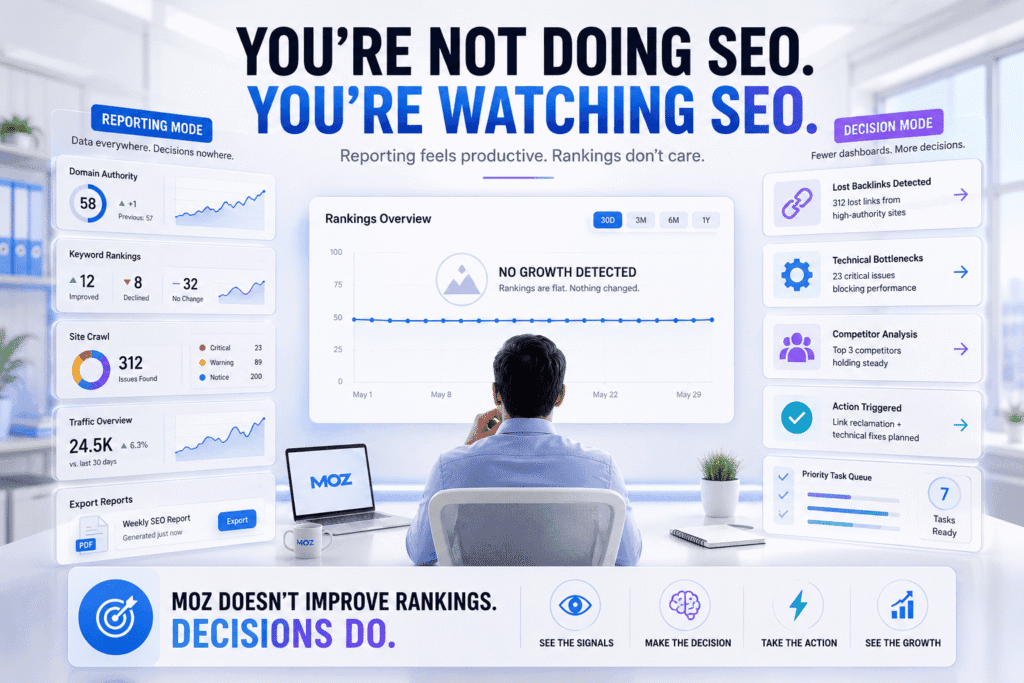
Most people who use Moz for SEO have built, without realizing it, a very sophisticated ritual of checking things and then not doing anything differently.
You know the routine. DA is up a point — good. Three keywords slipped — concerning, worth watching. The site crawl is showing critical errors — yeah, it’s always showing critical errors. You export the report, you close the tab, and somewhere in the back of your head you’ve filed this as “done SEO today.” The rankings stay exactly where they are. Next month, same report, slightly different numbers, same feeling of productive motion that isn’t actually moving anything.
Here’s what nobody says plainly enough: Moz is not a reporting tool. It was never meant to be a reporting tool. The fact that it looks like one — clean dashboards, color-coded trend lines, exportable everything — is almost a design liability, because it makes it very easy to confuse visibility with action. You can spend an hour in Moz and leave with seventeen screenshots and zero decisions. That’s not using the tool. That’s using the tool as a comfort blanket.
The practitioners who actually move rankings with Moz aren’t the ones logging in most often. They’re the ones who’ve decided — before they open the platform — what each metric has to show them to trigger a specific response. Not “DA dropped, I should build more links.” Something more precise than that: “If DA drops while my top three competitors hold steady, that’s a link profile decay signal and I’m auditing lost links this week.” That’s a decision framework. Everything else is observation tourism.
What makes this hard to admit is that the reporting habit feels like diligence. You’re in the platform regularly. You’re tracking the numbers. You care. But caring about data and knowing what data is trying to tell you are genuinely different skills — and most Moz SEO workflows are built entirely around the first one while quietly ignoring the second.
The crawl report is the most honest example of this. The Moz site crawl flags your technical errors clearly, prioritizes them by severity, and explains what each one means. And still — still — most practitioners look at that list, acknowledge it exists, and go write another blog post instead. Not because they’re incompetent. Because content feels like progress and technical fixes feel like maintenance — and humans are bad at choosing maintenance over momentum even when maintenance is the actual bottleneck. The cost of that choice is invisible right up until it isn’t.
In 2026, the cost is higher than it’s ever been. Google’s February 2026 Discover core update explicitly rewarded more in-depth, original content from sites with demonstrable expertise — which means the gap between sites making real decisions and sites generating reports is widening with every update cycle. The reporting habit used to cost you momentum. Now it’s starting to cost you ground you’ve already won.
So before this guide gets into metrics and frameworks and the specific Moz features worth your time — it’s worth sitting with that for a second. Because if you carry the reporting habit into the rest of this, you’ll read everything that follows, nod along, and then go build another dashboard. The tool isn’t the problem. The posture is.
And the posture starts — almost always — with how you think about Domain Authority. Which is where things get genuinely complicated.
Domain Authority Is a Flawed Metric and You Should Still Care About It Deeply
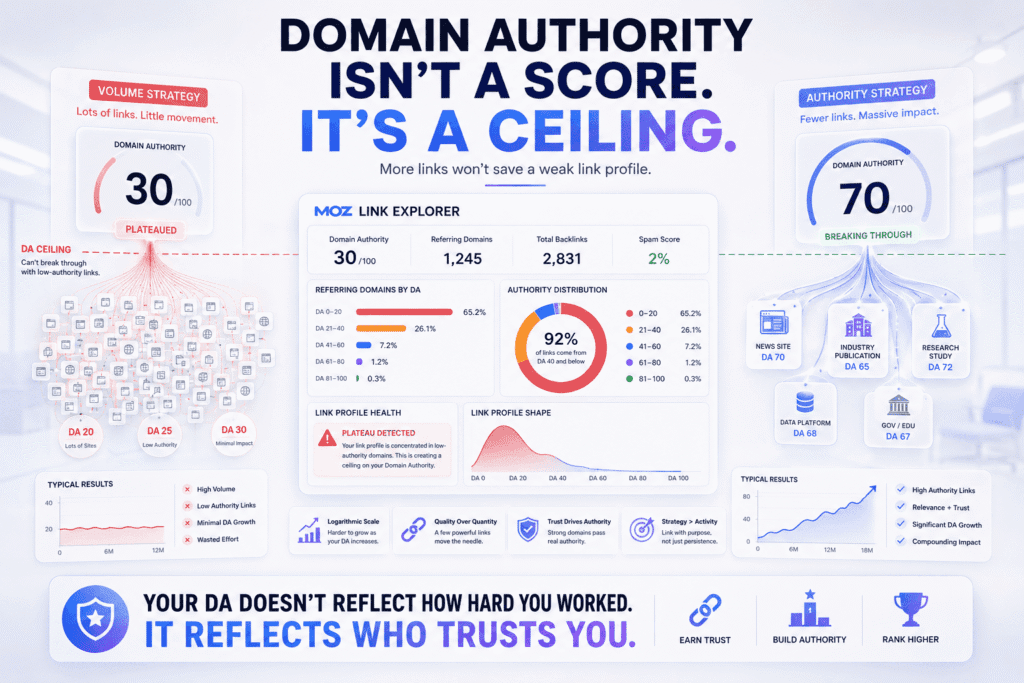
Nobody wants to hear this, but Domain Authority is not something you improve. It’s something that reflects decisions you made a year ago. And if you’ve been treating it as a target — something to push upward through effort and consistency — that reframe alone might explain why the number hasn’t moved despite everything you’ve thrown at it.
The metric runs on a logarithmic scale. That’s not a technical footnote — it’s the reason your entire link strategy might be structurally broken without you knowing it. Getting from DA 30 to 40 requires a fundamentally different kind of effort than getting from 20 to 30. Not more effort. Different effort. Specifically: links from domains that are stronger than your current average, not just more links from the same tier you’ve already tapped. A hundred links from DA 25 sites will do almost nothing. Three links from DA 70 sites will move the needle in a way that makes the hundred feel embarrassing in retrospect.
Most people use Moz as a Domain Authority checker — they come in, read the number, and leave. The number is the least interesting thing that page is showing you. Which is a problem, because the page is also showing you the shape of your entire link profile — and that shape is what actually explains why the number is where it is.
Most people know this in theory. Almost nobody builds their link strategy around it in practice.
The reason DA plateaus aren’t content problems — even though they feel like content problems — is that content and links are being run as parallel strategies when they need to be the same strategy. You’re publishing to attract links, presumably. But attracting links from domains strong enough to actually shift your DA means your content has to be built with those specific domains in mind — what they reference, what makes them look credible for citing you, what fills a gap in what they’ve already covered. That’s a different editorial brief than “write something good and promote it.”
Why Your DA Plateau Isn’t a Content Problem
This is where Moz for SEO stops being abstract and starts being diagnostic. Pull up Moz Link Explorer right now. Don’t look at the total number of referring domains. Sort by the DA of the sites linking to you and just — look at the shape of it.
If the vast majority of your links are coming from domains below DA 40, you don’t have a content volume problem. You have a ceiling problem. And the ceiling isn’t going anywhere until you start producing the kind of content that DA 60+ sites actually link to — which, bluntly, is usually not another well-optimized blog post. It’s original data. It’s a free tool. It’s a study someone can cite without feeling like they’re just passing along someone else’s opinion. The sites with the authority to move your score are not browsing your blog. They need a reason to reference you that makes them look good for doing it.
This is the part of Moz for SEO that tutorials skip entirely, because it’s uncomfortable. It means your content strategy and your DA strategy have to be planned together, and most sites aren’t doing that. They’re publishing consistently on one track and doing outreach on another, and then wondering why the number moves one point every four months.
Related Reading Ahrefs vs Semrush vs Moz: The Complete and Honest SEO Tool Comparison Domain Authority is a Moz-specific metric — Ahrefs and Semrush measure authority differently, and those differences matter depending on how you use the data. This comparison breaks down exactly where each tool’s authority metrics are strongest and where they fall short.
The Three Link Profile Shapes That Predict DA Stagnation
There’s a version of this that gets written as a listicle with bullet points and bold headers. This isn’t that. These are three patterns — you’ll recognize yours immediately.
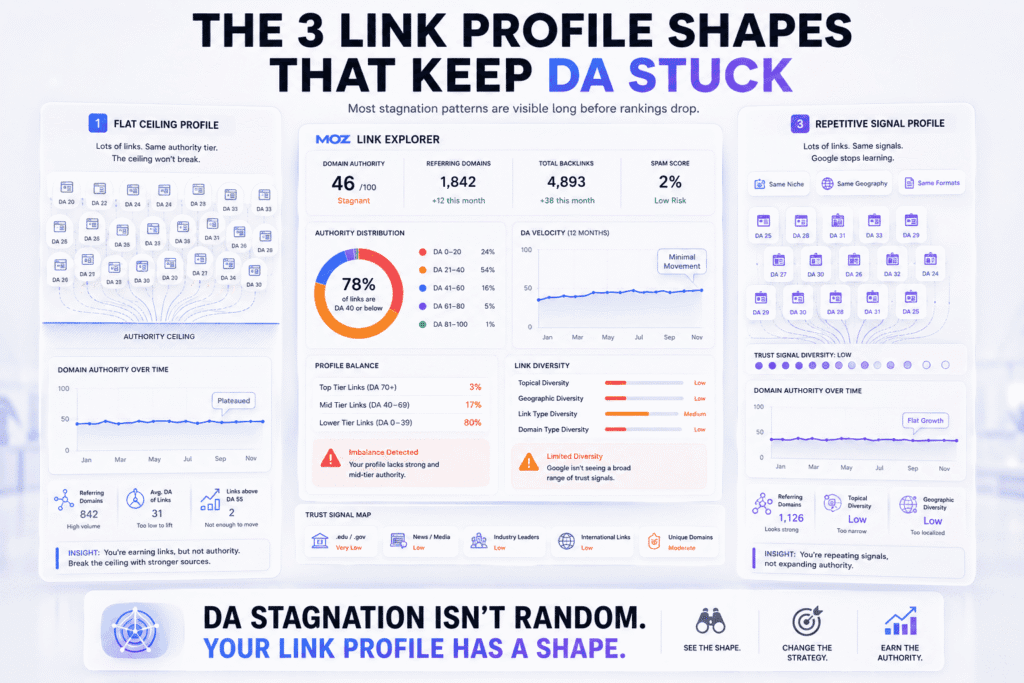
The first is what you might call a flat ceiling profile: lots of referring domains, most of them sitting in the DA 20–40 range, almost nothing above DA 55. This site has been working. It’s been doing outreach, publishing linkable content, building relationships. And it’s stuck — not because the effort is wrong but because the effort is being aimed entirely within its own peer group. The links are real. They’re just not strong enough to pull the score upward anymore.
The second is trickier because it looks healthy on the surface. A few very strong links — a press mention, something that went briefly viral, a DA 80 site that linked to you once — sitting on top of a long tail of very weak ones, with almost nothing in between. DA looks respectable. But the profile is hollow in the middle, which means it’s more fragile than it appears. If those top-tier links age out or get removed, the drop will feel sudden even though it was entirely predictable.
The third one is the most common and the least discussed: a profile that looks diverse in number but isn’t diverse in signal. All the links are coming from the same niche, the same geography, the same three content formats. Moz’s spam score won’t flag it. The referring domain count looks fine. But the DA trajectory has gone flat because the profile stopped telling Google anything new about who you are and who trusts you.
None of these fix themselves with more content or more outreach aimed at the same targets. Moz shows you clearly which problem you have — if you’re willing to look at the profile instead of the number. But knowing which pattern you’re in is only useful if it changes what you build next and who you build it for. That’s a strategy decision. Moz just happens to be the clearest mirror available for making it.
The number is a lagging indicator. By the time it moves, the decision that moved it is already six months old. Which means the practitioners who consistently improve DA aren’t the ones refreshing the dashboard — they’re the ones making better acquisition decisions upstream and waiting with reasonable patience for the score to catch up.
That patience, by the way, is much easier to maintain when your keyword strategy is actually working. Which most people’s isn’t — including people who think it is.
The Keyword Research Feature Nobody Uses Correctly (Including People Who Think They Do)
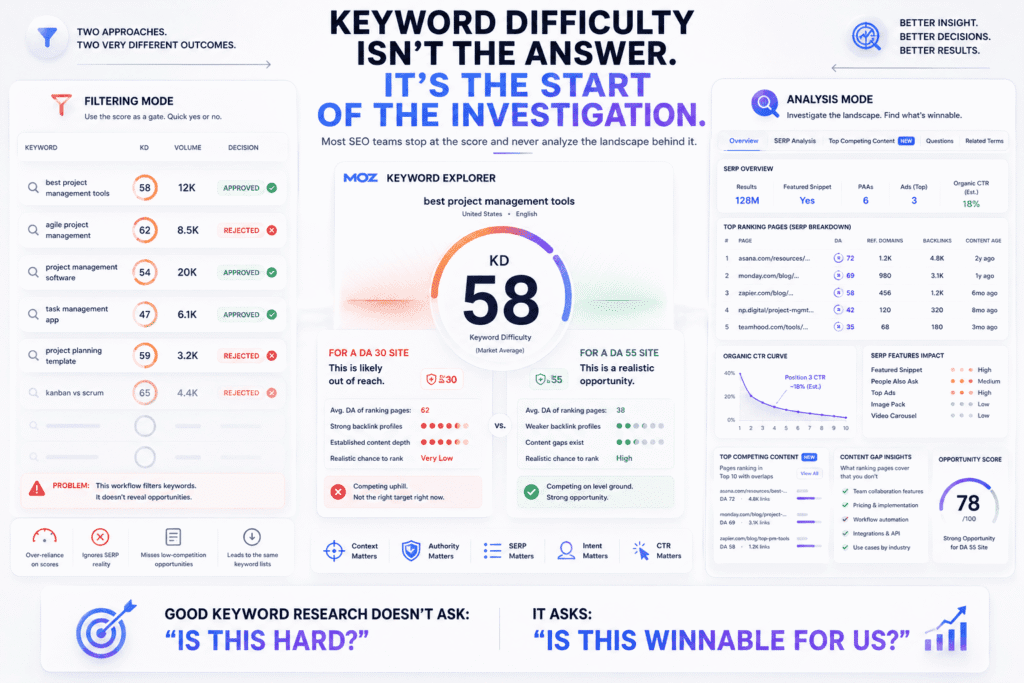
The difficulty score is not the problem. The problem is that everyone is using it the same way — as a gate, a green light or a red light, a number that either grants permission to pursue a keyword or revokes it. You open Moz Keyword Explorer, type in a term, see a difficulty score of 58, decide yes or no. Repeat for ninety keywords. Call it keyword research.
That process is not keyword research. It’s keyword filtering. And there’s a meaningful difference between the two that most Moz for SEO workflows have quietly collapsed.
Here’s the thing about a Moz keyword difficulty score of 58: it means almost nothing in isolation. It’s a market average. It’s telling you how competitive the landscape is across all the sites trying to rank for that term — not how competitive it is for your specific site, with your specific DA, targeting that specific term right now. A DA 55 site looking at a keyword with an average ranking page DA of 38 is not looking at the same 58 as a DA 30 site looking at the same keyword. The number is identical. The reality is completely different.
Moz shows you the SERP breakdown for every keyword in Keyword Explorer. The actual DA of every page currently ranking. Whether those pages have hundreds of linking domains or twelve. Whether the content is two years old or two months. That’s where the real difficulty assessment lives — not in the score, in the breakdown. And most people close that tab without opening it because the score already told them what they wanted to know.
This is the part that’s a little uncomfortable to say: keyword research has become, for a lot of teams, primarily a political exercise. You pull the data, attach volume numbers to a list of topics, present it in a meeting, and the numbers make the decisions feel defensible. Nobody in that meeting is asking whether the DA of the pages currently ranking for those terms makes them actually winnable. The numbers create the appearance of rigor without the substance of it. Moz hands you everything you need to do this properly, and the workflow has evolved to use about forty percent of it.
The Organic CTR filter is the most ignored feature in Keyword Explorer — and it’s the one that would most change which keywords make the list if people actually used it. Raw search volume is not traffic potential. A keyword pulling ten thousand searches a month with a SERP full of featured snippets, three paid ads above the fold, and a People Also Ask box eating the middle of the page might deliver less organic traffic at position three than a keyword with two thousand searches and a clean results page where position three actually gets clicked. The CTR modifier adjusts for this. It reweights the entire list. Turn it on and watch several of your “high priority” keywords quietly become medium priority, and a few overlooked ones move up.
Most people don’t turn it on. The raw volume number is more satisfying. Bigger feels better even when bigger is misleading.
There’s a 2026-specific reason the SERP analysis move matters more than it used to. Moz recently added a Top Competing Content feature to its Competitive Research suite — a direct response to the growing demand for content gap intelligence that the platform had previously left underserved. It doesn’t close the gap with Semrush’s content tooling entirely, but it changes what’s possible inside a Moz for SEO keyword workflow in a meaningful way. The SERP breakdown tells you who is ranking and how strong they are. The Top Competing Content feature tells you what content is actively competing for the same keyword space right now. Used together, they turn keyword research from a filtering exercise into an actual competitive assessment — which is what it was always supposed to be.
That’s what good Moz keyword research actually looks like in practice: you pull a list, you sort by keyword difficulty, and then — before you filter anything out — you open the SERP analysis on every term above your instinctive threshold and ask one question: who is actually ranking here, and do I have a realistic claim on this space in the next six months? Some of those “too hard” keywords will turn out to be wide open because the ranking pages are thin, outdated, or from domains you’re already close to in authority. Some of your “manageable” keywords will turn out to be dominated by sites you have no business competing with yet.
The score told you one thing. The reality told you something else entirely. And the only way to know which is which is to look past the number at the actual competitive landscape underneath it.
Which, as it happens, is exactly what your competitors’ backlink profiles are also hiding from you — and what most people completely miss when they go looking.
Related Reading Keyword Research for New Websites: How To Find Keywords You Can Actually Rank For If Moz’s difficulty scores have been blocking your keyword list before it even gets started, this guide walks through how to find winnable keywords based on your site’s actual authority position — not just the numbers.
What Your Competitors’ Backlink Profiles Are Actually Telling You (It’s Not What You’re Looking For)
Everyone who uses Moz as a backlink analysis tool is looking for the same thing when they pull a competitor profile: a list of sites that link to the competition but not to them. An outreach queue. Names, URLs, DA scores, export to CSV, hand off to whoever does the emails.
Fine. That works, sort of, sometimes. But it’s also the most superficial thing a competitor’s backlink profile can tell you — and the more valuable intelligence is sitting one layer deeper, where almost nobody looks.
What the profile is actually sitting on — if you read it structurally instead of transactionally — is a record of editorial decisions. Every link in that profile represents a moment when someone looked at a piece of content and decided it was worth referencing. Aggregated across hundreds of links, that’s not a contact list. That’s a map of what your market rewards. And that map is worth considerably more than the outreach spreadsheet it usually gets reduced to.
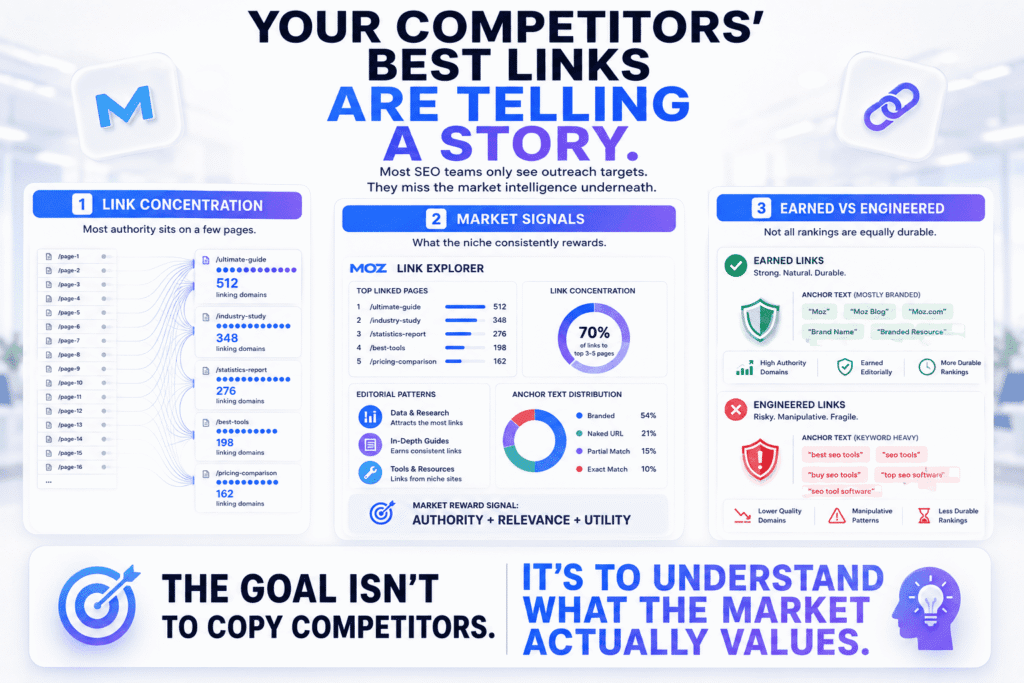
Here’s the move most people skip. Open a strong competitor in Moz Link Explorer. Don’t sort by the DA of the domains linking to them — that’s the instinct, resist it. Sort instead by the number of unique linking domains pointing to each individual page on their site. Then look at the top twenty pages. What you’ll almost always find is that their link equity isn’t spread across their content. It’s concentrated. Three pages, maybe five, are pulling the weight. Everything else has a handful of links at best.
Those three to five pages are the only part of their site that matters for this exercise. Because those are the pages the market actually decided were worth linking to — not the pages the competitor thought were their best work, not the pages they promoted hardest. The ones the market chose. That distinction is where the real competitive intelligence lives, and most Moz for SEO analyses blow straight past it.
Now here’s where it gets easy to go wrong. The natural instinct after finding a competitor’s top linked page — say it’s an original industry data study — is to go build an industry data study. Which might be correct. Probably isn’t, at least not for the reason you think. The format isn’t what earned the links. The conditions were. Maybe the study filled a gap nobody had addressed yet. Maybe it landed at exactly the right moment in an industry conversation that was already happening. Maybe it got picked up by one high-authority site early and everything else followed from that. Copy the format without understanding the conditions and you’ll produce something well-made that earns twenty links instead of four hundred, and you’ll wonder what went wrong.
This is also where Moz’s competitive content tooling becomes relevant. The backlink profile tells you what content the market has already rewarded. Moz’s Top Competing Content feature — added to the Competitive Research suite in a recent update — tells you what content is currently competing for the same keyword space you’re targeting. Used together, those two data sources answer different but complementary questions: what has worked historically in your niche, and what is actively competing right now. Most practitioners are using one or neither. Using both changes the quality of what you decide to build next.
The Link Intersect feature — domains linking to multiple competitors but not to you — is useful for a different purpose than most people use it for. Those aren’t primarily outreach targets. They’re a filter. Run Intersect after you’ve done the structural analysis, and use it to identify which domains are the consistent linkers in your niche — the ones whose editorial behavior shapes topical authority signals in your space. Understanding what those specific sites choose to reference, and what they consistently ignore, is more valuable than cold-emailing them about content they haven’t seen.
One more thing that’s almost always ignored in competitor profiles, and it’s one of the sharper signals Moz surfaces: anchor text distribution. If a competitor is ranking strongly for a term you care about and their inbound anchor text is mostly branded — people linking with their company name rather than keyword phrases — those links were almost certainly earned, not engineered. The content did something genuinely useful or interesting. If the anchors are heavily keyword-optimized, that’s a different story about how those links were acquired, and it’s worth asking how durable that ranking actually is. Neither pattern is a verdict. But it changes whether you’re trying to out-earn a competitor or simply out-wait them — and those require completely different strategies.
The whole point of running competitive backlink analysis in Moz isn’t to find people to email. It’s to understand, with some precision, what this specific market links to and why — so that what you build next is designed for that reality rather than just added to the pile of things hoping to attract attention.
What will actually cost you rankings in the meantime, though, has nothing to do with links or competitors. It’s already sitting in your own site.
The Moz Site Crawl Tells You What’s Wrong. Here’s Why You Keep Ignoring It.
The crawl report has been sitting in your Moz account with unresolved critical errors for longer than you’d like to admit. Not because you don’t know they’re there. Because fixing them feels like maintenance and maintenance feels like not doing SEO.
That’s the honest version of what’s happening. And it’s costing more than most practitioners want to calculate.
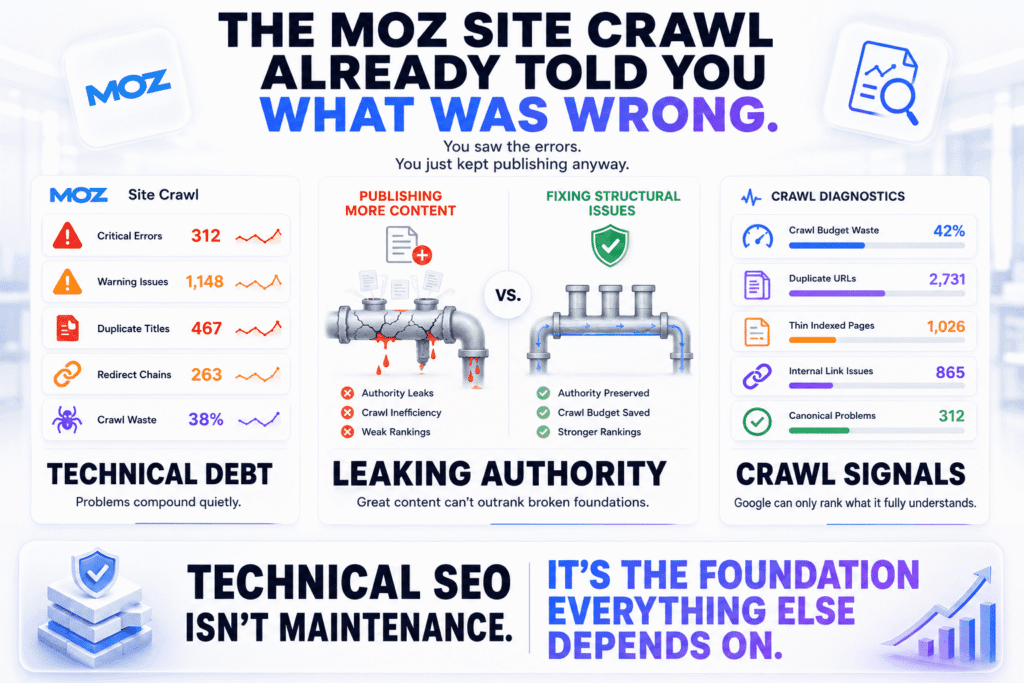
Here’s the specific way this plays out: a site does genuinely good work on content and links for twelve months. Rankings improve, slowly, the way they’re supposed to. Then they plateau — not dramatically, not with a penalty, just a quiet ceiling that shouldn’t be there given the work that’s gone in. An audit eventually happens, usually because a client is asking uncomfortable questions, and somewhere in the crawl data is a crawl budget problem, or a canonicalization issue, or three hundred pages of thin content getting indexed that are quietly diluting the authority of the pages that actually matter. The technical issue wasn’t invisible. It was in the Moz site crawl the whole time, flagged clearly, sitting underneath the content calendar like a leak under a floor.
The reason it didn’t get fixed isn’t laziness. It’s that content produces things you can point to and technical fixes produce things you can’t. You can show a client twelve new articles. You can show them a backlink report with forty new referring domains. You cannot easily show them the rankings you didn’t lose because you fixed a duplicate content issue in March. The value of technical SEO is almost entirely in the counterfactual, which makes it permanently vulnerable to deprioritization in any environment where someone has to justify their time.
Moz’s crawler flags issues in three tiers: critical, warning, and low priority. Most teams look at the critical list, acknowledge it, and then go write another blog post. The critical list is not a backlog. It’s a bleed. Every month those issues sit unresolved is a month your content and link work is operating at reduced efficiency — earning less than it should, ranking lower than it deserves, leaking authority through structural gaps that the crawler identified and you chose not to close.
Used properly, the Moz SEO audit tool isn’t a report you generate quarterly and file away. It’s a standing diagnostic — something that runs in the background and surfaces decisions, not just errors. The difference between those two postures is the difference between a site that gradually tightens its technical foundation and one that carries the same crawl debt forward indefinitely.
The specific issues that matter most — and this is where Moz for SEO technical audits earn their subscription fee — are not always the ones Moz marks critical. Redirect chains, for instance, are frequently marked as warnings. But a site with fifteen percent of its internal links pointing through redirect chains is hemorrhaging link equity in a way that compounds quietly over time. Pages with duplicate title tags get flagged consistently but deprioritized consistently because they don’t feel urgent. They are urgent. Duplicate titles are a signal problem — they tell Google you haven’t decided what your own pages are about, which means Google will decide for you, and it will usually decide wrong.
There’s also a crawl behavior pattern that Moz surfaces and almost nobody acts on: pages that are being crawled but shouldn’t be. Faceted navigation generating thousands of near-duplicate URLs. Parameter-based pages with no canonical tags. Paginated archives with no clear indexing directive. These aren’t exotic technical problems — they show up on ordinary sites with ordinary content management systems — and they matter because every page Google crawls that it shouldn’t is a page it might not crawl that it should. Crawl budget isn’t infinite. How you spend it is a strategic decision, and most sites are spending it badly without knowing it.
None of this requires a developer to diagnose. It’s all in the crawl report. The gap isn’t access to the information — it’s the discipline to treat technical debt as load-bearing rather than cosmetic. A site with clean technical fundamentals and average content will frequently outrank a site with excellent content and structural problems, because Google can only reward what it can fully access and understand.
The crawl report is the most consistently underused part of Moz. Not because it’s hard to read. Because acting on it is less satisfying than publishing something new — and in most SEO workflows, satisfaction and priority have gotten confused with each other.
One thing worth saying directly, since it was promised in the introduction: several of the most valuable diagnostic moves in this guide don’t require a full Moz Pro subscription to start. The MozBar — recently rebuilt from the ground up as MozBar V5, updated as recently as May 2026 — gives you on-page Domain Authority and link metrics for any site you visit directly in your browser. The rebuild wasn’t cosmetic — the performance improvements mean it now runs without the lag that made earlier versions frustrating on complex SERPs, which makes the competitive reality-check move described in the keyword section significantly faster to execute in practice. The free version of Moz Link Explorer gives you a limited number of link lookups per month — enough to audit your top linked pages and run a quick competitor profile. Moz Keyword Explorer offers ten free queries a month — not enough for a full research session but enough to pressure-test three or four priority keywords against their actual SERP competition. None of these replace the full platform for serious ongoing work. But if you’re evaluating whether Moz is worth the subscription, the free tools give you enough to validate the diagnostic approach before committing to the full cost. Start there, build the decision-making habit first, and the case for upgrading will make itself.
There’s a completely separate Moz product that suffers from an even more extreme version of this neglect — and it’s one that, for a significant portion of sites, matters more than anything in Moz Pro.
Related Reading How To Do a Complete SEO Audit for a Small Business Website The Moz site crawl tells you what’s broken. This guide walks you through what to actually do about it — a step-by-step audit process built specifically for small business sites without a developer on speed dial.
Moz Local Is a Completely Different Product That Most People Treat as an Afterthought
If your business has a physical location — or serves customers in specific cities or regions — and you’re not using Moz Local, you are not doing local SEO. You are doing the part of SEO that feels like local SEO while the actual work sits untouched.
That’s a harder line than most people draw. It’s the right one.
Moz Local and Moz Pro are not the same product with different features. They’re two different systems built for two different ranking competitions. Most practitioners treat Moz Local as an optional add-on — something to bolt onto the workflow when there’s budget left over. That mental model is wrong in a way that has real ranking consequences. Among local SEO tools, Moz Local has one of the clearest value propositions in the category. It just gets chronically underused because most practitioners never stop to ask which ranking competition it was actually built for — and the answer changes everything about how you use it.
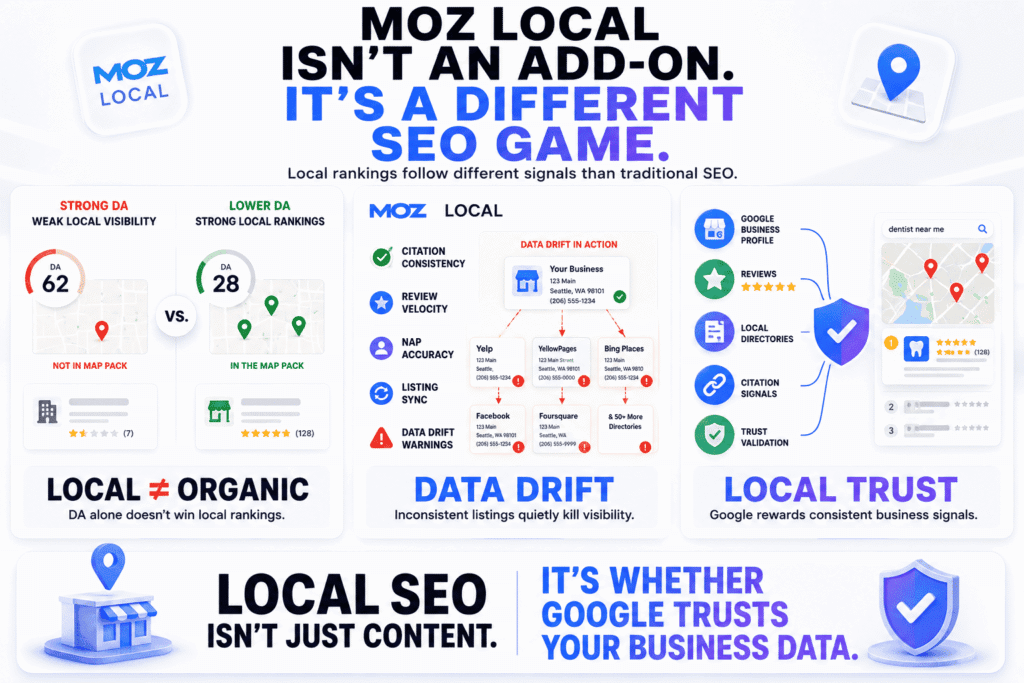
Local pack rankings — the map results, the three-pack, the listings that show up when someone searches “dentist near me” or “plumber in New York” — do not respond to the same signals as organic rankings. DA matters less here. Content matters less. What matters is citation consistency, review velocity, proximity, and whether Google trusts that your business is what you say it is, located where you say it is, and has been consistently saying so across every directory and data aggregator on the internet.
Most practitioners know this in a general way and act on it in almost no way at all.
The specific thing Moz for SEO local audits surface that nothing else catches cleanly is what you might call data drift — and it’s more common and more damaging than the industry tends to acknowledge. Your NAP data was correct when you set it up. It may even be correct on Google right now. But data aggregators — the backend infrastructure that feeds business information to dozens of directories simultaneously — update each other, sometimes with old data, sometimes with wrong data, sometimes with a combination of both. A business that moved locations eighteen months ago and updated its Google Business Profile but didn’t audit its aggregator ecosystem is now sitting on a citation landscape that’s half correct and half not. In the local algorithm, half correct reads almost identically to wrong. The rankings drop. The owner blames a competitor or an update. The actual problem is a data consistency issue that’s been quietly compounding since moving day.
This is the part that genuinely frustrates practitioners who’ve seen it more than once: it’s completely fixable. It’s not a strategic problem or a content problem or a link problem. It’s a data hygiene problem with a clear solution. And it sits there unaddressed because nobody ran the audit.
Worth noting here: Moz made significant updates to Moz Local at the end of 2024, expanding its features and social integration capabilities. Those updates make the citation monitoring and listing management significantly more comprehensive than the version most older tutorials describe — which means if you evaluated Moz Local a year or two ago and decided it wasn’t worth the additional cost, the product you dismissed is not the product that exists now.
There’s an integration nobody talks about that’s worth naming directly: the directories Moz Local flags as citation problems are frequently also linking domains. A well-maintained, consistent listing on a high-authority local directory is both a citation signal and a backlink. When Moz Local and Moz Pro get treated as separate workflows — which they almost always do — practitioners miss the chance to use one to prioritize the other. The directories most worth fixing from a citation standpoint are often the same ones most worth fixing from a link equity standpoint. That overlap costs nothing to act on. Almost nobody does.
The other assumption worth dismantling here is that DA is a useful proxy for local pack performance. It isn’t — or at least not in the way practitioners expect. A DA 28 site with clean NAP data, strong and recent reviews, and well-maintained local listings will outrank a DA 60 site with citation inconsistencies and a Google Business Profile that hasn’t been touched in two years — not occasionally, regularly. The local pack is running a different algorithm with different weights, and if you’re evaluating a local SEO effort primarily through Domain Authority, you’re using a barometer to measure temperature. The instrument isn’t wrong. It’s just not measuring what you think it’s measuring.
Moz Local gives you the right instruments for this specific competition. Most practitioners are just too comfortable in the Moz Pro dashboard to switch windows.
The broader assumption this complicates — and it’s one that runs through almost every Moz tutorial ever written — is that Moz is one coherent platform with one coherent workflow. It isn’t. It’s two meaningfully different products that share a login and occasionally inform each other, and the practitioners getting genuine results from both are the ones who stopped treating Local as a downstream feature and started treating it as a parallel system with its own logic, its own metrics, and its own definition of what winning looks like.
Where both systems stop, though, is a line worth drawing honestly — because past that line, Moz can’t help you, and pretending otherwise is how strategies fail quietly.
Related Reading Why Your Business Is Not Ranking on Google Maps Moz Local shows you the citation inconsistencies. This article explains exactly why those inconsistencies are costing you local pack rankings — and what to fix first if you want to show up in the map results.
The Honest Comparison Nobody Wants to Write: Where Moz Stops and Your Strategy Begins
The Moz vs Ahrefs and Moz vs Semrush debates have been running so long they’ve become their own content category — which is mostly a sign that people would rather argue about tools than fix their strategy. This guide won’t settle that debate. It will name Moz’s actual limitations plainly, because a guide that doesn’t is just a brochure.
Moz’s index is smaller than Ahrefs. Not marginally — meaningfully. If you’re doing competitive backlink research at a scale where the difference between finding 400,000 referring domains versus 600,000 actually changes your conclusions, that gap is real and it matters. For most sites — DA under 60, link profiles in the tens of thousands, not the millions — it doesn’t change a single decision in practice. The links Moz isn’t showing you at that scale are not the links responsible for your ranking gaps. But if you’re doing enterprise-level link analysis and you’re still using Moz as your primary backlink tool, that’s a scope mismatch worth being honest about.
Crawl frequency is slower than some competitors. Fresh link data within hours matters if you’re running active link velocity monitoring or doing PR-driven link building where timing is part of the strategy. For everyone else — which is most people reading this — waiting a few days for a link to surface in Moz doesn’t change what you do next. If it does change what you do next, you’re operating at a scale where the tool selection question has already been answered by your team size and your budget, not by a blog post.
The content gap analysis is thinner than Semrush’s — and this one actually matters for a meaningful percentage of practitioners. If content strategy is your primary SEO lever — more time planning and producing content than building links or fixing technical problems — Semrush will give you more to work with on that specific dimension. That’s not Moz failing. That’s Moz making a product decision. They built a platform optimized for link intelligence and site health diagnostics. Content ideation isn’t where the development resources went, and the product is honest about that whether the marketing is or not.
Those are the real limitations. Not dealbreakers for most — but worth knowing before you blame the tool for something that was always a strategy problem.
One pricing note that changes the entry calculation for a lot of practitioners: Moz now offers a Starter plan at $39 per month on annual billing — a tier that didn’t exist until recently. It’s limited — one site, 50 tracked keywords — but for a solo practitioner or a small site testing the decision-forcing workflow before committing to a full subscription, it’s a meaningfully lower barrier than the platform carried for most of its history. If budget was the reason you were stretching free tool limits instead of building a proper workflow, that excuse is thinner now than it was.
So here’s the decision framework, and it’s simpler than the debate usually makes it sound: use Moz for SEO when your primary questions are about link authority, site health, and keyword opportunity relative to your domain’s specific competitive position. Use Semrush when content gaps and competitor content strategy are the primary questions. Use Ahrefs when index completeness is non-negotiable. These aren’t competing religions — serious practitioners often use two, sometimes three — but most Moz dissatisfaction comes from asking the tool questions it wasn’t designed to answer and then concluding the tool is weak rather than concluding the workflow is wrong.
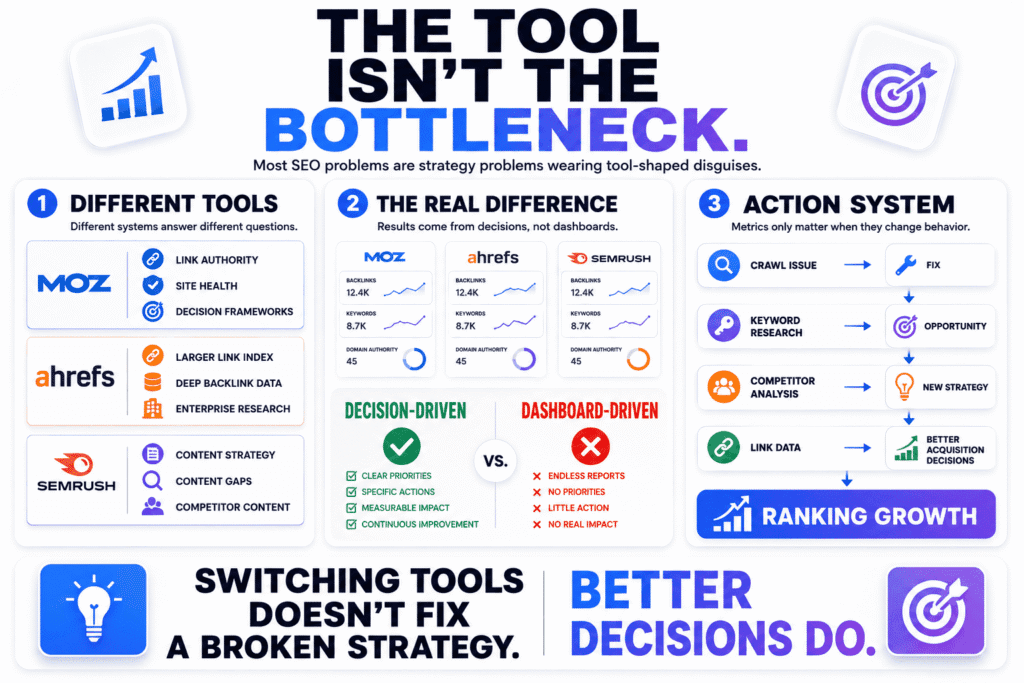
Here’s the part of the comparison conversation that almost never gets said: no tool gap has ever been the actual reason a site’s SEO wasn’t working. Practitioners who switch from Moz to Ahrefs and immediately see results were already making better decisions — the new tool got the credit it didn’t entirely earn. Practitioners who switch and see nothing change were dealing with a strategy problem that better data couldn’t fix, because they weren’t using the data they already had to make decisions in the first place. The tool is rarely the bottleneck. It just gets blamed with the most confidence.
Which is the same thing this guide has been circling since the first section.
The whole argument, collapsed into one place: Moz works when every metric you check is attached in advance to a specific action. When the crawl report produces a fix list, not a folder. When competitor analysis changes what you build, not just who you email. When keyword research filters for winnable terms based on your actual authority profile, not a difficulty score you’ve decided feels right. When the platform is forcing decisions rather than just reflecting conditions.
None of that is a Moz feature. It’s a discipline you bring to the tool. And the slightly uncomfortable truth — the one this guide has been building toward without quite saying directly — is that the practitioners who aren’t getting results from Moz probably wouldn’t get dramatically better results from switching. They’d get a new dashboard, a new set of metrics, and the same fundamental habit of measuring things carefully and then continuing exactly as before.
The tool isn’t what needs to change.
Related Reading On-Page SEO: What Google Actually Rewards Now Moz tells you what’s technically wrong with your pages. This article covers what Google actually wants to see when it gets there — the on-page signals that turn a technically clean site into a ranking one.
Frequently Asked Questions About Moz for SEO
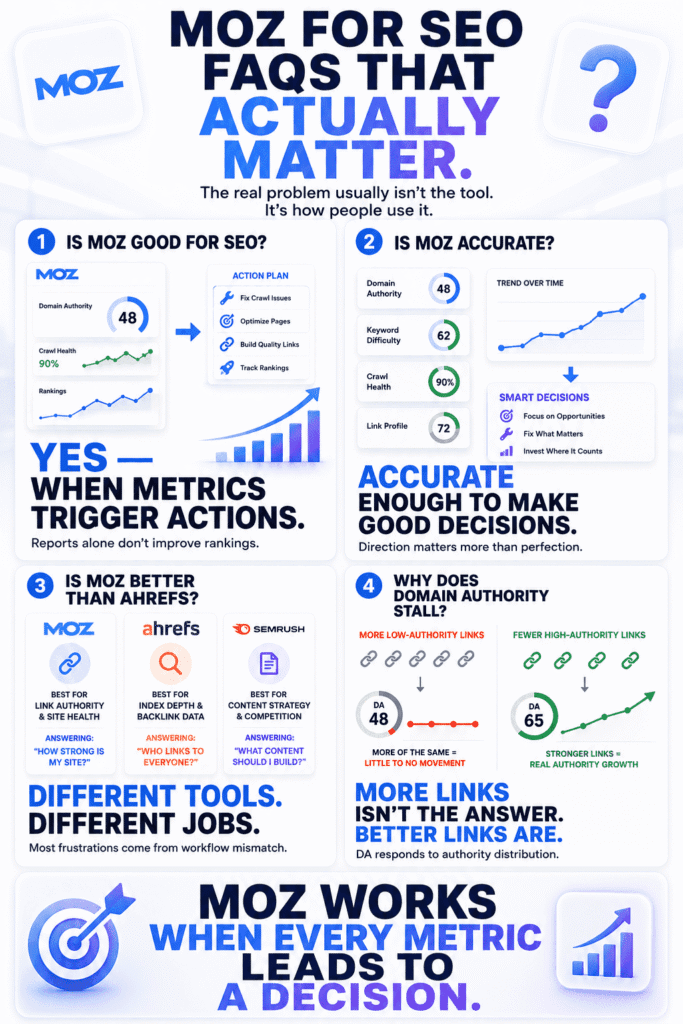
Is Moz good for SEO in 2026? Yes — with a specific caveat. Moz is good for SEO when you use it as a decision-forcing system rather than a reporting dashboard. The practitioners getting real movement from it aren’t checking it more often than everyone else. They’ve decided in advance what each metric has to show them before it triggers a specific action. Used that way, it’s one of the most coherent SEO platforms available. Used as a place to generate reports and export screenshots, it’s an expensive subscription that feels productive without being productive.
Is Moz accurate? Accurate enough for the decisions most practitioners need to make — which is the honest answer the debate usually avoids. Moz’s Domain Authority scores, keyword difficulty ratings, and link data are directionally reliable, meaning they’ll tell you whether something is improving or declining, whether a keyword is competitive or not, whether your link profile is healthy or struggling. They won’t match Ahrefs’ index size at enterprise scale, and they won’t update as fast as some competitors. For sites under DA 60 doing non-enterprise SEO work, those gaps don’t change a single practical decision.
Is Moz better than Ahrefs? Wrong question — and the fact that it keeps getting asked is part of why so many practitioners stay stuck. Moz and Ahrefs are built for overlapping but distinct use cases. Moz is stronger for site health diagnostics, Domain Authority tracking, and keyword opportunity relative to your specific authority footprint. Ahrefs is stronger for index completeness and link velocity monitoring at scale. The practitioners dissatisfied with Moz are almost always asking it questions it wasn’t designed to answer, then blaming the tool for the mismatch.
Is Moz worth it? For most small to mid-sized sites doing serious SEO work: yes, Moz Pro is worth the subscription — but only if your workflow is built around acting on what it shows you. If your current Moz usage consists primarily of checking DA, running monthly ranking reports, and exporting crawl errors into a folder you’ll get to later, the subscription isn’t the problem. The workflow is. Fix the workflow first. The tool will justify itself quickly once you do.
How do I use Moz for keyword research properly? Stop using Moz Keyword Explorer as a difficulty filter and start using it as a competitive reality check. Pull up the SERP analysis for every keyword above your instinctive difficulty threshold — look at the actual DA of pages currently ranking, how many linking domains they have, how recently the content was updated. A keyword scored 62 where the ranking pages are thin and outdated is more winnable for your site than a keyword scored 38 dominated by DA 80 sites. The difficulty score is a market average. Your situation is specific. Also — turn on the Organic CTR modifier. It reweights the entire list based on actual traffic potential rather than raw search volume. Most people never touch it.
What is Domain Authority and why does it keep stalling? Domain Authority is Moz’s proprietary metric for predicting how well a site will rank in search results, scored on a logarithmic scale from 1 to 100. It stalls because it responds to link profile distribution, not link volume. If every link you’re building is coming from domains in the same authority tier you’re already in, DA will inch forward and then stop — regardless of how many links you accumulate. Moving DA consistently requires earning links from domains stronger than your current average, which requires building content specifically designed to attract a different tier of linker, not just more content aimed at the same audience you already have.
Disclosure: Some links in this article maybe affiliate links. If you purchase through them I may earn a commission — at no additional cost to you. This article reflects genuine practitioner experience with the tools discussed. Affiliate relationships don’t influence the analysis, including where I’ve been critical.