
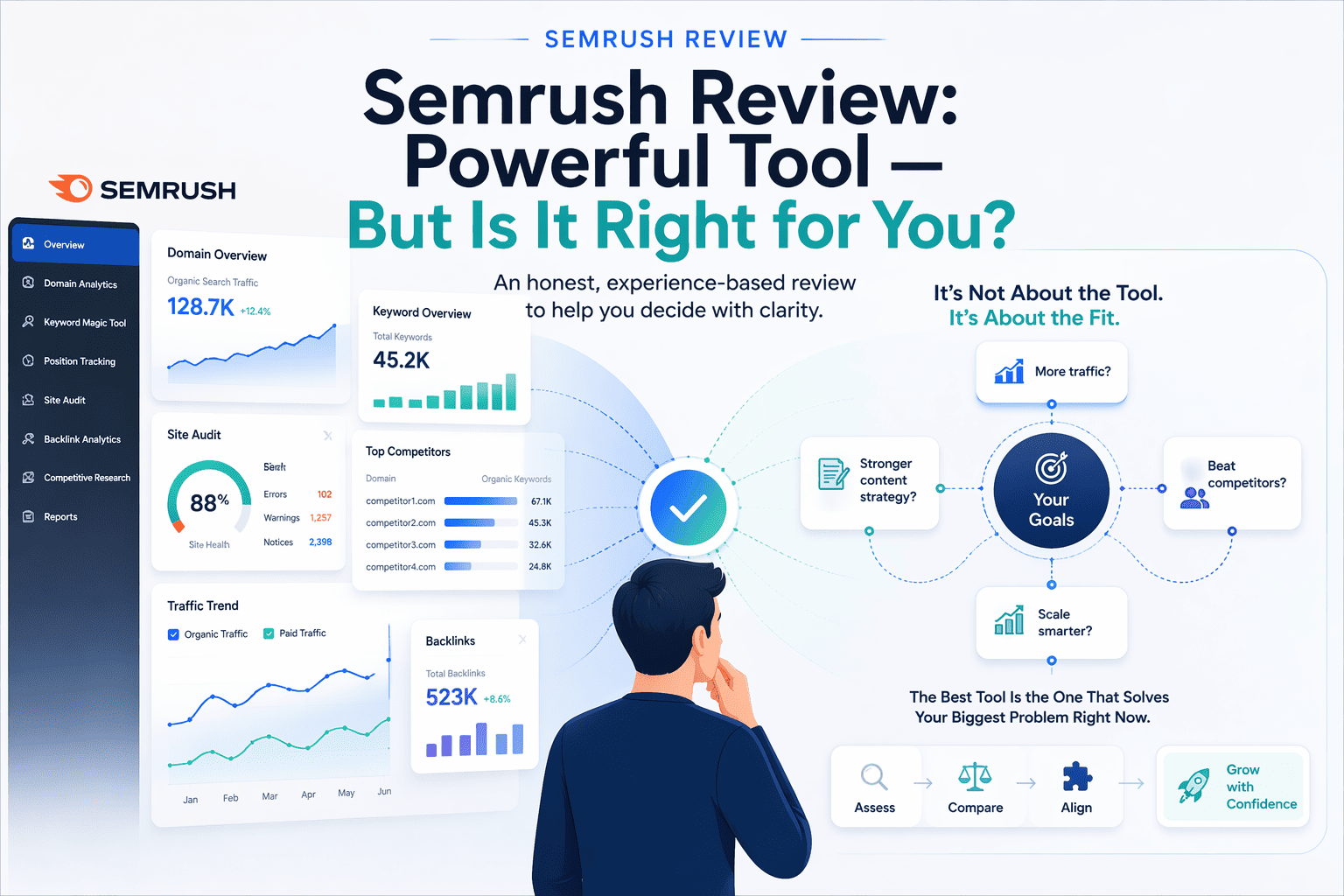
When people search for a Semrush review, they’re often trying to answer a simple question: Is this tool actually worth paying for, or is it just another overhyped SEO platform? I think that question deserves a more honest answer than a feature checklist.
Semrush can be incredibly powerful, but it can also feel expensive, complex, and in some cases unnecessary — depending on where you are in your growth. That nuance gets lost in a lot of reviews. So rather than just walk through tools and pricing, this article looks at where Semrush creates real leverage, where it can feel like too much software, and who it genuinely makes sense for. Because whether a tool is “good” is only part of the story. Whether it fits you is usually the bigger question.
If you think software decisions are mostly about choosing the “best” platform, this guide on how to choose the right marketing tools may help frame the question differently.
Table of Contents
I Thought Semrush Was Just an SEO Tool — I Was Wrong
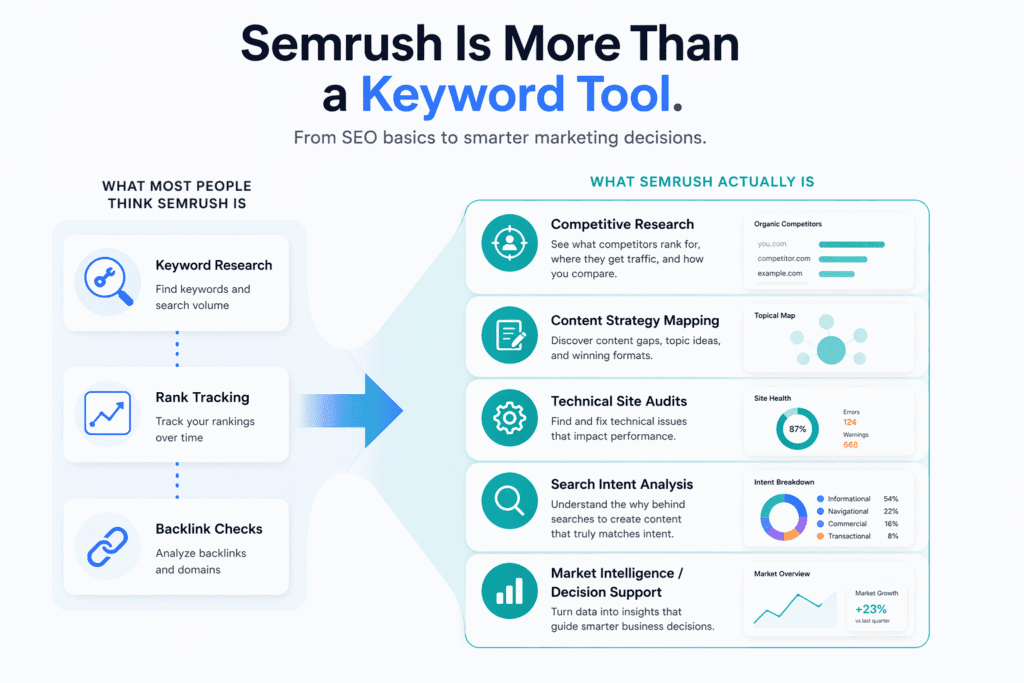
I used to think Semrush was basically a very expensive keyword tool. That was my honest read of it at first.
You research keywords, track rankings, maybe run a site audit once in a while and feel productive. That seemed to be the whole proposition. Useful, yes — but not necessarily something I saw as deeper than a bundle of SEO utilities.
That impression didn’t really hold up. What changed for me wasn’t discovering some hidden feature buried in the platform. It was realizing I was using it too narrowly.
A lot of people approach Semrush as if it’s there to hand them answers — What keyword should I target? Why did traffic drop? What are competitors doing? But it’s often better at helping you ask smarter questions.
That sounds abstract until you use it long enough. You start noticing you’re not just checking keywords anymore. You’re looking at why certain pages win. Why a competitor keeps showing up in topics you overlooked. Why a content plan that looked solid on paper may have major gaps.
That’s a very different use case from “SEO tool.” And honestly, I think this is where some users get disappointed with Semrush. They pay for it expecting immediate tactical wins, then spend most of their time inside reports they barely use. That happens. There is definitely a version of Semrush where you overpay for a giant dashboard and touch 10% of what’s there.
That criticism is fair. But I’d also argue the problem is often not that the platform lacks value — it’s that people treat data as strategy. Those are not the same thing. A keyword gap report is not a content strategy. An audit score is not a growth plan. A competitor visibility graph is not insight unless you know what to do with it.
That distinction took me a while to appreciate. One thing I underestimated was how much Semrush crosses into market research territory. Not formal research in the academic sense — I mean practical visibility into how a niche moves.
That matters more than people think. Sometimes the most useful thing the platform shows you is not a keyword to pursue, but an assumption you’ve been making that turns out to be wrong. Those moments are hard to measure, but they’re often where the real value sits.
Now, I’ll be honest — I also think Semrush can feel bloated. There are areas where it tries to be everything at once, and not every part feels equally strong. Some features feel essential while others feel like they exist because all-in-one platforms are expected to keep expanding and that’s the trade-off.
Breadth creates power, but it also creates noise. And if you’re a solo blogger or small site owner, that noise can be expensive. So yes, Semrush does SEO but calling it an SEO tool feels a little like calling a Swiss Army knife “a blade.” This is technically true but Not really the point.
That broader view of search connects closely with what actually drives website traffic, which is often more nuanced than rankings alone.
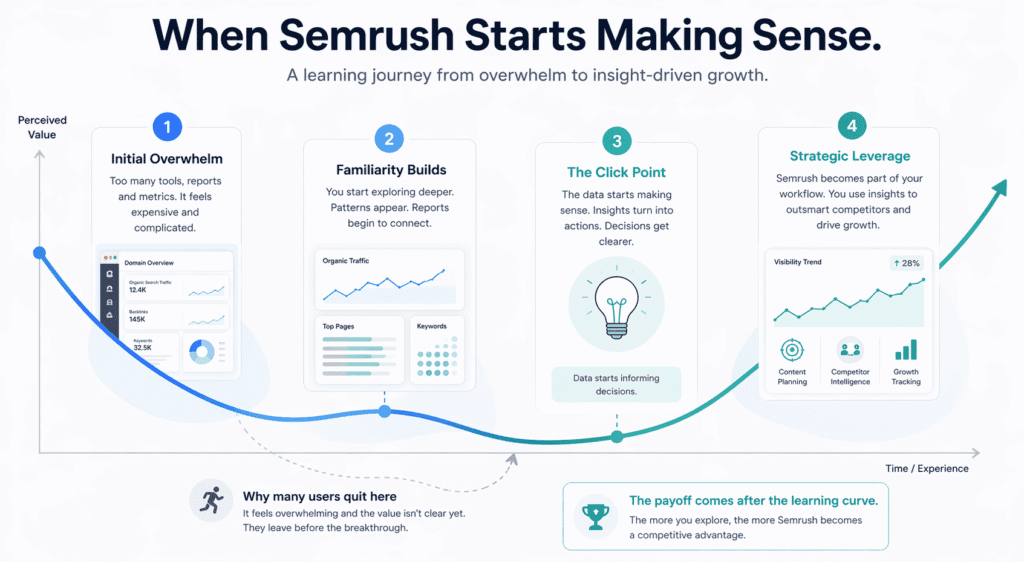
The Moment Semrush Starts Making Sense (And Why Many People Quit Before That)
A lot of people don’t quit Semrush because it’s a bad tool. They quit because they meet it too early. I think that happens more than most reviews admit.
When people first sign up, they often expect immediate clarity — plug in a domain, pull some keywords, uncover a few “easy wins,” and justify the subscription. That expectation feels reasonable but that’s usually not how it works.
In the beginning, Semrush can feel like a lot of moving parts without a clear payoff. Too many reports, many metrics and several places to click. And if I’m being honest, the platform doesn’t always help itself here. It can feel dense and that’s often where the drop-off happens.
Someone tries the tool for a few weeks, uses maybe 5% of it, decides it’s overpriced, and leaves. I understand that reaction. I have also seen people write off Semrush before reaching the point where it actually starts becoming useful because there usually is a moment where it clicks.
For me, that moment tends to happen when you stop using it to “find data” and start using it to test assumptions. That’s a very different mindset. Instead of asking, What keywords can I target? you start asking, Why is a competitor outranking me for topics I thought I owned?
Instead of treating audits like technical checklists, you begin noticing which issues are likely noise and which ones may actually affect growth- That shift matters. Because once you use the platform this way, it feels less like software and more like decision support.
And that’s where many Semrush reviews oversimplify things. They often focus on features, but not on when those features begin to have practical value. Those are not the same discussion.
One thing I’ve noticed is that Semrush starts making sense when you stop expecting shortcuts from it. That sounds counterintuitive, but I think it’s true. People who want a quick tactical tool sometimes get frustrated. People who use it to improve judgment tend to get much more from it.
That doesn’t mean there isn’t a trade-off. There is. The learning curve is real, and I think some marketers understate that. For smaller site owners especially, paying for a platform that only becomes powerful after familiarity can feel hard to justify. Sometimes it is hard to justify, and I actually think that’s part of an honest Semrush review people should hear.
Not every user reaches the payoff point. Some won’t need to. If your needs are basic, that “aha” moment may never be worth the cost. But when it does happen, it often comes quietly. You stop bouncing between disconnected tools. You start spotting patterns instead of isolated metrics. You make fewer reactive decisions. You spend less time guessing. That’s usually when people realize they’re not really paying for keyword data anymore. They’re paying for better-informed decisions. And in my view, that’s the point where Semrush starts making sense. Before that, it can just feel expensive.
I’ve seen a similar dynamic in this MailerLite review, where simplicity looks like a weakness until you understand where it becomes leverage.
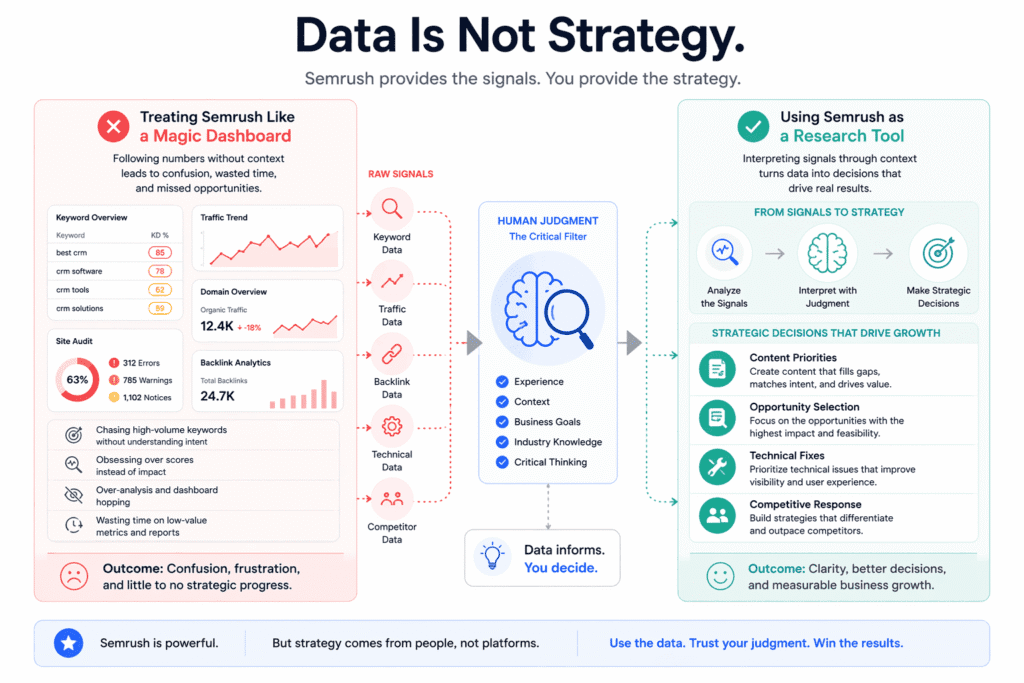
The Problem With Treating Semrush Like a “Magic Dashboard”
I think one of the more dangerous myths around Semrush is the idea that enough data eventually turns into answers- which is wrong. At least not automatically and yet people slip into that mindset all the time.
You open a sophisticated platform, see hundreds of metrics, charts, opportunity scores, audit warnings, competitor data — and it’s easy to assume the intelligence is in the dashboard itself. As if strategy is waiting there to be extracted. I used to think that too, to some extent. But over time, I’ve become more skeptical of dashboards that look like they can think for you. Because they can’t. They can surface signals and expose blind spots. These will help you ask better questions.
But they do not remove judgment from the process. And that’s where people sometimes get into trouble. They start treating metrics like verdicts. Keyword difficulty becomes permission. Traffic trends become explanations. Visibility scores become proof of progress. And sometimes they’re none of those things. They’re just indicators.
That may sound obvious written out, but in practice people forget it. Especially when a tool presents data with so much confidence. I’ve seen people make weak content decisions because a metric looked authoritative. That happens more than many admit.
And honestly, this is where some Semrush review articles feel too flattering to me. They can unintentionally suggest the platform gives clarity simply because it gives data. Those are not the same thing. More data can absolutely create more confusion and sometimes more second-guessing too.
There’s a version of using Semrush where you end up jumping from report to report, convincing yourself research is happening, while really you’re just circling. I call that dashboard drift. It feels productive. Often it isn’t. And the risk gets worse when people start assuming metrics can substitute for context- which they can’t.
A keyword may look attractive and still be wrong for your audience. A competitor gap may look promising and still be a distraction. An audit issue may be technically valid and practically unimportant. Tools rarely know those distinctions.
That’s why I think the best way to use Semrush is not as an answer machine, but as a system for challenging assumptions. That’s much more useful. Because strategy usually comes from interpreting signals, not obeying them. That’s a big difference.
In my experience, people who struggle with Semrush often expect certainty from it. People who get value from it tend to tolerate ambiguity and use the data to sharpen judgment. This is a subtle difference but huge consequences.
And there’s another trade-off people don’t talk about enough: too much available insight can slow decisions down. That sounds backward, but it’s true. There’s always one more report to check, one more filter and one more data layer. At some point, the search for perfect information becomes avoidance. That isn’t a Semrush problem exactly. It’s a human one. But sophisticated platforms can feed it.
So yes, I think there’s a real problem with treating Semrush like a magic dashboard. Because the moment you assume the platform itself contains the strategy, you risk outsourcing the one thing software can’t replicate very well: Judgment. And for me, any honest Semrush review has to acknowledge that.
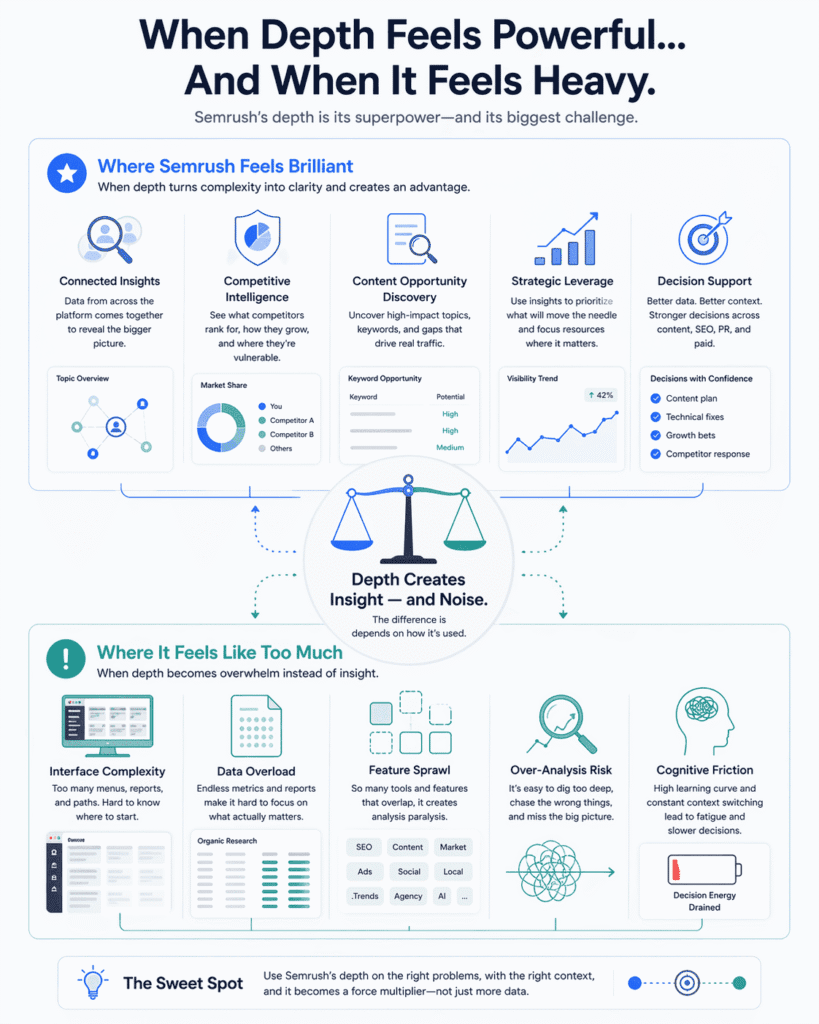
Where Semrush Feels Brilliant and Where It Feels Like Too Much
One thing I’ve come to appreciate about Semrush is that some of what makes it impressive is also what makes it overwhelming. That isn’t a contradiction- it is the product.
There are moments where it feels genuinely smart. Not in the overhyped “AI-powered” sense people throw around, but in the practical sense that the platform can surface relationships you may have missed on your own. And when that happens, it feels brilliant.
Sometimes it’s seeing a competitor gap you weren’t looking for. Other times it’s realizing a content strategy has structural weaknesses, not just weak pages. And some instances, it’s something simpler — using multiple signals together and getting to a better decision faster. That’s where Semrush can feel less like a tool and more like leverage. I think that’s the version longtime users get attached to.
But there’s another side to it. And I don’t think enough Semrush review articles talk honestly about this. Sometimes the platform feels like too much because of too many pathways, too many metrics asking for attention and too many places where analysis can spill into over-analysis. I’ve had moments inside Semrush where I thought, This is incredibly useful, while in other instances where I thought, Why does this need to be this complicated?
Both were honest reactions. And I think many users have both. The weird thing is, the brilliance and the excess often come from the same source — depth. Depth can create insight but it can also create noise. That trade-off shows up everywhere in the platform.
When Semrush is helping reduce uncertainty, it feels worth the complexity. But when it adds layers to decisions that were already simple, it can feel heavy. That’s a very different experience. I’ve noticed it often feels strongest when it helps you connect things. Not just gather information, but connect it. That’s where some of its best value lives.
But when it starts feeling like a control room where every switch might matter, the experience changes. Then it can feel like complexity disguised as capability. And that distinction matters because not every feature adds real utility. Some features expand possibility while others just expand interface and all those are not the same. I actually think this is where people sometimes confuse “all-in-one” with “better.”
More included does not always mean more useful. Sometimes it means more distraction. And if you’re a solo site owner, that distraction can become expensive very quickly. That’s why I’d be cautious of reviews that only celebrate how much Semrush does. A lot isn’t automatically a virtue. Sometimes focus is a virtue too.
There are parts of Semrush I find thoughtfully powerful. There are parts I think could benefit from restraint. Both things can coexist. And honestly, that makes me trust the tool more, not less. Because software that tries to do this much will always involve trade-offs.
The real question isn’t whether Semrush ever feels bloated. It sometimes does. But the question is whether the insight you gain outweighs the friction. For some people it absolutely does and for others it may not. And I think a credible Semrush review should leave room for both truths.
That same trade-off between power and overwhelm came up in my Systeme.io vs Kartra comparison too.
Where Semrush’s Real Value Often Shows Up (And It’s Not Always in the Features People Talk About)
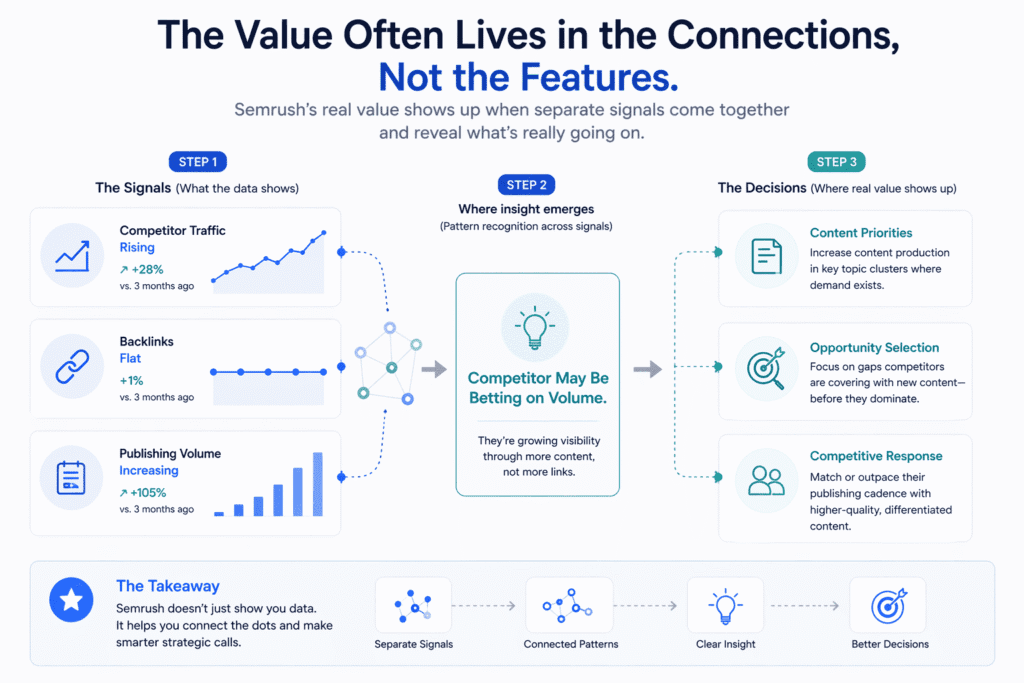
And this is where I think some of the platform’s strongest value sits — not in individual tools, but in the way different signals begin forming a pattern.
That sounds vague. Here’s what it actually looks like.
You notice a competitor’s traffic is up, but their backlink profile hasn’t moved. Then you check their content — they’ve been quietly publishing at twice their usual pace. Neither data point alone would have caught your attention. Together, they tell you something useful: they’re betting on volume. Now you have a decision to make.
That’s the pattern recognition I’m talking about. Not sophisticated. But it’s the kind of connection that’s easy to miss when you’re working across separate tools — and easier to catch when everything sits in one place.
I don’t want to oversell this. Pattern recognition can become pattern imagination if you’re careless, and Semrush won’t protect you from that. The risk of reading too much into data is real, and it’s on you.
But when people ask where Semrush has felt worth paying for, I think it’s often here. Not in dashboards. Not in feature counts. In moments where it sharpens judgment rather than just reporting numbers.
That’s a harder thing to demonstrate. It doesn’t show up in a feature comparison table. But it tends to be the thing people mean when they say a tool has become genuinely useful, as opposed to just regularly used.
What I’d Be Careful About Before Paying for It
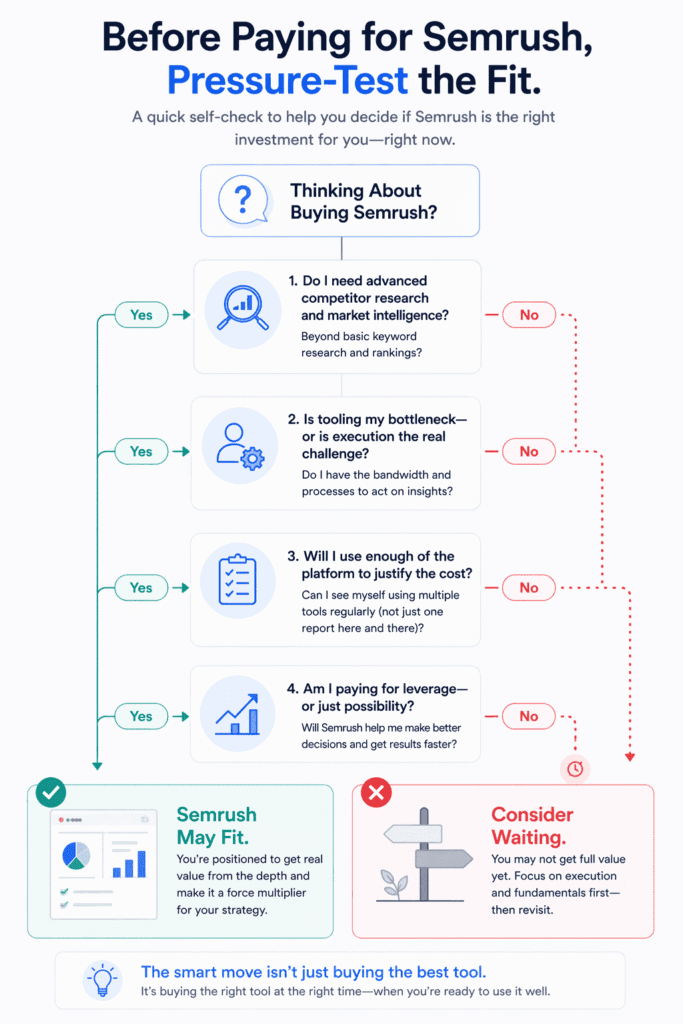
If I were considering paying for Semrush, I’d probably spend less time asking Is it worth the money? and more time asking: Am I actually ready to use something like this well?
That sounds like a small distinction. I don’t think it is. Because one thing I’ve seen with premium tools — not just Semrush — is people often buy them a little too early. Not because the tools aren’t good but because their needs haven’t grown into them yet. And that can be an expensive mismatch.
I’d be careful about paying for capability that outruns your current workflow. That happens more than people admit. There’s a temptation to think better tools will solve upstream problems, weak content planning, inconsistent publishing and when there is no real SEO process.
But software rarely fixes those things. Sometimes it just makes the gaps more visible. And honestly, I think some Semrush review articles gloss over this because it complicates the “worth it” narrative and this matters a lot.
If you’re still at the stage where your main challenge is producing useful content consistently, advanced competitive intelligence may not be your bottleneck. It may just be shiny complexity. And I’d be cautious about paying for shiny complexity.
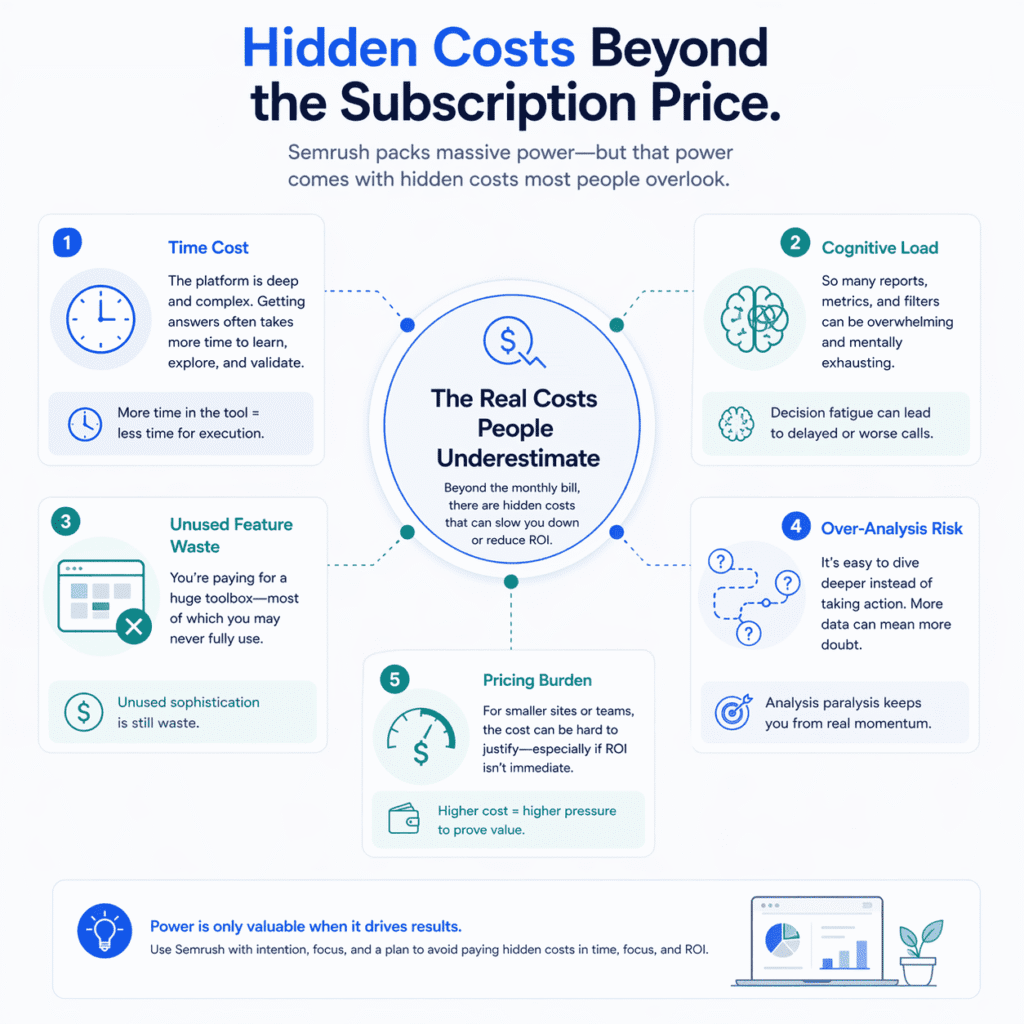
I’d also be careful about assuming you’ll use more of the platform than you probably will. People are optimistic buyers. We all do this. We imagine using every report, every insight layer, every workflow. Then reality shows up. And maybe you use three or four things regularly. That doesn’t make the tool bad. But it should affect how you think about value.
Because unused sophistication is still waste. That’s something I rarely see said plainly. Another thing I’d watch is the expectation of fast ROI. I think people quietly expect expensive tools to prove themselves quickly. But with Semrush, the payoff can sometimes be indirect. Better decisions, fewer blind spots and smarter prioritization. Those things compound, but they don’t always show up neatly in month one or two.
If you’re buying it expecting instant lift, I’d be careful. That expectation can create disappointment even when the tool is working. I’d also pay attention to whether you’re drawn to the promise of depth more than you actually need it.
That sounds abstract, but it matters. Sometimes we confuse sophisticated software with strategic maturity. As if using advanced tools makes our process advanced. It doesn’t. And I think that misconception quietly drives a lot of unnecessary subscriptions. There’s also a practical caution I’d mention. Semrush can create a lot of input. And input has a cost. Not just financially — cognitively.
More reports can mean more things to second-guess. More opportunities can mean more distractions. Sometimes too much insight fragments focus. That risk is real. Especially for solo operators. And maybe this is slightly opinionated, but I think people underestimate the value of simpler tools used well. There are cases where a leaner stack with clearer execution beats an expensive all-in-one setup. I’ve seen that happen.
So yes, if I were writing an honest Semrush review, I’d say be careful — not because the platform lacks value, but because it’s easy to pay for possibility when what you need is leverage. And those are very different purchases.
Where Semrush Can Frustrate More Than People Admit
I like Semrush, but I also think some reviews are too polite about where it can be frustrating. And yes — there are frustrations. One is simply that the platform can sometimes feel heavier than it needs to be. Not unusable but just heavy.
There are moments where I want an answer and feel like I’m walking through three layers of software to get there. That wears on you- especially over time. And I think people understate how much usability affects whether a tool gets used consistently. Another thing I’d be honest about: some data should be treated as directional, not gospel. I’d be cautious with anyone treating estimates as reality.
That’s not a Semrush flaw alone. That’s a tool-risk in general. But it matters enough to say. There’s also occasional feature sprawl. I’ll put it bluntly — parts of the platform feel like they grew because enterprise software tends to grow. Not because every addition made the experience better. That may sound harsh. I think it’s fair.
And for smaller publishers, pricing can absolutely be friction. Not “perceived” friction but real friction. I dislike when reviews dismiss that too casually. Sometimes a tool is genuinely expensive relative to where someone is in their growth. That should be okay to say. I’d actually trust a Semrush review less if it pretended these trade-offs don’t exist. Because they do. And acknowledging them doesn’t weaken the case for the product. It strengthens the honesty of the review.
If You’re a Small Site Owner, This Is the Question That Matters More Than “Is It Worth It?”
If you run a smaller site, I actually think “Is Semrush worth it?” is the wrong first question. Not a useless question. Just not the most important one. Because it pushes you toward thinking about price before thinking about fit. And with a tool like Semrush, fit matters more.
The question I’d care about first is this: Will this tool improve decisions I’m already trying to make — or am I hoping it will compensate for decisions I haven’t learned to make yet? That may sound uncomfortable, but I think it matters. Especially for newer site owners.
Because a lot of people assume advanced tools create advantage by default. I’m not convinced they do. Sometimes they just create more inputs. And more inputs are not always more progress.
If you’re running a small affiliate site, your main bottleneck may not be lack of keyword data or competitor intelligence. It may be about publishing enough quality content, topical focus or maybe about patience before seeing results. And if that’s true, then buying more sophisticated software may not move the needle much. That’s not anti-tool. That’s just respecting bottlenecks.
I think many Semrush review articles rush too quickly to answer whether the subscription is justified, without asking whether the user is positioned to extract much value in the first place. That feels backwards to me. Because value is not what a tool can do. It’s what it helps you do- and that is a huge difference.
And for small site owners, that distinction can save a lot of money. I’d almost frame it this way: Don’t ask whether Semrush is worth paying for. Ask whether it creates leverage in the stage you’re currently in. That’s a better question. Because there are stages where it absolutely might.
If you’re building content clusters, doing competitive research seriously, trying to prioritize where limited effort goes — yes, I can see Semrush becoming genuinely useful. Maybe even disproportionately useful. But there are other stages where the tool may mostly add complexity. And I think people should say that more plainly.
Sometimes your next growth move is not better software. It’s better execution, more content, staying consistent for six more months. Not glamorous, but often true.
There’s also something else I’d be careful about. Small site owners sometimes ask Is it worth it? as if there should be a universal answer. There isn’t. For one person, the subscription may feel like strategic leverage, while for another, it may feel like expensive overhead wearing the clothes of sophistication. Both can be honest conclusions- and I think that’s okay.
Personally, I think the deeper question is whether Semrush helps you make fewer bad decisions. That may matter more than whether it helps you find more opportunities. Because avoided mistakes compound too. That often gets ignored.
So yes, if I were writing an honest Semrush review, I’d say stop asking first whether it’s worth the money. Ask whether it strengthens judgment at your current stage. Because if it does, the pricing conversation looks very different. If it doesn’t, the answer may already be clear.
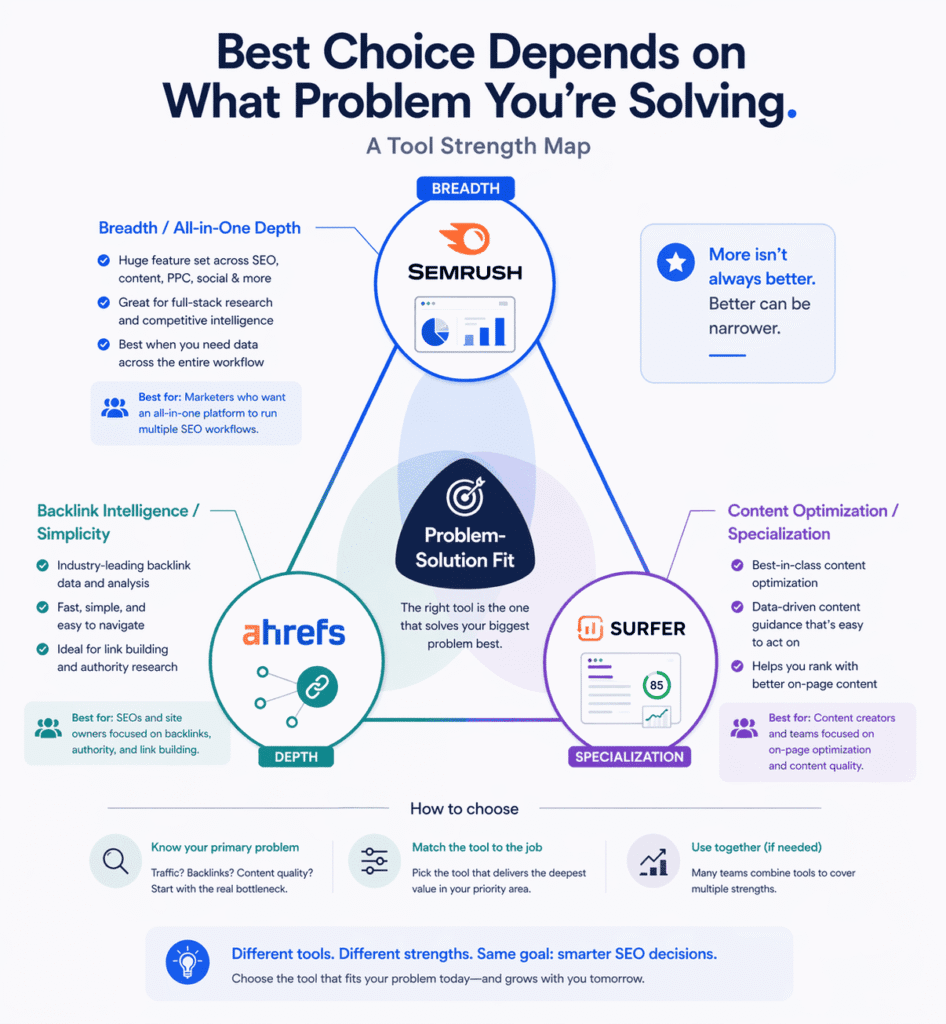
What Other Tools Sometimes Do Better — Even If Semrush Does More
I think one mistake people make in a Semrush review is assuming the tool that does the most must also do everything best. That logic sounds reasonable. It often isn’t. Sometimes doing more means making compromises. That’s true in software generally, and I think it’s true with Semrush too.
There are areas where I genuinely think Semrush is incredibly strong. But there are also moments where a more specialized tool can feel cleaner, sharper and more direct.
And that matters more than comparison tables usually capture. Take something as simple as workflow friction. People often compare tools by features, databases, or pricing. Fair enough. But they don’t talk enough about how a tool feels when you use it repeatedly. That matters a lot.
Sometimes a specialist tool wins not because it has more capability, but because it gets you to an answer faster with less noise and less interpretation required. That can be a real advantage.
For example, I’ve heard plenty of experienced SEOs say they prefer the backlink exploration in Ahrefs for certain workflows. Not because Semrush is weak there. Because the experience fits how they think. That distinction matters. And I think it gets flattened too much in software comparisons. The same thing can happen with content tools.
Some people prefer dedicated platforms like Surfer SEO because they feel more focused. Less ecosystem. More task-specific. Sometimes that focus creates clarity. And clarity has value. I’d even argue specialization sometimes beats comprehensiveness. That’s not a criticism of Semrush. That’s just reality.
All-in-one platforms usually trade elegance in some places for breadth across many. That’s the bargain. And depending on what you need, that can be a great trade or a frustrating one. There are also times when simpler tools outperform simply because they reduce cognitive load. People underestimate that.
If a lighter tool helps you act faster and think less about the tool itself, that can be strategically better. Even if it does less. Especially if you’re a solo operator. I’ve seen people build strong workflows with smaller stacks precisely because less software created more focus. That idea deserves more respect.
And honestly, I distrust reviews that act as though acknowledging competitors do certain things better somehow weakens Semrush. It doesn’t. It makes the review more credible.
No mature tool dominates every subcategory. That would be strange. What I think Semrush often does very well is breadth plus connection. What some other tools sometimes do better is precision, simplicity or elegance. And those are not trivial advantages. Sometimes they’re decisive ones.
I also think the more interesting question is rarely “Which tool is best?” It’s Which tool helps me think better for the kind of work I’m doing? That’s a much smarter question. And it often leads to more nuanced answers. Sometimes the answer is Semrush. Other times it’s a specialist tool or Semrush plus a specialist tool. That’s often where experienced users end up anyway.
So yes, Semrush may do more. But doing more is not the same as doing every important thing best. And I think any honest Semrush review should be comfortable saying that plainly.
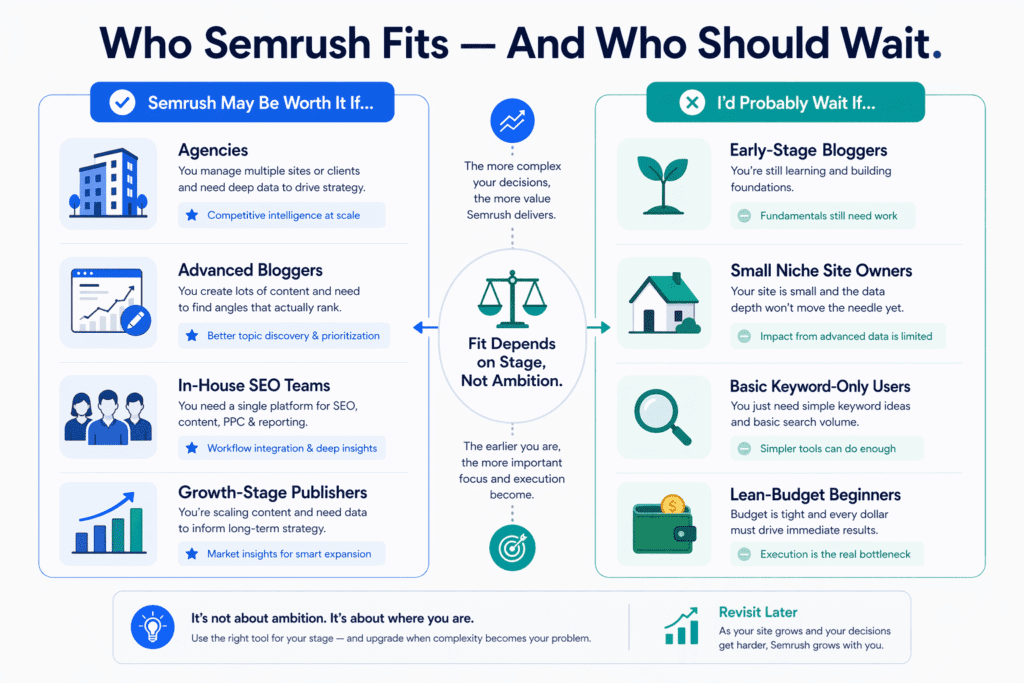
Who I’d Actually Recommend Semrush To — And Who I’d Tell to Wait
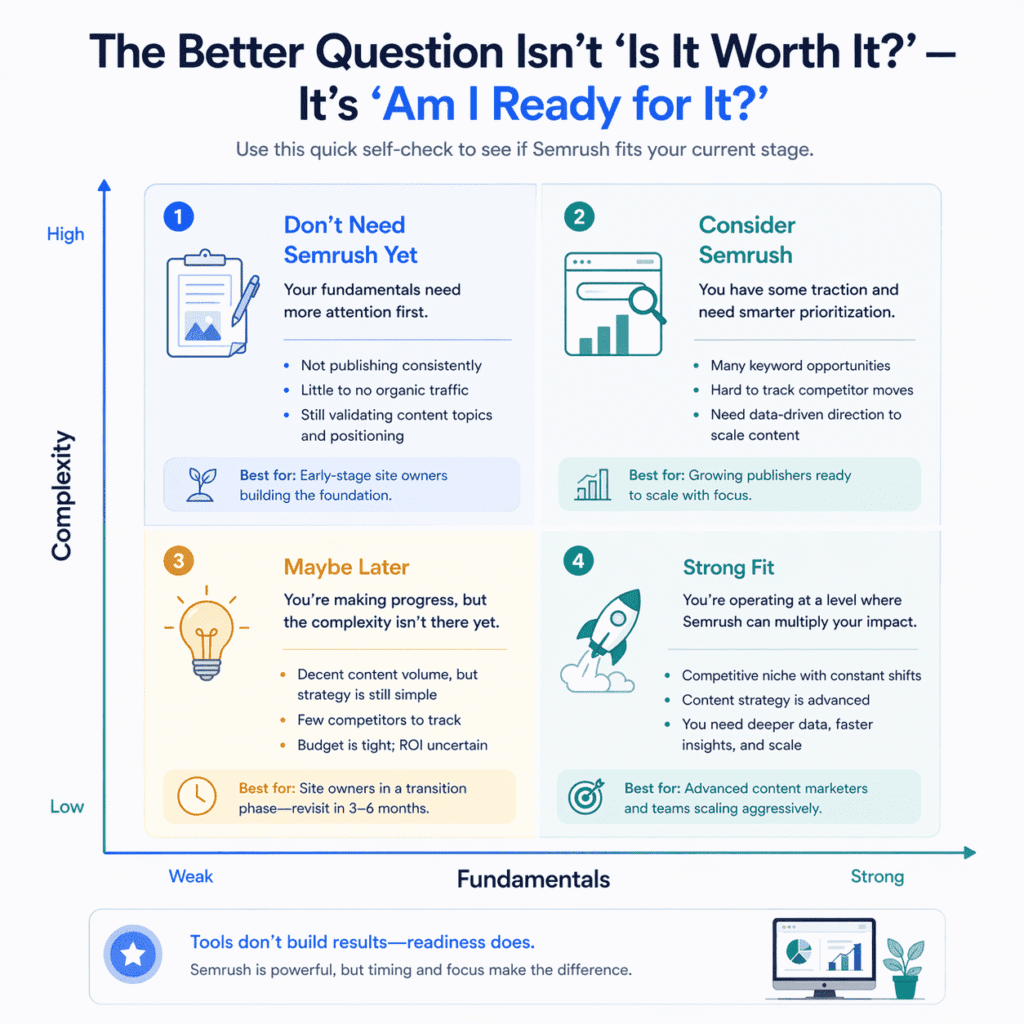
If someone asked me whether they should get Semrush, I probably wouldn’t answer by talking about features first. I’d ask where they are in their growth. Because that usually answers the question.
If you’re at a stage where prioritization is harder than idea generation, Semrush starts becoming interesting. That’s when the tool often earns its keep. If you’re comparing content opportunities, watching competitors seriously, or trying to reduce guesswork in SEO decisions, I can absolutely see the case. That feels like real fit.
But if you have a newer site, little content, and your main challenge is execution, I’d honestly be slower to recommend paying for it. Not because the platform lacks value but because your bottleneck may be elsewhere. And software doesn’t fix the wrong bottleneck. That’s a costly misunderstanding.
I might put it even more simply: Use Semrush when complexity has become your problem. Wait when fundamentals still are. That may be the cleanest dividing line I know. And I realize that’s less aggressive than many affiliate-style recommendations. But it feels truer.
An honest Semrush review should help people know when not to buy too. That’s part of trust.
The Real Question Isn’t Whether Semrush Is Good — It’s Whether It Fits You
After looking at what Semrush does well — and where it can feel excessive — I keep coming back to one conclusion: the real question isn’t whether Semrush is good, but whether it fits the problems you need solved. That matters more than feature lists.
For some users, Semrush can become strategic leverage — helping improve decisions, reduce blind spots, and support growth in ways simpler tools may not. For others, it may feel like more capability than their current stage requires, which can turn into unnecessary cost or complexity. Both reactions can be valid.
In the end, I’d judge Semrush less by how much it can do and more by whether its strengths align with your bottlenecks. If they do, it may be worth the investment. If they don’t, a simpler setup may serve you better. And honestly, that feels like the most useful conclusion any Semrush review can offer.
If you’re still weighing your options, it’s worth taking a closer look at Semrush vs Ahrefs to see how the two tools compare in real-world use.
Disclosure: This article may contain affiliate links. If you make a purchase through these links, I may earn a commission at no extra cost to you. All opinions are based on hands-on testing and independent research.