
Every few months, someone on a marketing team opens a spreadsheet, adds up what they’re spending on tools, and has a quiet moment of reckoning. The number is rarely the surprise. The list is.
The free vs paid marketing tools debate has been running long enough that it’s produced a lot of confident opinions and very little useful guidance. Most of it collapses into the same advice: free tools are good for beginners, paid tools are better when you’re serious, upgrade when you’re ready to scale. Clean, logical, and mostly useless — because it treats the decision as a budget question when it’s really an operational one.
This article isn’t a comparison chart. It won’t tell you which tools to buy or which free alternatives are worth your time. What it will do is work through the assumptions that make most tool decisions go wrong — before the pricing page, before the demo, before the free trial that quietly converts while you’re focused on something else.
Table of Contents
You’re Probably Asking the Wrong Question
Budget is the wrong starting point. It feels like the right one because pricing pages are designed to make it the first thing you see — but cost is a downstream variable, not the actual question.
The question worth asking is harder and less comfortable: what is specifically not working right now?
Not vaguely. Specifically. The thing that adds twenty minutes to a task that should take five. The step that keeps getting skipped because the current tool makes it annoying. The report that nobody reads because pulling it together is more effort than it’s worth. That level of specific.
Most people skip this part. They go straight from ‘we need to get better at email marketing’ to evaluating Mailerlite versus ActiveCampaign versus whatever showed up in the search results. The tool becomes a proxy for a decision that was never really made — about audience, about cadence, about what success even looks like for that channel.
And this is where the free vs paid marketing tools debate quietly goes off the rails. You end up comparing features for a problem you haven’t actually defined. So nothing you buy — free or paid — ends up feeling like quite the right fit. Because it isn’t.
There’s something worth sitting with here: a lot of tool problems are process problems in disguise. The CRM isn’t failing you because it lacks a feature. It’s failing because nobody agreed on how leads get logged, or what stage means what, or who owns follow-up. No upgrade fixes that. It just makes the dysfunction slightly more expensive.
The teams that tend to have the leanest, most functional stacks aren’t particularly disciplined about spending. They’re just honest earlier — about what’s broken, what’s actually needed, and what a tool can and can’t be expected to do. That honesty doesn’t cost anything. But skipping it does.
Mailerlite vs ActiveCampaign — full comparison
The $0 Cost Illusion
Nobody audits a free tool the way they audit a $200/month subscription. That asymmetry is the whole problem.
When something costs nothing, the due diligence stops. You sign up, poke around for twenty minutes, decide it’s “good enough,” and move on. Which is fine — until it isn’t, and by then you’ve built three months of habits around a tool you never properly evaluated.
The actual cost of free tools lives in the friction. Not the big, obvious friction — the small kind. The CSV you have to manually export every Monday because the free plan doesn’t support automated reports. The contact limit you hit right before a campaign goes out. The integration that technically exists but requires a Zapier workaround that breaks twice a month. None of these feel expensive in isolation. Together, over time, they quietly become someone’s part-time job.
There’s something the free tier is designed to do, and it isn’t to serve you indefinitely. It’s to get you dependent enough that upgrading feels easier than leaving. That’s not a conspiracy — it’s just how SaaS businesses work. The free plan is a long sales conversation. And the smarter the product, the better it is at making the ceiling feel like your problem to solve, not theirs.
The ceiling itself is worth thinking about more carefully than most people do. You don’t hit it on day one. You hit it after you’ve already reorganized your workflow around the tool, trained someone else to use it, and connected it to four other things. At that point, switching isn’t just inconvenient — it’s a small project. So you upgrade. Which was always the plan.
There’s a version of free that doesn’t get talked about enough — the free trial. Not the indefinitely free tier, but the 14-day window that ends quietly while you’re busy with something else. Trials have their own psychology. You adopt the tool under low-stakes conditions, build just enough familiarity with it that switching feels like a step backward, and then the billing starts before you’ve made a real decision. The free trial isn’t a grace period. It’s the most effective part of the sales process — the part where you sell yourself.
This is one of the more underappreciated dynamics in the free vs paid marketing tools conversation — the decision to upgrade rarely feels like a decision. It feels like the path of least resistance. Which is exactly how it was designed to feel.
None of this means free tools are a bad choice. Some of them are quietly excellent and stay that way for years. But “it’s free” is not an evaluation. It’s a reason to stop evaluating. And that’s where the real cost starts.
The data angle is worth naming too, even if it’s uncomfortable. Free tools aren’t running on goodwill — the business model has to work somehow. For many of them, the value exchange involves your data: how your audience behaves, what you’re sending, who’s on your list. This isn’t always sinister, but it’s rarely spelled out clearly either. For teams handling client data, or operating in industries with any kind of compliance requirement, “free” carries a cost that doesn’t show up in the pricing comparison but shows up very clearly in a data processing agreement — if anyone reads it.
Paid Tools Have a Dirty Secret Too
Ask someone what tools their team pays for and they’ll list them confidently. Ask them which ones they actually opened last week and the answer gets quieter.
Most teams use a fraction of what they pay for. Not because they’re lazy or disorganized — because the tool they bought in the demo isn’t quite the tool that showed up in practice. The demo had clean data, a knowledgeable guide, and a narrative arc. Reality had a messy CRM, three people with different ideas about how to use it, and a Q3 deadline that meant nobody had time to finish the onboarding they started in January.
Vendors know this. The utilization numbers get tracked internally with a level of detail most customers would find uncomfortable. Low feature adoption isn’t a problem to solve — it’s a stable condition that’s already been priced in. If every customer used every feature, support costs would be higher, churn would be harder to predict, and the pricing model would need to change. The gap between what’s sold and what’s used isn’t a bug. It’s load-bearing.
The sales process deserves some scrutiny here. A well-run SaaS demo is a controlled environment — the right account, the right setup, someone who’s done this presentation four hundred times. You’re not seeing the product. You’re seeing the product’s best possible version of itself.
And the questions most people forget to ask are the ones that would actually matter: how long does implementation realistically take, what does the first 90 days look like for a team like ours, and what do customers usually wish they’d known before signing.
This is where the free vs paid marketing tools comparison gets genuinely complicated — because the case for paying isn’t just about features or reliability. It’s also about whether your team will actually use what they’re paying for. A free tool used consistently will outperform a paid platform that got a thorough onboarding in February and has been quietly accumulating dust since March.
Feature bloat makes this worse over time. Paid tools tend to get heavier as they age — more modules, more settings, more integrations built for enterprise accounts that smaller teams will never touch. The interface that felt clean in year one is now hiding things three menus deep. The changelog started as a list of improvements and gradually became a list of additions nobody asked for. Complexity accumulates, and the cost of that complexity gets passed to the user in the form of time and cognitive overhead, not line items.
Paying for a tool is not the same as solving the problem the tool was bought to solve. That part still requires the work.
The Accidental $400/Month Stack
The number is never the surprise. It’s the list.
Most teams, when they actually pull up every active subscription in one place, don’t react to the total — they react to the tools they forgot existed. The platform someone signed up for during a slow week in February. The trial that converted quietly because canceling required a phone call and the person who signed up had since left. The tool that solved a real problem once and has been renewing itself every month since, untouched.
This is how it actually accumulates. Not through bad decisions — through a series of individually reasonable ones that nobody was tracking as a pattern. A free trial that worked well enough to keep. An upgrade that made sense at the time because the team was growing. A tool a previous hire swore by that got absorbed into the stack by inertia rather than intention. No single moment where someone said “yes, we need all of this.” Just a slow drift toward complexity that feels manageable right up until someone actually adds it up.
The part that gets missed in most conversations about tool sprawl is who’s responsible for it. In small teams, often nobody is. Tools get added by whoever had the problem that week — the designer, the freelancer, the founder at 11pm trying to fix something before a deadline. There’s no procurement process, no stack owner, no one asking whether this overlaps with something already paid for. The stack grows the way a junk drawer grows. Gradually, then all at once, and always with more duplicates than you’d expect.
Switching costs are part of what keeps the junk drawer full. Moving away from a tool that’s embedded in your workflow — even a tool everyone agrees isn’t working well — is a project. There’s data to migrate, integrations to rebuild, a team to retrain, and institutional memory tied up in whatever naming conventions and folder structures grew around the old system. None of that is insurmountable, but all of it is real, and it’s enough friction that “we’ll deal with it later” wins most of the time. Later becomes never. The tool stays. The subscription renews. And the stack gets slightly more calcified with each passing quarter.
Overlap is the real cost. Not the subscriptions themselves — the fact that three tools are doing versions of the same job, none of them doing it completely, and switching between them has become so normalized that nobody questions it anymore. That’s the sign the stack has stopped being a set of tools and started being a set of habits.
Auditing it is less about finding the waste and more about having a conversation the team has been quietly avoiding — about what’s actually being used, what was adopted for someone who’s no longer there, and what’s being kept because canceling feels like admitting the decision was wrong. That last one is more common than anyone likes to say out loud.
What You’re Really Paying For (It’s Rarely the Features)
The feature list is the least interesting thing on a pricing page. It’s also the thing most people spend the most time on.
Features are easy to compare. They fit neatly into tables, they’re concrete, they give you something to point to when explaining the decision to someone else. But features are also the part of the tool you evaluate once, during the buying process, and then mostly stop thinking about. What you actually live with is everything else.
Reliability is the obvious one, though it rarely gets named directly. Not reliability as an abstract quality — the specific, operational kind. The report that runs when you need it to. The scheduled post that goes out without you checking. The sync between tools that just keeps working without anyone maintaining it. None of this is exciting to pay for, and none of it shows up in a comparison chart. But the cost of unreliability is measurable in real time — the send that didn’t go, the data that’s wrong, the hour spent diagnosing something that shouldn’t have broken.
Support is similar. It sounds like a minor consideration until the moment it isn’t. Most free tools offer a help center and a community forum, which works adequately when the problem is common and the timing is flexible. Neither of those conditions applies when something breaks mid-campaign or a client is waiting on a deliverable. What you’re paying for with a good support tier isn’t answers — it’s the ability to get answers on your schedule, not theirs.
The thing that gets talked about least is business continuity — meaning, whether the tool will still exist and still work in two years. Free tools fold, pivot, get acqui-hired into irrelevance, or simply stop being maintained once the team behind them moves on. This happens often enough that it probably shouldn’t be called a risk so much as an eventual certainty for any given free product. Paid tools aren’t safe from this either, but there’s at least a commercial incentive to keep the product functional and the customers from leaving. That incentive is worth something.
Integration depth is another thing that rarely makes it into the headline features but determines a significant amount of day-to-day usability. A paid tool with native integrations — ones that are maintained, stable, and don’t require a middleware layer to function — compresses a surprising amount of friction out of a workflow. The free alternative might technically connect to the same platforms, but “technically connects” and “reliably works” are different things. Three Zapier steps that each have a 2% chance of failing on any given day add up to something that breaks regularly enough to require a person to monitor it. That person’s time has a cost. It just doesn’t appear on the tool’s pricing page.
None of this is to say features don’t matter. Sometimes a specific capability is genuinely the thing you need and the reason a particular tool is the right choice. But when someone says a paid tool is “worth it,” they’re almost never talking about the features. They’re talking about the hour they didn’t lose, the deadline they didn’t miss, the thing that worked when it needed to. That’s what’s actually on the invoice. The features are just the story told to justify it.
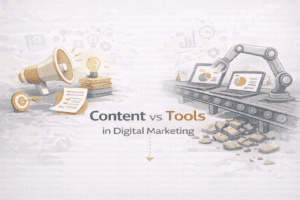
why Tools Alone Won’t Improve Your Marketing Results
Stage Matters More Than Budget
Spend enough time around early-stage teams and you notice a pattern: the ones struggling with their tools are rarely struggling because of price. They’re struggling because they bought for a version of themselves that doesn’t exist yet.
It’s an easy mistake to make. You’re building something, you have a sense of where it’s going, and the tools you choose feel like part of that vision. So you buy the platform that makes sense for fifty clients when you have eight. You set up the automation infrastructure before you’ve figured out what you’re actually automating. The tool becomes an expression of ambition rather than a response to a current, specific problem — and then it sits there, expensive and underused, while the actual work gets done in a Google Doc.
What makes stage hard to think about clearly is that it’s not just about size. This is also where the free vs paid marketing tools conversation tends to go wrong — it gets framed around budget when it should be framed around operational maturity. A five-person team that’s been operating for three years and knows its workflow has different needs than a five-person team that’s six months old and still figuring out what it does. Headcount is visible. Operational maturity is harder to see, and it’s the thing that actually determines what a team needs from its tools.
The underinvestment side of this gets less attention but it’s just as real. Teams that have been running lean for a long time tend to keep running lean past the point where it’s serving them — partly habit, partly because nobody wants to own the project of changing infrastructure mid-stride.
The spreadsheet that handled things fine at ten clients starts showing stress at twenty-five, and the response is usually to add a column rather than ask whether the spreadsheet should still be doing this job at all. The cost of that decision doesn’t show up anywhere obvious. It shows up in how long things take, in the errors caught late, in the mental overhead of working around a system that was built for a smaller version of the operation.
Buying ahead of your stage isn’t always wrong. Sometimes a tool takes real time to implement properly, and waiting until you desperately need it means you’re migrating during a period when you can least afford the disruption. But there’s a difference between buying six months ahead and buying two years ahead. One is pragmatic. The other is expensive optimism dressed up as planning.
The question worth sitting with isn’t what you can afford or even what you need. When weighing free vs paid marketing tools, the more honest filter is what your operation actually looks like right now — not the roadmap version, not the pitch deck version — and whether your tools are built around that reality or around a more flattering one.

You May Also Read My Article on: How to Choose the Right Marketing Tools for Your Business
Building a Stack Before You Have a Process Is Backwards
Tool shopping feels productive in a way that’s hard to argue with in the moment. You’re researching, comparing, making decisions. It has the texture of work. It’s usually not.
The sequence matters more than most people admit. Most teams find a tool, adopt it, and then figure out how it fits — or doesn’t — into how they actually operate. Which means the tool gets chosen before anyone has a clear picture of what it’s supposed to support. And then the tool shapes the process instead of the other way around, which is how you end up with workflows that exist because of what the software allows rather than because anyone decided that’s how the work should flow.
CRMs are where this gets most expensive and most visible. Not because CRMs are bad tools — some of them are excellent — but because a CRM requires you to have already answered a set of questions most teams haven’t. What counts as a lead. What the stages actually mean in terms of real actions, not just labels. Who updates the record and when.
What happens when a deal goes quiet. A team that hasn’t worked through those questions will implement a CRM and then slowly stop using it, because using it correctly turns out to require a level of agreement that was never reached. The tool becomes shelfware not because it was the wrong tool but because it was the right tool for a process that didn’t exist yet.
The reason this keeps happening is that process work is uncomfortable in a way tool evaluation isn’t. Comparing pricing plans is objective. Sitting down as a team and getting specific about how work actually moves — not how everyone assumes it moves, but how it actually moves — surfaces disagreements that have usually been sitting there unaddressed for a while. It’s easier to buy a project management platform than to have the conversation about why the last three projects ran late. The platform has a launch date. The conversation doesn’t.
There’s also a visibility problem. A new tool signals something — investment, seriousness, momentum. You can announce it in a team meeting. You can’t really announce “we finally agreed on what done means.” Process is invisible infrastructure. It doesn’t demo well. So teams reach for the thing that does.
What’s harder to argue against is the fact that some tools genuinely do help teams develop process rather than assuming it. This is actually one of the more useful ways to think about free vs paid marketing tools — not which one has better features, but which one is simple enough to use before your process is fully formed. A simple board that makes work visible can surface bottlenecks that were previously just vibes. Basic analytics can force a team to get specific about what they’re actually trying to move.
These tools are useful precisely because they’re simple enough that the team’s confusion about process becomes visible through using them — rather than hidden underneath a layer of features that require the process to already be figured out.
The difference is between tools that illuminate the work and tools that assume it. One helps you see what needs fixing. The other just makes the dysfunction harder to untangle.
REALATED ARTICLE: Traffic growth is less about tools and more about decisions most sites avoid making — What Actually Drives Website Traffic (And Why Most Sites Get It Wrong) breaks down what those decisions actually look like.
The One Question That Cuts Through Every Pricing Page
Pricing pages are not evaluation tools. They’re sales documents. The feature tables, the tiered checkmarks, the “most popular” badge nudging you toward the middle option — all of it is designed to move you toward a decision, not help you make one.
Which is why most tool decisions get made backwards. Someone scans the feature list, finds a few things that sound useful, decides the price seems reasonable, and signs up. The features aren’t driving the decision — they’re being recruited to justify one that was already half-made. The mind goes first and the feature list comes second, dressed up as evidence.
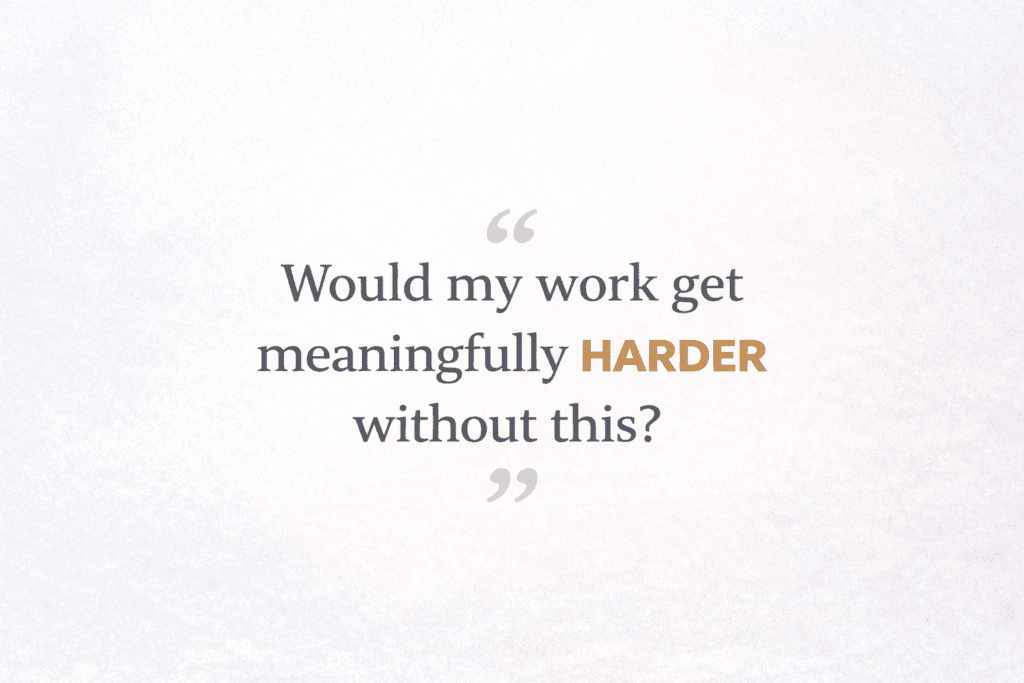
The question worth asking instead is: would my work get meaningfully harder without this?
Not better with it. Harder without it. Better is almost infinitely flexible — you can talk yourself into “better” for nearly any tool if you try. Harder is more honest. It asks you to name something specific that breaks or slows down or disappears in the tool’s absence. And for a lot of tools, if you sit with that question long enough to answer it properly, the answer is closer to “no, not really” than most people expect.
The same question applied to tools already in the stack is even more useful — and more uncomfortable. Not “is this good” or “do people like it” but “what changes tomorrow if we cancel.” Teams that ask this regularly tend to have leaner, more deliberate stacks. Teams that don’t ask it tend to find out the answer accidentally during a budget review.
Where the question breaks down is with tools that work by preventing things rather than enabling them. Deliverability platforms, monitoring tools, backup systems — these don’t make anything visibly better on a normal day. Their value is entirely in what doesn’t happen, which makes them genuinely hard to evaluate and easy to cut when someone’s looking for line items to trim. The question “would things get harder without this” is almost impossible to answer honestly for a tool whose job is to keep things from getting harder. That’s a different category, and it deserves a different kind of scrutiny.
For everything else — the upgrade prompt, the competitor with the longer feature list, the annual plan that’s 20% cheaper if you commit now — the question holds. It won’t make the decision for you. But it’ll tell you whether you’re making a decision or just responding to one that was made for you.
Read our full review on Constant Contact
There’s No Right Answer, But There Are Honest Ones
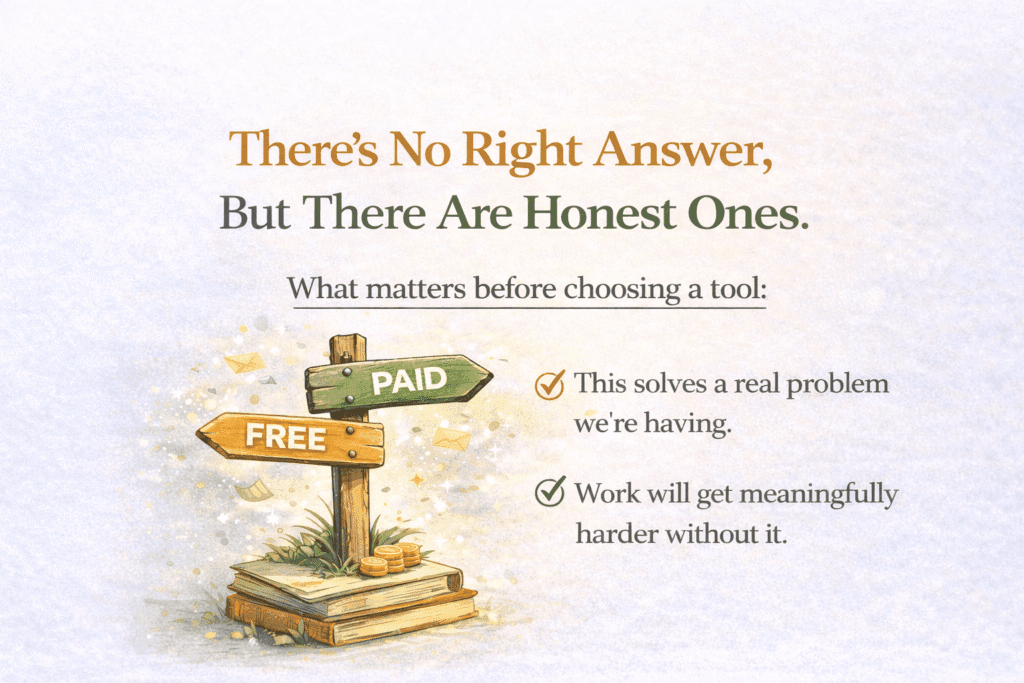
After everything — the pricing comparisons, the feature tables, the free trial countdowns, the stack audits — the question that actually matters is simpler and harder than any of them: are your tools serving your work, or have you started working around them?
That question doesn’t care whether something is free or paid. It doesn’t care how long you’ve been using it, who recommended it, or how much the migration away from it would cost. It just asks whether the thing is doing its job. And the honest answer, for most teams, is that some tools are and some aren’t — and the ones that aren’t have usually been on a quiet shortlist of “things to address eventually” for longer than anyone would comfortably admit.
The noise around this topic doesn’t help. The free vs paid marketing tools conversation generates a constant low-level pressure about what serious teams use, what the current best-practice stack looks like, what you’re supposedly missing if you’re not on a particular platform. Most of it is people sharing what they use rather than whether it’s working. Those are different conversations. One is a preference. The other is an evaluation. They get conflated constantly, which is part of why so many tool decisions feel more like social decisions than operational ones.
What the teams who handle this well tend to have in common isn’t discipline or budget or technical sophistication. It’s a lower tolerance for ambiguity about whether something is earning its place. They cancel things. Not dramatically, not as part of a quarterly optimization ritual — just when it becomes clear that a tool has stopped doing what it was brought in to do. That willingness to act on an honest assessment, rather than file it away, is rarer than it should be.
It’s also worth acknowledging that the answer looks different depending on what kind of tool you’re talking about. The free vs paid calculus for an email marketing platform is completely different from the same conversation about an SEO tool, a design platform, or a project management system. In email marketing alone, the gap between a free Mailerlite plan and a paid ActiveCampaign or Constant Contact subscription isn’t always a features gap — sometimes it’s purely a scale and automation gap that won’t matter to you for another eighteen months. In analytics, free tools have matured to the point where paying more doesn’t reliably get you better outcomes.
Getting tool decisions wrong is recoverable. Migrations are annoying. Overspending for a few months is a real cost but not a serious one. The thing that’s harder to recover from is the habit of not looking clearly — of letting the stack accumulate and the friction normalize and the question of whether any of this is working get pushed further and further down the list.
There’s no perfect stack. There’s just the one you’ve actually thought about — and when it comes to free vs paid marketing tools, thinking clearly about it, even once, is already better than most teams manage.
You May Read our full review of Mailerlite
Knowing which tools actually fit your workflow matters more than chasing the most popular ones — and choosing the right marketing tools for your business starts with understanding what problem you’re actually trying to solve.
Disclosure: This article contains affiliate links. If you make a purchase through these links, I may earn a commission at no extra cost to you. All opinions are based on hands-on testing and independent research.