
Nobody warns you properly before you start.
There are courses, YouTube videos, podcasts, blog posts — an almost overwhelming amount of content telling you what to do and how to do it. And yet somehow, despite all of it, most people who get into online marketing still spend their first year or two making the same painful, avoidable mistakes. Not because they’re not trying. Not because they’re not consuming enough advice. But because there’s a significant difference between understanding something intellectually and actually knowing it — and that gap only closes through experience.
I spent three years in online marketing before things started working in any meaningful way. Three years of wrong turns, wasted budgets, misplaced effort, and more than a few moments of wondering whether any of it was ever going to compound into something real. And looking back now, the online marketing mistakes I made weren’t random or unusual — they were almost predictable. The kind that show up again and again in almost everyone’s story, just wearing slightly different clothes each time.
This isn’t a list of things I read about and thought sounded important. Everything here is something I lived through, got wrong, and eventually had to unlearn. Some of it cost money. Some of it cost months. All of it taught me something I couldn’t have learned any other way.
If you’re somewhere in the early or middle stages of figuring this out — still waiting for things to click, still not entirely sure whether you’re on the right track — this is the article I wish someone had handed me at the start.
Table of Contents
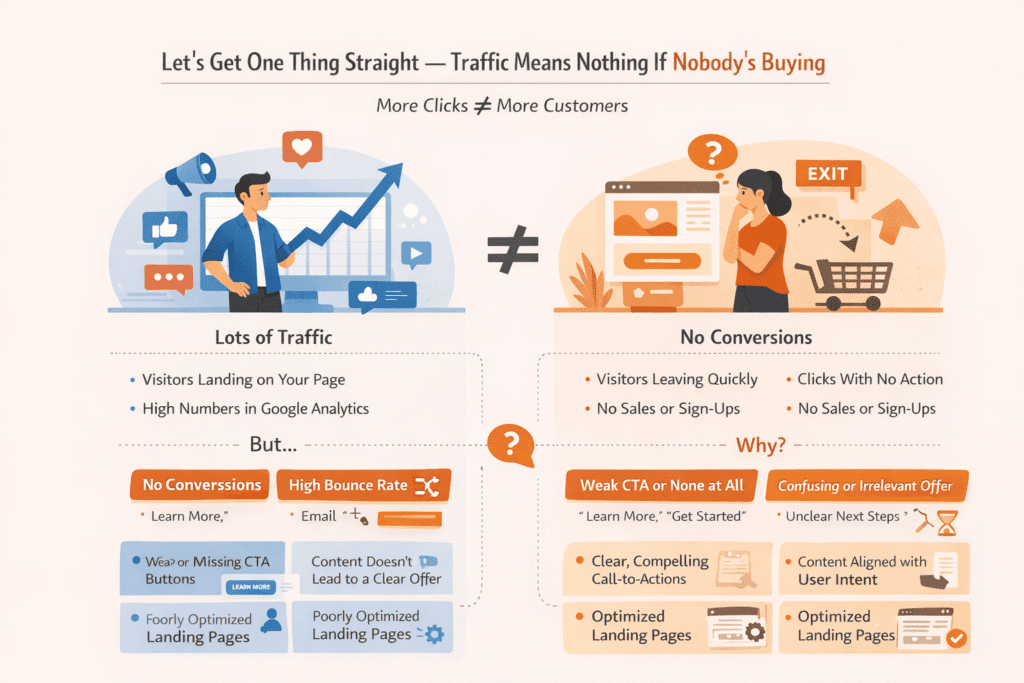
Let’s Get One Thing Straight — Traffic Means Nothing If Nobody’s Buying
For a long time, I thought I was winning.
The traffic was going up. The graph was pointing in the right direction. I’d check Google Analytics first thing in the morning like it was going to tell me something new, and when the numbers were good, I felt good. That was the whole feedback loop. Numbers up, mood up. Simple.
Except nothing was actually happening. People were landing on the site and leaving. Not because they hated it — just because there was nothing obvious for them to do when they got there. I hadn’t really thought about that part.
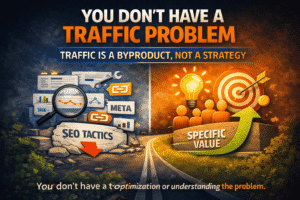
And this is the thing that took me embarrassingly long to figure out: getting traffic and getting customers are two completely different skills. One is about being findable while the other is about being convincing. I had spent all my energy on the first one and almost none on the second.
What was broken wasn’t my SEO. It was everything after the click.
Landing pages that didn’t really say anything. Calls to action that were either missing or so vague they meant nothing — “learn more,” “get started,” that kind of thing. Content that attracted one type of person and then pointed them toward something completely unrelated. Someone would read a post I wrote about growing an email list, and then land on a homepage that looked like it was designed for someone else entirely. Obviously they left and I would have too.
The frustrating part is that traffic is easy to get excited about because you can see it. It shows up in dashboards, in screenshots, in the kind of numbers that look good when you’re explaining to someone what you do. Conversions are slower, messier, and harder to attribute — so they get pushed to the back of the priority list. Especially when you’re starting out and you’re basically just trying to prove to yourself that any of this is working.
I’ve spoken to a lot of people who say online marketing “didn’t work” for them. And almost every time, when you actually dig into it, the traffic was fine. Sometimes it was pretty good. What wasn’t working was what happened when someone arrived. The site wasn’t clear and the offer didn’t land. There was no real reason to stick around or come back.
That’s a conversion problem. Not a traffic problem. But because nobody framed it that way, they kept trying to solve it by chasing more traffic — which is a bit like turning up the volume when the problem is that the song itself isn’t connecting.
One of the most common online marketing mistakes I see — and one I lived through myself — is treating traffic as the finish line when it’s actually just the starting gun. The race doesn’t begin when someone lands on your page. It begins the moment they start deciding whether to stay.
Look, traffic matters. I’m not saying ignore it. But there’s an order to this. If your site can’t do anything useful with the visitors it already has, sending more people there just means more people leaving. Fix the leaks first. Make sure there’s a clear, logical path from “I just arrived” to “I understand what this is and I want it.” Then scale the traffic.
That one reframe — from how do I get more people here to what does someone actually need to see to take a step forward — was the thing that started making a real difference for me. It sounds obvious written down like that. It really wasn’t obvious at the time.
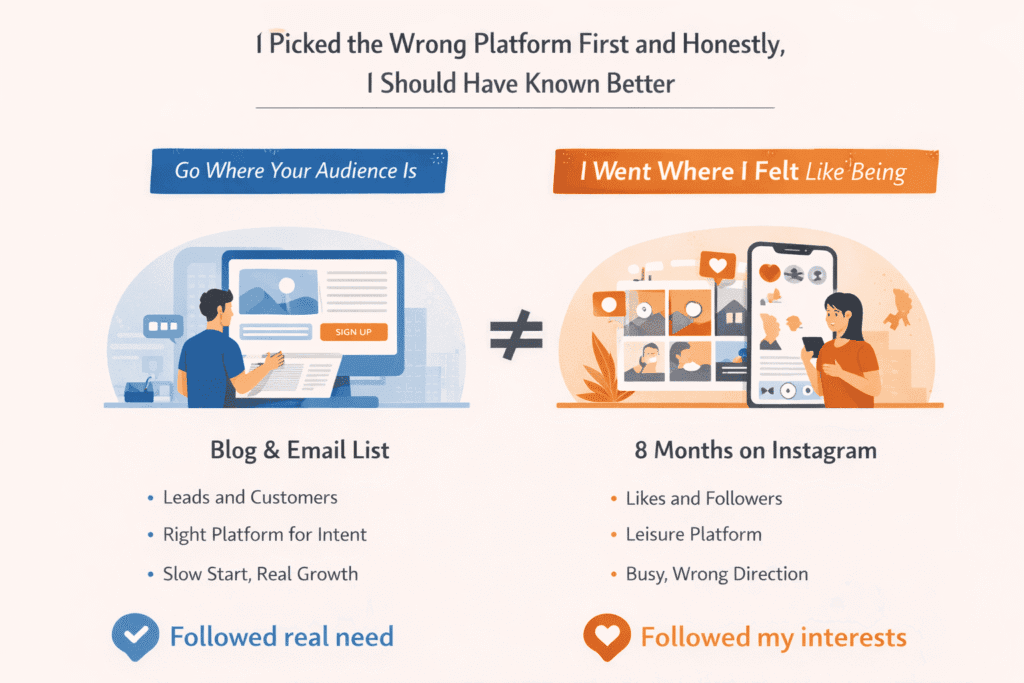
I Picked the Wrong Platform First and Honestly, I Should Have Known Better
I spent eight months on Instagram. Not casually but properly committed — designing graphics, writing captions, researching hashtags, posting consistently, engaging with other accounts. The whole thing, and I want to be clear about this: I was not lazy about it. I showed up. I did the work but I just did it in completely the wrong place.
The people I was trying to reach — small business owners, people trying to get their heads around marketing without a big budget or a team — they weren’t on Instagram looking for that kind of help. They were on Google at 11pm trying to figure out why their Facebook ads weren’t working. They were in LinkedIn groups asking questions. They were subscribed to newsletters from people they’d come to trust over time. They were not, as it turns out, waiting for my carousel post.
And here’s what bothers me when I look back on it — I knew this. Not clearly, not in a way I’d written down somewhere, but I knew it in the way you know something and choose not to examine it too closely because examining it would mean admitting you’ve been wasting your time. So I kept posting. Kept tweaking the aesthetic. Told myself the audience would come if I just stayed consistent.
It didn’t come. Or rather, some people came, followed, left a comment occasionally — but none of it connected to anything real. No leads. No conversations that went anywhere. Just numbers that looked okay on the surface and meant nothing underneath.
Picking the wrong platform is one of those online marketing mistakes that’s easy to dismiss in hindsight — of course Instagram wasn’t right for that audience — but genuinely hard to see when you’re in it, committed, and telling yourself that consistency will eventually pay off. The sunk cost of eight months makes the truth harder to look at directly.
The advice that sent me down this road was “go where your audience is.” Which sounds sensible. The problem is it assumes you already know where your audience is, and most people starting out have absolutely no idea. So “go where your audience is” gets interpreted as “go where you already spend time” or “go where things look exciting right now” — which in my case meant Instagram, because that’s what everyone around me was talking about.
Platform choice is messier than most people admit. It’s not just about demographics or where a certain age group hangs out. It’s about what headspace someone is in when they’re on that platform. Instagram is a leisure environment. People are unwinding, browsing, half-paying attention. Asking someone to stop and genuinely engage with a complex idea in that context is hard. Whereas someone reading a long blog post or a detailed LinkedIn article has already opted into thinking. They came there to consume something substantial. That’s a completely different conversation to try to have.
I eventually moved to a blog and a simple email list. It felt boring compared to Instagram. No likes, no follower counts, no visible social proof of any kind for a long time. Just writing and sending and hoping someone found it useful. But within a few months it had done more for my actual business than eight months of Instagram ever came close to doing.
The honest lesson isn’t “Instagram is bad” or “pick the right platform and everything works.” It’s more uncomfortable than that. It’s that most people pick a platform based on where they feel comfortable or where things look exciting, dress it up as a strategy, and then spend months being busy in the wrong direction. I did exactly that. The signals were there early. I just didn’t want to see them.
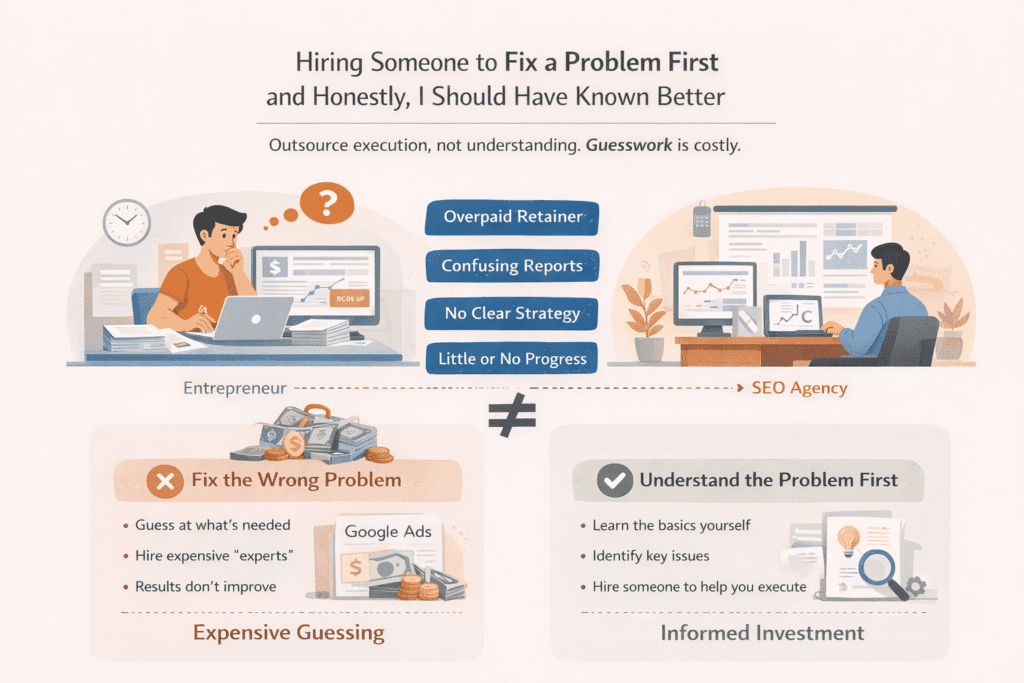
Hiring Someone to Fix a Problem You Don’t Understand Yet Is an Expensive Lesson
The first time I hired outside help, I genuinely thought I was being smart about it.
I was six months in, not getting the results I wanted, and I’d convinced myself the missing piece was expertise — someone who knew more than me, who could come in and fix whatever I was clearly doing wrong. So I found an SEO agency, agreed to a monthly retainer that made me wince a little, and waited for things to turn around.
They sent reports every month. The reports had charts. The charts looked very professional. I understood almost none of it — and here’s the thing I didn’t admit to myself until much later: I didn’t know enough to know whether it was working. I was paying for something I couldn’t evaluate. That’s not a vendor problem. That’s a me problem.
Three months in, nothing had meaningfully changed. And when I finally pushed for a real conversation about why, I realized something that stung more than the wasted money — I had hired them to solve the wrong problem. I thought the issue was SEO. It wasn’t. The actual issue was that I had no clear offer, no defined audience, and content that wasn’t really speaking to anyone in particular. You cannot SEO your way out of a positioning problem. It doesn’t matter how clean your backlink profile is if the site itself doesn’t make sense to the people landing on it.
But I didn’t know that then. So I paid for SEO, got SEO, and stayed stuck.
This same mistake happens with ads specialists, social media managers, copywriters, designers — almost every corner of marketing. The pattern is always the same. Someone isn’t getting results, decides they need professional help, and hires someone before they’ve actually diagnosed what’s broken. The hired person does their job. The underlying problem stays exactly where it was. And because the business owner didn’t understand the problem going in, they often can’t even tell that’s what happened.
Here’s the distinction that actually matters: there’s a massive difference between hiring someone to execute something you understand, and hiring someone to think for you about something you’ve never touched. The first one scales your capacity. The second one just moves your confusion somewhere more expensive.
And I want to be careful here because I’m not saying don’t hire people. Outsourcing is how you eventually get out of doing everything yourself — that part is real. But there’s a version of outsourcing that works and a version that doesn’t, and the difference almost always comes down to whether you understood the problem before you handed it over.
You don’t need to become an expert before you hire an expert. But you do need to understand the problem well enough to recognise what solving it actually looks like.
Can you describe what success looks like in three months? Do you know what questions to ask in the first meeting? Would you be able to tell — even roughly — if the work being done is pointing in the right direction? If the answer to those is no, you’re not ready. Not because the freelancer or agency isn’t good, but because you won’t be able to have an honest conversation with them about whether any of it is working — and that conversation is half the value of the relationship.
What I’d do differently is spend a month trying to do the thing myself first. Not to become an expert. Just to develop enough of a point of view to be a useful client. That month is uncomfortable and slow and you’ll produce mediocre work. But you’ll come out of it knowing where the real friction is, what’s harder than it looks, and what questions actually matter. When you do sit down with someone who knows what they’re doing, you’ll be able to push back, ask the uncomfortable questions, and spot when you’re being told what you want to hear rather than what you need to know.
The people I’ve seen get the best results from working with specialists are almost never the ones who handed everything over and hoped for the best. They’re the ones who came in with opinions. Rough ones, sometimes wrong ones — but opinions. That only happens when you’ve done enough of the work yourself to have some skin in the game.
Hiring too early doesn’t just cost money. It outsources the understanding you actually needed to build yourself — and in marketing, that understanding is the thing that keeps paying you back long after the campaign is over.
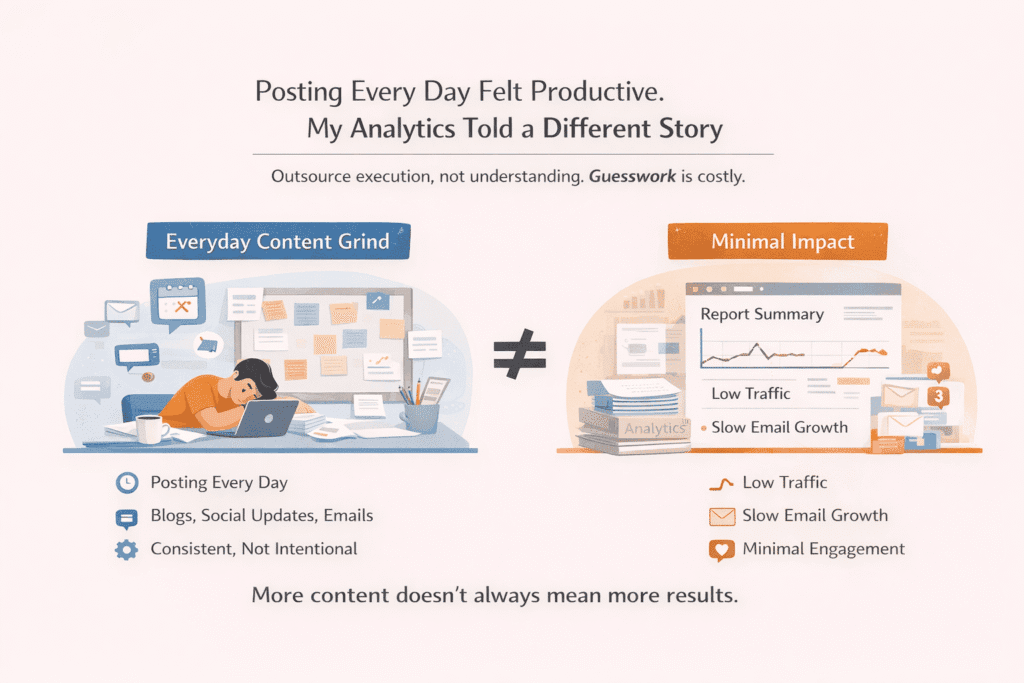
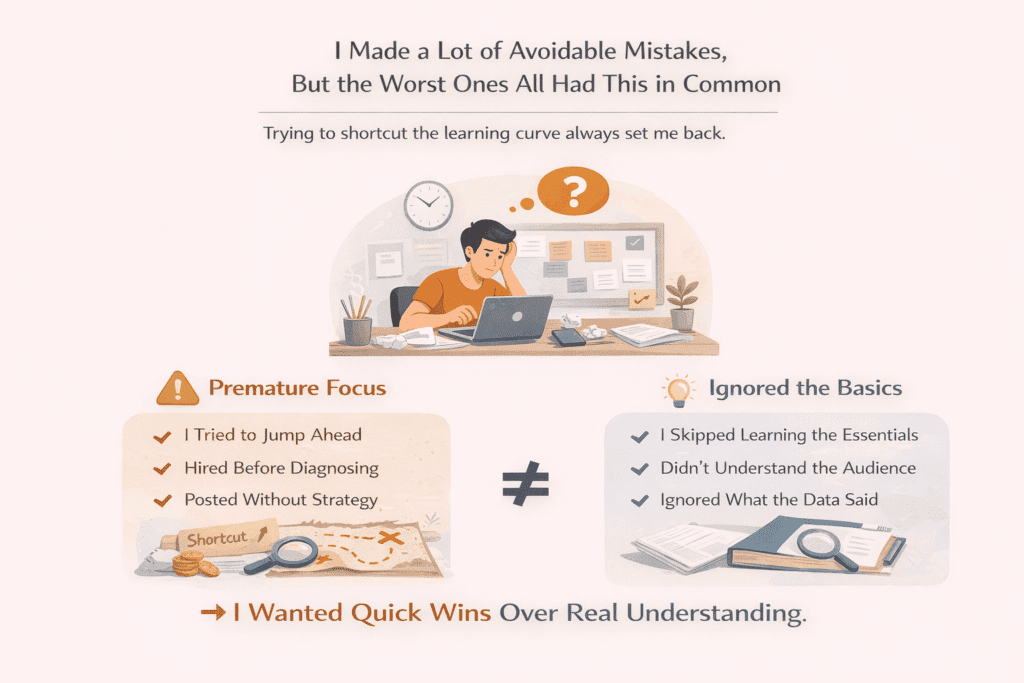
Posting Every Day Felt Productive. My Analytics Told a Different Story.
For a solid stretch of time I was creating something every single day. Blog posts, social updates, emails, the occasional video that took three times longer than it should have. I had a content calendar. Colour coded. I was not messing around.
My analytics were completely unbothered.
Traffic was flat. The email list was growing at the kind of pace where you have to zoom out to a three month view just to convince yourself the line is actually going up. Engagement existed but it was thin — the kind where the same handful of people interact with everything and you’re quietly aware that outside that small circle, nobody is really paying attention.
I kept going anyway. Because I was consistent, and consistency was the thing everyone said mattered. Show up every day. Trust the process. Play the long game. I had fully absorbed the content marketing gospel and I was living it, and it wasn’t working, and I didn’t want to look at that too directly so I just kept producing.
The moment that actually stopped me wasn’t an insight. It was exhaustion. I ran out of steam one week and missed a few days and sat down properly with my analytics for the first time in months — not to check the numbers but to actually read them. To ask what they were telling me rather than just looking for evidence that things were okay.
What they were telling me was not great.
I went back through everything I’d published over the previous four months. Looked at what had actually done something — driven traffic, generated signups, started a real conversation — versus what had just existed for a few days and then quietly disappeared. And the split was brutal. A small handful of pieces were responsible for almost everything. The rest had essentially made no difference at all.
That would have been fine if the handful had been random — if it were just luck, I could have kept producing at volume and accepted the hit rate. But it wasn’t random. The pieces that worked were specific. They answered something a real person was actually searching for. They took a position that wasn’t already everywhere. They gave someone a reason to forward it or bookmark it or come back. The pieces that didn’t work were just… content. Decent, competent, completely forgettable content that added to the pile without doing anything to stand out from it.
And here’s the part that’s genuinely uncomfortable to admit — some of my worst-performing pieces were ones I’d spent real time on. Carefully written, properly edited, published with confidence. Gone within a week. Meanwhile one piece I’d knocked out in an afternoon because I was annoyed about something I kept seeing people get wrong — that one is still pulling in traffic. Effort and impact have a much messier relationship than anyone tells you.
After that I slowed down a lot. Went from daily to twice a week, sometimes once. The content calendar got deleted. Instead of asking “what should I post today” I started asking different questions — harder ones. Is there actually something here that someone couldn’t get from the dozen other articles on this topic? What is this piece for, specifically? What does someone do differently after reading it?
Those questions kill a lot of content ideas before they become content.
The productivity of daily posting is real — it just has nothing to do with results. You are genuinely working. You are genuinely spending time and energy. The effort is not fake. But effort in the wrong direction, maintained consistently over months, just means you get very good at producing things that don’t move the needle. Consistency without direction is just noise.
What I’d tell someone in the thick of this — still grinding the daily schedule, still wondering why nothing is compounding — is to stop for a week. Not to rest. To look back at everything you’ve made and ask, honestly, which of it actually did something. The answer will be clarifying. It might also be a little brutal. But it’ll tell you more about what to do next than any content strategy advice ever will.
Less output, more intention. That’s the whole lesson. I just wish it hadn’t taken me four months of colour coded calendars to get there.
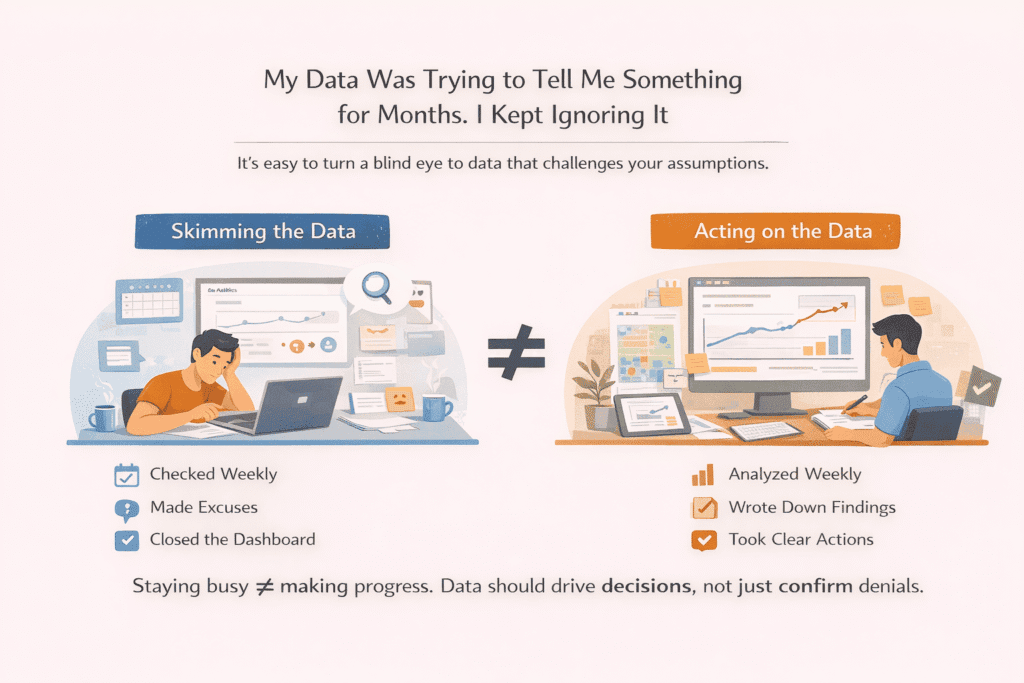
My Data Was Trying to Tell Me Something for Months. I Kept Ignoring It.
I had Google Analytics installed from day one. Search Console too. A heatmap tool for a while that literally showed me where people were clicking and where they were giving up. The data was all there. I just wasn’t really looking at it.
And I want to be specific about what “not really looking” means — because it wasn’t that I avoided the dashboards. I opened them regularly. I checked the numbers. I registered what they said. I just had a very reliable habit of closing them again without doing anything uncomfortable.
That’s the version of this mistake that nobody talks about. Everyone assumes the problem is people not tracking things — no analytics installed, flying completely blind. That happens. But the more common version, in my experience, is having all the data and still managing to learn almost nothing from it. Not from laziness. From a very quiet, very consistent decision to not follow the numbers somewhere they were pointing.
My bounce rate on certain pages was bad. Not ambiguous — bad. People were landing and leaving in under twenty seconds. This was not a mystery. The page wasn’t working and the data was saying so, clearly, every single week. And every single week I’d see it, feel a vague unease, and move on to something that felt more like building and less like admitting something had gone wrong.
New content felt like progress. Fixing a broken page felt like failure. So I kept writing new content and the broken page kept bouncing visitors and nothing changed.
There was something else happening too, something I find harder to admit. I had completely different relationships with good numbers and bad numbers. When traffic was up I’d go deep — click through sessions, look at sources, find things to feel good about. When things were flat or down I’d open the dashboard, clock the news, and close it without going further. I was using the data as a mood regulator, not a decision-making tool. Absorbing what confirmed things were fine while skimming past what didn’t.
Which is a very human thing to do.
It’s also a completely useless way to run anything.
The justifications were always ready. Sample size too small. Probably seasonal. Give it another month. None of those thoughts were wrong exactly — they were just wrong in the way that convenient thoughts tend to be. True enough to feel reasonable. Applied consistently enough to mean I never quite had to act. One month it was sample size, next month seasonality, month after that something else, and underneath all of it the same pages kept leaking visitors and the same traffic sources kept underdelivering and I kept not dealing with it.
What broke the pattern wasn’t discipline or a new framework. It was just — eventually — getting annoyed enough at my own excuses to sit down and write out what the data was actually saying. Plain language- No charitable interpretation. What do these numbers literally mean if I take my feelings out of it.
It took an hour.
The conclusions weren’t surprising. That was the part that stung. None of it was new information. The data had been saying the same things for months — I’d just been giving myself permission to hear it as maybe rather than yes. Two pages needed to be rebuilt from scratch. One traffic source I’d been putting real effort into was pulling in people who left immediately and never came back. My best content was in a slightly different direction than where I’d been focusing, which meant the whole content strategy needed a quiet correction.
Not catastrophic problems. Fixed over a couple of months, things started moving properly for the first time in a while.
The data hadn’t changed. I had just finally stopped negotiating with it.
Here’s what I actually think the real problem is, having watched other people go through versions of the same thing — it’s not that marketers don’t understand analytics. Most people understand enough. The problem is that data is only useful if you’re willing to let it tell you something you didn’t already want to hear. When it confirms your instincts, everyone’s suddenly very data driven. When it contradicts something you’ve already decided you like — a piece of content you’re proud of, a strategy you’ve committed to, a platform you enjoy using — that’s when the sample sizes suddenly get suspicious and the seasonal explanations start appearing.
The gap between seeing a number and being willing to follow it somewhere inconvenient — that gap is where most marketing efforts quietly stall. Not because of bad tools or wrong tactics. Because of a very ordinary human reluctance to look directly at something that might require you to change course.
I still catch myself doing it sometimes. The dashboard is open. The numbers are right there. And I’m already thinking of reasons why this particular month might be an exception.
Every Year Has Its Shiny New Thing. In 2026, There Are Several.
Online marketing has always had a next big thing. When I started it was chatbots. Before that, Snapchat. Before that, Vine. There is always something arriving that’s going to change everything, and there is always a version of me — or someone like me — dropping what was working to go figure out the new thing before everyone else gets there.
I have lost so much time to this.
Right now the list is longer than usual. AI content tools, Faceless YouTube, Zero-click SEO. Generative engine optimisation. Answer engine optimisation. Short-form video, still, apparently forever. Every single one arrives with its own wave of people saying this is the thing you need to be doing right now and its own separate wave of people selling courses about it before anyone has figured out whether it actually works at scale.
Here’s my honest position — some of it genuinely matters and most of it can wait. The trick is knowing which is which, and the marketing industry is specifically, almost professionally, bad at helping you figure that out.
AI tools have actually changed how I work. Not in the way being promised two years ago — not the replace-everything, infinite-content-machine version — but in quieter ways around research, editing, working through ideas that aren’t fully formed yet. That’s real and I’m not dismissing it. But the way new things get introduced in this space — breathlessly, urgently, with heavy implication that you’re already behind — is almost perfectly engineered to make you drop what you’re doing and start chasing. And starting over has a cost that never makes it into the announcement post.
Every time you abandon an existing strategy for a new one, you lose whatever momentum you’d built. Reset the learning curve. Spend weeks getting up to speed on something that might turn out to be a trend wearing a shift’s clothing — and by the time you figure that out, the people who stayed focused have quietly pulled ahead while you were busy being early to something that didn’t pan out.
I chased faceless YouTube for a while. The logic felt solid — high demand, no need to be on camera, potentially massive reach. Built a small system around it, published consistently for three months. The results were underwhelming in a way I couldn’t immediately diagnose, and what I eventually figured out was that the format works brilliantly for certain types of content — broadly appealing topics, high search volume, visually interesting subjects — and was a genuinely poor fit for what I was actually trying to say. The idea wasn’t wrong. The application to my situation was wrong. But I’d jumped in based on general excitement rather than asking whether it made sense for me specifically.
That’s exactly the move that gets people every time.
It’s never framed as should I do this. It’s always framed as everyone is doing this, why aren’t you — and that second question is much harder to sit with calmly because it’s not really about strategy. It’s about not wanting to feel like you’re missing something. FOMO dressed up as market research is still FOMO. It just has better slides.
The question I’ve started asking before touching anything new — and this took me way too long to land on — is whether what I’m looking at represents a genuine shift in how people find and consume information, or just a new execution format sitting on top of existing behaviour. Because those are completely different things with completely different implications.
GEO — generative engine optimisation — is probably a real shift. The way people get answers is changing in ways that are structural, not cosmetic, and ignoring that entirely would be a mistake I’d regret. Faceless YouTube is a format. Useful for some people with certain types of content. Not a fundamental change in anything. But in the breathless way both get talked about online, they arrive with identical urgency — which makes it genuinely hard to tell them apart if you’re not paying close attention.
The other thing I try to ask, and don’t always manage to answer honestly, is whether I’m actually interested in something new because it fits what I’m building — or because I’m anxious about being left behind. Anxiety feels like urgency. It’s not. Urgency has a reason attached to it. Anxiety is just the fear of missing out with better posture.
Here’s what I’ve noticed about the people who seem to build things that actually last — they are almost never the ones who were first to every new platform. They’re the ones who got very good at something, stayed there longer than felt comfortable, and only picked up something new when they had a specific, boring, practical reason to believe it would extend what they were already doing. No grand announcements. No pivots. Just a quiet addition that made sense.
I’m still working on being that person, honestly. The new thing still pulls at me. Every announcement still produces a moment of genuine anxiety where I wonder if this is the one I shouldn’t ignore. I’ve just gotten slightly better at waiting a few weeks before acting on it — long enough to watch the first wave of people try it and report back, long enough for the breathless energy to settle into something more like actual information.
Sometimes the new thing turns out to matter. More often it turns out to be fine for other people and irrelevant to what I’m doing. Either way, waiting a few weeks to find out has never once cost me anything I couldn’t recover.
Nobody Told Me How Long This Was Actually Going to Take
I had a timeline in my head when I started. Vague but real — get the basics in place, publish for a few months, start seeing something meaningful by month four or five. I have no idea where that timeline came from. Some mixture of optimism, YouTube success stories that skipped the middle, and advice from people who’d either forgotten how long it took them or were being strategically encouraging.
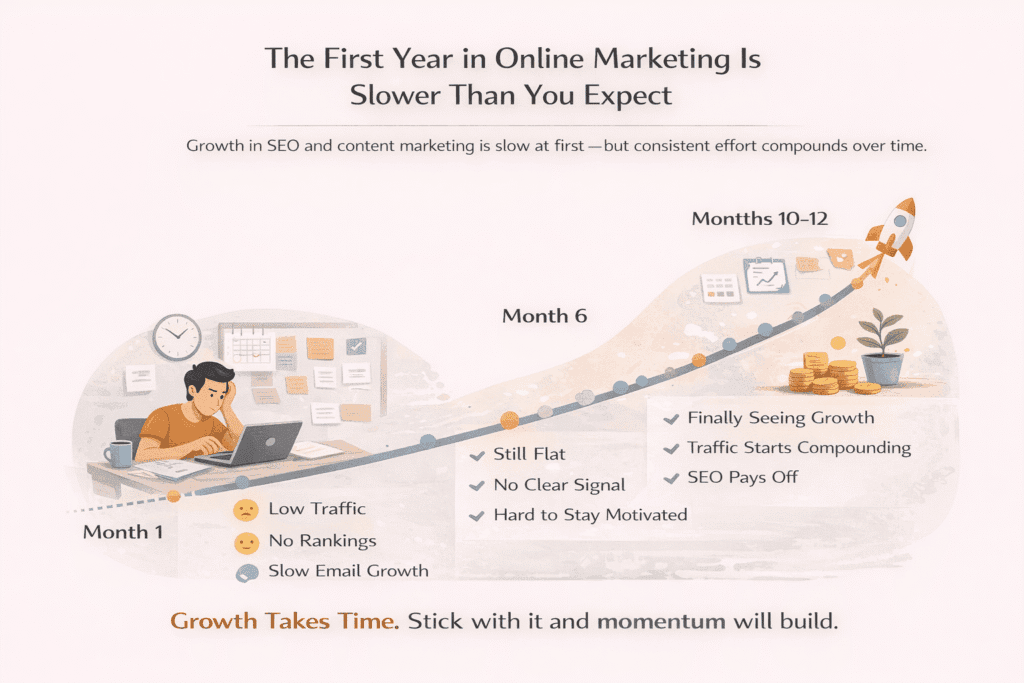
Month four arrived. But nothing seemed changing. Then Month six was here and still nothing that looked like progress.
By month nine I wasn’t panicking exactly — it was quieter than that. Just a persistent, low-grade suspicion that I was missing something everyone else seemed to understand. That one of the less-discussed online marketing mistakes is building a completely fictional idea of what the first year looks like — and then spending that year confused about why reality isn’t matching it.
Because here’s what nobody puts in the blog post. The content was fine. The strategy made reasonable sense. I wasn’t doing everything wrong. The only actual problem was that I’d invented a timeline with no relationship to how any of this works — and when results didn’t show up on that invented schedule, I treated the delay as evidence something was broken rather than just evidence that it takes longer than you think.
SEO and content marketing in particular operate on a feedback loop that feels completely absent until it suddenly isn’t. You publish for months. Traffic doesn’t move. Rankings don’t move. The email list grows by ones and twos if you’re lucky. And then something shifts — not dramatically, not all at once, but a piece starts ranking, pulls another piece up with it, and the compounding everyone talks about is suddenly not theoretical anymore. It’s actually there.
The gap between when the work happens and when that shift occurs can be six months. Often longer. And nothing in that waiting period — absolutely nothing — tells you clearly whether you’re on the right track or quietly wasting your time. That ambiguity is what actually breaks people. Not laziness. Not lack of skill. The inability to keep going when there’s no signal telling you to keep going.
I came close to quitting twice.
The first time was month seven. Someone I’d started around the same time was visibly getting traction — content being shared, list growing, things moving. I spent a week convinced I’d made a fundamental error somewhere, chosen the wrong approach, aimed at the wrong thing. I kept going mostly out of stubbornness. Not confidence — stubbornness. That’s not the version of the story I’d tell if I were selling something, but it’s what happened.
The second time was month ten. A different kind of tired by then. Not physically — just worn down by not knowing. By doing real work and having almost nothing concrete to point to. I nearly rebranded, started over completely, convinced myself a clean slate was what I needed. Didn’t. And about six weeks after that near-pivot, things started moving in ways they hadn’t in almost a year.
I’ve watched enough people go through this now to know those two moments — somewhere around month seven, somewhere around month ten — are not random. That window, roughly six to twelve months in, is where most people make the quiet decision to stop. Not with a dramatic announcement. Just in the small daily choice of whether to open the laptop and keep going, or find a reason not to. The gap between effort and visible results is at its absolute widest right there. The work is real. The payoff is still entirely theoretical. And that combination is genuinely hard to sit with.
What I wish someone had told me — and what I think would have actually helped rather than just sounded encouraging — is that the first year is disproportionately, unfairly slow. Not because nothing is happening, but because almost none of what’s happening is visible yet. Authority accumulates slowly. Content indexes slowly. Trust, with both readers and search engines, builds in ways you can’t see in real time. The second year is different. Not easy — different. Small things from a year ago start paying small dividends. The feedback loop that was completely absent in year one begins to exist, quietly, at the edges.
By year three the relationship with time changes completely. Work done today for results expected in six months doesn’t produce anxiety anymore. Not because patience arrives like some kind of gift. But because you’ve seen the pattern repeat enough times to trust it. That trust wasn’t available to me in month four. It couldn’t have been. You cannot borrow confidence from experience you haven’t had yet. That’s just not how it works.
The practical thing — and I mean genuinely practical, not motivational — is to stop measuring results in the early stages and start measuring inputs. Not because results don’t matter. Because in the first year, results are a lagging indicator so far behind the actual work that using them as your main feedback signal will make you feel like a failure on a timeline that hasn’t played out yet. Measure instead whether the content is getting sharper. Whether you understand who you’re writing for better than you did three months ago. Whether the work is improving even when the numbers aren’t.
Those things are in your control. The timeline isn’t. Trying to manage something you can’t control while ignoring the things you can — that’s one of the online marketing mistakes that doesn’t look like a mistake while you’re making it. It looks like reasonable concern. It feels like paying attention. But it’s mostly just burning energy on a variable that isn’t yours to manage.
The hardest part of this isn’t the strategy. It’s not the competition or the algorithm changes or figuring out what to write about. It’s the waiting. It’s doing real work for real months with almost nothing to show for it and choosing to continue anyway. Most people who eventually figure online marketing out don’t have dramatically better strategies than the people who gave up. They just stayed in the room a little longer — long enough for the slow, invisible work to become visible.
I know that sounds uncomfortably close to “just persist and everything works out.” It’s not quite that. Sometimes you persist and something fundamental needs to change and the sooner you figure that out the better. But you cannot know which situation you’re in at month four. You probably can’t know at month seven. You find out by staying long enough to see whether what you’re building has legs — and that takes longer than any timeline you’ll draw up before you start. Mine did and Most do.
Three Years Later, Here’s What I Actually Think About Online Marketing
Three years in and my honest feeling about all of this is — complicated.
Not disillusioned. Things are working in ways they weren’t before and I’m genuinely grateful for that on most days. But the version of online marketing I’m actually doing looks almost nothing like what I thought I was signing up for — and I’m still not entirely sure whether the gap between those two things represents growth or just a slower, more expensive way of arriving at reality.
What I actually believe now, not the version I’d package for a webinar — this is harder than the people selling courses about it need it to appear. Not unreasonably hard. Not impossible. But hard in specific ways that nobody really prepares you for. The strategy stuff, the platform decisions, the content formats — that’s all figureoutable. What’s actually difficult is the tolerance for ambiguity. The willingness to be wrong repeatedly without that meaning you’re failing. The ability to keep making decisions when you genuinely don’t know if the last ten decisions were right. Nobody puts that in the curriculum.
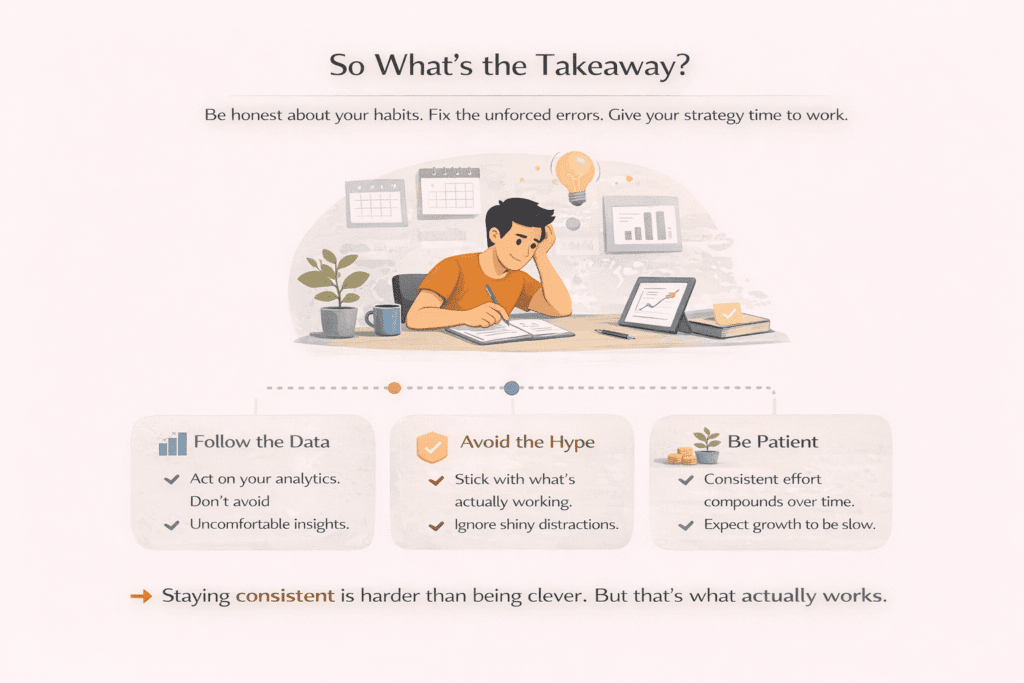
I believe the fundamentals matter more than everything else combined and are also the least interesting thing to talk about so they get skipped. Know who you’re trying to reach. Understand what they actually need. Say something useful. Do it over time without stopping. That’s most of it. Every tool, every platform, every optimisation strategy is either a way of executing those fundamentals more efficiently — or a distraction from not having sorted them out yet. Most people, myself included for longer than I’d like to admit, spend the majority of their time on the everything-else before the foundation is actually solid.
The tools have genuinely improved and I want to say that clearly because I think the honest position gets lost between two loud camps — the people saying AI changes everything and the people saying it changes nothing useful. For me it’s changed specific things in specific ways that I find genuinely useful. Research is faster. The blank page is less daunting. Half-formed ideas become workable drafts more quickly than they used to. That’s real. But I’ve also watched people use the exact same tools to produce more content with less thought behind it — and more content with less thought is not a strategy. It’s just a more efficient way of creating things nobody particularly needed.
Here’s something I wouldn’t have believed three years ago — the relationships have mattered more than almost any tactic. Not networking in the business-card sense. In a specific, practical sense. The things that actually moved the needle for me — the collaborations, the introductions, the pieces that reached people I couldn’t have reached on my own — almost all of them came through someone who knew me well enough to trust me. None of that appeared in any course. It just happened when I stopped treating this like a broadcasting exercise and started having real conversations with people who cared about the same things.
The comparison problem is real and I don’t think anyone talks about it honestly enough. Online marketing is one of the only fields where everyone’s highlight reel is public, searchable, and sitting there waiting to be found on exactly the days when your own numbers aren’t moving. Revenue screenshots. Follower counts. Viral posts. I spent a significant portion of my first two years measuring my progress against other people’s visible results — which I knew was meaningless and did anyway. Still catch myself doing it. The only comparison that means anything is whether things are better than they were six months ago for you, in your actual situation, with your actual constraints. Everything else is just noise that happens to come with numbers attached.
Something shifted around the two year mark that I find genuinely hard to describe. The anxiety became less constant. Not because everything was working — plenty wasn’t — but because I’d built up enough experience to have opinions that came from having actually tried things rather than having read about them. That sounds small. It isn’t. Decisions made from real experience have a different quality to them — they’re connected to something concrete, which means when they go wrong you can figure out why rather than just feeling confused and starting over.
The online marketing mistakes I’ve written about in this article — I don’t regret them the way I expected to. They cost time and money and some of them cost confidence in ways that took a while to recover from. But each one taught me something I’m not convinced I could have learned by reading about it. You can understand intellectually why obsessing over traffic without a conversion strategy doesn’t work. You can nod along, think yes that makes sense, file it away. And then go chase traffic anyway — because you haven’t yet felt the specific, grinding frustration of watching your numbers go up while nothing else changes. The feeling is what makes it stick. The reading just gives you language for it afterward.
If I’m being fully honest about what online marketing actually requires from you as a person — not what it rewards, not what the success stories demonstrate, but what it requires — it’s being comfortable not knowing whether it’s working for longer than feels remotely reasonable. Making decisions with incomplete information. Caring genuinely about the people you’re trying to reach, because if that care isn’t real the content starts going hollow in ways that are hard to pinpoint but that readers somehow always notice.
It also requires a kind of honesty with yourself that turns out to be surprisingly uncomfortable in practice. About whether the strategy is working or whether you’re hoping it will. About whether you’re avoiding something in the data. About whether the new platform you’re excited about makes sense or whether you’re just anxious. About whether you’re producing content that actually says something or just producing content because producing content is what you do now.
That last question is the one I keep coming back to.Does this actually say something a real person would find worth reading. Not is it optimised. Not is the keyword placed correctly. Not does it fit the content calendar. Does it say something a real person would find worth reading, worth sharing, worth coming back for. Because if it doesn’t — if it’s just content in the shape of content, competent and completely forgettable — then all the strategy wrapped around it is scaffolding around an empty building.
Three years of online marketing mistakes, course corrections, near-pivots, and slow compounding later — that’s still the question I ask first. Some days the answer is yes and I publish it. Some days it isn’t and I keep working. The metrics have gotten better. The anxiety has gotten quieter. But that question hasn’t gotten easier. I’m not sure it’s supposed to.
Disclosure: This article may contain affiliate links. If you make a purchase through these links, I may earn a commission at no extra cost to you. All opinions are based on hands-on testing and independent research.