
If you’re trying to figure out how to choose the right marketing tools, it’s easy to get overwhelmed by all the options out there. Every tool promises to be the best, the most powerful, or the one that will finally fix everything.
But choosing the right tool isn’t really about finding what looks impressive — it’s about understanding what actually fits the way you work. And that’s where most people get stuck without realizing it.
This article takes a different approach. Instead of focusing on tools themselves, we’ll look at how to make better decisions around them — so you end up with something that actually works for you, not just something that looks good on paper.
Table of Contents
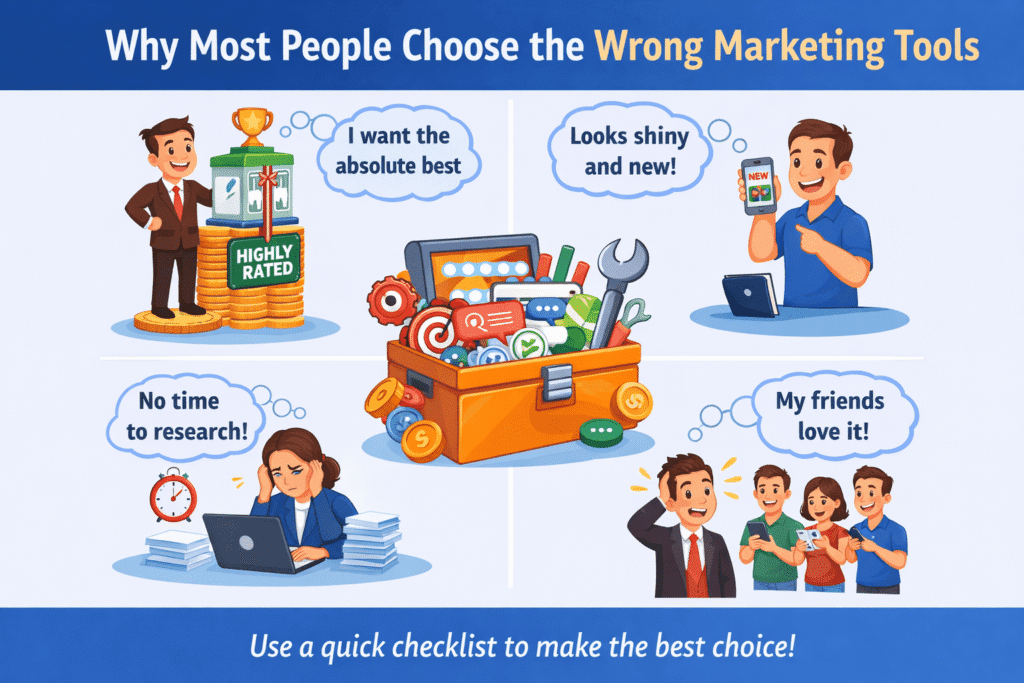
Why Most People Choose the Wrong Marketing Tools
Most people don’t choose bad marketing tools. They just choose them too early.
What usually happens is this: you come across a recommendation — maybe a blog, a YouTube video, or a “best tools” list — and something clicks. It sounds right, it looks powerful, and it feels like the missing piece. So you go for it. No real hesitation.
The problem is, at that point, you’re not choosing based on your situation. You’re choosing based on someone else’s.
I’ve seen this happen a lot — and honestly, I’ve done it too. You pick a tool because it’s popular or highly recommended, and only later do you realize it doesn’t quite fit how you actually work. Not because it’s a bad tool, but because it solves a slightly different problem than the one you have.
Another thing that trips people up is the idea that more features automatically mean better results. It sounds logical, but in practice, it rarely works that way. What you end up with is a tool that does a lot… except the one or two things you actually needed it for, at least not in a simple way. So instead of making your work easier, it quietly adds friction.
There’s also this subtle expectation that tools will fix things for you. That once you have the “right” platform, everything else will fall into place. But tools don’t create clarity — they depend on it. If your process is unclear, the tool just exposes that faster.
And then there’s the influence of what others are using. It’s easy to assume that if a successful business relies on a certain tool, you should too. But their context — their team, their goals, their stage — is completely different. What works well for them might feel unnecessarily complicated for you.
When you look at it this way, choosing the wrong tool isn’t really a mistake. It’s usually just a sign that the decision came before the understanding.
From working with different marketing tools over the past few years, I’ve noticed that the biggest challenges rarely come from the tools themselves — but from how they’re chosen and used.
Before You Even Look at Tools, Fix This First
Before you spend time comparing tools, there’s a step most people skip — and it’s usually the reason things don’t work later.
It’s not about the tool. It’s about what you’re actually trying to do.
A lot of the time, people jump straight into tools because it feels like progress. You sign up for something, explore the dashboard, maybe even start setting things up. It gives you the sense that you’re moving forward. But underneath that, there’s often no clear direction.
I’ve been there. You think, “This tool should help me get better results,” but you haven’t really defined what “better” means. More traffic? Better conversions? More consistency? Without that clarity, every tool starts to feel like it’s doing something — but not necessarily what you need.
Another thing that doesn’t get talked about enough is how tools assume you already have some kind of process. Even simple ones. They’re not designed to figure things out for you — they’re designed to support something that already exists. So if your workflow is unclear or inconsistent, the tool doesn’t fix it. It just makes the gaps more obvious.
And sometimes, it actually makes things worse. You end up spending time learning features you don’t need, setting things up halfway, or switching between tools because none of them feel quite right. Not because they’re bad — but because they’re being used without a clear foundation.
If you pause for a moment and just map out what you’re currently doing — even roughly — things start to look different. Where does your traffic come from? What happens after someone visits your site? Where do things stop or slow down?
It doesn’t need to be perfect. Just visible.
Once you can see that, choosing a tool becomes a lot simpler. You’re no longer trying to find something impressive — you’re trying to find something that fits.
And that shift alone changes how you make the decision.
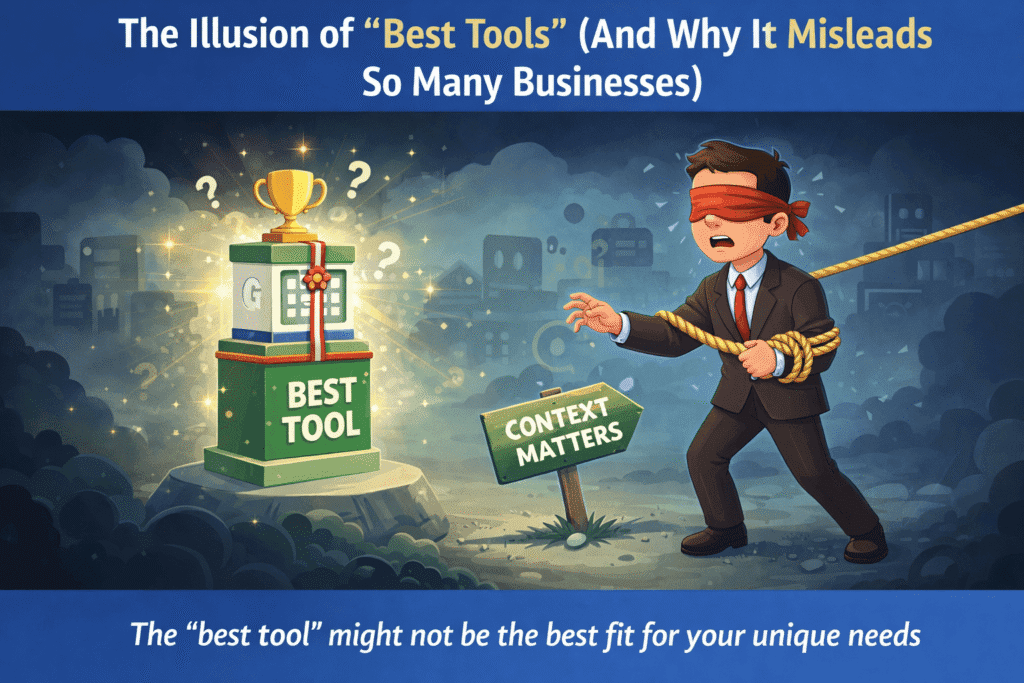
The Illusion of “Best Tools” (And Why It Misleads So Many Businesses)
The idea of a “best tool” sounds convenient. It makes the whole process feel easier — like there’s a clear answer somewhere, and you just need to find it.
But the more you rely on that idea, the more confusing things tend to get.
What usually happens is this: you read a few recommendations, maybe compare a couple of “top tools” lists, and start noticing the same names showing up again and again. That repetition creates a kind of confidence — it feels like those tools must be the right choice.
But that confidence is often borrowed, not earned.
Most of those lists aren’t written for your situation. They’re written to cover as many people as possible. So they naturally lean toward tools that look strong across the board — lots of features, wide appeal, recognizable names. That works for a general audience, but it doesn’t always translate well to a specific business.
I’ve seen people pick tools this way and then struggle to actually use them. Not because the tools are bad, but because they’re slightly out of sync with how they work. Too complex, too broad, or just built for a different stage.
There’s also something subtle that happens when you keep comparing “best” options. You start evaluating things you didn’t even care about in the first place. Features that sounded irrelevant suddenly feel important, just because they’re part of the comparison. And before you realize it, you’re making a decision based on completeness instead of fit.
Another layer to this is how those recommendations are created. Some are genuinely helpful, but others are influenced — by partnerships, by trends, or simply by what gets attention. That doesn’t make them useless, but it does mean they’re not as neutral as they appear.
At some point, the idea of “best” stops being helpful. It just adds noise.
What tends to work better is a quieter approach — looking at your situation first, and then asking what actually fits into it. Not what ranks highest, not what everyone else is using, just what makes sense for how you work.
That shift doesn’t make the decision easier. But it usually makes it better.
What Actually Matters When Choosing a Tool (It’s Not What You Think)
Most people think choosing a tool comes down to features, pricing, or how popular it is. That’s usually where the comparison starts — and where it goes wrong.
What tends to matter more is something less obvious: how well the tool fits into the way you already work.
In my experience, the tools that actually get used are not always the most powerful ones. They’re the ones that feel easy to pick up, don’t interrupt your workflow, and don’t require you to constantly adjust how you do things. If a tool demands too much change upfront, there’s a good chance it won’t last, no matter how impressive it looks.
Another thing people underestimate is friction. Not the big, obvious kind — but the small, repeated moments where something feels slightly inconvenient. Logging in, navigating menus, setting things up, switching between tabs. Individually, they don’t seem like a problem. But over time, they add up. And that’s usually when people quietly stop using the tool.
There’s also a tendency to focus on what a tool can do instead of what you’ll actually use it for. A platform might offer ten different capabilities, but if you realistically only need one or two, the rest becomes background noise. Worse, it can make simple tasks feel unnecessarily complicated.
What you’ll notice is that the “best” tool on paper isn’t always the one that works best in practice. The one that fits your pace, your level of experience, and your current needs — that’s the one that tends to stick.
And that’s really the difference. Not capability, but compatibility.
When a Simple Tool Will Outperform a “Powerful” One
There’s a point where a tool stops being helpful and starts getting in the way. It doesn’t happen all at once — it’s gradual.
At first, a powerful tool feels like an upgrade. You see all the features, the dashboards, the flexibility… and it gives the impression that you’re stepping into something more advanced. More capable.
But then you actually try to use it.
You spend time figuring out where things are. You click around, try to set things up properly, maybe even watch a tutorial or two. And eventually, you get it working — but it takes effort. More than you expected.
And that’s where the difference shows up.
A simpler tool doesn’t ask for that kind of investment. You open it, and within a few minutes, you’re already doing the thing you came to do. No setup phase, no learning curve that slows you down. Just action.
That might not sound like a big advantage, but over time, it is.
Because what tends to happen with more complex tools is not that people quit immediately — they just use them less. They postpone tasks. They avoid opening the tool unless necessary. It becomes something you intend to use, not something you naturally reach for.
I’ve noticed that the tools that actually stick are rarely the most impressive ones. They’re the ones that don’t interrupt your flow. The ones that don’t make you think too much before getting started.
There’s also this assumption that having more options gives you more control. Sometimes it does. But sometimes it just creates hesitation. Too many choices, too many ways to do the same thing, and suddenly something simple takes longer than it should.
That’s where simpler tools quietly win. Not because they do more — but because they make it easier to keep going.
Of course, there’s a trade-off. At some point, you might outgrow them. You might need more flexibility, more depth. But that usually happens later, when your process is already clear.
Starting with something complex too early often slows things down in ways that aren’t obvious at first.
And in most cases, consistency beats capability.
You may read my article that compares a simple and more advanced email platform: MailerLite vs ActiveCampaign
In my experience testing and using various marketing tools, the ones that perform best are not always the most advanced — they’re the ones that fit naturally into an existing workflow.
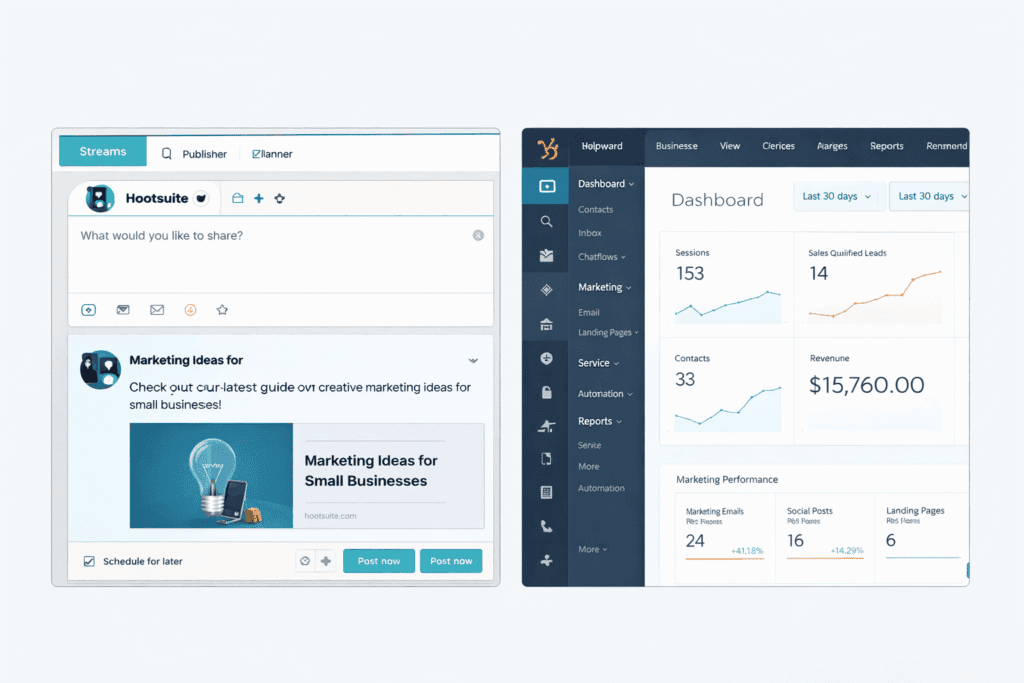
Sometimes the difference between simple and powerful tools isn’t obvious at first. This comparison makes it easier to see where each one fits.
Simple vs Powerful Marketing Tools
| Factor | Simple Tools | Powerful Tools |
|---|---|---|
| Ease of Use | Very easy to start, minimal learning curve | Requires time to learn and set up properly |
| Setup Time | Quick (minutes) | Longer (hours or days) |
| Features | Limited to core functions | Wide range of advanced features |
| Flexibility | Less flexible, more structured | Highly customizable |
| Best For | Beginners, small workflows, quick execution | Advanced users, complex workflows |
| Risk | Outgrowing the tool over time | Not fully utilizing all features |
| Daily Use | High (used consistently) | Can drop due to complexity |
| Cost Efficiency | Often cost-effective for basic needs | Higher cost, but scalable for growth |
You may check my experience using MailerLite for email marketing
The Hidden Trade-Offs Nobody Talks About
Most tools are presented as upgrades. Better, faster, more efficient. And to be fair, they usually are — at least in certain ways.
But what doesn’t get talked about enough is what changes around them.
You don’t just add a tool and keep everything else the same. Something always shifts.
Sometimes it’s small. You start doing things slightly differently because the tool is built a certain way. You follow its workflow, its structure, its logic. At first, it feels helpful. Over time, you realize you’ve adjusted more than you expected.
I’ve noticed this especially with tools that try to “simplify everything.” They remove steps, automate decisions, organize things neatly. But in doing that, they also take some control away. You get results, but you’re less involved in how those results come together. And that’s fine — until something stops working and you don’t know where to look.
There’s also the quiet dependency that builds up.
At the beginning, it’s just a tool you’re trying out. Then it becomes part of your routine. Then your data is inside it, your workflow depends on it, and switching starts to feel like a bigger decision than it should be. Not impossible — just inconvenient enough that you keep postponing it.
Another thing that doesn’t show up in feature lists is how tools affect your pace. Some make things faster, yes. But sometimes they also make you slower in ways that aren’t obvious. You spend time setting things up, learning how everything connects, double-checking configurations. The work gets done, but with more overhead than you expected.
None of this means tools are a bad idea.
It just means they’re not neutral.
Every tool pushes you in a certain direction — in how you work, how you think about tasks, even how you prioritize things. And that influence isn’t always obvious when you’re deciding whether to use it.
Most people focus on what a tool adds.
It’s just as useful to pay attention to what it quietly changes.
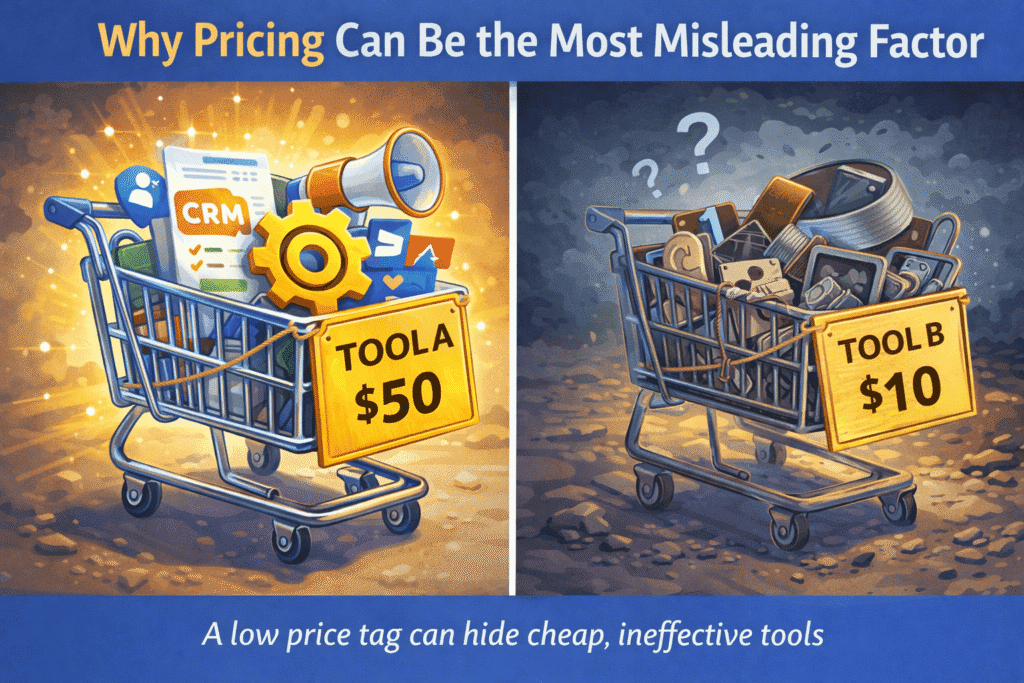
Why Pricing Can Be the Most Misleading Factor
Pricing is usually the first thing people look at. It feels concrete. You see a number, you compare it, and it gives you the sense that you’re making a rational decision.
But that number rarely tells you what the experience will actually feel like.
I’ve seen people go for the cheaper option thinking they’re being careful, only to realize later that it doesn’t quite do what they expected. Not in a dramatic way — just small gaps. Something missing here, an extra step there. Nothing deal-breaking on its own, but enough to slow things down over time.
And then there’s the opposite. A more expensive tool that looks like it does everything. It feels like a step up, something more “serious.” But once you’re inside it, you start noticing how much of it you’re not using. The tool isn’t the problem — it’s just built for a different level of need.
What makes this tricky is that pricing gives you a sense of certainty too early. You feel like you’ve already narrowed things down just by comparing costs, even though you haven’t really looked at how the tool fits into what you’re doing.
There’s also the way pricing unfolds over time. What looks simple at first can get layered — upgrades, limits, add-ons. Or you realize you need a second tool to fill a gap, and now the “cheaper” option isn’t so cheap anymore.
In my experience, pricing only starts to make sense after you understand how you’ll actually use the tool. Before that, it’s just a number without context.
And that’s where people get misled — not because they ignored the price, but because they trusted it too much.
When Skipping a Tool Is the Smarter Decision
There’s a point where adding another tool feels like progress — even when it isn’t.
You tell yourself, “This should make things easier,” and sometimes it does. But other times, it just adds another layer to something that wasn’t clear to begin with.
I’ve noticed that when things feel messy, the instinct is to fix it with something external. A new platform, a better system, something that promises to organize everything. But if you’re not sure what you’re trying to organize, the tool just sits there, waiting for a structure that doesn’t really exist yet.
And then it turns into something you check occasionally, not something you rely on.
There’s also this phase people don’t talk about — when you’re still figuring things out. Your process isn’t stable, your approach changes week to week, and you’re still testing what works. That’s usually the worst time to introduce a tool that expects consistency. It ends up feeling like you’re constantly adjusting either yourself or the tool, and neither quite fits.
What tends to work better in that stage is keeping things simple. Even a bit manual. Writing things down, doing tasks step by step, seeing what actually sticks. It’s slower, but it gives you something tools can’t really provide — a clearer sense of how you work.
Once that’s in place, tools start to make more sense. They fit into something real, instead of trying to create it.
Skipping a tool, in that context, isn’t falling behind. It’s just not rushing into something before you’re ready to use it properly.
And that usually saves more time than it costs.
Digital Marketing Mistakes That Cost Months
How to Tell If a Tool Fits Your Workflow (Not Just Your Expectations)
At first, most tools feel like a good fit.
You go through the features, maybe try a few things, and it all seems to line up with what you had in mind. It makes sense on the surface. That initial impression can be convincing.
But that’s usually where expectations are at their strongest — before the tool becomes part of your routine.
The real difference shows up later, in the small moments.
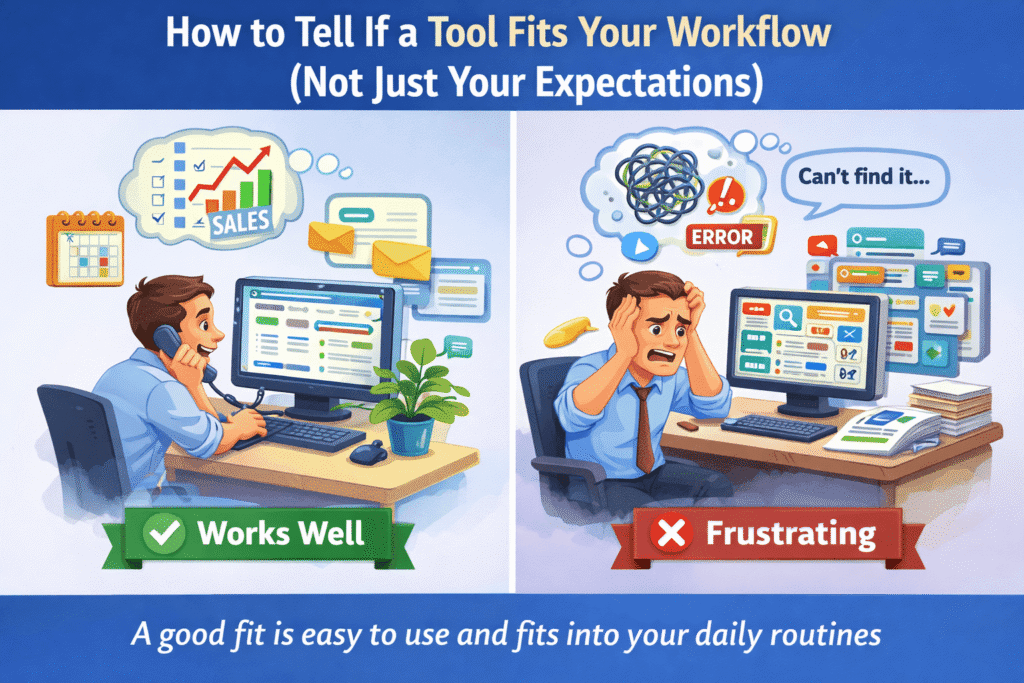
Not when you’re exploring the tool, but when you’re trying to get something done quickly. When you’re in the middle of your work and you just want things to move without thinking too much. That’s when you start noticing whether the tool is helping or quietly getting in the way.
Sometimes it’s subtle. You take an extra step that feels unnecessary. You pause to remember where something is. You adjust how you normally do things just to make the tool work. None of it feels like a big problem, but it keeps repeating.
And over time, that repetition matters.
I’ve found that tools that actually fit don’t draw attention to themselves. You don’t think about using them — you just do. There’s no sense of “figuring it out” every time you open them. They match how you naturally approach the task.
A lot of people judge tools based on what they’re capable of, especially early on. But capability doesn’t tell you much about fit. A tool can be impressive and still feel slightly off once it becomes part of your daily work.
There’s also a simple test that tends to reveal more than anything else: after a few days, do you find yourself opening the tool without hesitation, or do you delay it? Not because you’re busy, but because you know it will take a bit more effort than you’d like.
That reaction is easy to ignore, but it’s usually accurate.
A tool that fits doesn’t just match what you expected at the beginning. It keeps working quietly in the background, without forcing you to adjust every time you use it.
What I’ve consistently seen is that small mismatches between a tool and how you work tend to matter more over time than feature lists or initial impressions.
A Practical Way to Decide Without Overthinking It
There’s a point where looking at more options stops being helpful.
At first, comparing tools feels productive. You’re learning, narrowing things down, getting a sense of what’s out there. But after a while, the differences start to blur. Everything looks capable, every tool seems like it could work, and instead of getting closer to a decision, you just feel more stuck.
I’ve been in that loop before — going back and forth between options, thinking one more comparison will make things clear. It rarely does.
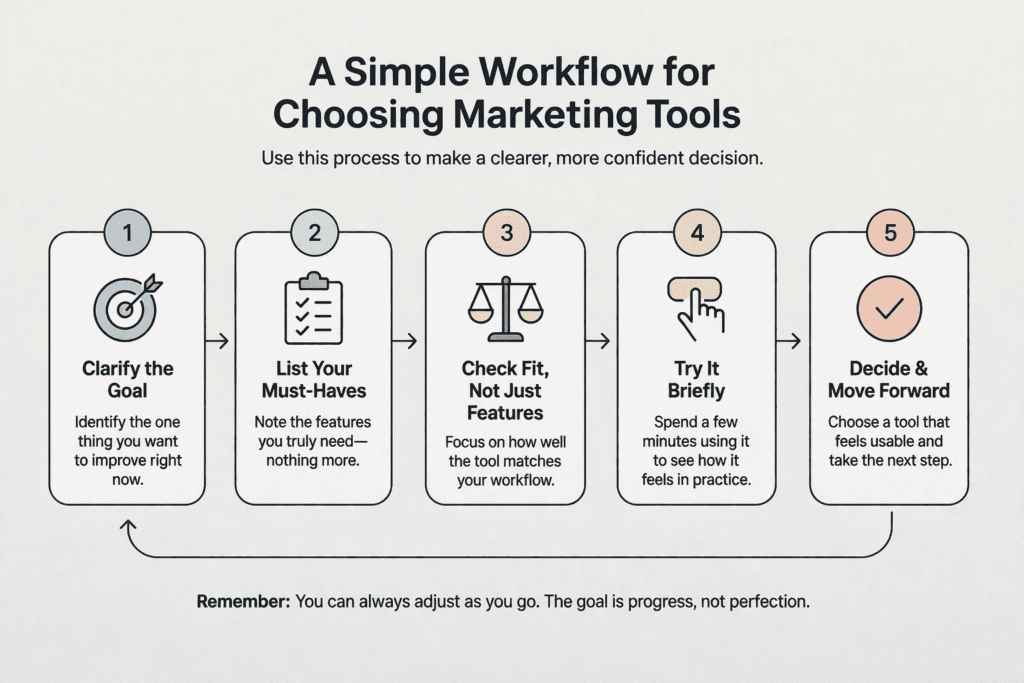
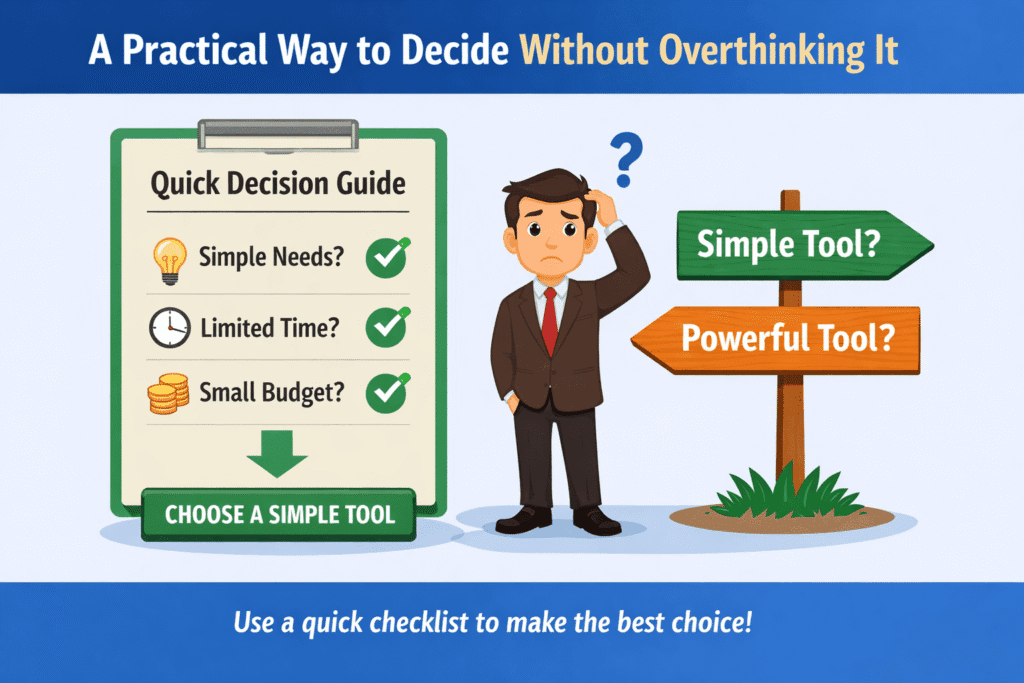
What actually helps is shifting your focus away from the tools and back to what you need right now. Not everything the tool could possibly do, just the one thing that would make your current work easier. When you narrow it down like that, most of the extra features stop mattering.
At that point, the decision becomes less about finding the best option and more about choosing something that’s good enough to try.
One thing I’ve found useful is to stop relying on research at that stage and actually use the tool, even briefly. Not in a structured way — just enough to see how it feels when you’re trying to get something done. That first interaction usually tells you more than all the comparisons combined.
There’s also a moment where you can tell you’re no longer learning anything new. You’re just revisiting the same points in slightly different ways. That’s usually the signal to stop looking and start deciding.
Because in practice, the decision doesn’t need to be perfect. It just needs to be usable.
And if it turns out to be slightly off, you’ll notice. You adjust, you switch, you move on. That part is easier than it seems.
What tends to hold people back isn’t choosing wrong.
It’s staying in that in-between phase for too long.
After going through this process multiple times, it becomes clear that choosing tools is less about finding the best option and more about understanding what actually works in practice.
Conclusion
By the time you get to the end of all this, the decision usually feels less complicated than it did at the beginning.
Not because there’s a clear “best” option — but because you’re looking at it differently.
Instead of trying to figure out which tool stands above the rest, you start noticing which one actually fits into what you’re already doing. And that shift tends to remove a lot of the pressure around getting it exactly right.
Most tools will work. Some will work better than others. But very few decisions here are permanent.
What matters more is whether you can take the next step without overthinking it.
In a lot of cases, the right choice doesn’t feel like a big decision. It just feels… usable. Something you can start with, even if it’s not perfect.
And once you start using it, things become clearer in a way that research never quite provides.
That’s usually when you realize the decision was never really about the tool in the first place.
You can see this difference clearly when comparing tools like MailerLite and ActiveCampaign — one focuses on simplicity, while the other is designed for more complex workflows.
Budget shapes strategy whether you plan for it or not, and the debate between free vs paid marketing tools is less about cost and more about what stage of growth you’re actually in.
REALATED ARTICLE: Traffic growth is less about tools and more about decisions most sites avoid making — What Actually Drives Website Traffic (And Why Most Sites Get It Wrong) breaks down what those decisions actually look like.
Disclosure: This article contains affiliate links. If you make a purchase through these links, I may earn a commission at no extra cost to you. All opinions are based on hands-on testing and independent research.